
Peptide Dosage Chart at a Glance
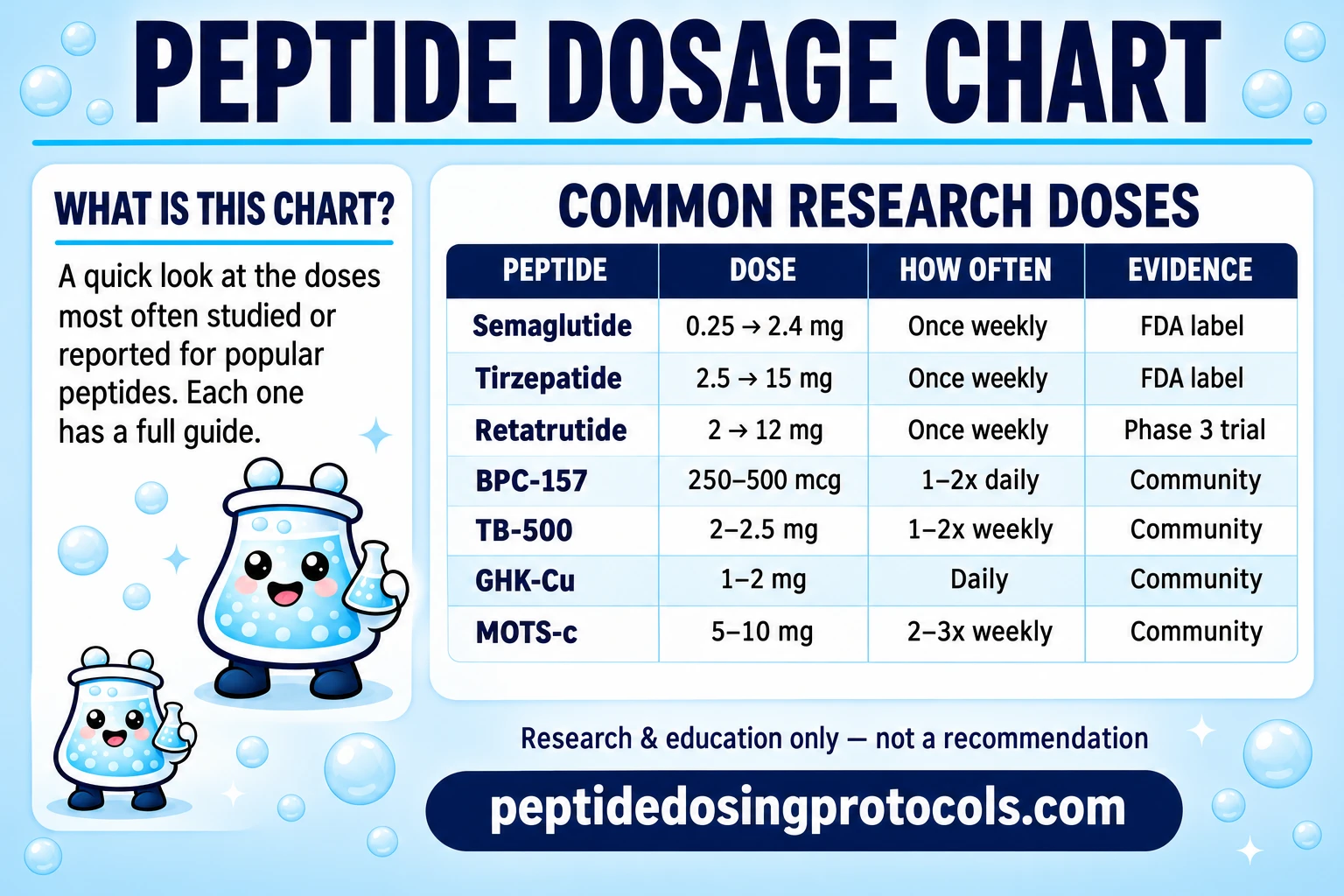
This chart shows the seven peptides people look up most. The full tables below cover every peptide and stack, grouped by goal.
How to Read This Peptide Dosage Chart
Each row sums up the dosing section of a full guide on this site. Dose is the amount given each time, and an arrow (→) means the dose starts low and steps up over several weeks. How often is the usual schedule. Route is how it is given: SubQ is a small shot under the skin, and IM is a shot into a muscle.
Evidence tells you where each number comes from. A dose from an FDA label and a dose passed around online look the same in a table, so check this column before you compare two rows.
- FDA label
- The dose printed on an approved US drug label, such as Wegovy, Zepbound, or Vyleesi. It is the strongest evidence here, and it applies to that exact product and use.
- Clinical trials
- Doses tested in published human studies. They apply to the people and conditions those studies tested.
- Clinic or compounding practice
- Amounts that clinics and compounding pharmacies commonly use. No controlled trial has tested them.
- Community
- Amounts people in research communities report using. No human trial has set these doses, and nobody has shown they are safe.
- Animal only
- Only animal studies exist. Animal doses do not convert into a safe human dose.
Research peptides are not the same as prescription drugs
A research vial labeled semaglutide or tirzepatide is not proven to match Wegovy or Zepbound, and label doses apply only to the approved product. Talk to a licensed clinician before using any compound on this page.
Weight Loss and Metabolic Peptide Doses
GLP-1 drugs and related compounds start low and step up every four weeks so the stomach can adjust. Most are once-weekly shots. AOD-9604, 5-Amino-1MQ, and SLU-PP-332 rely on community reports because no human trial has set their doses.
Peptide
Dose
0.25 mg → 2.4 mg
How often
Once weekly, up every 4 weeks
Route
SubQ
Evidence
FDA label (Wegovy)
Chart
Peptide
Dose
2.5 mg → 15 mg
How often
Once weekly, up 2.5 mg every 4+ weeks
Route
SubQ
Evidence
FDA label (Zepbound)
Chart
Peptide
Dose
2 mg → 12 mg
How often
Once weekly, up every 4 weeks
Route
SubQ
Evidence
Clinical trials (Phase 3)
Chart
Peptide
Dose
0.25 mg → 2.4 mg
How often
Once weekly, 16-week ramp
Route
SubQ
Evidence
Clinical trials (Phase 3)
Chart
Peptide
Dose
0.6–4.8 mg (trial arms)
How often
Once weekly
Route
SubQ
Evidence
Clinical trials (Phase 2/3)
Chart
Peptide
Peptide
Peptide
Dose
50–100 mg oral; 2.5–5 mg SubQ
How often
Once daily
Route
Oral / SubQ
Evidence
Community
Chart
Peptide
Peptide
| Peptide | Dose | How often | Route | Evidence | Chart |
|---|---|---|---|---|---|
| Semaglutide | 0.25 mg → 2.4 mg | Once weekly, up every 4 weeks | SubQ | FDA label (Wegovy) | Dosage chart |
| Tirzepatide | 2.5 mg → 15 mg | Once weekly, up 2.5 mg every 4+ weeks | SubQ | FDA label (Zepbound) | Dosage chart |
| Retatrutide | 2 mg → 12 mg | Once weekly, up every 4 weeks | SubQ | Clinical trials (Phase 3) | Dosage chart |
| Cagrilintide | 0.25 mg → 2.4 mg | Once weekly, 16-week ramp | SubQ | Clinical trials (Phase 3) | Dosage chart |
| Survodutide | 0.6–4.8 mg (trial arms) | Once weekly | SubQ | Clinical trials (Phase 2/3) | Dosage chart |
| Tesofensine | 0.25–0.5 mg | Once daily, morning | Oral tablet | Clinical trials | Dosage chart |
| AOD-9604 | 300–500 mcg | Once daily | SubQ | Community | Dosage chart |
| 5-Amino-1MQ | 50–100 mg oral; 2.5–5 mg SubQ | Once daily | Oral / SubQ | Community | Dosage chart |
| Lipo-C | 0.5–1 mL | 1–2x weekly | SubQ / IM | Compounding practice | Dosage chart |
| SLU-PP-332 | 25–50 mg | Once daily | Oral tablet | Community (mouse data only) | Dosage chart |
Healing and Recovery Peptide Doses
Repair peptides have strong animal data but almost no human dosing trials. Most amounts below are the ones research communities share most often. Treat them as examples, since none has been proven in people. ARA-290 is the exception, with doses from human trials.
Peptide
Peptide
Peptide
Peptide
Peptide
Peptide
Dose
1–4 mg (up to 8 mg)
How often
Once daily, about 4 weeks
Route
SubQ
Evidence
Clinical trials
Chart
| Peptide | Dose | How often | Route | Evidence | Chart |
|---|---|---|---|---|---|
| BPC-157 | 250–500 mcg | 1–2x daily | SubQ / oral | Community | Dosage chart |
| TB-500 | 2–2.5 mg | 2x weekly, then 1x weekly | SubQ | Community | Dosage chart |
| GHK-Cu | 1–2 mg | Daily or 5 days a week | SubQ / topical | Community | Dosage chart |
| KPV | 200–500 mcg | Once daily | SubQ / oral | Community | Dosage chart |
| Cartalax | 2–5 mg | Once daily, about 12 weeks | SubQ | Community | Dosage chart |
| ARA-290 | 1–4 mg (up to 8 mg) | Once daily, about 4 weeks | SubQ | Clinical trials | Dosage chart |
Growth Hormone Peptide Doses
These peptides signal the pituitary gland to release more growth hormone. Short-acting ones are taken daily, often before bed. CJC-1295 with DAC lasts about a week, so it is taken weekly.
Peptide
Peptide
Peptide
Peptide
Peptide
Peptide
Peptide
| Peptide | Dose | How often | Route | Evidence | Chart |
|---|---|---|---|---|---|
| Ipamorelin | 100–300 mcg a day | Once daily or split in 2 | SubQ | Community | Dosage chart |
| CJC-1295 (no DAC) | 100–200 mcg | Once daily | SubQ | Community | Dosage chart |
| CJC-1295 (DAC) | 1–2 mg | Once weekly | SubQ | Community | Dosage chart |
| Sermorelin | 200–300 mcg (100–500 range) | Nightly | SubQ | Former FDA label | Dosage chart |
| Tesamorelin | 1.28–2 mg | Once daily | SubQ | FDA label (Egrifta) | Dosage chart |
| GHRP-6 | 100–300 mcg | 3x daily, empty stomach | SubQ | Community | Dosage chart |
| IGF-1 LR3 | 20–40 mcg (up to 100) | Once daily | SubQ / IM | Community | Dosage chart |
Brain, Mood and Sleep Peptide Doses
Several of these come from Russian medicine, where they are sold as nasal sprays. Nasal and injected doses are not the same, so compare doses within one route only.
Peptide
Dose
250–500 mcg SubQ; 600–2,700 mcg nasal
How often
Once daily (nasal: 2–3x)
Route
SubQ / nasal
Evidence
Community (SubQ); Russian clinical (nasal)
Chart
Peptide
Dose
0.6–1.5 mg a day
How often
Split into 2 doses
Route
Nasal (SubQ less common)
Evidence
Russian clinical
Chart
Peptide
Dose
300–1,000 mcg
How often
Once daily
Route
SubQ / nasal
Evidence
Community (no direct studies)
Chart
Peptide
Peptide
Peptide
Dose
5–30 mL a day (clinical liquid)
How often
Daily courses of 10–21 days
Route
IV / IM
Evidence
Clinical trials
Chart
| Peptide | Dose | How often | Route | Evidence | Chart |
|---|---|---|---|---|---|
| Selank | 250–500 mcg SubQ; 600–2,700 mcg nasal | Once daily (nasal: 2–3x) | SubQ / nasal | Community (SubQ); Russian clinical (nasal) | Dosage chart |
| Semax | 0.6–1.5 mg a day | Split into 2 doses | Nasal (SubQ less common) | Russian clinical | Dosage chart |
| Adamax | 300–1,000 mcg | Once daily | SubQ / nasal | Community (no direct studies) | Dosage chart |
| DSIP | 100–300 mcg | Evening | SubQ | Community | Dosage chart |
| Pinealon | 1–2 mg | Once daily, 10–20 days | SubQ / oral | Community | Dosage chart |
| Cerebrolysin | 5–30 mL a day (clinical liquid) | Daily courses of 10–21 days | IV / IM | Clinical trials | Dosage chart |
Anti-Aging, Skin and Energy Peptide Doses
This group mixes approved drugs, supplements, and compounds with only animal data. Check the Evidence column before comparing one row to another.
Peptide
Dose
50–100 mg SubQ; 250–500 mg IV
How often
2–3x weekly (SubQ)
Route
SubQ / IV
Evidence
Clinic practice
Chart
Peptide
Peptide
Peptide
Dose
5–10 mg
How often
Daily for 10–20 days, 2–3x a year
Route
SubQ
Evidence
Russian studies; community
Chart
Peptide
Peptide
Dose
250–500 mcg
How often
Once daily, 16 weeks
Route
SubQ
Evidence
Community (animal data only)
Chart
Peptide
Peptide
Dose
250–1,000 mcg
How often
Daily to load, then 1–2x weekly
Route
SubQ
Evidence
Community
Chart
Peptide
| Peptide | Dose | How often | Route | Evidence | Chart |
|---|---|---|---|---|---|
| NAD+ | 50–100 mg SubQ; 250–500 mg IV | 2–3x weekly (SubQ) | SubQ / IV | Clinic practice | Dosage chart |
| MOTS-c | 5–10 mg | 2–3x weekly, 4–8 weeks | SubQ | Community (animal data) | Dosage chart |
| SS-31 | 40 mg | Once daily | SubQ | FDA label (Barth syndrome only) | Dosage chart |
| Epitalon | 5–10 mg | Daily for 10–20 days, 2–3x a year | SubQ | Russian studies; community | Dosage chart |
| Humanin | No set human dose | Varies | SubQ | Animal only | Dosage chart |
| FOXO4-DRI | 250–500 mcg | Once daily, 16 weeks | SubQ | Community (animal data only) | Dosage chart |
| Glutathione | 250–1,000 mg | Daily | Oral (IV in clinics) | Clinical trials | Dosage chart |
| Melanotan II | 250–1,000 mcg | Daily to load, then 1–2x weekly | SubQ | Community | Dosage chart |
| Methylene Blue | 5–20 mg | Daily, often split | Oral | Community | Dosage chart |
Immune Peptide Doses
Thymosin Alpha-1 has the clearest dosing here because it is an approved drug in many countries outside the US. The other two rely on community use.
Peptide
Peptide
Peptide
Dose
100–250 mcg (up to 500)
How often
Once daily, 5 days a week
Route
SubQ
Evidence
Community (trials were topical)
Chart
| Peptide | Dose | How often | Route | Evidence | Chart |
|---|---|---|---|---|---|
| Thymosin Alpha-1 | 1.6 mg | 2x weekly | SubQ | Approved outside the US | Dosage chart |
| VIP | 50–200 mcg | 1–2x daily | SubQ (nasal in clinics) | Community | Dosage chart |
| LL-37 | 100–250 mcg (up to 500) | Once daily, 5 days a week | SubQ | Community (trials were topical) | Dosage chart |
Sexual Health and Hormone Peptide Doses
PT-141 has a US label with clear limits. Kisspeptin and oxytocin doses depend heavily on the form and route, so read the full guide before comparing numbers.
Peptide
Dose
1.75 mg
How often
As needed; max 1 a day, 8 a month
Route
SubQ
Evidence
FDA label (Vyleesi)
Chart
Peptide
Peptide
| Peptide | Dose | How often | Route | Evidence | Chart |
|---|---|---|---|---|---|
| PT-141 (Bremelanotide) | 1.75 mg | As needed; max 1 a day, 8 a month | SubQ | FDA label (Vyleesi) | Dosage chart |
| Kisspeptin | 50–200 mcg (kisspeptin-10) | Once daily | SubQ | Community | Dosage chart |
| Oxytocin | 24–48 IU a day | Split 1–2x daily | Nasal | Clinical trials | Dosage chart |
Peptide Stack and Blend Doses
A blend dose is the total amount drawn from a mixed vial, so each compound gets a share of it. Only CagriSema has been tested as a combination in trials.
Peptide
Peptide
Dose
0.25 mg → 2.4 mg of each
How often
Once weekly
Route
SubQ
Evidence
Clinical trials (Phase 3)
Chart
Peptide
Dose
Tirzepatide 2.5 → 15 mg + cagrilintide 0.25 → 2.4 mg
How often
Once weekly, staggered start
Route
SubQ
Evidence
Community
Chart
Peptide
Dose
5:1 blend, starting at 2 mg + 0.4 mg
How often
Once weekly
Route
SubQ
Evidence
Community
Chart
Peptide
Dose
Retatrutide weekly ramp + MOTS-c 5 mg
How often
Weekly + 2–3x weekly
Route
SubQ
Evidence
Community
Chart
Dose
Retatrutide 2 → 12 mg + 200 mcg CJC/Ipa
How often
Weekly + nightly
Route
SubQ
Evidence
Community
Chart
Peptide
Dose
Semax 300–800 mcg + Selank 250–500 mcg
How often
Once daily
Route
SubQ / nasal
Evidence
Community
Chart
| Peptide | Dose | How often | Route | Evidence | Chart |
|---|---|---|---|---|---|
| Wolverine Stack (BPC-157 + TB-500) | 0.5–2 mg blend (250–1,000 mcg each) | Daily | SubQ | Community | Dosage chart |
| GLOW (GHK-Cu + BPC-157 + TB-500) | About 2.3 mg blend (10 units) | Daily | SubQ | Community | Dosage chart |
| KLOW (GHK-Cu + KPV + BPC-157 + TB-500) | 2–6 mg blend | Daily | SubQ | Community | Dosage chart |
| CJC-1295 + Ipamorelin | 100–300 mcg each | Once daily, before bed | SubQ | Community | Dosage chart |
| Tesamorelin + Ipamorelin | 167–667 mcg each (5/5 vial) | Once daily | SubQ | Community | Dosage chart |
| CagriSema (Cagrilintide + Semaglutide) | 0.25 mg → 2.4 mg of each | Once weekly | SubQ | Clinical trials (Phase 3) | Dosage chart |
| Cagrilintide + Tirzepatide | Tirzepatide 2.5 → 15 mg + cagrilintide 0.25 → 2.4 mg | Once weekly, staggered start | SubQ | Community | Dosage chart |
| Cagrilintide + Retatrutide | 5:1 blend, starting at 2 mg + 0.4 mg | Once weekly | SubQ | Community | Dosage chart |
| Retatrutide + MOTS-c | Retatrutide weekly ramp + MOTS-c 5 mg | Weekly + 2–3x weekly | SubQ | Community | Dosage chart |
| Advanced Recomp (Retatrutide + CJC-1295 + Ipamorelin) | Retatrutide 2 → 12 mg + 200 mcg CJC/Ipa | Weekly + nightly | SubQ | Community | Dosage chart |
| Selank + Semax | Semax 300–800 mcg + Selank 250–500 mcg | Once daily | SubQ / nasal | Community | Dosage chart |
How to Turn a Peptide Dose Into Syringe Units
Most peptides come as a dry powder. You add bacteriostatic (BAC) water, then draw the dose with a U-100 insulin syringe, where 100 units equals 1 mL. The same dose can be 5 units or 10 units depending on how much water went into the vial.
- 01
Find the concentration
Divide the vial amount by the water you added. A 10 mg vial with 2 mL of water holds 5 mg (5,000 mcg) per mL.
- 02
Find the volume
Divide your dose by the concentration. 250 mcg ÷ 5,000 mcg per mL = 0.05 mL.
- 03
Convert to units
Multiply the volume by 100. 0.05 mL × 100 = 5 units on a U-100 syringe.
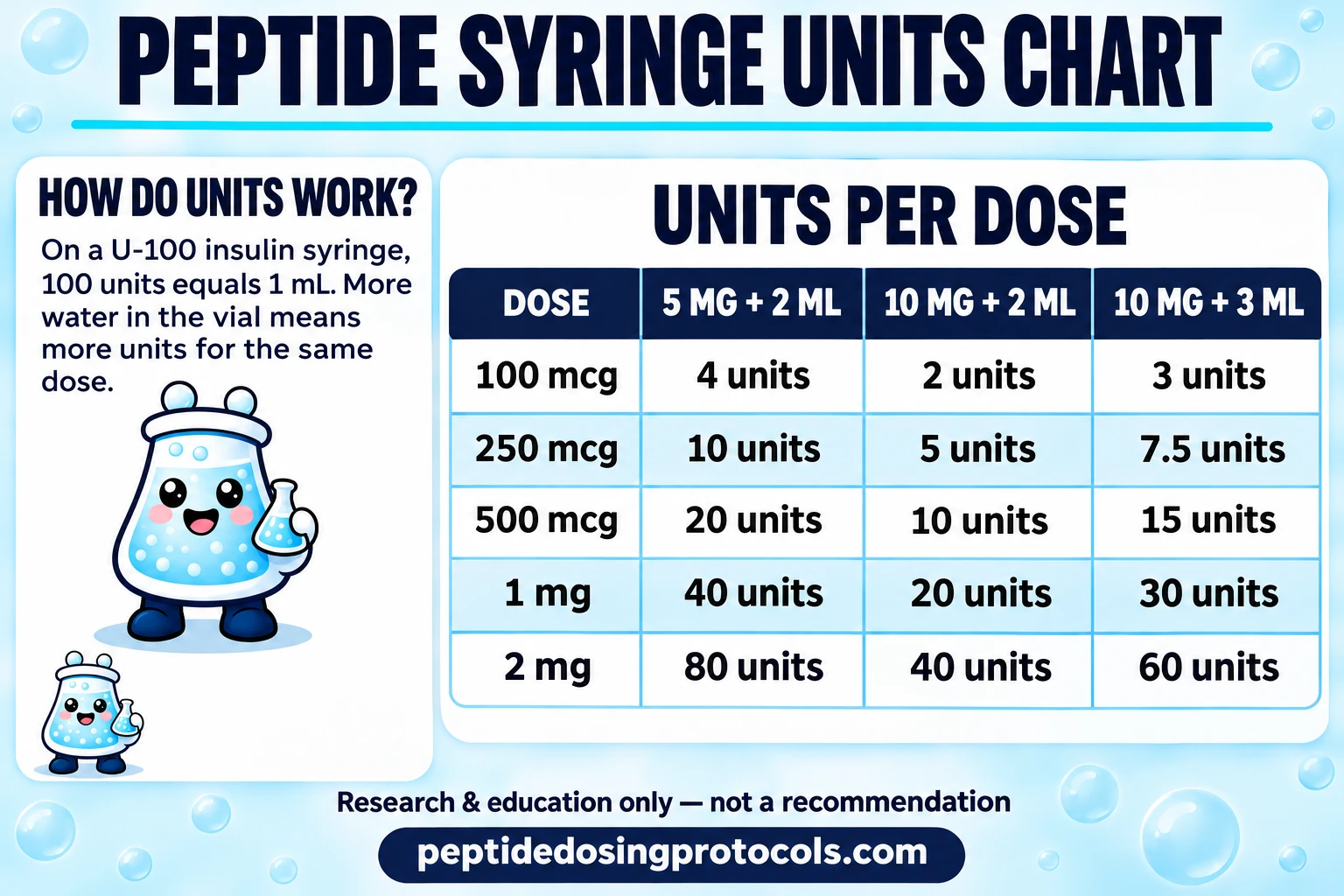
Syringe units for common doses (U-100 syringe)
Dose
100 mcg
5 mg vial + 2 mL
4 units
10 mg vial + 2 mL
2 units
10 mg vial + 3 mL
3 units
Dose
250 mcg
5 mg vial + 2 mL
10 units
10 mg vial + 2 mL
5 units
10 mg vial + 3 mL
7.5 units
Dose
500 mcg
5 mg vial + 2 mL
20 units
10 mg vial + 2 mL
10 units
10 mg vial + 3 mL
15 units
Dose
1 mg
5 mg vial + 2 mL
40 units
10 mg vial + 2 mL
20 units
10 mg vial + 3 mL
30 units
Dose
2 mg
5 mg vial + 2 mL
80 units
10 mg vial + 2 mL
40 units
10 mg vial + 3 mL
60 units
| Dose | 5 mg vial + 2 mL | 10 mg vial + 2 mL | 10 mg vial + 3 mL |
|---|---|---|---|
| 100 mcg | 4 units | 2 units | 3 units |
| 250 mcg | 10 units | 5 units | 7.5 units |
| 500 mcg | 20 units | 10 units | 15 units |
| 1 mg | 40 units | 20 units | 30 units |
| 2 mg | 80 units | 40 units | 60 units |
1 mg = 1,000 mcg. Concentrations: 5 mg + 2 mL = 2,500 mcg/mL; 10 mg + 2 mL = 5,000 mcg/mL; 10 mg + 3 mL = about 3,333 mcg/mL.
For any other vial size or water amount, use the free PepPal Reconstitution Calculator. Each protocol guide also has its own reconstitution table.
Peptide Supplies Needed
Measuring the doses on this chart takes a research vial, U-100 insulin syringes, and alcohol swabs. Check each supplier's testing records and current prices before you buy. Each protocol guide also links the matching product for that compound.
Recommended Supplies
Use discount code PEPPAL at Peptide Partners checkout. See why we love Peptide Partners.
Peptide Partners Research Catalog
At-Home Blood Test
Research Supplies
Disclosure: supply links may earn PDP a commission at no cost to you.
Affiliate disclosure: PDP may earn a commission from eligible links at no added cost to you. Prices, stock, and testing records can change.
Companion Supplies & Routine Support
Why Peptide Dosage Charts Disagree
Dosage charts online often list different numbers for the same peptide. These are the usual reasons.
- Most research peptides have no tested human dose. Charts copy community numbers from each other, and the numbers drift as they get copied. Rows here built on those numbers say "Community" in the Evidence column.
- Nasal, oral, and injected doses of the same peptide can differ by 10 times or more, and some charts mix them. Each row here names its route, and the full guides keep each route separate.
- A chart that lists "10 units" only works for the vial and water amount it assumed. Convert from mcg or mg yourself instead of copying someone else's units.
- Some charts blend prescription drugs with research products. A drug label dose applies only to that product, and a research powder with the same name is a different product.
Peptide Dosage Chart FAQ
Q1: What is a normal peptide dose?
There is no single normal dose. Peptide doses range from about 20 mcg (IGF-1 LR3) to 2 mg or more (TB-500, tirzepatide), and some are given daily while others are weekly. Find the peptide in the chart above, then open its full guide for the schedule.
Q2: How many units is 250 mcg?
It depends on the vial. With a 10 mg vial and 2 mL of water, 250 mcg is 5 units on a U-100 syringe. With a 5 mg vial and 2 mL, it is 10 units. With a 10 mg vial and 3 mL, it is 7.5 units. See the syringe units chart.
Q3: What is the difference between mcg and mg?
1 mg (milligram) equals 1,000 mcg (micrograms). Many peptides are dosed in mcg, like BPC-157 at 250 mcg. GLP-1 drugs are dosed in mg, like semaglutide at 2.4 mg. Mixing up the two is a 1,000-times error, so check the unit every time.
Q4: Do you take peptides every day?
Some, not all. BPC-157, KPV, and most growth hormone peptides are usually daily. Semaglutide, tirzepatide, and retatrutide are once weekly. TB-500 and Thymosin Alpha-1 are about twice weekly. The How often column shows the usual schedule for each one.
Q5: Are peptide doses based on body weight?
Usually not. Most label and community doses are fixed amounts. A few exceptions use weight, such as Thymosin Alpha-1 for adults under 40 kg and many animal studies. Animal doses by weight do not convert into a safe human dose.
Q6: Why do GLP-1 doses go up every 4 weeks?
Starting low and stepping up slowly gives the stomach time to adjust and lowers nausea. The Wegovy and Zepbound labels and the retatrutide Phase 3 trials all use four-week steps. A label allows staying at a lower step longer if side effects are hard to tolerate.
Q7: Where do the doses on this chart come from?
Each row summarizes the dosing section of the linked guide on this site. Those guides cite FDA labels, published trials, and clearly labeled community sources. The Evidence column shows which kind of source each row is based on.
Q8: Is this chart medical advice?
No. This is an educational reference. Most compounds here are not FDA-approved, and community doses have not been proven safe. Talk to a licensed clinician before using any peptide.
Sources
- 1. U.S. Food and Drug Administration. Wegovy (semaglutide) injection and tablets - Prescribing Information (June 2026). FDA (2026)
- 2. U.S. Food and Drug Administration Zepbound (tirzepatide) injection — Prescribing Information (revised August 2026). Eli Lilly / FDA-approved prescribing information (2026)
- 3. Giblin K, Kaplan LM, Somers VK, et al. Retatrutide for the treatment of obesity, obstructive sleep apnea and knee osteoarthritis: Rationale and design of the TRIUMPH registrational clinical trials. Diabetes, Obesity and Metabolism (2025)
- 4. Garvey WT, Blüher M, Osorto Contreras CK, et al. Coadministered Cagrilintide and Semaglutide in Adults with Overweight or Obesity (REDEFINE 1). New England Journal of Medicine (2025)
- 5. Le Roux CW, Steen O, Lucas KJ, Startseva E, Unseld A, Hennige AM. Glucagon and GLP-1 receptor dual agonist survodutide for obesity: a randomised, double-blind, placebo-controlled, dose-finding phase 2 trial. The Lancet Diabetes & Endocrinology (2024)
- 6. U.S. Food and Drug Administration Egrifta SV (tesamorelin) prescribing information. FDA (2024)
- 7. U.S. Food and Drug Administration. FORZINITY (elamipretide) injection — Highlights of Prescribing Information. accessdata.fda.gov (2025)
- 8. Bremelanotide (subcutaneous route) — Description and Dosing. Mayo Clinic Drugs & Supplements (2026)
- 9. Dominari A, et al. Thymosin alpha 1: A comprehensive review of the literature. World Journal of Virology (2020)
- 10. Astrup A, Madsbad S, Breum L, Jensen TJ, Kroustrup JP, Larsen TM Effect of tesofensine on bodyweight loss, body composition, and quality of life in obese patients: a randomised, double-blind, placebo-controlled trial. The Lancet (2008)
- 11. Heij L, Niesters M, Swartjes M, et al. Safety and efficacy of ARA 290 in sarcoidosis patients with symptoms of small fiber neuropathy: a randomized, double-blind pilot study. Molecular Medicine (2012)
- 12. Richie JP Jr, Nichenametla S, Neidig W, et al. Randomized controlled trial of oral glutathione supplementation on body stores of glutathione. European Journal of Nutrition (2015)
- 13. Sikich L, Kolevzon A, King BH, McDougle CJ, et al. Intranasal Oxytocin in Children and Adolescents with Autism Spectrum Disorder. New England Journal of Medicine (2021)
Related Dosing Protocols
Educational use only
This chart is an educational research reference and is not medical advice. Most compounds listed are not FDA-approved, and community-reported doses have not been shown to be safe or effective in people. Consult a licensed healthcare provider before considering any peptide.
Need the full schedule?
Every row in this chart links to a full guide with the week-by-week schedule, reconstitution table, side effects, and sources.

Written by Garret Grant
Founder & Lead Researcher · B.S. Civil Engineering, UCLA
Last updated: November 2026
Human-researched and AI-assisted with full editorial review. I verify sources, protocol interpretation, and final judgments personally. See methodology.
Share this page
See our research first on Google
Add us as a preferred source for Top Stories.