Methylene Blue Quick Start
Methylene blue is a bright blue synthetic dye that doubles as a medicine. It was first made in 1876 as a textile dye, then became one of the oldest drugs still in use. Its chemical name is methylthioninium chloride.
In hospitals it is given by IV to treat a blood disorder called methemoglobinemia. Online, it is sold as oral drops and promoted for energy, focus, and mitochondrial support. Those supplement uses are not FDA-approved, and this page treats them as research context, not advice.
The most important fact for anyone reading a dosing chart: the number of drops means nothing until you know the solution's concentration. A 1% solution holds about 0.5 mg per drop. A 2% solution holds about 1 mg per drop. The same 10 drops can be a very different dose.
Format
Sold ready-to-use as an oral liquid. There is no powder to reconstitute and no BAC water needed.
Concentration first
Find the percentage on the label (0.5%, 1%, or 2%) before counting any drops.
Low-dose window
Cognitive research used a hormetic curve: low doses (about 0.5-4 mg/kg) helped, high doses (>10 mg/kg) reversed the effect.
Grade
Pharmaceutical-grade (USP) only. Industrial and aquarium-grade dye can carry heavy-metal contaminants.
Research status
FDA-approved for methemoglobinemia; all nootropic and longevity uses are off-label or unregulated.
Disclaimer
This page is an educational research reference and is not medical advice. Methylene blue is a potent MAO inhibitor with serious drug interactions. Talk to a qualified clinician before use, especially if you take any antidepressant or have G6PD deficiency.
Methylene Blue Dosing Protocol & Schedule
There are two completely different dosing worlds for methylene blue, and mixing them up is the most common mistake. One is the clinical IV dose for methemoglobinemia. The other is the much lower oral dose people use as a supplement. The numbers below are reported research and community context, not a dosing recommendation.
Methylene Blue Use Contexts
Choose the context you are researching. These describe how methylene blue has been studied or used, not instructions to follow.
Low-dose oral drops, the format sold online.
Most oral-supplement users describe low daily amounts, commonly in the 5-20 mg range, often split between morning and early afternoon. Published reviews note a conservative ceiling around 0.5-2 mg/kg for general low-dose use, with side effects becoming more likely above roughly 7 mg/kg. This is community and review-level context, not a clinical standard. This is not a dosing recommendation.
Because methylene blue can be mildly stimulating, users typically avoid late-day dosing. It is fat-soluble, so taking it with food may reduce stomach upset. None of this is medical guidance — it simply describes reported patterns.
Doses used in published human brain studies.
The human cognitive studies used single oral doses far higher than typical supplement use. A 2017 Radiology fMRI study (Rodriguez and colleagues, 26 healthy adults) used a single low oral dose. A separate fMRI connectivity study used 280 mg, estimated as about 4 mg/kg for a 70 kg adult. A 2017 phobia study (Telch and colleagues, 42 adults) used 260 mg after extinction training. This is not a dosing recommendation.
These were single-session research doses under monitoring, not daily supplement plans. The benefit seen in animals follows a hormetic curve: low doses (about 0.5-4 mg/kg) helped memory, while doses above about 10 mg/kg reversed the effect.
The FDA-approved methemoglobinemia dose.
For acquired methemoglobinemia, the FDA-approved label (ProvayBlue) lists 1 mg/kg given intravenously over 5-30 minutes, with a possible repeat dose after one hour. This is a hospital procedure administered by clinicians, dosed on lean body weight, and usually completed within one day. This is label information, not a dosing recommendation.
Dose context by use (research and review-level, not a recommendation)
Context
Oral supplement (community)
Typical range reported
~5-20 mg/day
Route
Oral drops
Setting
Unsupervised, unregulated
Context
Cognitive research (single dose)
Typical range reported
~260-280 mg (about 4 mg/kg)
Route
Oral
Setting
Monitored study
Context
Methemoglobinemia (approved)
Typical range reported
1 mg/kg
Route
IV
Setting
Hospital, clinician-administered
| Context | Typical range reported | Route | Setting |
|---|---|---|---|
| Oral supplement (community) | ~5-20 mg/day | Oral drops | Unsupervised, unregulated |
| Cognitive research (single dose) | ~260-280 mg (about 4 mg/kg) | Oral | Monitored study |
| Methemoglobinemia (approved) | 1 mg/kg | IV | Hospital, clinician-administered |
Ranges are reported context only. Methylene blue is an MAOI with serious interactions; dosing should involve a clinician. This is not a dosing recommendation.
Evidence boundary
No standardized, FDA-recognized oral supplement dose for methylene blue exists. Supplement ranges come from community use and reviews, not controlled long-term trials.
Methylene Blue Supplies Needed
Methylene blue ships as a ready-to-use oral liquid, so there is no reconstitution and no BAC water for normal oral use.
Recommended U.S. and Canada Supply
Choose your region
Use discount code PEPPAL at Ion Peptide checkout. See why we love Ion Peptide.
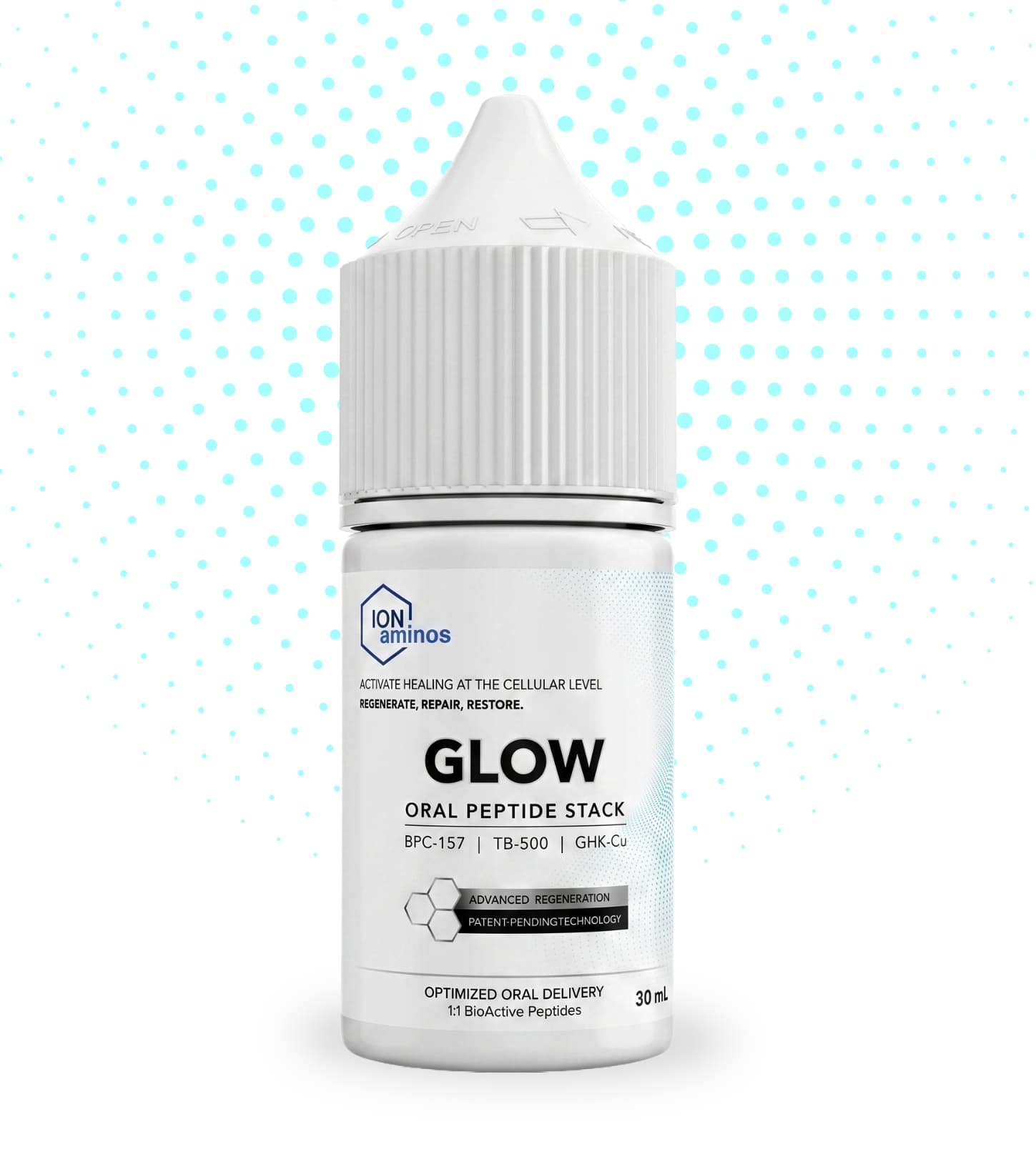
Methylene Blue 60ml
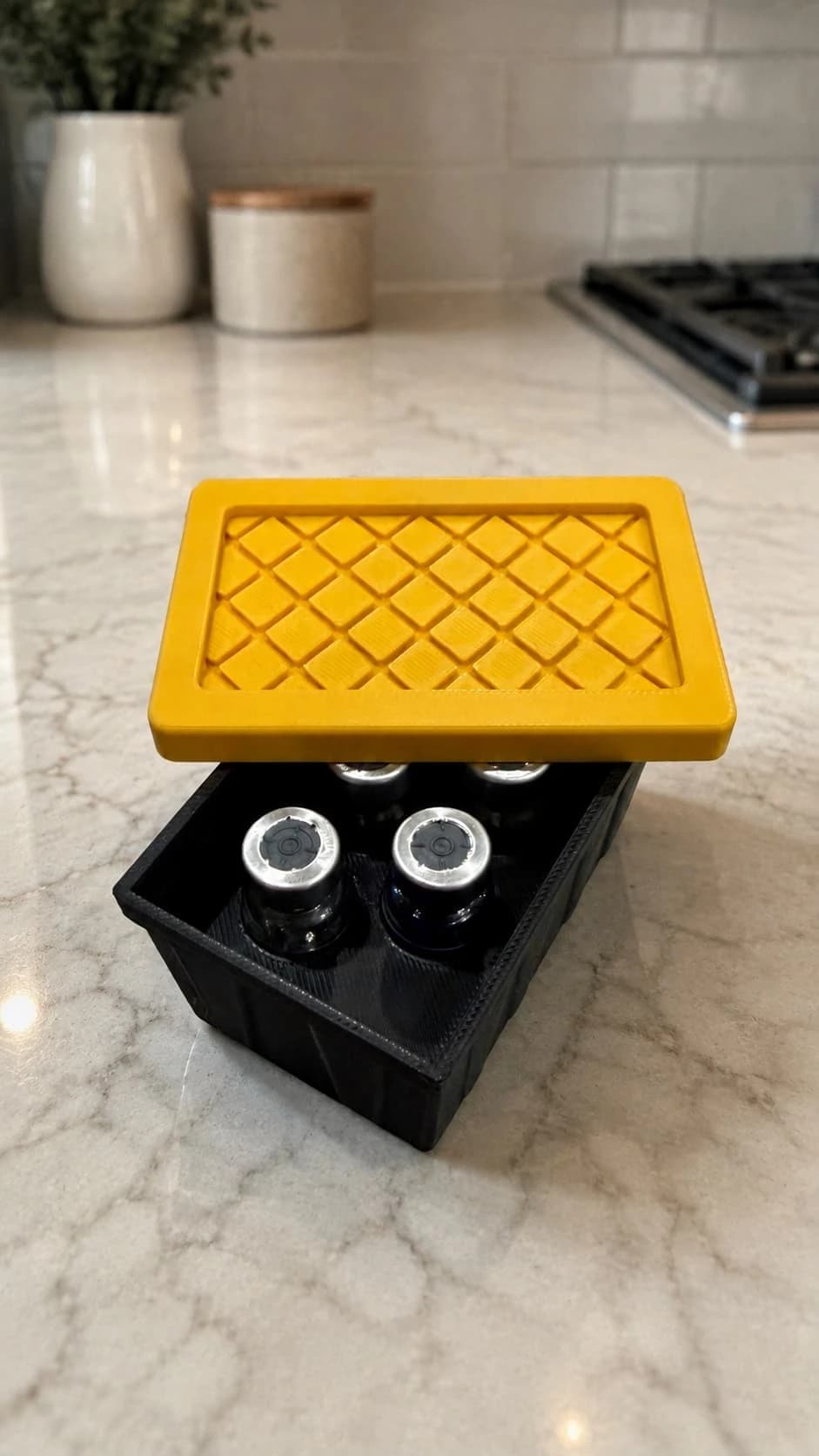
5-Vial Tote Case
At-Home Blood Test
Research Supplies
Disclosure: supply links may earn PDP a commission at no cost to you.
Methylene Blue Bottles
Bottle count depends on concentration and how much is used per day. A 60 mL 1% bottle holds about 600 mg total.
| Use length | Planning note |
|---|---|
30 days 1 bottle | Low daily use from one 60 mL 1% bottle. |
60 days 1-2 bottles | Depends on daily amount and concentration. |
90 days 2 bottles | Re-check concentration before estimating. |
30 days
1 bottle
Low daily use from one 60 mL 1% bottle.
60 days
1-2 bottles
Depends on daily amount and concentration.
90 days
2 bottles
Re-check concentration before estimating.
Measuring
For accuracy beyond drop-counting.
| Use length | Planning note |
|---|---|
Any length 1 oral syringe | Reusable; rinse between uses. |
Any length
1 oral syringe
Reusable; rinse between uses.
Bottle math is approximate and depends on the exact concentration and amount used. Confirm the product label before ordering. This is not a dosing recommendation.
Companion Supplies & Routine Support
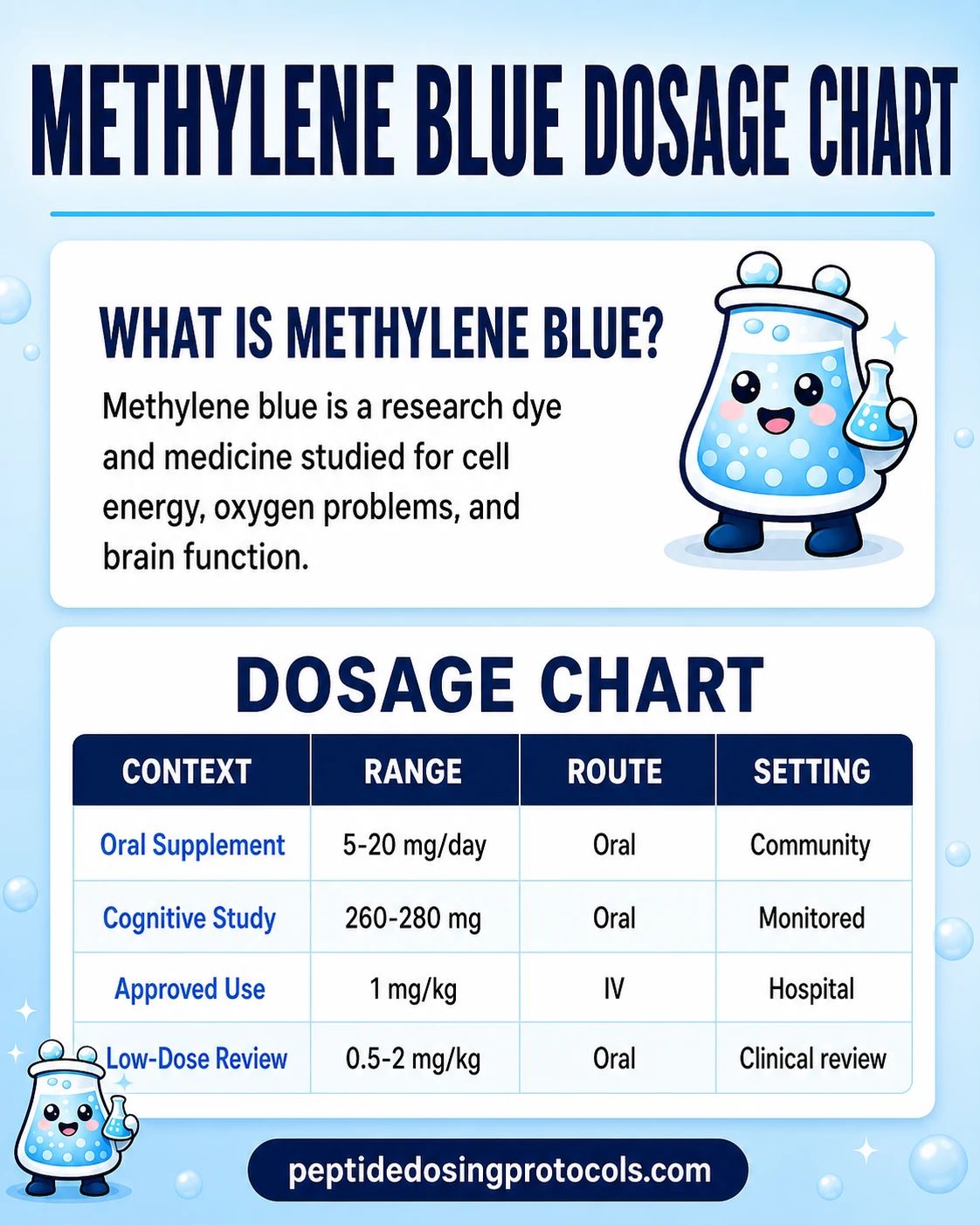
Methylene Blue Dosage Chart
This Methylene Blue dosage chart summarizes the oral supplement, cognitive-study, and hospital IV dose contexts shown in the dosing section above.
Methylene Blue Drop-to-Milligram Math
Methylene blue does not need reconstitution — it is sold as a finished liquid. The real math problem is converting drops into milligrams, and that depends entirely on the solution's concentration. Get the concentration wrong and you can be off by 2x or more.
What the percentage means
Concentration is listed as a percentage or as mg per mL. A 1% solution is the same as 10 mg/mL. A 0.5% solution is 5 mg/mL. A 2% solution is 20 mg/mL. A standard dropper makes roughly 20 drops per mL, so each drop is about 1/20th of the per-mL amount.
Approximate milligrams per drop by concentration
Solution
0.5%
mg per mL
5 mg/mL
Approx. mg per drop
~0.25 mg
Drops for ~10 mg
~40 drops
Solution
1%
mg per mL
10 mg/mL
Approx. mg per drop
~0.5 mg
Drops for ~10 mg
~20 drops
Solution
2%
mg per mL
20 mg/mL
Approx. mg per drop
~1 mg
Drops for ~10 mg
~10 drops
| Solution | mg per mL | Approx. mg per drop | Drops for ~10 mg |
|---|---|---|---|
| 0.5% | 5 mg/mL | ~0.25 mg | ~40 drops |
| 1% | 10 mg/mL | ~0.5 mg | ~20 drops |
| 2% | 20 mg/mL | ~1 mg | ~10 drops |
Drop size varies by dropper. For larger amounts, a 1 mL oral syringe is more accurate than counting drops. This table is math context, not a dosing recommendation.
- 01
Read the concentration
Find the percentage or mg/mL on the label. If neither is listed, do not guess — contact the maker or choose a clearly labeled product.
- 02
Convert to mg per drop
Divide the mg/mL by about 20. A 1% (10 mg/mL) solution is about 0.5 mg per drop.
- 03
Switch to a syringe for larger amounts
Counting 40 drops is error-prone. A cheap 1 mL oral syringe measures the same dose more reliably.
- 04
Dilute in water or juice
Methylene blue is intensely staining and bitter. Most users add the dose to a glass of water or juice.
Calculator tip
For custom concentration and volume math, the PepPal calculator can convert mg, mL, and concentration so you are not relying on drop-counting alone.
How Methylene Blue Works
Methylene blue's main trick is that it moves electrons around easily. In plain terms, it can pick up and drop off electrons inside cells, which lets it step into chemical reactions that depend on that hand-off.
In the approved use, this is why it reverses methemoglobinemia. It helps convert iron in hemoglobin from a broken form (Fe3+) back to the working form (Fe2+) so blood can carry oxygen again.
In the brain-energy theory, low doses are described as a mitochondrial electron carrier. The technical version: it can shuttle electrons in the mitochondrial electron transport chain and boost cytochrome c oxidase activity, which is tied to how cells make energy (ATP). This effect is dose-dependent and reverses at high doses.
Separately, methylene blue is a potent monoamine oxidase inhibitor (MAOI), especially of MAO-A. That is the property behind both some of its studied mood effects and its most dangerous interaction — serotonin syndrome.
Redox / electron shuttle
Cycles between oxidized and reduced forms; restores hemoglobin function.
Mitochondrial support (low dose)
Increases cytochrome c oxidase activity in preclinical models.
MAO inhibition
Potent MAO-A inhibitor — the source of the serotonin-syndrome risk.
Main limitation
Most mechanism-to-benefit links are preclinical or based on small human studies.
Who Methylene Blue Is For and Who Should Avoid It
This is the most important section on the page. Methylene blue has two hard contraindications and several caution groups that turn a low-risk supplement into a dangerous one.
- Anyone taking serotonergic medication. SSRIs, SNRIs, MAOIs, tricyclic antidepressants, and some others can combine with methylene blue's MAOI activity to cause serotonin syndrome, which can be fatal. The FDA notes most reported cases involved these drugs.
- Anyone with G6PD deficiency. Methylene blue is contraindicated here. It needs G6PD to work and can trigger paradoxical methemoglobinemia and hemolysis (red blood cell destruction). About 2% of the US population has G6PD deficiency, often undiagnosed.
- Pregnancy. Methylene blue may cause fetal harm; injection during pregnancy has been linked to neonatal intestinal atresia and fetal death. It is generally avoided.
- Breastfeeding. It is not known whether it passes into breast milk; caution is advised.
- Severe kidney impairment. The label advises caution because of slower clearance.
- People on multiple medications. It can inhibit certain liver enzymes (CYP450), raising levels of drugs like warfarin and others.
The antidepressant rule
For non-emergency systemic use, the FDA recommends stopping most serotonergic drugs for at least two weeks beforehand. Do not stop any prescribed medication on your own — this requires a clinician.
Methylene Blue Side Effects & Safety
Even used alone, methylene blue has predictable effects. The most universal one is harmless but dramatic: it temporarily turns urine, and sometimes the tongue and stool, blue-green.
Common, usually mild
- Blue-green urine, tongue, or stool (expected, harmless).
- Nausea, stomach upset, or diarrhea, especially at higher amounts.
- Headache, dizziness.
- Mild stimulation or trouble sleeping if taken late in the day.
Serious
- Serotonin syndrome when combined with serotonergic drugs — agitation, tremor, fever, confusion, rapid heart rate. A medical emergency.
- Paradoxical methemoglobinemia at high doses (above about 7 mg/kg), because methylene blue itself becomes an oxidant.
- Hemolysis / hemolytic anemia, especially in G6PD deficiency or with long-term high dosing.
- Phototoxicity — increased light sensitivity; the label advises protection from strong light.
Quality-control risk
Non-pharmaceutical methylene blue (industrial or aquarium dye) can contain heavy metals and other contaminants. A 2022 quality analysis found some consumer products were contaminated or misbranded. Use only USP / pharmaceutical-grade, third-party-tested product.
Methylene Blue Timeline & What to Monitor
For the approved IV use, methylene blue acts fast — methemoglobin levels and oxygenation often improve within an hour. For oral supplement use, reported subjective effects (energy, focus) are usually described within 30-60 minutes, though this is anecdotal.
Methylene blue has a fairly long half-life and is cleared over roughly a day or more, mostly in urine (which is why urine stays blue for a while). Exact clearance varies by dose, route, and the person.
Reasonable things a clinician might monitor with repeated or higher-dose use include hemoglobin (for hemolysis), oxygen saturation readings (pulse oximeters can read falsely with the dye present), and any signs of serotonin syndrome. Long-term daily-use safety data in healthy people is limited.
Pulse oximeter note
Methylene blue can interfere with pulse-oximeter readings, sometimes showing a falsely low oxygen number. Clinicians account for this; it is worth knowing if you wear a monitor.
Methylene Blue Clinical Evidence Context
The evidence splits cleanly into one strong, narrow approved use and a wider set of promising-but-preliminary uses. Keeping those separate is the honest way to read methylene blue.
Approved use (strong)
Acquired methemoglobinemia: decades of clinical use; FDA-approved as ProvayBlue (2016) and a separate Nexus Pharmaceutical injection approved in 2025.
Cognitive effects (small human trials)
A 2017 Radiology fMRI trial (Rodriguez et al., N=26) found a single low oral dose increased brain activity in attention and memory tasks. A connectivity fMRI study (N=28, 280 mg) showed altered functional connectivity. Telch et al. 2017 (N=42, 260 mg) studied fear-extinction memory in phobic adults.
Mood / psychiatry (preliminary)
Small studies have explored low-dose methylene blue in mood disorders, tied to its MAOI activity. Evidence is early and not a basis for self-treatment.
Antimicrobial / antiviral (preclinical)
Lab studies report activity against some pathogens and, in vitro, against SARS-CoV-2. It is not approved or proven for these uses in people.
Cancer and Alzheimer's (preclinical / unproven)
Frequently claimed online. Human evidence is absent or inconclusive; these are not supported uses. No published trial shows methylene blue treats cancer in people.
I read the Rodriguez 2017 Radiology paper directly to confirm it tested a single low oral dose in healthy adults rather than a daily regimen, which is a distinction many supplement pages blur.
The honest summary: strong for one rare blood emergency, genuinely interesting but small for cognition, and mostly preclinical for the headline 'longevity' and 'anti-cancer' claims.
Methylene Blue Storage & Handling
Methylene blue liquid is generally stored at room temperature, away from direct light, with the cap closed. It is a finished solution, so there is no powder to refrigerate or reconstitute.
Storage at a glance
Typical storage
Methylene blue oral solution
Room temp, 59-86F (15-30C)
Light
Methylene blue oral solution
Keep away from direct light
Appearance
Methylene blue oral solution
Deep blue liquid; should stay clear, not cloudy
Handling
Methylene blue oral solution
Stains skin, fabric, and surfaces permanently
| Methylene blue oral solution | |
|---|---|
| Typical storage | Room temp, 59-86F (15-30C) |
| Light | Keep away from direct light |
| Appearance | Deep blue liquid; should stay clear, not cloudy |
| Handling | Stains skin, fabric, and surfaces permanently |
Follow the specific product label, which overrides general guidance.
Staining
Methylene blue stains almost everything it touches. Work over a surface you can wipe, and expect blue urine — it is harmless and temporary.
Methylene Blue Mistakes & Troubleshooting
- Counted drops without checking concentration. The #1 error. A 2% solution is double a 1% solution per drop. Always convert using the label.
- Used aquarium or industrial dye. These are not for human use and can carry contaminants. Only USP / pharmaceutical-grade.
- Took it with an antidepressant. Serious serotonin-syndrome risk. This needs a clinician and usually a washout period.
- Stomach upset. Often from too much at once or taking it undiluted; users dilute it well in water or juice and take it with food.
- Alarmed by blue urine. Expected and harmless.
- Took it late in the day. Can be mildly stimulating and disrupt sleep.
- Skin or counter stains. Methylene blue stains are stubborn; some surfaces respond to a dilute hypochlorite (bleach) solution.
Methylene Blue Regulatory Status
As of June 2026, the regulatory picture has two clearly separate halves, and most online confusion comes from blending them.
- FDA-approved drug: Methylene blue injection is FDA-approved for acquired methemoglobinemia. ProvayBlue received approval in 2016, and a Nexus Pharmaceutical methylene blue injection was approved in 2025. This is a prescription, clinician-administered use.
- Not approved as a supplement: The oral 'nootropic' and longevity products sold online are not FDA-approved and are not evaluated for those uses. Their claims are not vetted by the FDA.
- Off-label clinical uses: Doctors sometimes use it off-label (for example, vasoplegic shock or ifosfamide-induced encephalopathy). Off-label use is legal under the practice of medicine but is not an FDA endorsement.
- Compounding: Some pharmacies compound methylene blue formulations on prescription, which is a separate pathway from over-the-counter supplements.
Interest spiked in early 2025 after a widely shared video of Robert F. Kennedy Jr. adding a blue liquid to water, plus podcast coverage. Popularity is not the same as approval — the regulatory status above did not change because of the trend.
Methylene Blue vs Methyl Blue vs Grades of Methylene Blue
Two comparisons cause the most confusion: methylene blue versus 'methyl blue,' and the different purity grades of methylene blue itself.
Common methylene blue mix-ups
Term
Methylene blue (USP)
What it is
Pharmaceutical-grade methylthioninium chloride
Human use?
Yes — the only grade for people
Term
Methyl blue
What it is
A different dye (aniline blue family), not the same compound
Human use?
No
Term
Industrial-grade methylene blue
What it is
Lower-purity dye for labs/manufacturing
Human use?
No — contaminant risk
Term
Aquarium methylene blue
What it is
Treats fish; not made to human-purity standards
Human use?
No
| Term | What it is | Human use? |
|---|---|---|
| Methylene blue (USP) | Pharmaceutical-grade methylthioninium chloride | Yes — the only grade for people |
| Methyl blue | A different dye (aniline blue family), not the same compound | No |
| Industrial-grade methylene blue | Lower-purity dye for labs/manufacturing | No — contaminant risk |
| Aquarium methylene blue | Treats fish; not made to human-purity standards | No |
Names look alike but the compounds and purity differ. Only USP / pharmaceutical-grade is intended for human use.
Within human-grade product, the practical differences are concentration (0.5%, 1%, 2%), whether it is third-party tested, and the format (drops, troches, or sprays). Grade and testing matter more than brand.
FAQ
Q1: What is methylene blue?
Methylene blue (methylthioninium chloride) is a synthetic blue dye that is also a medicine. It was first made in 1876 as a textile dye and later became a drug. Today it is FDA-approved by IV for a blood disorder called methemoglobinemia and is separately sold as an unregulated oral supplement for other uses.
Q2: What does methylene blue do?
Its core action is moving electrons around inside cells. In the approved use, that restores hemoglobin so blood can carry oxygen. In low-dose research, it is described as a mitochondrial electron carrier tied to cellular energy. It is also a potent MAO inhibitor, which is the source of its serious antidepressant interaction.
Q3: Is methylene blue safe?
Under medical supervision at approved doses it has a long track record. As an unsupervised supplement it carries real risks: serotonin syndrome if combined with antidepressants, hemolysis in people with G6PD deficiency, and contaminants in non-pharmaceutical grades. It is not considered safe in pregnancy. This page is not medical advice.
Q4: How many drops of methylene blue should I take per day?
There is no standardized supplement dose, and the drop count is meaningless without the concentration. A 1% solution is about 0.5 mg per drop, a 2% solution about 1 mg per drop. Community oral use often falls around 5-20 mg per day, but that is not a clinical standard. This is research context, not a dosing recommendation — talk to a clinician.
Q5: How do you take methylene blue orally?
It is sold as a ready-to-use liquid, so there is no mixing. People typically add the measured amount to water or juice because it is bitter and staining, and take it earlier in the day since it can be mildly stimulating. For accuracy beyond a few drops, a 1 mL oral syringe is more reliable than counting drops.
Q6: Who should not take methylene blue?
Anyone taking serotonergic drugs (SSRIs, SNRIs, MAOIs, tricyclics) because of serotonin-syndrome risk, anyone with G6PD deficiency because of hemolysis risk, and people who are pregnant or breastfeeding. People with severe kidney impairment or on multiple medications should also avoid it without medical guidance.
Q7: What should you not take with methylene blue?
Most importantly, antidepressants and other serotonergic medications, which can trigger serotonin syndrome. It can also raise levels of some drugs processed by the liver, such as warfarin. For non-emergency use, the FDA suggests stopping most serotonergic drugs for at least two weeks first — but only a clinician should manage that.
Q8: Can you take methylene blue every day?
Long-term daily-use safety data in healthy people is limited. The published cognitive studies used single doses, not daily regimens, and high or prolonged dosing raises the risk of hemolysis and methemoglobinemia. Daily use should involve a clinician, especially given the MAOI interactions.
Q9: Why does methylene blue turn urine blue?
Methylene blue is a strong dye, and the body clears much of it through the kidneys, which tints urine blue or blue-green. This is harmless and temporary. It can also stain the tongue and stool. The color is expected, not a side effect to worry about.
Q10: Does methylene blue treat cancer or Alzheimer's?
No. These are common online claims, but the evidence is preclinical or inconclusive, not approved. Some lab and animal work is interesting, but no human trial supports using methylene blue to treat cancer or Alzheimer's. Treat these as research areas, not proven uses.
Q11: What grade of methylene blue is safe to buy?
Only pharmaceutical-grade (USP) methylene blue is intended for human use. Industrial-grade and aquarium methylene blue are not made to human-purity standards and can contain heavy metals. Look for USP grade plus third-party testing for purity and heavy metals, and a clearly listed concentration.
Q12: Is methylene blue FDA-approved?
Yes, but only as an injectable prescription drug for acquired methemoglobinemia (ProvayBlue, approved 2016, plus a Nexus Pharmaceutical injection approved in 2025). The oral supplements sold for energy, focus, or longevity are not FDA-approved and are not evaluated for those uses.
Q13: Is this page medical advice?
No. This is an educational research reference. Methylene blue is a potent MAOI with serious interactions and contraindications, so any real-world use should be discussed with a qualified clinician.
Sources & Research
- 1. U.S. Food and Drug Administration PROVAYBLUE (methylene blue) injection — Highlights of Prescribing Information. FDA / accessdata.fda.gov (2016)
- 2. Pharmacy Times FDA Approves Methylene Blue Injection for Acquired Methemoglobinemia (Nexus Pharmaceutical). Pharmacy Times (2026)
- 3. Rodriguez P, Zhou W, Barrett DW, et al. Multimodal Randomized Functional MR Imaging of the Effects of Methylene Blue in the Human Brain. Radiology (2017)
- 4. Talley Watts L, et al. Methylene blue modulates functional connectivity in the human brain (280 mg, ~4 mg/kg). Brain Imaging and Behavior / PMC (2016)
- 5. Telch MJ, Bruchey AK, Rosenfield D, et al. Post-Session Administration of USP Methylene Blue Facilitates Retention of Pathological Fear Extinction and Contextual Memory in Phobic Adults. Journal of Psychiatric Research / PMC (2017)
- 6. Drugs.com Methylene Blue Monograph for Professionals — interactions, G6PD contraindication, pregnancy warnings. Drugs.com (2026)
- 7. Drugs.com Methylene Blue Dosage Guide — clinical dosing and oral dilution note. Drugs.com (2025)
- 8. Anesthesia Patient Safety Foundation (Pedavally S, Fugate JE, Rabinstein AA). Methylene Blue and the Risk of Serotonin Toxicity. APSF Newsletter (2025)
- 9. DailyMed / NLM Methylene Blue injection label — G6PD contraindication, paradoxical methemoglobinemia, fetal harm. DailyMed (U.S. National Library of Medicine) (2024)
- 10. Medscape (Hunter Handsfield et al.) Methemoglobinemia Treatment & Management — methylene blue is an oxidant >7 mg/kg; ~2% of US population is G6PD-deficient. Medscape / eMedicine (2025)
- 11. Tucker D, Lu Y, Zhang Q, et al. From Mitochondrial Function to Neuroprotection — review of methylene blue's hormetic dose-response. Molecular Neurobiology / PMC (2018)
- 12. PubChem Methylene Blue | C16H18ClN3S | CID 6099 — compound identity and properties. PubChem (NIH/NLM) (2026)
- 13. Harvard Health Publishing What to know about methylene blue — the only FDA-approved use is methemoglobinemia. Harvard Health (2025)
Related Dosing Protocols
Educational use only
This guide is an educational research reference, not medical advice or a treatment plan. Methylene blue is a potent MAO inhibitor with serious drug interactions and contraindications; discuss any use with a qualified clinician.
Calculate concentration and dose math
Use the calculator to convert mg, mL, and solution concentration so you are not relying on drop-counting alone.

Written by Garret Grant
Founder & Lead Researcher · B.S. Civil Engineering, UCLA
Last updated: July 2026
Human-researched and AI-assisted with full editorial review. I verify sources, protocol interpretation, and final judgments personally. See methodology.
Share this page