

Survodutide Quick Start
Survodutide is a 29-amino-acid peptide developed by Boehringer Ingelheim with Zealand Pharma. Its research code is BI 456906. It is a once-weekly subcutaneous peptide, meaning it is injected under the skin. It acts on two targets at the same time: the GLP-1 receptor and the glucagon receptor.
Researchers study Survodutide for weight loss because GLP-1 can lower appetite and glucagon may help the body burn more energy. The same glucagon effect is why researchers also study Survodutide for MASH, a serious fatty liver disease.
Survodutide is investigational. As of June 2026, it is not FDA-approved and is not sold by licensed U.S. pharmacies. The newest trial results (SYNCHRONIZE-1) were announced on April 28, 2026, with full data due at the American Diabetes Association 2026 Scientific Sessions in June.
Mechanism
Dual GLP-1 + glucagon receptor agonist. This is different from tirzepatide, which targets GLP-1 + GIP.
Route
Subcutaneous injection, once weekly.
Trial top dose
4.8 mg once weekly in the Phase 2 obesity trial, after a 20-week escalation.
Phase 3 result
16.6% body weight loss at 76 weeks vs 3.2% on placebo (SYNCHRONIZE-1).
Status
Not FDA-approved as of June 2026.
Investigational, not a treatment plan
This page is an educational research-context summary, not medical advice and not a treatment plan. Survodutide is not FDA-approved and is not available by prescription. Any peptide use should be discussed with a qualified clinician.
Survodutide Dosing Protocol & Schedule
All dosing information on this page comes from published clinical trial protocols. Survodutide has no FDA-approved label, so there is no consumer dose to copy. The tables below show what researchers studied in Phase 2 and Phase 3 trials.
Trial-studied dose escalation (Phase 2)
The Phase 2 obesity trial included 387 adults with a BMI of 27 or higher and no diabetes. People received 0.6 mg, 2.4 mg, 3.6 mg, or 4.8 mg of Survodutide once weekly, or placebo, for 46 weeks. The dose went up during the first 20 weeks, then stayed steady for the next 26 weeks.
Phase 2 trial: weight loss by survodutide arm at 46 weeks
Arm
Placebo
Average weight loss
-2.8%
Note
Reference arm.
Arm
0.6 mg once weekly
Average weight loss
-6.2%
Note
Lowest studied dose.
Arm
2.4 mg once weekly
Average weight loss
-12.5%
Note
Mid dose.
Arm
3.6 mg once weekly
Average weight loss
-13.2%
Note
Mid-high dose.
Arm
4.8 mg once weekly
Average weight loss
-14.9% in the main analysis
Note
Top dose; people who completed the trial reached around 18.7%. This is not a dosing recommendation.
| Arm | Average weight loss | Note |
|---|---|---|
| Placebo | -2.8% | Reference arm. |
| 0.6 mg once weekly | -6.2% | Lowest studied dose. |
| 2.4 mg once weekly | -12.5% | Mid dose. |
| 3.6 mg once weekly | -13.2% | Mid-high dose. |
| 4.8 mg once weekly | -14.9% in the main analysis | Top dose; people who completed the trial reached around 18.7%. This is not a dosing recommendation. |
From the Phase 2 trial. Most people who stopped treatment did so during the fast 20-week dose increase. This is trial reporting only and not a dosing recommendation.
Phase 3 SYNCHRONIZE-1 topline result (April 28, 2026)
In the Phase 3 SYNCHRONIZE-1 trial, 725 adults with obesity or overweight and no type 2 diabetes were treated for 76 weeks. The dose increase was slower and more flexible than in Phase 2.
Phase 3 SYNCHRONIZE-1 topline result at 76 weeks
Endpoint
Average body weight change
Survodutide
-16.6%
Placebo
-3.2%
Endpoint
≥5% body weight loss
Survodutide
85.1% of participants
Placebo
38.8% of participants
Endpoint
Average absolute weight loss
Survodutide
Up to ~17.8 kg (~39.2 lb)
Placebo
Smaller change
| Endpoint | Survodutide | Placebo |
|---|---|---|
| Average body weight change | -16.6% | -3.2% |
| ≥5% body weight loss | 85.1% of participants | 38.8% of participants |
| Average absolute weight loss | Up to ~17.8 kg (~39.2 lb) | Smaller change |
Topline result reported by Boehringer Ingelheim on April 28, 2026. Full results are due at the ADA 2026 Scientific Sessions in June. This is not a dosing recommendation.
Phase 3 LIVERAGE trials are studying Survodutide for MASH, a serious fatty liver disease. These trials include people with moderate to advanced liver scarring, including cirrhosis. Results are expected later in 2026.
Not a dosing recommendation
The dose ranges above come from clinical trial protocols. Survodutide is investigational, not FDA-approved, and not available by prescription as of June 2026. Do not use this table to plan personal dosing.
Survodutide Supplies Needed
Affiliate disclosure: PDP may earn a commission when you use eligible supplier links, at no extra cost to you. Math below assumes once-weekly subcutaneous use and the two most common research vial sizes (6 mg and 10 mg).
Recommended U.S. and Canada Supply
Choose your region
Use discount code SAVE10 at Peptira checkout. See why we love Peptira.
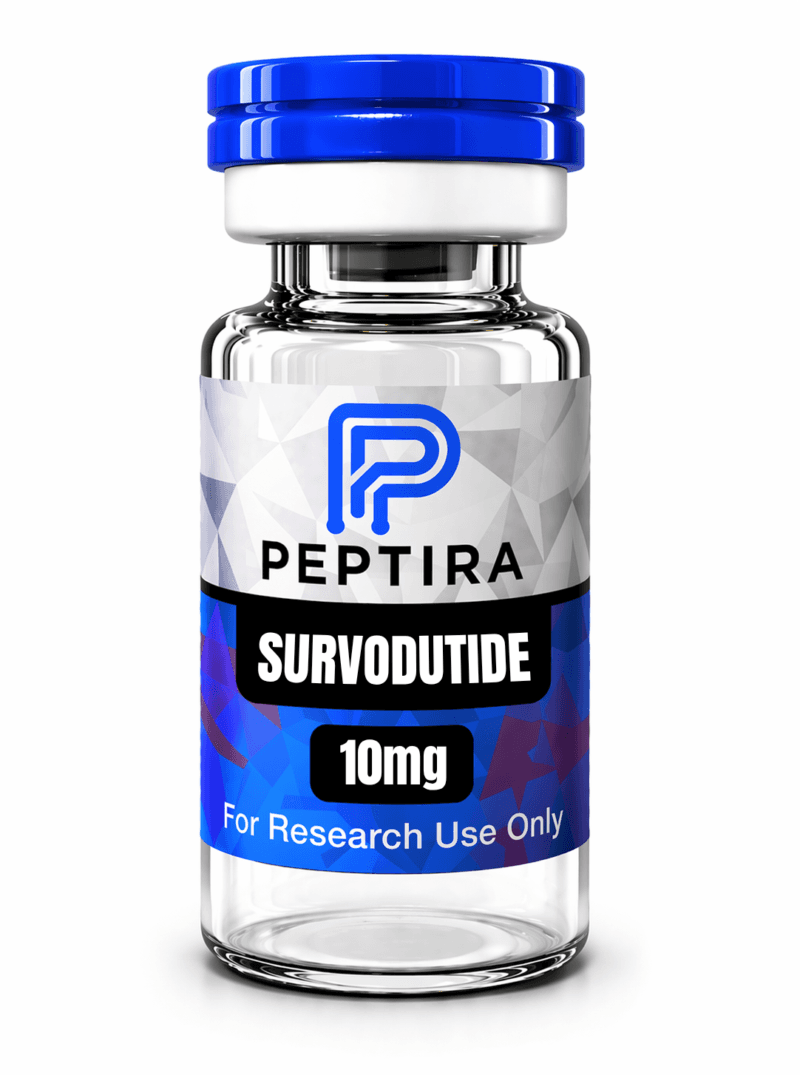
Survodutide
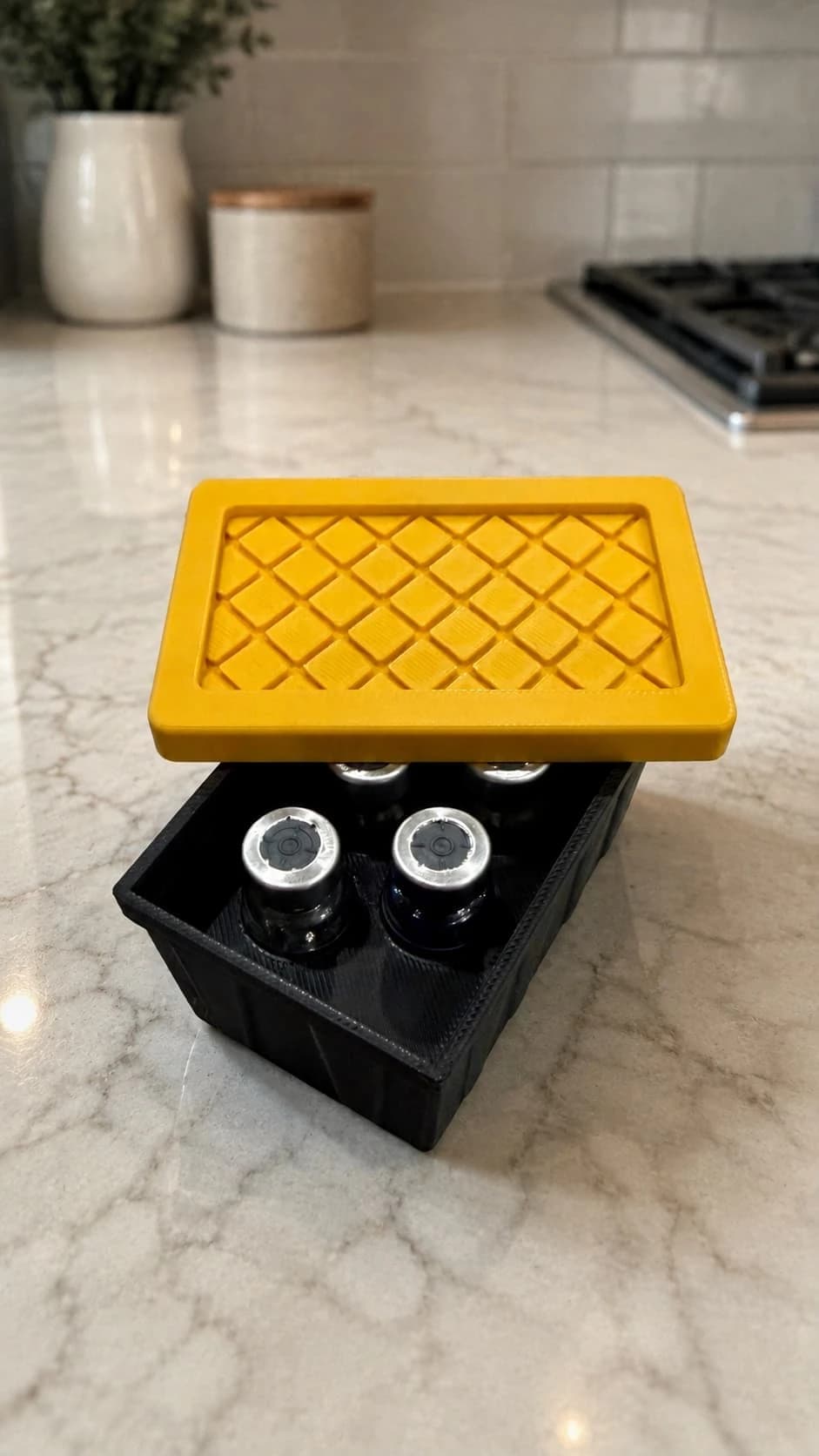
5-Vial Tote Case
At-Home Blood Test
Research Supplies
Disclosure: supply links may earn PDP a commission at no cost to you.
Peptide Vials (research-grade)
Once-weekly use means one vial covers several weeks at most studied doses. The math below assumes a 4-week, 8-week, and 12-week planning window.
| Cycle length | Planning note |
|---|---|
4 weeks 1 vial | One 6 mg or 10 mg vial covers four weekly draws at common research doses. |
8 weeks 1 to 2 vials | A single 10 mg vial may cover up to ~8 weeks at lower doses; a 6 mg vial usually needs a second vial. |
12 weeks 2 to 3 vials | Plan for one extra vial of margin in case of priming losses. |
4 weeks
1 vial
One 6 mg or 10 mg vial covers four weekly draws at common research doses.
8 weeks
1 to 2 vials
A single 10 mg vial may cover up to ~8 weeks at lower doses; a 6 mg vial usually needs a second vial.
12 weeks
2 to 3 vials
Plan for one extra vial of margin in case of priming losses.
Insulin Syringes (U-100, 0.3 or 0.5 mL)
One fresh syringe per weekly injection. Survodutide is once-weekly, so syringe counts are modest.
| Cycle length | Planning note |
|---|---|
4 weeks 4 syringes | 1 syringe per week. |
8 weeks 8 syringes | 1 syringe per week. |
12 weeks 12 syringes | 1 syringe per week. |
4 weeks
4 syringes
1 syringe per week.
8 weeks
8 syringes
1 syringe per week.
12 weeks
12 syringes
1 syringe per week.
Bacteriostatic Water
Use 1.0 to 2.0 mL per vial for reconstitution. One 10 mL bottle covers several vials.
| Cycle length | Planning note |
|---|---|
4-12 weeks 1 × 10 mL bottle | 4 weeks: Uses 1 to 2 mL.; 8 weeks: Uses 2 to 4 mL.; 12 weeks: Uses 3 to 6 mL; spare bottle gives margin. |
4-12 weeks
1 × 10 mL bottle
4 weeks: Uses 1 to 2 mL.; 8 weeks: Uses 2 to 4 mL.; 12 weeks: Uses 3 to 6 mL; spare bottle gives margin.
Numbers round up for priming losses, dropped syringes, and small protocol changes. Confirm exact vial size and current pricing on the supplier page before ordering.
Companion Supplies & Routine Support
Survodutide Reconstitution Calculator

Powered by PepPal
Survodutide Reconstitution Calculator
Start with the protocol example, then customize every field.
Loaded reference
PDP Phase 2 and vial-math example
Your draw
10units
0.1 mL on a U-100 insulin syringe
- Concentration
- 6 mg/mL
- Target in mg
- 0.6 mg
- Math-only doses per vial
- 10
One free emailed save per person, checked by PepPal.
Educational calculation tool only. The loaded amount is a reference from this page, not a personal dose recommendation. Confirm the vial label, route, syringe type, and actual liquid added before relying on a result.
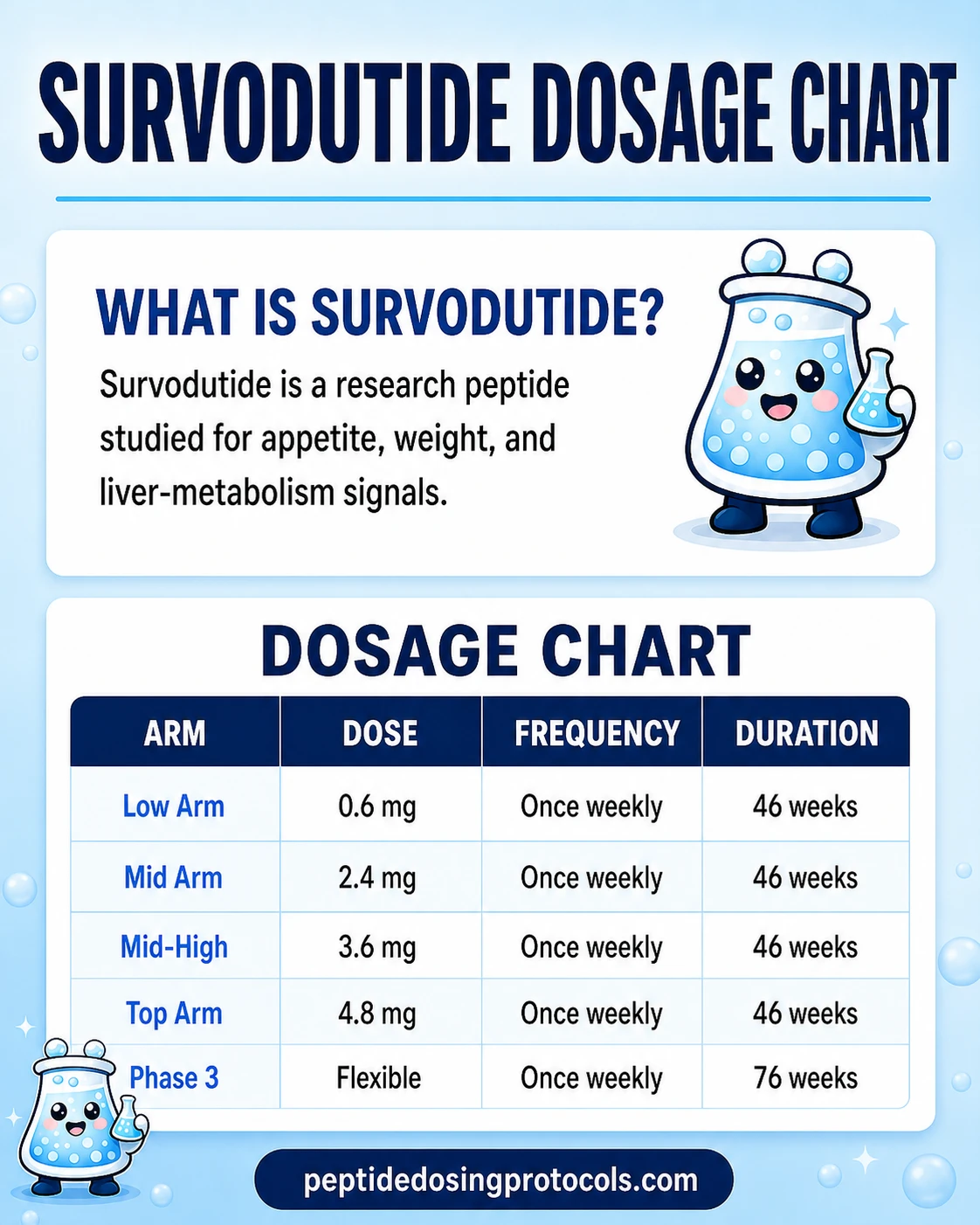
Survodutide Dosage Chart
This Survodutide dosage chart summarizes the Phase 2 and Phase 3 once-weekly trial dose arms shown in the dosing section above.
Survodutide Reconstitution Guide
Research-use Survodutide is usually sold as a dry, freeze-dried powder. Before it can be drawn into a syringe, the powder is mixed with bacteriostatic water (BAC water). The two common research vial sizes are 6 mg and 10 mg. The math below covers both.
Reconstitution math for common Survodutide research vial sizes
Vial size
6 mg
BAC water added
1.0 mL
Concentration
6.0 mg/mL
1 unit (U-100) equals
0.060 mg (60 mcg)
Vial size
6 mg
BAC water added
2.0 mL
Concentration
3.0 mg/mL
1 unit (U-100) equals
0.030 mg (30 mcg)
Vial size
10 mg
BAC water added
1.0 mL
Concentration
10.0 mg/mL
1 unit (U-100) equals
0.100 mg (100 mcg)
Vial size
10 mg
BAC water added
2.0 mL
Concentration
5.0 mg/mL
1 unit (U-100) equals
0.050 mg (50 mcg)
| Vial size | BAC water added | Concentration | 1 unit (U-100) equals |
|---|---|---|---|
| 6 mg | 1.0 mL | 6.0 mg/mL | 0.060 mg (60 mcg) |
| 6 mg | 2.0 mL | 3.0 mg/mL | 0.030 mg (30 mcg) |
| 10 mg | 1.0 mL | 10.0 mg/mL | 0.100 mg (100 mcg) |
| 10 mg | 2.0 mL | 5.0 mg/mL | 0.050 mg (50 mcg) |
Choose a volume that puts your planned weekly dose on an easy-to-read unit mark.
- 01
Wipe the vial top
Use a fresh alcohol swab on the rubber stopper of both the survodutide vial and the BAC water vial.
- 02
Draw BAC water
Use a clean syringe to draw 1.0 to 2.0 mL of bacteriostatic water, depending on the vial size and target concentration.
- 03
Add slowly
Insert the needle and let the water run down the inside wall of the survodutide vial, not directly onto the powder.
- 04
Swirl, do not shake
Gently swirl or roll the vial between your hands until the powder dissolves into a clear solution. Shaking can damage the peptide.
- 05
Inspect
The solution should look clear with no cloudiness or particles. If it looks off, do not use the vial.
- 06
Label and refrigerate
Write the reconstitution date on the vial. Store at 2 to 8 °C (35.6 to 46.4 °F).
- 07
Draw your dose
Use a fresh U-100 insulin syringe for each weekly draw. Match the unit mark to the table above for your chosen concentration.
Need custom vial math?
If your vial size, BAC water volume, or target dose is different, use the calculator for exact unit conversions.
How Survodutide Works
Survodutide acts on two targets at the same time: the GLP-1 receptor and the glucagon receptor. That is why it is grouped with newer obesity peptides like tirzepatide and retatrutide, but it is not the same as either one.
In plain English: GLP-1 may lower appetite and slow how fast food leaves the stomach. Glucagon may raise energy use, meaning the body may burn more calories at rest. Glucagon also acts in the liver, which is why Survodutide is being studied for MASH.
In research papers, Survodutide is called a dual agonist because one peptide molecule turns on both receptors. It also has a fatty-acid tail, similar to semaglutide, which helps it last long enough for once-weekly dosing.
Lowers appetite (GLP-1 arm)
In Phase 2, around 16.6% of survodutide participants reported decreased appetite vs 3.4% on placebo.
Raises energy expenditure (glucagon arm)
Preclinical work showed Survodutide raised energy use in animal models and lowered liver fat.
Targets liver tissue
Glucagon receptors are common in the liver, which is why Survodutide is also being tested in MASH and MASH-cirrhosis trials.
Who Survodutide Is For and Who Should Avoid It
Survodutide is still being studied. It has no FDA-approved use, so there is no official patient label. The list below is based on who was left out of trials and on common GLP-1 drug warnings.
- Pregnancy and breastfeeding: not studied in these groups. Avoid.
- Personal or family history of medullary thyroid cancer or MEN 2: this is a common warning for GLP-1 drugs.
- History of pancreatitis: GLP-1 drugs carry a pancreas inflammation warning.
- Severe stomach or gut disease: nausea, vomiting, diarrhea, and constipation are common with Survodutide.
- Diabetes treated with insulin or sulfonylureas: blood sugar may need close medical adjustment.
- Children and teenagers: no pediatric data exists.
- Known peptide allergies: one Phase 2 participant had angioedema, a serious swelling reaction.
If any of these apply, Survodutide should only be considered inside a formal clinical trial.
Survodutide Side Effects & Safety
Survodutide side effects in trials were mostly stomach and gut related, similar to GLP-1 drugs. Nausea, vomiting, diarrhea, and constipation were most common while the dose was going up, then often improved once the dose stayed steady.
Phase 2 obesity trial reported rates
- Any stomach or gut side effect: 75% on Survodutide vs 42% on placebo.
- Stopped because of side effects: 25% on Survodutide vs 4% on placebo. This was mostly during the fast 20-week dose increase.
- Serious side effects: 4.2% on Survodutide vs 6.5% on placebo.
- Notable single events: one case of dehydration with kidney failure and one case of angioedema, a serious swelling reaction.
Phase 2 MASH trial reported rates
- Nausea: 66% on survodutide vs 23% on placebo.
- Diarrhea: 49% on survodutide vs 23% on placebo.
- Vomiting: 41% on survodutide vs 4% on placebo.
- Stopped because of side effects: 20% on Survodutide vs 3% on placebo. Most were stomach and gut side effects during dose increase.
Phase 3 SYNCHRONIZE-1 safety signal
Boehringer reported that stomach and gut side effects in SYNCHRONIZE-1 were mild to moderate and most common while the dose was going up. No new safety concerns were reported in the topline release. Full safety data is due at ADA 2026 in June.
GLP-1 class cautions
- Pancreatitis: GLP-1 drugs carry a pancreas inflammation warning.
- Medullary thyroid cancer: GLP-1 drugs carry a thyroid cancer warning based on animal data.
- Heart rate: a small heart-rate increase was reported with survodutide.
- Hypoglycemia: higher risk if combined with insulin or sulfonylureas.
Survodutide Timeline & What to Monitor
The timeline below shows when changes were reported in trials. These are research reference points, not personal health targets.
- Weeks 0–20: dose-increase phase in Phase 2. Most stomach and gut side effects appeared during this window.
- Weeks 20–46: steady-dose phase in Phase 2. Weight loss continued and most side effects faded.
- Weeks 46–76: extended exposure in Phase 3 SYNCHRONIZE-1. Average weight loss reached 16.6% at 76 weeks.
- Body composition: Boehringer's initial Phase 3 analysis described most of the weight loss as fat tissue, with only a small share from lean mass. Waist circumference also dropped.
Trial-style tracking often includes weight, waist size, blood pressure, heart rate, fasting glucose, HbA1c for people with diabetes, and basic liver labs. These are research markers, not personal lab orders.
Survodutide Clinical Evidence Context
Survodutide has more human trial data than many research peptides in this class. Published studies include Phase 2 trials for obesity and MASH, a Phase 2 type 2 diabetes trial, and a 2025 meta-analysis. Phase 3 SYNCHRONIZE-1 topline data was released on April 28, 2026, with full data due at ADA 2026 in June.
Phase 3 obesity (SYNCHRONIZE-1)
725 adults, 76 weeks, average 16.6% weight loss vs 3.2% placebo. 85.1% reached ≥5% loss. Topline reported by Boehringer Ingelheim, April 28, 2026.
Phase 2 obesity (Le Roux et al., Lancet Diabetes & Endocrinology, 2024)
387 adults, 46 weeks, with more weight loss at higher weekly doses. The 4.8 mg arm reached around 14.9% loss in the main analysis, or about 18.7% among people who completed the trial.
Phase 2 MASH (NEJM, 2024)
295 adults with MASH and liver scarring. More people on Survodutide improved than on placebo, but stomach and gut side effects were common.
Phase 2 type 2 diabetes (Blüher et al., Diabetologia, 2023)
Compared to placebo and open-label semaglutide. Survodutide reduced HbA1c by ~1.5% versus placebo, comparable to 1.0 mg/week semaglutide.
Systematic review and meta-analysis (PMC, 2025)
A pooled review of randomized Survodutide trials in obesity. It supported the dose-related weight-loss finding and the stomach-and-gut side-effect pattern.
Key gaps: long-term heart outcome data is still missing, head-to-head trials against tirzepatide and retatrutide have not been run, and the LIVERAGE Phase 3 MASH program has not yet reported results.
Survodutide Storage & Handling
Survodutide can be damaged by heat and light. Storage rules are similar to other long-acting GLP-1 peptides.
Survodutide storage temperatures
Form
Dry powder (sealed vial, long-term)
Temperature
-4 °F (-20 °C) or colder
Note
Best for long storage. Keep dark and dry.
Form
Dry powder (short-term)
Temperature
35.6 to 46.4 °F (2 to 8 °C)
Note
Acceptable for short transit and short holds.
Form
Reconstituted (in BAC water)
Temperature
35.6 to 46.4 °F (2 to 8 °C)
Note
Refrigerate. Use within the BAC water shelf window.
Form
Appearance
Temperature
Clear after mixing
Note
Cloudy or particulate solution means stop using it.
| Form | Temperature | Note |
|---|---|---|
| Dry powder (sealed vial, long-term) | -4 °F (-20 °C) or colder | Best for long storage. Keep dark and dry. |
| Dry powder (short-term) | 35.6 to 46.4 °F (2 to 8 °C) | Acceptable for short transit and short holds. |
| Reconstituted (in BAC water) | 35.6 to 46.4 °F (2 to 8 °C) | Refrigerate. Use within the BAC water shelf window. |
| Appearance | Clear after mixing | Cloudy or particulate solution means stop using it. |
Avoid repeated freezing and thawing. Let frozen vials reach room temperature before opening to reduce moisture on the vial.
Survodutide Protocol Mistakes & Troubleshooting
Missed weekly dose
Survodutide remains investigational. In GLP-1-class trial protocols, a missed dose was generally taken only within a short window of the original day; after that window, it was skipped and the next dose occurred on the regular schedule without doubling up. This is trial-protocol reporting, not personal guidance.
The vial looks cloudy after mixing
Stop. Cloudy liquid can mean the peptide broke down, the vial is contaminated, or powder did not fully dissolve. Survodutide should be clear after mixing.
Nausea is severe during escalation
Most people who stopped in Phase 2 did so during the fast 20-week dose increase. Phase 3 SYNCHRONIZE used a slower, more flexible increase, which seemed easier to tolerate.
I added the wrong amount of BAC water
Recalculate the concentration. The vial is now at a different mg/mL, so your unit math also changes. Use the calculator before the next draw.
I forgot to refrigerate the reconstituted vial
If it sat at room temperature for more than a few hours, treat the vial as compromised.
I am trying to compare to retatrutide or tirzepatide
See the comparison section below. These are not interchangeable, the receptor targets are different, and only tirzepatide is FDA-approved among this group.
Survodutide Regulatory Status
As of June 2026, Survodutide is not FDA-approved for any human use. It is still an investigational drug. Boehringer Ingelheim has not yet submitted Survodutide for FDA approval, and more Phase 3 results are still expected during 2026.
Phase 3 status (June 2026): SYNCHRONIZE-1, the obesity trial, reported positive topline results on April 28, 2026. Full data is scheduled for the ADA 2026 Scientific Sessions in June. The LIVERAGE MASH trials are still ongoing, with results expected later in 2026.
FDA designations: Survodutide received FDA Fast Track designation for MASH, formerly called NASH.
Research-use-only market: Survodutide is sold to research labs by some suppliers under research-use-only labels. These products are not regulated as drugs and are not sold as prescription medicine. Quality and purity depend on the supplier.
Status checked June 2026
Regulatory status can change quickly. Confirm current FDA approval and submission status on FDA.gov and on Boehringer Ingelheim's investigator relations page before relying on this paragraph for planning.
Survodutide vs Retatrutide vs Tirzepatide vs Semaglutide
Survodutide is part of a fast-moving group of obesity peptides. They all use GLP-1 in some way, but each one pairs it with a different second or third target.
Dual and multi-receptor obesity peptide comparison (June 2026)
Peptide
Survodutide (BI 456906)
Receptor targets
GLP-1 + Glucagon
Top reported weight loss
16.6% (Phase 3 SYNCHRONIZE-1, 76 weeks)
Route
Subcutaneous, once weekly
FDA status
Investigational
Peptide
Retatrutide
Receptor targets
GLP-1 + GIP + Glucagon (triple)
Top reported weight loss
24.2% (Phase 2, 48 weeks)
Route
Subcutaneous, once weekly
FDA status
Investigational
Peptide
Tirzepatide (Mounjaro / Zepbound)
Receptor targets
GLP-1 + GIP
Top reported weight loss
20.9% (SURMOUNT-1, 72 weeks)
Route
Subcutaneous, once weekly
FDA status
FDA-approved (T2D and obesity)
Peptide
Semaglutide (Ozempic / Wegovy / Rybelsus)
Receptor targets
GLP-1 only
Top reported weight loss
14.9% (STEP 1, 68 weeks)
Route
Subcutaneous, once weekly (oral Rybelsus daily)
FDA status
FDA-approved (T2D and obesity)
Peptide
CagriSema (cagrilintide + semaglutide)
Receptor targets
GLP-1 + Amylin
Top reported weight loss
22.7% (REDEFINE-1 Phase 3)
Route
Subcutaneous, once weekly
FDA status
Investigational
| Peptide | Receptor targets | Top reported weight loss | Route | FDA status |
|---|---|---|---|---|
| Survodutide (BI 456906) | GLP-1 + Glucagon | 16.6% (Phase 3 SYNCHRONIZE-1, 76 weeks) | Subcutaneous, once weekly | Investigational |
| Retatrutide | GLP-1 + GIP + Glucagon (triple) | 24.2% (Phase 2, 48 weeks) | Subcutaneous, once weekly | Investigational |
| Tirzepatide (Mounjaro / Zepbound) | GLP-1 + GIP | 20.9% (SURMOUNT-1, 72 weeks) | Subcutaneous, once weekly | FDA-approved (T2D and obesity) |
| Semaglutide (Ozempic / Wegovy / Rybelsus) | GLP-1 only | 14.9% (STEP 1, 68 weeks) | Subcutaneous, once weekly (oral Rybelsus daily) | FDA-approved (T2D and obesity) |
| CagriSema (cagrilintide + semaglutide) | GLP-1 + Amylin | 22.7% (REDEFINE-1 Phase 3) | Subcutaneous, once weekly | Investigational |
Numbers are from each peptide's primary trial. These are not interchangeable and the side-effect profiles differ. This is not a clinical recommendation.
Key differences in plain English: Survodutide is GLP-1 plus glucagon. Retatrutide is the triple agonist: GLP-1, GIP, and glucagon. Tirzepatide and semaglutide are FDA-approved. CagriSema pairs GLP-1 with amylin instead of glucagon or GIP.
FAQ
Q1: What is Survodutide?
Survodutide is a 29-amino-acid peptide developed by Boehringer Ingelheim with Zealand Pharma. Its research code is BI 456906. It acts on both the GLP-1 receptor and the glucagon receptor, which is why it is called a dual agonist.
Q2: Is Survodutide FDA-approved?
No. As of June 2026, survodutide is investigational and is not FDA-approved for any human use. The Phase 3 SYNCHRONIZE-1 trial reported positive topline results on April 28, 2026, and full data is due at the ADA 2026 Scientific Sessions in June.
Q3: How much weight did people lose with Survodutide?
In the Phase 3 SYNCHRONIZE-1 trial, adults with obesity or overweight without type 2 diabetes lost an average of 16.6% of body weight at 76 weeks, versus 3.2% on placebo. 85.1% of survodutide participants reached at least a 5% weight loss versus 38.8% on placebo.
Q4: How is Survodutide dosed in clinical trials?
The Phase 2 obesity trial used once-weekly subcutaneous arms of 0.6 mg, 2.4 mg, 3.6 mg, or 4.8 mg, with a 20-week dose escalation followed by 26 weeks of maintenance. Phase 3 SYNCHRONIZE-1 used an extended, more flexible escalation. This is trial-protocol reporting, not a dosing recommendation.
Q5: Can I buy Survodutide?
Survodutide is not available by prescription in the United States as of June 2026. Some research suppliers sell it under research-use-only labels, but those products are not regulated as prescription drugs and are not intended for human use. Always confirm current FDA status before drawing conclusions.
Q6: How does Survodutide compare to Retatrutide?
Both are investigational once-weekly subcutaneous peptides. Survodutide targets GLP-1 and glucagon. Retatrutide targets GLP-1, GIP, and glucagon. In headline trials, retatrutide reported higher top-arm weight loss than Survodutide, but the two have not been compared head-to-head.
Q7: How does Survodutide compare to Tirzepatide?
Tirzepatide is GLP-1 plus GIP. Survodutide is GLP-1 plus glucagon. Tirzepatide is FDA-approved for type 2 diabetes (Mounjaro) and for obesity (Zepbound). Survodutide is still investigational. No head-to-head trial has been published.
Q8: What are the main Survodutide side effects?
The most common Survodutide side effects are nausea, vomiting, diarrhea, and constipation. In the Phase 2 obesity trial, around 75% of Survodutide participants reported a stomach or gut side effect versus 42% on placebo. Most happened during the fast 20-week dose increase. Phase 3 SYNCHRONIZE-1 reported mostly mild to moderate stomach and gut side effects with a slower dose increase.
Q9: Who should avoid Survodutide?
Groups that should avoid Survodutide outside a clinical trial include pregnant or breastfeeding people, people with a personal or family history of medullary thyroid cancer or MEN 2, people with pancreatitis history, people with severe stomach or gut disease, children and teenagers, and anyone with known peptide allergies.
Q10: How is Survodutide reconstituted?
For research-use vials, a common approach is to add 1.0 to 2.0 mL of bacteriostatic water per vial. A 6 mg vial with 1.0 mL of BAC water gives 6.0 mg/mL; a 10 mg vial with 1.0 mL gives 10.0 mg/mL. On a U-100 insulin syringe, 1 unit equals 0.01 mL. Swirl gently, do not shake, and refrigerate after mixing.
Q11: What is the LIVERAGE program?
LIVERAGE and LIVERAGE-Cirrhosis are Phase 3 Survodutide trials for MASH, a serious fatty liver disease. They include adults with moderate to advanced liver scarring, including cirrhosis. Results are expected later in 2026.
Q12: Is this page medical advice?
No. This page is an educational research-context reference. Survodutide is not FDA-approved and is not available by prescription. Talk to a qualified clinician before considering any peptide.
Sources & Research
- 1. Boehringer Ingelheim. Results from Phase III SYNCHRONIZE-1 obesity trial (press release, April 28, 2026). Boehringer Ingelheim (2026)
- 2. Le Roux CW, Steen O, Lucas KJ, Startseva E, Unseld A, Hennige AM. Glucagon and GLP-1 receptor dual agonist survodutide for obesity: a randomised, double-blind, placebo-controlled, dose-finding phase 2 trial. The Lancet Diabetes & Endocrinology (2024)
- 3. Sanyal AJ, Bedossa P, Fraessdorf M, et al. A Phase 2 Randomized Trial of Survodutide in MASH and Fibrosis. New England Journal of Medicine (2024)
- 4. Blüher M, Rosenstock J, Hoefler J, Manuel R, Hennige AM. Dose-response effects on HbA1c and bodyweight reductions with a dual glucagon/GLP-1 receptor agonist, survodutide, compared with placebo and open-label semaglutide in people with type 2 diabetes: a randomised clinical trial. Diabetologia (2024)
- 5. Zimmermann T, Thomas L, Baader-Pagler T, et al. BI 456906: Discovery and preclinical pharmacology of a novel GCGR/GLP-1R dual agonist with robust anti-obesity efficacy. Molecular Metabolism (2022)
- 6. Authors et al. Evaluating the efficacy and safety of survodutide for obesity: a systematic review and meta-analysis of randomized controlled trials. PMC (peer-reviewed meta-analysis) (2025)
- 7. Mikhail N, Wali S. Survodutide, a promising agent with novel mechanism of action for treatment of obesity and type 2 diabetes. Journal of Endocrinology and Disorders (2024)
- 8. ClinicalTrials.gov. A Study to Test How Well Different Doses of BI 456906 Help People With Overweight or Obesity Lose Weight (NCT04667377, Phase 2). ClinicalTrials.gov (2024)
- 9. ClinicalTrials.gov. A Study to Test Whether Survodutide (BI 456906) Helps People Living With Overweight or Obesity Lose Weight (SYNCHRONIZE-1, NCT06066529). ClinicalTrials.gov (2026)
- 10. U.S. Food and Drug Administration. Drugs@FDA: search for survodutide approval status (no approved product as of June 2026). FDA.gov (2026)
Related Dosing Protocols
Educational use only
This guide is an educational research reference, not medical advice or a treatment plan. Survodutide is investigational and not FDA-approved for human use as of June 2026.
Calculate vial math
Use the calculator for custom vial size, BAC-water volume, and syringe-unit math.

Written by Garret Grant
Founder & Lead Researcher · B.S. Civil Engineering, UCLA
Last updated: August 2026
Human-researched and AI-assisted with full editorial review. I verify sources, protocol interpretation, and final judgments personally. See methodology.
Share this page