Epitalon Quick Start
Epitalon, also spelled epithalon, is a small peptide made of four amino acids in a row: Ala-Glu-Asp-Gly. You may also see it written as AEDG. A peptide is just a short chain of amino acids, the same building blocks that make protein.
Researchers study epitalon mostly for aging. The two areas that get the most attention are telomeres (protective caps on the ends of your DNA) and the body clock that controls sleep and melatonin. This page covers the reported dosing context, how the vial is mixed, supplies, and safety. For a broader benefits and evidence overview, read the Epitalon guide on Peptide Advisors.
Reconstitute
Add 2.0 mL BAC water to a 10 mg vial. That gives 5 mg/mL.
Reported schedule
Short cycles: about 5-10 mg/day for 10-20 days, 1-2 times a year.
Easy measuring
On a 5 mg/mL mix, 5 mg equals 1.0 mL, which is 100 units on a U-100 syringe.
Timing
Many reported protocols use evening dosing to line up with the natural melatonin rhythm.
Research status
Not FDA-approved. Sold research-use-only as of June 2026.
Educational research reference
This page reports dosing context from published research and community protocols. It is not medical advice, a treatment plan, or a recommendation to use epitalon.
Epitalon Dosing Protocol & Schedule
Epitalon dosing is unusual because the cycles are short and spaced far apart. Most peptides are dosed for weeks or months. Reported epitalon protocols instead use a short burst, then a long break.
Two reported patterns show up most often in the literature and in community protocols. Both deliver a similar total dose per cycle. The numbers below describe what has been reported, not a personal recommendation.
Two commonly reported epitalon cycle patterns
Pattern
Standard short cycle
Daily amount
5 mg/day (evening, SubQ)
Days on
20 days
Repeat
2-3 times per year
Pattern
Condensed cycle
Daily amount
10 mg/day (evening, SubQ)
Days on
10 days
Repeat
2-3 times per year
| Pattern | Daily amount | Days on | Repeat |
|---|---|---|---|
| Standard short cycle | 5 mg/day (evening, SubQ) | 20 days | 2-3 times per year |
| Condensed cycle | 10 mg/day (evening, SubQ) | 10 days | 2-3 times per year |
Both patterns add up to roughly 100 mg per cycle. Reported protocols space cycles 4-6 months apart. Higher single doses (up to ~50 mg/day in some animal-era work) have not shown clearer results in the available research.
Route matters here. Almost all reported protocols use a subcutaneous (SubQ) injection, meaning a small injection into the fat layer just under the skin. Some community sources mention an intranasal spray version, but that route is far less studied and dosing equivalence is unclear.
Evidence boundary
There is no large, blinded human trial that tested a specific epitalon injection dose against placebo for telomere length. The schedules above come from older Russian research programs and self-reported community use, not from a modern FDA-style dosing trial.
Epitalon Supplies Needed
Supply math below is based on the standard reported schedule: 5 mg per day from a 10 mg vial reconstituted with 2.0 mL BAC water, for a 20-day cycle. One 10 mg vial covers two daily doses, so a 20-day cycle uses about 10 vials.
Recommended U.S. and Canada Supply
Choose your region
Use discount code SAVE10 at Peptira checkout. See why we love Peptira.
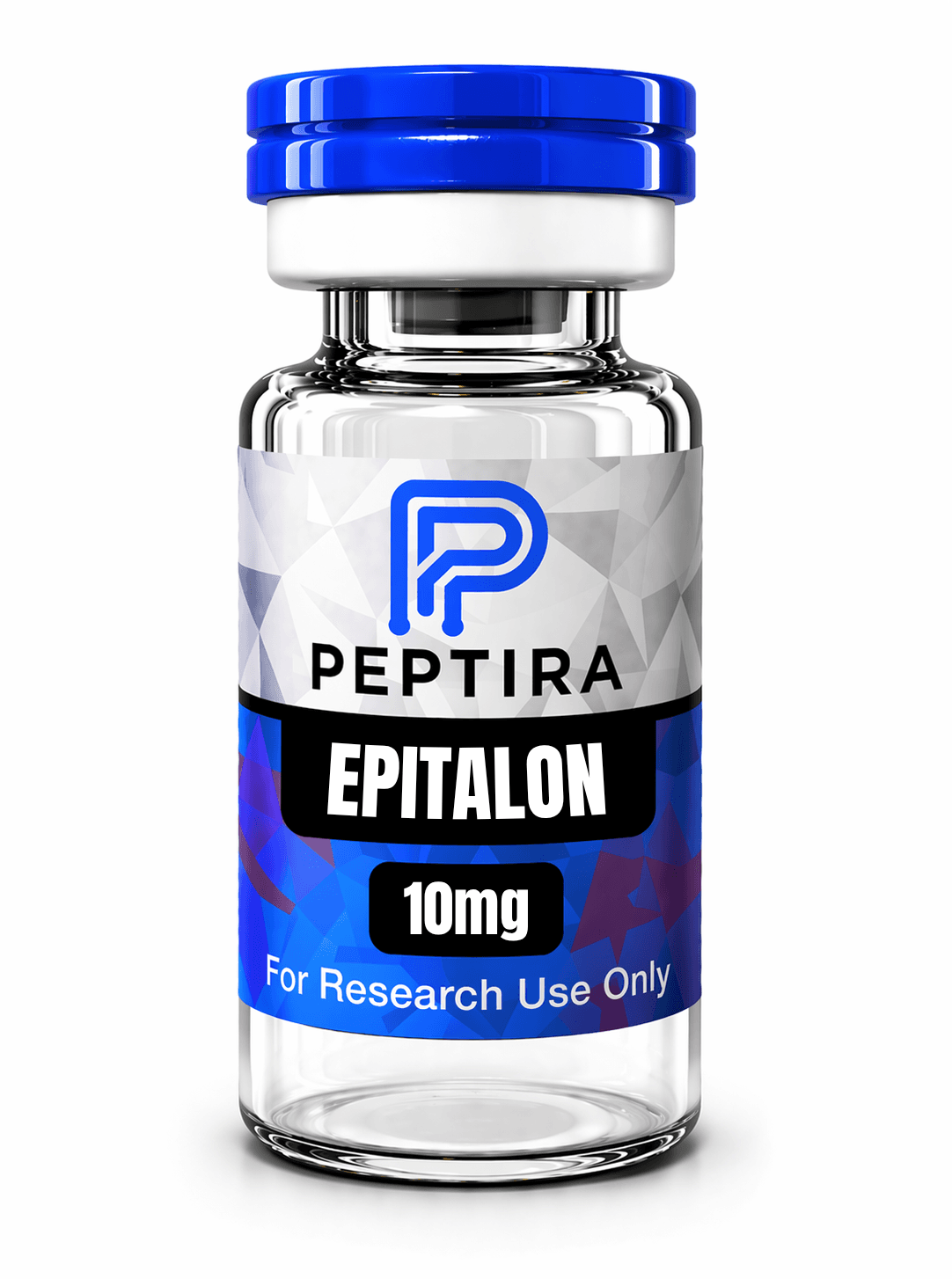
Epitalon
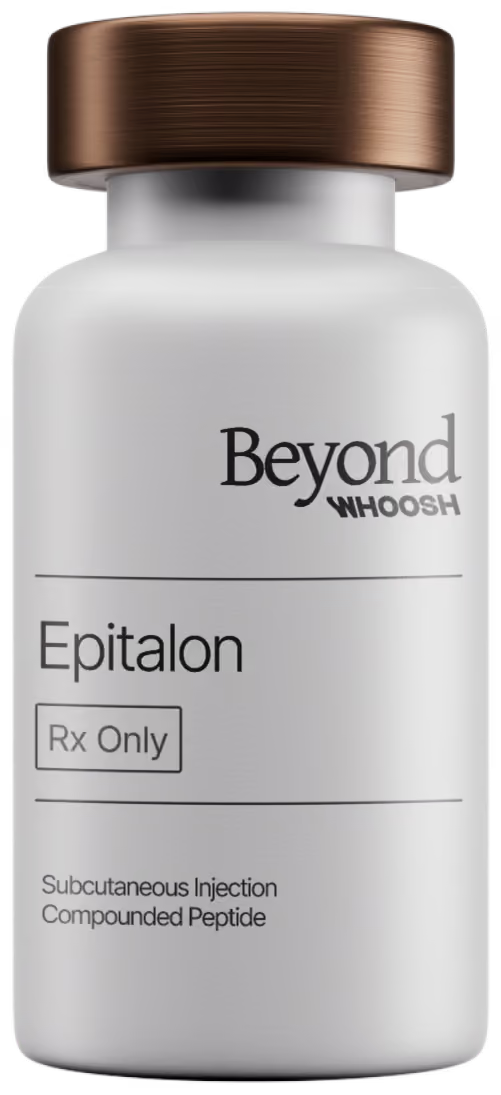
Pharmacy Grade Epitalon
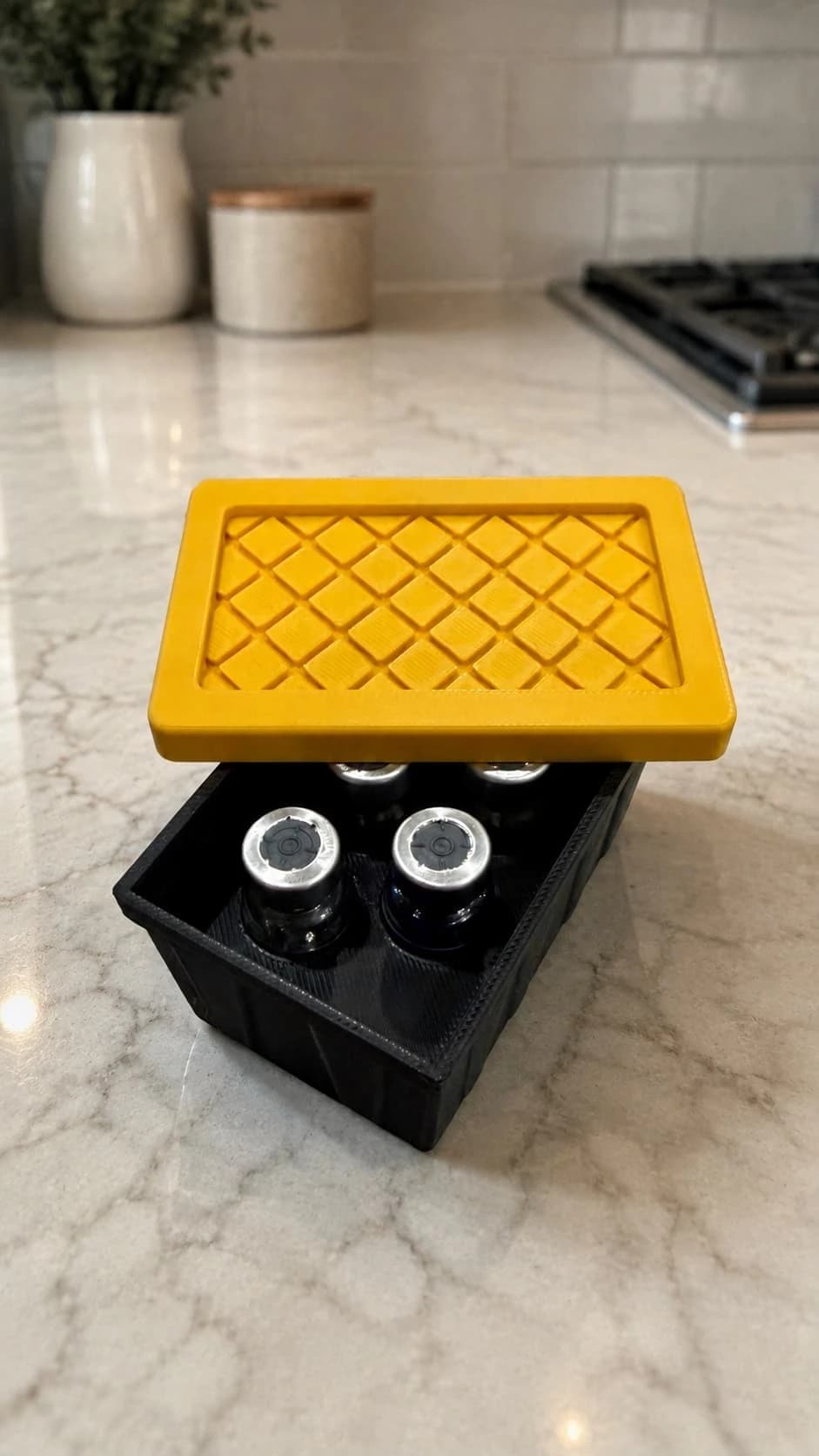
5-Vial Tote Case
At-Home Blood Test
Research Supplies
Disclosure: supply links may earn PDP a commission at no cost to you.
Peptide Vials (10 mg)
Based on 5 mg/day. A 10 mg vial covers 2 daily doses. 50 mg vials cover 10 doses each, so a full 20-day cycle is 2 of the 50 mg size instead.
| Cycle length | Planning note |
|---|---|
10-day cycle 5 x 10 mg vials | 10 doses at 5 mg/day. |
20-day cycle 10 x 10 mg vials | 20 doses at 5 mg/day. |
10-day cycle
5 x 10 mg vials
10 doses at 5 mg/day.
20-day cycle
10 x 10 mg vials
20 doses at 5 mg/day.
Insulin Syringes (U-100)
One syringe per daily injection. Prefer 1 mL / 100-unit syringes since a 5 mg dose is a full 1.0 mL draw.
| Cycle length | Planning note |
|---|---|
10-day cycle 10 syringes | 1 per day. |
20-day cycle 20 syringes | 1 per day. |
10-day cycle
10 syringes
1 per day.
20-day cycle
20 syringes
1 per day.
Bacteriostatic Water
Use 2.0 mL per 10 mg vial.
| Cycle length | Planning note |
|---|---|
10-day cycle 1 x 10 mL bottle | 5 vials use 10 mL total. |
20-day cycle 2 x 10 mL bottles | 10 vials use 20 mL total. |
10-day cycle
1 x 10 mL bottle
5 vials use 10 mL total.
20-day cycle
2 x 10 mL bottles
10 vials use 20 mL total.
Round up for priming losses, dropped syringes, and damaged swabs. If you use 50 mg vials, you need fewer vials but more BAC water per vial — recheck the math for your exact vial size with the calculator.
Companion Supplies & Routine Support
Epitalon Reconstitution Calculator

Powered by PepPal
Epitalon Reconstitution Calculator
Start with the protocol example, then customize every field.
Loaded reference
PDP reported-schedule example
Your draw
100units
1 mL on a U-100 insulin syringe
- Concentration
- 5 mg/mL
- Target in mg
- 5 mg
- Math-only doses per vial
- 2
One free emailed save per person, checked by PepPal.
Educational calculation tool only. The loaded amount is a reference from this page, not a personal dose recommendation. Confirm the vial label, route, syringe type, and actual liquid added before relying on a result.
Epitalon Dosage Chart
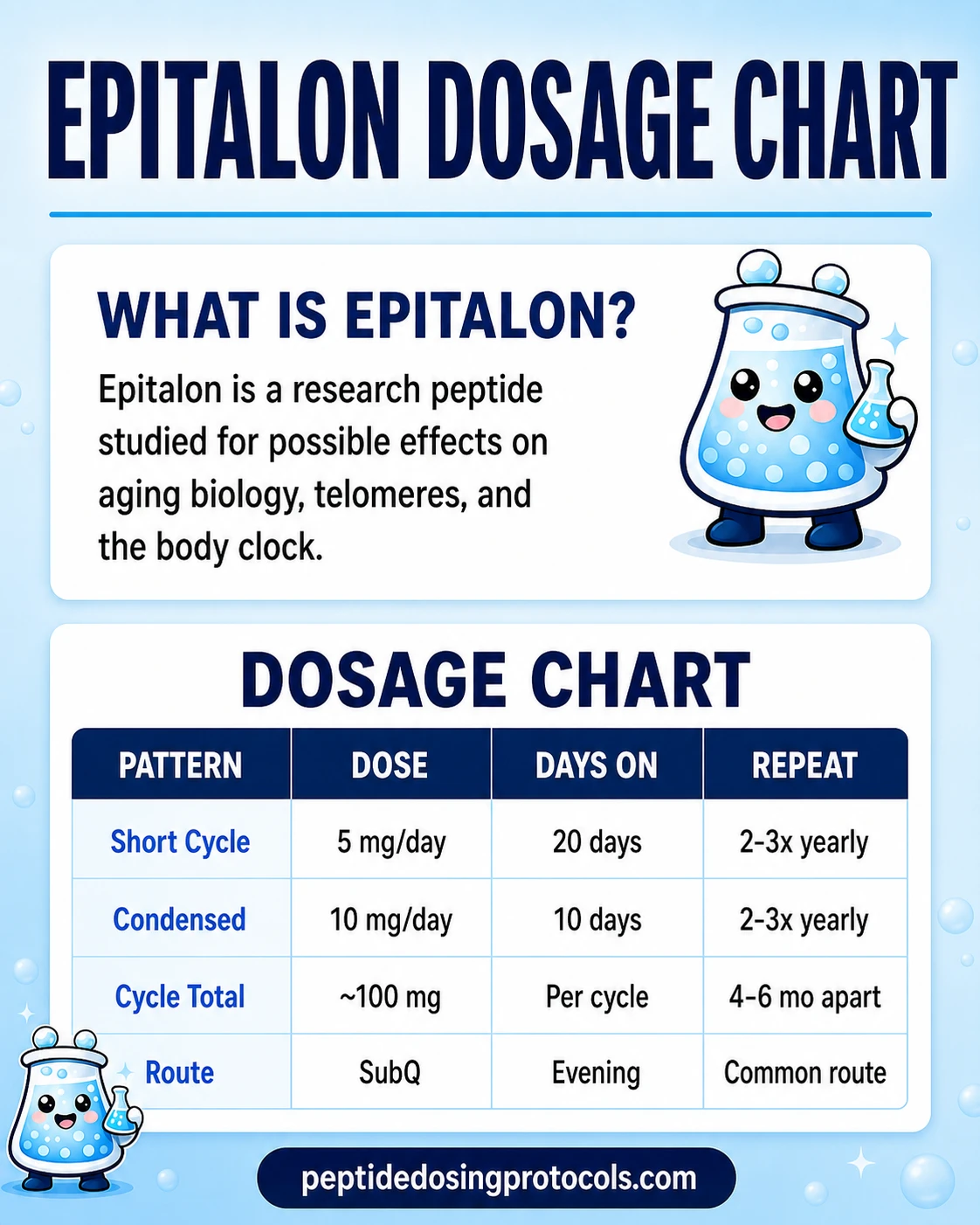
This Epitalon dosage chart summarizes the reported short-cycle patterns from 5 mg to 10 mg daily shown in the dosing section above.
Epitalon Reconstitution Guide
Reconstitution means adding liquid to the dry powder so you can measure and inject it. Epitalon ships as a dry, freeze-dried powder. You add bacteriostatic water (BAC water), which is sterile water with a tiny amount of preservative.
The mix you choose sets your concentration, which is how much peptide is in each milliliter. A simple, common mix is shown below for both popular vial sizes.
Epitalon reconstitution math (U-100 syringe)
Vial size
10 mg
BAC water added
2.0 mL
Concentration
5 mg/mL
5 mg dose
1.0 mL = 100 units
10 mg dose
Whole vial
Vial size
50 mg
BAC water added
5.0 mL
Concentration
10 mg/mL
5 mg dose
0.5 mL = 50 units
10 mg dose
1.0 mL = 100 units
| Vial size | BAC water added | Concentration | 5 mg dose | 10 mg dose |
|---|---|---|---|---|
| 10 mg | 2.0 mL | 5 mg/mL | 1.0 mL = 100 units | Whole vial |
| 50 mg | 5.0 mL | 10 mg/mL | 0.5 mL = 50 units | 1.0 mL = 100 units |
These are two clean, easy-to-measure mixes. Other volumes work too; the calculator handles any vial size and target dose.
- 01
Wipe both stoppers
Swab the BAC water vial and the peptide vial tops with alcohol.
- 02
Draw the water
Draw your planned BAC water volume into a syringe (for example, 2.0 mL for a 10 mg vial).
- 03
Add it slowly
Aim the water down the inside wall of the vial. Do not spray it onto the powder.
- 04
Swirl, do not shake
Gently roll or swirl until the powder fully dissolves. Shaking can damage the peptide.
- 05
Check the liquid
It should look clear. If it stays cloudy or has floaters, do not use it.
- 06
Label it
Write the date and concentration on the vial.
- 07
Refrigerate
Store at 2-8 C (35.6-46.4 F), away from light, and use within about 1-2 weeks.
Let the calculator do the math
For any other vial size, like a 50 mg vial or a different target dose, use the calculator to get exact BAC water volume and syringe units.
How Epitalon Is Thought to Work
In plain terms, epitalon is studied because it may help cells keep their DNA caps longer and may help reset the body clock. Those are two separate ideas, and they have different levels of proof.
The first idea is telomeres. Every time a cell divides, the telomere caps on its DNA get a little shorter. An enzyme called telomerase can add length back, but most adult cells keep telomerase switched off. In lab dishes using human cells, epitalon increased telomerase activity and let cells divide more times than usual (Khavinson et al., Bull Exp Biol Med, 2003).
The second idea is the pineal gland, a small gland in the brain that releases melatonin and helps run your sleep-wake cycle. Epitalon was built from a pineal extract called epithalamin. The melatonin evidence is mixed: it improved melatonin rhythm in some animal and human extract studies, but at least one rat study found no melatonin effect from the synthetic peptide.
What is and is not proven
The telomerase effect is mostly from cell and animal studies. There is no large, blinded human trial proving that injected synthetic epitalon lengthens telomeres or extends human lifespan.
Who Should Be Most Cautious
Because epitalon is not approved and has thin human safety data, several groups have the most reason to avoid it. This is general research context, not medical screening.
- Anyone who is pregnant or breastfeeding — there is no safety data for these groups.
- Anyone with an active cancer or a recent cancer history — telomerase activation is theoretical risk territory and has not been cleared as safe in people.
- Anyone on prescription medications without first talking to a qualified clinician, since interactions are not well studied.
- Anyone who cannot verify product quality with a current certificate of analysis (COA).
Talk to a clinician
A qualified clinician is the right person to weigh personal risk. This page cannot do that for you.
Epitalon Side Effects & Safety
Reported side effects are usually mild in the available literature and community reports. The most common are the ordinary issues that come with any injection.
- Injection-site reactions: redness, soreness, or a small bump where the needle went in.
- Mild drowsiness, especially with evening dosing, since the peptide is tied to melatonin signaling.
- Occasional reports of headache or temporary changes in sleep as the cycle starts.
The bigger safety gaps are about the unknowns, not the known side effects. Long-term human safety data are limited, and the telomerase question matters here too. In theory, switching telomerase on could affect cells you would not want dividing more, which is why people with cancer history are flagged as cautious cases.
Product quality is its own risk. Research-grade peptides are not made to pharmacy standards, so purity and sterility depend on the supplier. A current COA that matches the exact batch is the main way to check quality.
What People Report Over a Cycle
Because the human research is limited, timeline notes come mostly from self-reported community use, not from controlled trials. Treat them as anecdote, not proof.
- Sleep changes are the effect people mention earliest, often within the first several days of a cycle.
- Any telomere or aging-marker change would be slow and is not something you can feel; it would only show up on lab testing over a long period.
- Reported protocols repeat short cycles a couple of times a year rather than dosing continuously.
There are no standard required lab markers for epitalon. Some longevity researchers track telomere length or biological-age panels, but these tests are costly and their day-to-day value is debated.
Epitalon Clinical Evidence Context
Here is the part most guides get muddy. There are two related things, and they do not have the same proof. One is epithalamin, the natural pineal extract. The other is epitalon (AEDG), the synthetic four-amino-acid copy.
Human extract program (strongest human signal)
A long-running, non-blinded program in elderly subjects reported lower mortality with epithalamin, and lower still when combined with the thymic peptide thymalin (Khavinson, Neuroendocrinology Letters, 2003; Korkushko et al., Bull Exp Biol Med, 2006). A 12-year study reported 28% lower mortality and 2-fold lower cardiovascular mortality in treated elderly patients.
Human melatonin rhythm (extract)
Korkushko et al. (2004) reported improved circadian melatonin rhythm in elderly people given the pineal extract.
Human cells, in vitro (synthetic epitalon)
Khavinson et al. (2003) reported that epitalon raised telomerase activity and extended the dividing lifespan of human fibroblasts past the usual limit. A 2025 independent study in Biogerontology reported telomere lengthening in human cell lines, supporting the mechanism outside the original lab.
Animal lifespan and tumor data (preclinical)
Anisimov and colleagues reported extended lifespan and lower spontaneous tumor rates in mice. These are animal findings and do not prove a human anti-cancer benefit.
Single human case report
A 2023 case report described one person who self-administered epitalon and showed improved telomere and biological-age markers. A single case cannot prove an effect.
The honest summary
The best human longevity numbers come from the extract (epithalamin), often combined with another peptide, in studies that were not blinded. The synthetic-epitalon telomere data are mostly from cells and animals. No double-blind human RCT has confirmed that injected synthetic epitalon extends human lifespan.
Epitalon Storage & Handling
Epitalon storage
State
Lyophilized (powder)
Temperature
-4 F (-20 C) long-term
Notes
Keep dry and away from light.
State
Reconstituted (liquid)
Temperature
35.6-46.4 F (2-8 C)
Notes
Use within about 1-2 weeks.
State
Appearance
Temperature
Clear after mixing
Notes
Discard if cloudy or with particles.
| State | Temperature | Notes |
|---|---|---|
| Lyophilized (powder) | -4 F (-20 C) long-term | Keep dry and away from light. |
| Reconstituted (liquid) | 35.6-46.4 F (2-8 C) | Use within about 1-2 weeks. |
| Appearance | Clear after mixing | Discard if cloudy or with particles. |
Avoid repeated freeze-thaw cycles of the reconstituted vial.
Common Epitalon Mistakes
- Shaking the vial hard instead of swirling — this can break the peptide. Roll it gently.
- Cloudy or speckled liquid after mixing — do not use it; sterility or quality may be off.
- Wrong concentration math — a 10 mg vial in 2.0 mL is 5 mg/mL, so 5 mg is a full 1.0 mL (100 units), not 0.1 mL.
- Confusing the 10 mg and 50 mg vials — the BAC water volume and units per dose are different. Recheck with the calculator.
- Dosing in the morning when a protocol called for evening — timing is tied to the melatonin rhythm in most reported schedules.
Epitalon Regulatory Status
As of June 2026, epitalon is not approved by the FDA for any medical use. It is sold as a research-use-only chemical, which means it is not made or labeled for human use.
Epitalon is also not a dietary supplement and is not an approved medicine in the United States. The longevity research behind it comes largely from Russia and Ukraine. Western regulators have not reviewed or cleared it.
Research-use-only
Buying a product labeled research-use-only does not make it legal or safe to use in people. Verify current rules and product quality before doing anything.
Epitalon vs Other Longevity Peptides
Epitalon sits in the longevity peptide group, but it works on a different target than its neighbors. A quick contrast helps set expectations.
How epitalon compares
Compound
Epitalon
Main idea
Telomere and body-clock aging
Evidence base
Human cells + animals; non-blinded human extract data
Compound
MOTs-C
Main idea
Mitochondrial and metabolic aging
Evidence base
Mostly preclinical, growing interest
Compound
NAD+
Main idea
Cellular energy and repair
Evidence base
Preclinical plus early human work
| Compound | Main idea | Evidence base |
|---|---|---|
| Epitalon | Telomere and body-clock aging | Human cells + animals; non-blinded human extract data |
| MOTs-C | Mitochondrial and metabolic aging | Mostly preclinical, growing interest |
| NAD+ | Cellular energy and repair | Preclinical plus early human work |
These are not interchangeable. They target different parts of aging biology.
FAQ
Q1: What is epitalon and what is it used for?
Epitalon (also spelled epithalon, or AEDG) is a synthetic four-amino-acid peptide built from a pineal-gland extract. In research it is studied for aging, mainly for its effect on telomeres and the sleep-melatonin cycle. It is not FDA-approved and is sold for research use only.
Q2: What does epitalon do?
In lab studies on human cells, epitalon raised telomerase activity and let cells divide more times than usual. In animals it has been linked to longer lifespan. The strongest human data come from the related pineal extract, not the synthetic peptide, and come from non-blinded studies, so the human picture is still limited.
Q3: How is epitalon commonly dosed in research?
Reported protocols are short and spaced out. A common pattern is about 5 mg per day by subcutaneous injection for 20 days, or 10 mg per day for 10 days, repeated two to three times a year. This describes what has been reported in research and community sources, not a personal recommendation.
Q4: How do you reconstitute epitalon?
A simple mix for a 10 mg vial is 2.0 mL of bacteriostatic water, which gives 5 mg/mL. On that mix, a 5 mg dose is 1.0 mL, or 100 units on a U-100 syringe. For a 50 mg vial, 5.0 mL of BAC water gives 10 mg/mL. Use the calculator for any other vial size.
Q5: How do you reconstitute a 50 mg epitalon vial?
Adding 5.0 mL of bacteriostatic water to a 50 mg vial gives a 10 mg/mL concentration. On that mix, a 5 mg dose is 0.5 mL (50 units) and a 10 mg dose is 1.0 mL (100 units). Swirl gently, do not shake, and refrigerate after mixing.
Q6: When should epitalon be taken, and where is it injected?
Most reported protocols use evening or bedtime dosing to line up with the natural melatonin rhythm. The common route is a subcutaneous injection into the fat under the skin, with sites like the abdomen or thigh rotated each day to avoid irritation.
Q7: What is the half-life of epitalon?
Epitalon clears the bloodstream very quickly, on the order of minutes, which is typical for tiny peptides. Researchers think its effects last longer than its time in the blood because it may act on gene activity rather than staying in circulation. This is one reason short, repeated cycles are reported.
Q8: What are the side effects of epitalon?
Reported side effects are usually mild and injection-related, like redness or soreness at the site, and sometimes mild drowsiness with evening dosing. The larger concern is the unknowns: long-term human safety data are limited, and people with a cancer history are flagged as cautious cases because of the telomerase question.
Q9: Is epitalon FDA-approved?
No. As of June 2026, epitalon is not FDA-approved for any use and is not a dietary supplement. It is sold as a research-use-only chemical, which is not made or labeled for human use.
Q10: Is this page medical advice?
No. This is an educational research reference. It reports dosing context, reconstitution math, and evidence, but it is not a treatment plan. Talk to a qualified clinician about any personal health decision.
Sources & Research
- 1. Khavinson VKh, Bondarev IE, Butyugov AA Epithalon peptide induces telomerase activity and telomere elongation in human somatic cells. Bulletin of Experimental Biology and Medicine (2003)
- 2. Korkushko OV, Khavinson VKh, Shatilo VB, Antonyuk-Shcheglova IA Geroprotective effect of epithalamine (pineal gland peptide preparation) in elderly subjects with accelerated aging. Bulletin of Experimental Biology and Medicine (2006)
- 3. Khavinson VKh, et al. Effects of long-term peptide bioregulator administration on mortality in elderly subjects (clinical program). Neuroendocrinology Letters (2003)
- 4. Korkushko OV, Khavinson VKh, Shatilo VB, Magdich LV Effect of peptide preparation epithalamin on circadian rhythm of pineal melatonin function in elderly people. Bulletin of Experimental Biology and Medicine (2004)
- 5. Anisimov VN, Khavinson VKh, et al. Effect of Epitalon on biomarkers of aging, life span and spontaneous tumor incidence in female SHR mice. Biogerontology (2003)
- 6. Khavinson V, Goncharova N, Lapin B Synthetic tetrapeptide epitalon restores disturbed neuroendocrine regulation in senescent monkeys. Neuroendocrinology Letters (2001)
- 7. Al-Dulaimi T, et al. Epitalon increases telomere length in human cell lines through telomerase upregulation or ALT activity. Biogerontology (2025)
- 8. Cognitive Vitality, Alzheimer's Drug Discovery Foundation Epithalamin and Epithalon: research assessment of evidence and safety. Alzheimer's Drug Discovery Foundation (2021)
- 9. U.S. Food and Drug Administration Epitalon regulatory status: not an FDA-approved drug; research-use context. FDA.gov (2026)
Related Dosing Protocols
Educational use only
This guide is an educational research reference, not medical advice or a treatment plan. Epitalon is not FDA-approved and is sold for research use only.
Calculate vial math
Use the calculator for custom vial size, BAC-water volume, and syringe-unit math.

Written by Garret Grant
Founder & Lead Researcher · B.S. Civil Engineering, UCLA
Last updated: October 2026
Human-researched and AI-assisted with full editorial review. I verify sources, protocol interpretation, and final judgments personally. See methodology.
Share this page