

SS-31 Quick Start
SS-31 is a synthetic four-amino-acid peptide. It moves into the inner mitochondrial membrane and binds a phospholipid called cardiolipin, which is the structural scaffold the mitochondria use to pack their energy-making machinery. By binding cardiolipin, SS-31 helps stabilize that scaffold under stress.
SS-31 has three different names you will see online. The research code is SS-31 (also written SS31 or ss 31). The generic drug name is elamipretide. The FDA-approved brand name is FORZINITY, marketed by Stealth BioTherapeutics. Earlier development codes were MTP-131 and Bendavia.
Two very different real-world contexts
- Forzinity (FDA-approved drug): A prescription product approved on September 19, 2025 under accelerated approval to improve muscle strength in adult and pediatric patients with Barth syndrome who weigh at least 30 kg. Comes as a 280 mg / 3.5 mL (80 mg/mL) ready-to-use solution. Dosing, storage, and labeling are set by the FDA-approved package insert.
- Research-use SS-31 vials: Lyophilized peptide sold by research suppliers, usually in 10 mg, 40 mg, or 50 mg vials, intended for laboratory research. These are not FDA-approved medicines and have no human-use indication.
Route
Subcutaneous injection. The Forzinity label and TAZPOWER trial both used daily subcutaneous dosing.
Trial-context dose
40 mg subcutaneously once daily was the studied arm and is now the Forzinity recommended dose for patients ≥30 kg. Not a personal-use recommendation.
Frequency
Once daily, same time each day per Forzinity label.
Supplies (research-use vial)
Insulin syringes, alcohol swabs, bacteriostatic water if reconstitution is part of the protocol.
Research status
FDA-approved for Barth syndrome only. All other uses are investigational or research-use only.
Educational reference only
This page is not medical advice, a treatment protocol, or a prescription. Information about Forzinity (elamipretide) reflects the FDA-approved label as of June 2026 and is reported only as label information, not as a recommendation.
Peptide Dosing Protocols reports trial-context and FDA-label dosing for educational reference only. We do not publish dosing or cycle instructions for healthy-adult use of SS-31, because no such use has been studied in a published human trial.
SS-31 Dosing Protocol & Schedule
Dosing information for SS-31 comes from two distinct contexts. The first is the FDA-approved Forzinity label for Barth syndrome. The second is the TAZPOWER clinical trial, which is the published Phase 2/3 study Forzinity was approved on. Both used the same daily 40 mg subcutaneous dose. This is not a dosing recommendation.
SS-31 Dosing Reference Tabs
Choose the source you are researching to see the matching label or trial-context information.
The current FDA-approved Barth-syndrome label as of June 2026. Reported here as label information only.
Indication. Forzinity is approved to improve muscle strength in adult and pediatric patients with Barth syndrome weighing at least 30 kg. Approval is accelerated and based on improvement in knee extensor muscle strength, an intermediate clinical endpoint. Continued approval may be contingent on a confirmatory trial.
Forzinity recommended dosage (per FDA label)
Population
Patients ≥30 kg
Dose
40 mg
Route
Subcutaneous, once daily
Notes
Same time each day. Skip a missed dose; do not double up.
Population
Adults with severe renal impairment (eGFR <30 mL/min, not on dialysis)
Dose
20 mg
Route
Subcutaneous, once daily
Notes
Per FDA label dose adjustment.
Population
Adults with eGFR <30 mL/min and on dialysis
Dose
Not defined
Route
—
Notes
Insufficient information for a dosing regimen per label.
Population
Patients <30 kg
Dose
Not approved
Route
—
Notes
Safety and effectiveness not established.
| Population | Dose | Route | Notes |
|---|---|---|---|
| Patients ≥30 kg | 40 mg | Subcutaneous, once daily | Same time each day. Skip a missed dose; do not double up. |
| Adults with severe renal impairment (eGFR <30 mL/min, not on dialysis) | 20 mg | Subcutaneous, once daily | Per FDA label dose adjustment. |
| Adults with eGFR <30 mL/min and on dialysis | Not defined | — | Insufficient information for a dosing regimen per label. |
| Patients <30 kg | Not approved | — | Safety and effectiveness not established. |
Source: FORZINITY (elamipretide) injection prescribing information, initial U.S. approval 2025. This is not a dosing recommendation.
Product form. Forzinity is supplied as a 280 mg / 3.5 mL (80 mg/mL) ready-to-use single-patient-use vial. It is not a lyophilized research-use vial and does not require reconstitution. After first use, the vial is discarded after 8 days per label.
Why this matters
If you have seen 'SS-31 protocol' content online that lists a 40 mg subcutaneous daily dose, that number traces back to TAZPOWER and the Forzinity label, both of which studied Barth syndrome — not anti-aging, athletic performance, or healthy-adult use.
Reported study arms from the TAZPOWER Phase 2/3 trial. Educational reference only.
TAZPOWER (NCT03098797) was a randomized, double-blind, placebo-controlled, crossover trial in 12 male patients ages 12–35 with genetically confirmed Barth syndrome and body weight >30 kg, followed by an open-label extension that ran up to 168 weeks.
TAZPOWER study arms
Phase
Randomized crossover
Arm
Elamipretide
Dose
40 mg SC daily
Duration
12 weeks per period, with 4-week washout
Phase
Randomized crossover
Arm
Placebo
Dose
—
Duration
12 weeks per period
Phase
Open-label extension
Arm
All remaining patients on elamipretide
Dose
40 mg SC daily
Duration
Up to 168 weeks
| Phase | Arm | Dose | Duration |
|---|---|---|---|
| Randomized crossover | Elamipretide | 40 mg SC daily | 12 weeks per period, with 4-week washout |
| Randomized crossover | Placebo | — | 12 weeks per period |
| Open-label extension | All remaining patients on elamipretide | 40 mg SC daily | Up to 168 weeks |
Reported in Genetics in Medicine, 2024. This is not a dosing recommendation.
Endpoints. During the 12-week crossover period, elamipretide did not reach statistical significance vs. placebo on the two co-primary endpoints (6-minute walk distance and BTHS-SA total fatigue score). In the open-label extension, the 6-minute walk test improved from open-label baseline by a cumulative 96.1 meters at week 168 (P = .003), and knee extensor muscle strength improved — the latter being the endpoint FDA cited for accelerated approval.
Why community dosing differs. Some research-use community write-ups discuss SS-31 doses well below 40 mg/day (such as 5–10 mg/day). These figures are not from a published human trial in healthy adults and are not endorsed here. The only published human-trial dose for SS-31 in Barth syndrome is 40 mg/day SC.
Anecdotal research-use ranges discussed in peptide forums and community-facing protocol pages. Not clinical evidence.
Anecdotal only
These ranges summarize what fitness, longevity, and peptide-research communities report using. They are not validated protocols, not FDA-label dosing, and not a PDP recommendation. Published human SS-31 evidence does not establish an anti-aging, athletic-performance, or healthy-adult dose.
Across community-facing SS-31 pages and public forum reports, the most repeated non-clinical pattern is low milligram daily dosing, usually far below the 40 mg/day Barth-syndrome label and trial dose. Reports cluster around 1-5 mg/day for anti-aging or general mitochondrial support, 5-10 mg/day as a common guide-page range, and 10-20 mg/day for performance-oriented discussions. Some users report lower micro-style starts, while occasional high-dose anecdotes exist but are outliers.
Community-reported SS-31 ranges
Community pattern
Micro / sensitivity start
Reported dose
0.1-1 mg
Frequency / duration
Daily or several times weekly
Context and caveats
Seen in forum anecdotes from cautious or sensitive users. Effects and meaningfulness are uncertain; some commenters question whether very low dosing is active.
Community pattern
Low-dose maintenance
Reported dose
0.5-1 mg
Frequency / duration
3-5x/week for 8-12 weeks with breaks
Context and caveats
Reported by community-protocol aggregators as a niche long-term mitochondrial-support pattern. Anecdotal only.
Community pattern
Common anti-aging / mitochondrial support
Reported dose
1-5 mg
Frequency / duration
Once daily for 4-8 weeks
Context and caveats
Most consistent community-report cluster from forum aggregation and Reddit-style experience threads. Still far below clinical 40 mg/day dosing and not validated in healthy adults.
Community pattern
Guide-page standard range
Reported dose
5-10 mg
Frequency / duration
Once daily, often morning
Context and caveats
Repeated by community-facing protocol sites as a general research-use range. Some pages position this as a starting or standard range, but without controlled healthy-adult evidence.
Community pattern
Performance-oriented reports
Reported dose
10-20 mg
Frequency / duration
Once daily or pre-workout; often 4-12 weeks
Context and caveats
Appears on community protocol pages and some forum reports for athletic-performance framing. This is more expensive, higher volume, and still not clinically validated for performance.
Community pattern
Clinical-derived high dose
Reported dose
40 mg
Frequency / duration
Once daily; 12+ weeks in trials / ongoing per label
Context and caveats
This is the Forzinity/TAZPOWER Barth-syndrome dose, not a fitness-community dose. Some community pages cite it because it is the studied human dose, but PDP treats it as disease-specific label/trial context.
| Community pattern | Reported dose | Frequency / duration | Context and caveats |
|---|---|---|---|
| Micro / sensitivity start | 0.1-1 mg | Daily or several times weekly | Seen in forum anecdotes from cautious or sensitive users. Effects and meaningfulness are uncertain; some commenters question whether very low dosing is active. |
| Low-dose maintenance | 0.5-1 mg | 3-5x/week for 8-12 weeks with breaks | Reported by community-protocol aggregators as a niche long-term mitochondrial-support pattern. Anecdotal only. |
| Common anti-aging / mitochondrial support | 1-5 mg | Once daily for 4-8 weeks | Most consistent community-report cluster from forum aggregation and Reddit-style experience threads. Still far below clinical 40 mg/day dosing and not validated in healthy adults. |
| Guide-page standard range | 5-10 mg | Once daily, often morning | Repeated by community-facing protocol sites as a general research-use range. Some pages position this as a starting or standard range, but without controlled healthy-adult evidence. |
| Performance-oriented reports | 10-20 mg | Once daily or pre-workout; often 4-12 weeks | Appears on community protocol pages and some forum reports for athletic-performance framing. This is more expensive, higher volume, and still not clinically validated for performance. |
| Clinical-derived high dose | 40 mg | Once daily; 12+ weeks in trials / ongoing per label | This is the Forzinity/TAZPOWER Barth-syndrome dose, not a fitness-community dose. Some community pages cite it because it is the studied human dose, but PDP treats it as disease-specific label/trial context. |
The practical constraint is volume: at 10 mg/mL, 5 mg = 0.5 mL and 10 mg = 1.0 mL; at 20 mg/mL from a 50 mg vial, 10 mg = 0.5 mL and 20 mg = 1.0 mL.
Bottom line from the community scan: if you are documenting what enthusiasts and research-use communities discuss, the defensible range to report is 1-10 mg subcutaneous once daily, with 1-5 mg/day as the most common anecdotal cluster and 10-20 mg/day as a higher, performance-oriented discussion range. Keep the 40 mg/day number in the label/trial tabs because it belongs to Barth-syndrome clinical development, not general-use community evidence.
Cycle Guidelines (label and trial-context reporting)
Approach
Forzinity label use
Duration
Continuous, once daily
Review Point
Per prescriber
Best For
Barth syndrome, ≥30 kg, prescriber-led
Approach
TAZPOWER randomized arm
Duration
12 weeks per period
Review Point
End of period
Best For
Trial-context reporting only
Approach
TAZPOWER open-label extension
Duration
Up to 168 weeks
Review Point
Periodic per protocol
Best For
Trial-context reporting only
| Approach | Duration | Review Point | Best For |
|---|---|---|---|
| Forzinity label use | Continuous, once daily | Per prescriber | Barth syndrome, ≥30 kg, prescriber-led |
| TAZPOWER randomized arm | 12 weeks per period | End of period | Trial-context reporting only |
| TAZPOWER open-label extension | Up to 168 weeks | Periodic per protocol | Trial-context reporting only |
Cycling structure outside the Forzinity label is not defined by published human trials.
Boundary
PDP does not publish a personal-use cycle for SS-31. The only published human-trial structure is continuous daily 40 mg SC for Barth syndrome.
SS-31 Supplies Needed
The supplies math below uses the trial-context 40 mg daily dose and shows both common research-use formats: a 10 mg vial reconstituted with 1.0 mL BAC water (10 mg/mL) and a 50 mg vial reconstituted with 2.5 mL BAC water (20 mg/mL). It is reported as planning context, not a personal-use protocol.
Recommended U.S. and Canada Supply
Choose your region
Use discount code PEPPAL at Peptide Partners checkout. See why we love Peptide Partners.
SS-31 (50mg vials)
5-Vial Tote Case
At-Home Blood Test
Research Supplies
Disclosure: supply links may earn PDP a commission at no cost to you.
Community-reported dosing vial math
Community-reported pattern
Low daily support
Daily dose assumption
1 mg/day
4-week total
28 mg
10 mg vials
3 vials
50 mg vials
1 vial
8-week total
56 mg
10 mg vials
6 vials
50 mg vials
2 vials
Community-reported pattern
Common anecdotal cluster
Daily dose assumption
5 mg/day
4-week total
140 mg
10 mg vials
14 vials
50 mg vials
3 vials
8-week total
280 mg
10 mg vials
28 vials
50 mg vials
6 vials
Community-reported pattern
Guide-page standard range
Daily dose assumption
10 mg/day
4-week total
280 mg
10 mg vials
28 vials
50 mg vials
6 vials
8-week total
560 mg
10 mg vials
56 vials
50 mg vials
12 vials
Community-reported pattern
Higher performance-oriented reports
Daily dose assumption
20 mg/day
4-week total
560 mg
10 mg vials
56 vials
50 mg vials
12 vials
8-week total
1,120 mg
10 mg vials
112 vials
50 mg vials
23 vials
| Community-reported pattern | Daily dose assumption | 4-week total | 10 mg vials | 50 mg vials | 8-week total | 10 mg vials | 50 mg vials |
|---|---|---|---|---|---|---|---|
| Low daily support | 1 mg/day | 28 mg | 3 vials | 1 vial | 56 mg | 6 vials | 2 vials |
| Common anecdotal cluster | 5 mg/day | 140 mg | 14 vials | 3 vials | 280 mg | 28 vials | 6 vials |
| Guide-page standard range | 10 mg/day | 280 mg | 28 vials | 6 vials | 560 mg | 56 vials | 12 vials |
| Higher performance-oriented reports | 20 mg/day | 560 mg | 56 vials | 12 vials | 1,120 mg | 112 vials | 23 vials |
Community-reported only and not a PDP recommendation. Vial counts round up and do not include priming loss, damaged vials, or extra margin.
Peptide Vials (10 mg research-use)
Each 10 mg vial reconstituted with 1.0 mL BAC water yields 10 mg/mL. At a trial-context 40 mg/day, four 10 mg vials are needed per day.
| Cycle length | Planning note |
|---|---|
4 weeks 112 vials | 28 doses needed at 40 mg/day; 4 x 10 mg vials per dose. |
8 weeks 224 vials | 56 doses needed; round up for losses. |
12 weeks (TAZPOWER period) 336 vials | 84 doses needed; round up for losses. |
4 weeks
112 vials
28 doses needed at 40 mg/day; 4 x 10 mg vials per dose.
8 weeks
224 vials
56 doses needed; round up for losses.
12 weeks (TAZPOWER period)
336 vials
84 doses needed; round up for losses.
Peptide Vials (50 mg research-use)
Each 50 mg vial reconstituted with 2.5 mL BAC water yields 20 mg/mL. At a trial-context 40 mg/day, one vial supplies ~1.25 days of dosing.
| Cycle length | Planning note |
|---|---|
4 weeks 23 vials | 28 doses needed at 40 mg/day; ~1.25 doses per 50 mg vial. |
8 weeks 45 vials | 56 doses needed; round up for losses. |
12 weeks (TAZPOWER period) 68 vials | 84 doses needed; round up for losses. |
4 weeks
23 vials
28 doses needed at 40 mg/day; ~1.25 doses per 50 mg vial.
8 weeks
45 vials
56 doses needed; round up for losses.
12 weeks (TAZPOWER period)
68 vials
84 doses needed; round up for losses.
Insulin Syringes (U-100)
A 40 mg dose at 10 mg/mL is 4.0 mL, while a 40 mg dose at 20 mg/mL is 2.0 mL. Both exceed a single 1.0 mL insulin syringe and require split draws or a different clinical product. The Forzinity drug product is supplied at 80 mg/mL and does not require reconstitution.
| Cycle length | Planning note |
|---|---|
4 weeks (10 mg vials) 112 syringes | Plan 4 x 1.0 mL syringes per 40 mg dose at 10 mg/mL. |
4 weeks (50 mg vials) 56 syringes | Plan 2 x 1.0 mL syringes per 40 mg dose at 20 mg/mL. |
8 weeks (10 mg vials) 224 syringes | Recommend 3 x 100-count boxes. |
8 weeks (50 mg vials) 112 syringes | Recommend 2 x 100-count boxes. |
12 weeks (10 mg vials) 336 syringes | Recommend 4 x 100-count boxes. |
12 weeks (50 mg vials) 168 syringes | Recommend 2 x 100-count boxes. |
4 weeks (10 mg vials)
112 syringes
Plan 4 x 1.0 mL syringes per 40 mg dose at 10 mg/mL.
4 weeks (50 mg vials)
56 syringes
Plan 2 x 1.0 mL syringes per 40 mg dose at 20 mg/mL.
8 weeks (10 mg vials)
224 syringes
Recommend 3 x 100-count boxes.
8 weeks (50 mg vials)
112 syringes
Recommend 2 x 100-count boxes.
12 weeks (10 mg vials)
336 syringes
Recommend 4 x 100-count boxes.
12 weeks (50 mg vials)
168 syringes
Recommend 2 x 100-count boxes.
Bacteriostatic Water
Plan 1.0 mL BAC water per 10 mg vial or 2.5 mL BAC water per 50 mg vial. Round up for priming losses.
| Cycle length | Planning note |
|---|---|
4 weeks (10 mg vials) 12 x 10 mL bottles | 112 vials x 1.0 mL = 112 mL total. |
4 weeks (50 mg vials) 6 x 10 mL bottles | 23 vials x 2.5 mL = 57.5 mL total. |
8 weeks (10 mg vials) 23 x 10 mL bottles | 224 vials x 1.0 mL = 224 mL total. |
8 weeks (50 mg vials) 12 x 10 mL bottles | 45 vials x 2.5 mL = 112.5 mL total. |
12 weeks (10 mg vials) 34 x 10 mL bottles | 336 vials x 1.0 mL = 336 mL total. |
12 weeks (50 mg vials) 17 x 10 mL bottles | 68 vials x 2.5 mL = 170 mL total. |
4 weeks (10 mg vials)
12 x 10 mL bottles
112 vials x 1.0 mL = 112 mL total.
4 weeks (50 mg vials)
6 x 10 mL bottles
23 vials x 2.5 mL = 57.5 mL total.
8 weeks (10 mg vials)
23 x 10 mL bottles
224 vials x 1.0 mL = 224 mL total.
8 weeks (50 mg vials)
12 x 10 mL bottles
45 vials x 2.5 mL = 112.5 mL total.
12 weeks (10 mg vials)
34 x 10 mL bottles
336 vials x 1.0 mL = 336 mL total.
12 weeks (50 mg vials)
17 x 10 mL bottles
68 vials x 2.5 mL = 170 mL total.
Round up for priming losses, dropped syringes, damaged swabs, and protocol adjustments. Vial counts assume the 40 mg/day trial-context arm; smaller research-use draws would change vial math substantially.
Companion Supplies & Routine Support
SS-31 Reconstitution Calculator

Powered by PepPal
SS-31 Reconstitution Calculator
Start with the protocol example, then customize every field.
Loaded reference
PDP 50 mg research-vial example
Your draw
200units
2 mL on a U-100 insulin syringe
- Concentration
- 20 mg/mL
- Target in mg
- 40 mg
- Math-only doses per vial
- 1.3
This is more than 1 mL and exceeds a standard 1 mL U-100 syringe. Recheck every input.
One free emailed save per person, checked by PepPal.
Educational calculation tool only. The loaded amount is a reference from this page, not a personal dose recommendation. Confirm the vial label, route, syringe type, and actual liquid added before relying on a result.
SS-31 Reconstitution Guide
Forzinity does not require reconstitution
The FDA-approved Forzinity drug product ships as a 280 mg / 3.5 mL (80 mg/mL) ready-to-use solution. The reconstitution math below applies only to lyophilized research-use SS-31 vials.
Common research-use SS-31 vial sizes include 10 mg and 50 mg lyophilized powder. The table below shows both vial assumptions so the draw-volume math is explicit.
Reconstitution math (research-use vials)
Vial size
10 mg
BAC water added
1.0 mL
Final concentration
10 mg/mL
Volume per 5 mg
0.50 mL (50 units U-100)
Volume per 40 mg trial-context dose
4.0 mL total; split draws required
Vial size
10 mg
BAC water added
2.0 mL
Final concentration
5 mg/mL
Volume per 5 mg
1.00 mL (100 units U-100)
Volume per 40 mg trial-context dose
8.0 mL total; impractical for 40 mg
Vial size
50 mg
BAC water added
2.5 mL
Final concentration
20 mg/mL
Volume per 5 mg
0.25 mL (25 units U-100)
Volume per 40 mg trial-context dose
2.0 mL total; split draws required
Vial size
50 mg
BAC water added
5.0 mL
Final concentration
10 mg/mL
Volume per 5 mg
0.50 mL (50 units U-100)
Volume per 40 mg trial-context dose
4.0 mL total; split draws required
| Vial size | BAC water added | Final concentration | Volume per 5 mg | Volume per 40 mg trial-context dose |
|---|---|---|---|---|
| 10 mg | 1.0 mL | 10 mg/mL | 0.50 mL (50 units U-100) | 4.0 mL total; split draws required |
| 10 mg | 2.0 mL | 5 mg/mL | 1.00 mL (100 units U-100) | 8.0 mL total; impractical for 40 mg |
| 50 mg | 2.5 mL | 20 mg/mL | 0.25 mL (25 units U-100) | 2.0 mL total; split draws required |
| 50 mg | 5.0 mL | 10 mg/mL | 0.50 mL (50 units U-100) | 4.0 mL total; split draws required |
Educational research math; not a dose recommendation. The trial-context 40 mg dose far exceeds what fits in a single 1.0 mL insulin syringe at these concentrations.
- 01
Inspect the vial
Check the label, lot, and that the powder cake is intact and uncracked. Discard if damaged.
- 02
Bring to room temperature
Let the vial sit out 10–20 minutes after refrigeration so condensation does not form when you remove the cap.
- 03
Wipe both stoppers
Use a fresh alcohol swab on the SS-31 vial stopper and on the BAC water vial stopper.
- 04
Draw BAC water
Pull the planned BAC water volume into a sterile syringe. This page uses 1.0 mL for the 10 mg vial example and 2.5 mL for the 50 mg vial example.
- 05
Inject slowly down the vial wall
Aim the stream against the inner glass wall, not directly onto the powder. This reduces foaming.
- 06
Swirl, do not shake
Roll or gently swirl the vial until the solution is fully clear. Do not vortex or shake hard.
- 07
Label and store
Write the reconstitution date on the vial. Store reconstituted SS-31 refrigerated at 35.6–46.4°F (2–8°C). Do not freeze once reconstituted.
Use the calculator
If you want to plan dose volumes for a different vial size or BAC water amount, the PepPal calculator can map mg dose to insulin-syringe units.
How SS-31 Works
Mitochondria are the small structures inside cells that make most of the body's chemical energy (ATP). The inner mitochondrial membrane is folded into shapes called cristae, and those folds are packed with the proteins that run the electron transport chain — the assembly line for ATP.
Cardiolipin is a phospholipid that lives almost only in the inner mitochondrial membrane. It helps hold the cristae shape and helps the electron-transport-chain proteins sit in the right place. When cardiolipin is damaged or oxidized, the cristae lose shape, ATP production drops, and reactive oxygen species rise.
SS-31 is a four-amino-acid peptide built to bind cardiolipin. It crosses the cell membrane, accumulates in the inner mitochondrial membrane, and reversibly binds cardiolipin. By doing this, it helps stabilize cristae structure, supports electron-transport-chain assembly, lowers oxidative stress, and supports ATP production.
What this means in plain English
- SS-31 does not add new energy. It protects the structure that makes energy.
- It targets a problem that shows up in many diseases (mitochondrial dysfunction), but treating that mechanism does not automatically fix every disease driven by it.
- In Barth syndrome, cardiolipin remodeling is genetically broken (TAZ gene), which is why a cardiolipin-binding drug had a strong scientific rationale and is now FDA-approved for that disease.
Mechanism is not outcome
A clean mechanism story does not prove benefit in any specific human population. Outside Barth syndrome, larger SS-31 trials (heart failure, primary mitochondrial myopathy, dry AMD) have produced mixed and mostly unconfirmed results.
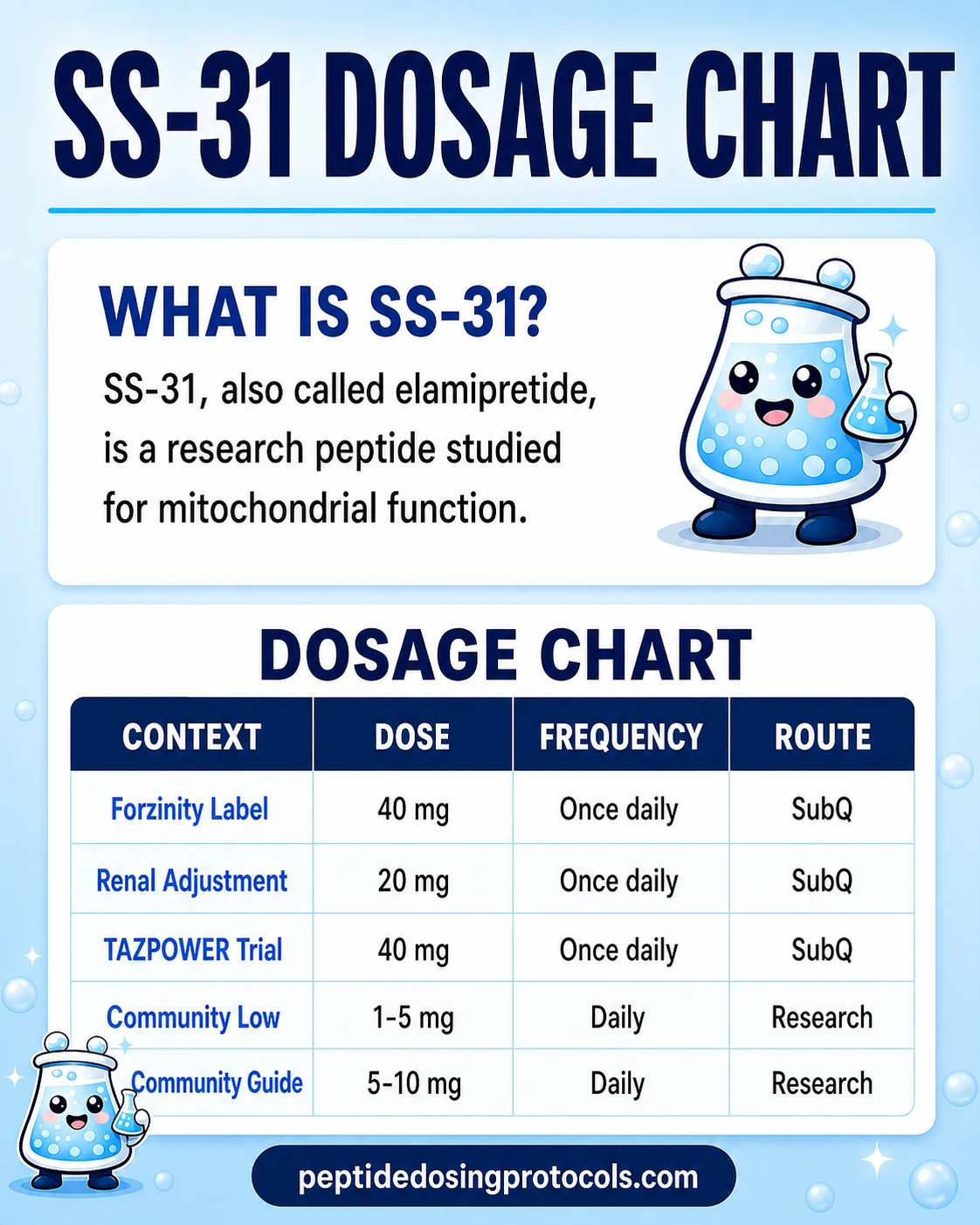
SS-31 Dosage Chart
This SS-31 dosage chart summarizes the Forzinity label, TAZPOWER trial, and community-reported dose contexts shown in the dosing section above.
Who SS-31 Is For and Who Should Avoid It
Forzinity (elamipretide) is a prescription drug. The FDA-approved population is narrow: patients with genetically confirmed Barth syndrome who weigh at least 30 kg. Anyone considering Forzinity should be evaluated and prescribed by a qualified clinician familiar with Barth syndrome.
Per the Forzinity label, do not use in
- Patients with serious hypersensitivity to elamipretide or any ingredient in the formulation.
- Neonates (the vial contains benzyl alcohol; benzyl-alcohol-containing drugs have caused serious adverse reactions in low-birth-weight and preterm neonates).
Use with caution and clinician oversight in
- Adults with severe renal impairment (eGFR <30 mL/min, not on dialysis): the label specifies a 20 mg daily dose adjustment.
- Adults with eGFR <30 mL/min on dialysis: insufficient data per label; no recommended regimen.
- Pregnancy and lactation: data are limited; refer to the prescriber.
Populations the FDA approval does not cover
- Healthy adults seeking anti-aging, cognitive, or athletic-performance benefits.
- Patients with primary mitochondrial myopathy, heart failure, or dry age-related macular degeneration. Some of these have been studied (MMPOWER, MMPOWER-3, ReCLAIM/ReCLAIM-2), but as of June 2026 none has produced an FDA approval, and Stealth's continued investigation in dry AMD and primary mitochondrial myopathy remains exactly that — investigation.
- Patients under 30 kg.
SS-31 Side Effects & Safety
Safety information for SS-31 comes mostly from the Forzinity clinical development program (TAZPOWER and the open-label extension), other elamipretide trials (heart failure, mitochondrial myopathy, dry AMD), and the FDA-approved label.
Most commonly reported in trials
- Injection-site reactions: redness, swelling, itching, or mild pain. These were the most common adverse events in TAZPOWER and the long-term extension.
- Headache, especially in the first weeks of dosing.
- Dizziness, mild nausea, or fatigue, mostly self-limited.
Notable per the Forzinity label
- Hypersensitivity reactions. Serious hypersensitivity has been observed; the label lists hypersensitivity as a contraindication for any ingredient.
- Benzyl alcohol content. Forzinity contains benzyl alcohol; not for use in neonates due to risk of metabolic acidosis and gasping syndrome with benzyl-alcohol-containing drugs.
- Renal impairment. Elamipretide and inactive metabolites accumulate in severe renal impairment; the label requires a 20 mg/day dose in adults with eGFR <30 mL/min not on dialysis.
Theoretical and quality-control risks
- Drug interactions: per the FDA label and Epocrates, no significant interactions have been identified, but kidney-stressing co-medications deserve clinician attention because elamipretide is renally cleared.
- Quality control of research-use vials: research-use SS-31 is not subject to FDA manufacturing oversight. Purity, identity, and endotoxin content can vary by supplier and lot. Buyer-side verification (COA review) is the only consumer-side check.
- Long-term safety beyond ~3.5 years (the longest TAZPOWER OLE follow-up) in healthy adults is not established. The trial population was small and tightly defined.
Stop and seek qualified medical care for
Any sign of allergic reaction, spreading or infected injection-site reactions, persistent severe headaches, new shortness of breath or chest symptoms, significant changes in urination or new swelling, or any side effect that significantly affects daily function. PDP does not provide medical advice.
SS-31 Timeline & What to Monitor
Most published human SS-31 endpoints were measured at week 12 (TAZPOWER randomized period), week 36 (early open-label extension), week 76 (natural-history-comparison analysis), and week 168 (long-term TAZPOWER OLE). There is no published human trial that defines a fast 'how soon will I feel it' answer outside of Barth syndrome.
TAZPOWER endpoint timing (Barth syndrome)
Time point
Week 12 (randomized period)
Endpoint reviewed
6-minute walk distance, BTHS-SA fatigue score
Result reported
No statistically significant difference vs placebo
Time point
Week 36 (OLE)
Endpoint reviewed
Cardiac stroke volume, exploratory functional outcomes
Result reported
Reported improvement from baseline
Time point
Week 64–76 (OLE vs natural-history controls)
Endpoint reviewed
6MWT
Result reported
+79.7 m at week 64 (P = .0004); +91.0 m at week 76 (P = .0005)
Time point
Week 168 (OLE)
Endpoint reviewed
6MWT (cumulative from OLE baseline)
Result reported
+96.1 m (P = .003); knee extensor strength improved (basis for FDA accelerated approval)
| Time point | Endpoint reviewed | Result reported |
|---|---|---|
| Week 12 (randomized period) | 6-minute walk distance, BTHS-SA fatigue score | No statistically significant difference vs placebo |
| Week 36 (OLE) | Cardiac stroke volume, exploratory functional outcomes | Reported improvement from baseline |
| Week 64–76 (OLE vs natural-history controls) | 6MWT | +79.7 m at week 64 (P = .0004); +91.0 m at week 76 (P = .0005) |
| Week 168 (OLE) | 6MWT (cumulative from OLE baseline) | +96.1 m (P = .003); knee extensor strength improved (basis for FDA accelerated approval) |
Source: TAZPOWER publications, Genetics in Medicine, 2024; natural-history comparison study, Orphanet Journal of Rare Diseases, 2022.
Reasonable things a clinician may monitor
- Renal function (eGFR, creatinine) at baseline and periodically — relevant because dose adjustment is required at eGFR <30.
- Injection-site appearance for spreading reactions or infection.
- Disease-specific endpoints when SS-31 is being used inside its indication — Barth-syndrome care typically includes echocardiography, functional capacity tests, and BTHS-SA scoring.
- Hypersensitivity history before starting.
What cannot be promised
Energy, longevity, fat loss, cognitive enhancement, and athletic-performance outcomes for SS-31 are not supported by published human RCTs in healthy adults. Mechanism plausibility is not proof of benefit.
SS-31 Clinical Evidence Context
SS-31 is one of the most studied mitochondria-targeting peptides in the world. A 2025 review noted SS-31 has been explored in over 150 peer-reviewed publications. The evidence is not uniformly positive — it varies by indication.
Barth syndrome (FDA-approved)
TAZPOWER (NCT03098797) is the pivotal Phase 2/3 trial. The 12-week randomized crossover phase did not reach statistical significance vs placebo on either co-primary endpoint. The 168-week open-label extension showed durable improvements in 6-minute walk distance and knee extensor muscle strength. The natural-history comparison study (8 OLE patients vs 19 untreated controls) reinforced these findings. FDA granted accelerated approval on September 19, 2025 based on knee extensor strength as an intermediate endpoint.
Heart failure
Multiple Phase 1–2 elamipretide studies in heart failure with preserved ejection fraction (HFpEF) and reduced ejection fraction (HFrEF) reported mixed and mostly modest signals. As of June 2026, no FDA approval exists in this indication.
Primary mitochondrial myopathy
MMPOWER and MMPOWER-3 Phase 3 trials evaluated elamipretide in primary mitochondrial myopathy. MMPOWER-3 did not meet its co-primary endpoints. Stealth has continued exploration but the indication is not FDA-approved as of June 2026.
Dry age-related macular degeneration
ReCLAIM and ReCLAIM-2 evaluated elamipretide in dry AMD. Mixed signals; investigational. Not FDA-approved for AMD as of June 2026.
Mechanism and preclinical evidence
Strong and consistent. Cardiolipin binding, cristae stabilization, ATP rescue, and ROS reduction have been confirmed across cell-culture and animal disease models including ischemia-reperfusion injury, doxorubicin cardiotoxicity, age-related muscle dysfunction, and acute kidney injury models.
Healthy-adult anti-aging or performance use
No published human RCT supports an anti-aging or athletic-performance indication for SS-31 in healthy adults. Anecdotes and supplier marketing are not evidence.
SS-31 Storage & Handling
Storage reference
Form
Forzinity (FDA-approved drug, 80 mg/mL solution)
Storage
Refrigerated 36–46°F (2–8°C); do not freeze
Notes
After first opening, may be stored refrigerated or at room temp 68–77°F (20–25°C). Discard 8 days after first opening per label.
Form
Lyophilized research-use SS-31 (powder)
Storage
-4°F (-20°C) long-term; refrigerated short-term
Notes
Use original sealed vial, away from light. Stability typically reported up to ~2 years frozen by suppliers, but verify supplier label and stability data.
Form
Reconstituted research-use SS-31 (liquid)
Storage
35.6–46.4°F (2–8°C)
Notes
Do not freeze. Protect from light. Many suppliers and protocol references suggest using within ~28 days of reconstitution.
| Form | Storage | Notes |
|---|---|---|
| Forzinity (FDA-approved drug, 80 mg/mL solution) | Refrigerated 36–46°F (2–8°C); do not freeze | After first opening, may be stored refrigerated or at room temp 68–77°F (20–25°C). Discard 8 days after first opening per label. |
| Lyophilized research-use SS-31 (powder) | -4°F (-20°C) long-term; refrigerated short-term | Use original sealed vial, away from light. Stability typically reported up to ~2 years frozen by suppliers, but verify supplier label and stability data. |
| Reconstituted research-use SS-31 (liquid) | 35.6–46.4°F (2–8°C) | Do not freeze. Protect from light. Many suppliers and protocol references suggest using within ~28 days of reconstitution. |
Forzinity storage is fixed by the FDA label. Research-use vial storage depends on supplier specifications and BAC water beyond-use rules.
Signs of degradation (research-use vials)
- Cloudy or hazy reconstituted solution that does not clarify.
- Visible particulates or floaters after dissolution.
- Color shift or yellowing in a previously clear solution.
- Powder cake that is wet, melted, or visibly contaminated before reconstitution.
SS-31 Protocol Mistakes & Troubleshooting
- 01
Missed dose
Per the Forzinity label, skip the missed dose and take the next dose at the scheduled time. Do not double up.
- 02
Cloudy or hazy vial
Discard. Reconstituted SS-31 should be clear. Cloudiness or particulates indicate degradation, contamination, or excessive shaking.
- 03
Wrong BAC water volume
If you used a different BAC water volume than planned, recalculate concentration before drawing a dose. The PDP calculator can verify the math.
- 04
Foaming during reconstitution
Wait 5–10 minutes for foam to settle. Going forward, inject BAC water down the vial wall instead of onto the powder, and swirl rather than shake.
- 05
Injection-site reaction
Site rotation across the abdomen, outer thigh, and back of the upper arm is standard technique; a persistent or spreading reaction warrants clinician evaluation.
- 06
Confusion between Forzinity and research-use SS-31
These are different products with different concentrations, different storage rules, different prescribing status, and different supply chains. Do not transfer dosing or storage rules between them.
- 07
When to seek qualified medical care
Any sign of allergic reaction, infection, persistent or severe side effects, or new symptoms outside the expected mild injection-site profile.
SS-31 Regulatory Status
As of June 2026, the FDA regulatory status of SS-31 / elamipretide is unusually layered, and most online write-ups still misstate it.
- FDA-approved (accelerated): Elamipretide HCl, brand name FORZINITY, marketed by Stealth BioTherapeutics. Approved September 19, 2025 to improve muscle strength in adult and pediatric patients with Barth syndrome weighing at least 30 kg. Continued approval is contingent on a confirmatory trial.
- Designations supporting approval: Orphan drug, priority review, and rare pediatric disease designations from FDA, plus orphan drug designation from the European Medicines Agency.
- Investigational (other indications): Elamipretide has been studied in heart failure, primary mitochondrial myopathy, dry AMD, and other conditions. None of these is FDA-approved as of June 2026, and Stealth's continuing work in dry AMD and primary mitochondrial myopathy remains in development.
- Research-use only (everything else): SS-31 vials sold by research suppliers as lyophilized powder are not FDA-approved medicines, are not subject to FDA drug manufacturing oversight, and have no human-use indication.
Verify before assuming
Regulatory status changes. Confirm current FDA status at accessdata.fda.gov before relying on this section for any decision.
SS-31 vs MOTS-c vs NAD+ vs CoQ10
SS-31 is often compared to other compounds people group under 'mitochondrial support.' These compounds work in different ways and are not interchangeable.
Mitochondrial-target comparison (mechanism only — not interchangeable)
Compound
SS-31 / elamipretide
How it works
Binds cardiolipin in inner mitochondrial membrane; stabilizes cristae and ETC
Strongest evidence
Phase 2/3 in Barth syndrome (TAZPOWER) → FDA-approved as Forzinity
FDA approval
Yes, Barth syndrome only (Sept 2025)
Compound
MOTS-c
How it works
Mitochondrial-derived peptide; AMPK pathway signaling, metabolic regulation
Strongest evidence
Preclinical and small human studies; no Phase 3 outcome trial
FDA approval
No
Compound
NAD+ / NMN / NR (precursors)
How it works
Raises NAD+ levels supporting sirtuin and metabolic enzymes
Strongest evidence
Several small human trials; mixed efficacy signals
FDA approval
No (sold as supplements / research compounds)
Compound
CoQ10 / Ubiquinol
How it works
Electron carrier in ETC; antioxidant function
Strongest evidence
Long history; mixed clinical results across indications
FDA approval
No (sold as supplement)
| Compound | How it works | Strongest evidence | FDA approval |
|---|---|---|---|
| SS-31 / elamipretide | Binds cardiolipin in inner mitochondrial membrane; stabilizes cristae and ETC | Phase 2/3 in Barth syndrome (TAZPOWER) → FDA-approved as Forzinity | Yes, Barth syndrome only (Sept 2025) |
| MOTS-c | Mitochondrial-derived peptide; AMPK pathway signaling, metabolic regulation | Preclinical and small human studies; no Phase 3 outcome trial | No |
| NAD+ / NMN / NR (precursors) | Raises NAD+ levels supporting sirtuin and metabolic enzymes | Several small human trials; mixed efficacy signals | No (sold as supplements / research compounds) |
| CoQ10 / Ubiquinol | Electron carrier in ETC; antioxidant function | Long history; mixed clinical results across indications | No (sold as supplement) |
Different mechanisms answer different questions. Combining them is not a PDP recommendation.
SS-31 vs MOTS-c is the most-searched direct comparison. SS-31 is a structural stabilizer (it sits in the membrane). MOTS-c is a signaling peptide (it changes how cells regulate energy metabolism). Both are usually discussed in mitochondrial-research contexts, but the evidence bases are very different — SS-31 has FDA-approved status for one disease; MOTS-c does not.
SS-31 Blood Tests & Monitoring
SS-31 is usually discussed in mitochondrial and oxidative-stress research. Monitoring focuses on broad metabolic, kidney, liver, inflammatory, and muscle-stress context.
Blood test markers to discuss with a clinician
Marker
Comprehensive metabolic panel (CMP)
Why it matters
Reviews liver, kidney, electrolytes, and glucose before interpreting energy or metabolic changes.
Timing
Baseline
Marker
CBC with differential
Why it matters
Screens anemia, infection patterns, and general blood-cell context that can affect fatigue.
Timing
Baseline
Marker
CRP
Why it matters
Adds broad inflammation context when inflammatory burden is part of the protocol question.
Timing
Optional
Marker
Creatine kinase (CK)
Why it matters
May help interpret muscle stress when muscle symptoms or intense training are present.
Timing
Optional
Marker
A1c
Why it matters
Shows longer-term glucose control relevant to mitochondrial and metabolic research.
Timing
Optional
| Marker | Why it matters | Timing |
|---|---|---|
| Comprehensive metabolic panel (CMP) | Reviews liver, kidney, electrolytes, and glucose before interpreting energy or metabolic changes. | Baseline |
| CBC with differential | Screens anemia, infection patterns, and general blood-cell context that can affect fatigue. | Baseline |
| CRP | Adds broad inflammation context when inflammatory burden is part of the protocol question. | Optional |
| Creatine kinase (CK) | May help interpret muscle stress when muscle symptoms or intense training are present. | Optional |
| A1c | Shows longer-term glucose control relevant to mitochondrial and metabolic research. | Optional |
Monitoring guidance is mitochondrial pathway-based and cautious because routine clinical monitoring standards are not established.
At-home blood test option
Easy at home option to monitor core metrics during research cycles.
Partner link: PDP may earn a commission at no cost to you.
Simple timing framework
Baseline
Discuss baseline labs before starting, especially with kidney disease, liver disease, mitochondrial disease, inflammatory disease, fatigue, or high training load.
Follow-up
Repeat relevant markers after 8-12 weeks if symptoms change or the protocol continues.
Longer term
For longer protocols, review broad health trends every 3-6 months with a clinician.
How to interpret the labs
- Routine labs do not directly measure mitochondrial repair.
- Fatigue can be driven by anemia, thyroid status, sleep, mood, medications, or chronic disease.
- Use symptom trends and functional measures alongside labs.
Do not wait for routine labs
Chest pain, fainting, severe weakness, dark urine, confusion, or new neurologic symptoms need medical review.
FAQ
Q1: Is SS-31 the same as elamipretide and Forzinity?
Yes. SS-31 is the original research code (also written SS31). Elamipretide is the generic drug name. FORZINITY is the FDA-approved brand name marketed by Stealth BioTherapeutics. Earlier development codes were MTP-131 and Bendavia.
Q2: Is SS-31 FDA-approved?
Partially. On September 19, 2025, the FDA granted accelerated approval to elamipretide as FORZINITY for Barth syndrome in patients weighing at least 30 kg. Outside of that indication, SS-31 is not FDA-approved and is sold by research suppliers as a research-use compound. See the FDA label at accessdata.fda.gov.
Q3: What dose was used in the SS-31 clinical trial?
The TAZPOWER Phase 2/3 trial in Barth syndrome used 40 mg subcutaneously once daily, both in the 12-week randomized crossover phase and in the open-label extension that ran up to 168 weeks. The Forzinity FDA label uses the same 40 mg/day dose for patients ≥30 kg, with a 20 mg/day adjustment for adults with severe renal impairment. This is reported as label and trial information, not a PDP dosing recommendation.
Q4: How is SS-31 reconstituted?
Forzinity is supplied at 80 mg/mL ready-to-use and does not require reconstitution. Lyophilized research-use SS-31 vials commonly come in 10 mg or 50 mg sizes. A 10 mg vial reconstituted with 1.0 mL bacteriostatic water yields 10 mg/mL; a 50 mg vial reconstituted with 2.5 mL yields 20 mg/mL. Always verify your specific vial's label.
Q5: How long is a typical SS-31 cycle?
There is no PDP-endorsed personal-use cycle for SS-31. The Forzinity label uses continuous daily dosing in patients with Barth syndrome. The TAZPOWER trial structure was 12 weeks per period in the randomized phase, with up to 168 additional weeks in the open-label extension.
Q6: What are the most common SS-31 side effects?
In TAZPOWER and other elamipretide trials, injection-site reactions (redness, swelling, itching) were the most common adverse events. Headaches, mild nausea, and fatigue have also been reported. Forzinity's label flags hypersensitivity and benzyl alcohol content (do not use in neonates) as specific concerns.
Q7: Who should avoid SS-31?
Per the Forzinity label, anyone with serious hypersensitivity to elamipretide or excipients should avoid it, and it should not be used in neonates because it contains benzyl alcohol. Adults with severe renal impairment require a dose reduction (20 mg/day at eGFR <30 mL/min not on dialysis), and there is insufficient information for adults on dialysis. Healthy adults seeking anti-aging or performance use are not within any FDA-approved population.
Q8: How does SS-31 compare to MOTS-c?
Both are studied in mitochondrial-research contexts, but they work differently. SS-31 binds cardiolipin in the inner mitochondrial membrane to stabilize structure. MOTS-c is a mitochondrial-derived peptide that signals through pathways like AMPK. SS-31 has Phase 2/3 human data and one FDA approval (Barth syndrome). MOTS-c has preclinical and small human studies but no Phase 3 outcome trial. They are not interchangeable. See the MOTS-c protocol for more detail.
Q9: Does SS-31 work for anti-aging or performance?
There is no published human randomized controlled trial demonstrating an anti-aging or athletic-performance benefit for SS-31 in healthy adults. The mechanism (cardiolipin stabilization) is biologically plausible, but mechanism plausibility is not proof of benefit. Most online claims in this space cite preclinical or anecdotal data, not human RCTs.
Q10: Is this page medical advice?
No. This page is an educational research reference. It reports trial-context dosing, FDA-label information, mechanism, and safety data from published sources. It is not a personal-use protocol, a prescription, or a substitute for evaluation by a qualified clinician.
Q11: How should SS-31 be stored?
Forzinity (the FDA-approved drug) is stored refrigerated at 36–46°F (2–8°C) and discarded 8 days after first opening, per its label. Lyophilized research-use SS-31 vials are typically stored long-term frozen at -4°F (-20°C); once reconstituted, they are stored refrigerated at 35.6–46.4°F (2–8°C), protected from light, and not refrozen.
Q12: Where can I read the Forzinity FDA label?
The full FDA-approved label is at accessdata.fda.gov. The FDA approval letter is in the same docket. Both should be considered the source of truth for current Forzinity dosing, indications, and safety information.
Sources & Research
- 1. U.S. Food and Drug Administration. FORZINITY (elamipretide) injection — Highlights of Prescribing Information. accessdata.fda.gov (2025)
- 2. U.S. Food and Drug Administration, Center for Drug Evaluation and Research. Approval Package for Application 215244Orig1s000 (FORZINITY). accessdata.fda.gov (2025)
- 3. Stealth BioTherapeutics Inc. FDA Accelerated Approval of FORZINITY (elamipretide HCl), the First Therapy for Barth Syndrome — News Release. PR Newswire (2025)
- 4. Shirley M. Elamipretide: First Approval. Drugs (PubMed) (2025)
- 5. Reid Thompson WR, Hornby B, Manuel R, et al. Long-term efficacy and safety of elamipretide in patients with Barth syndrome: 168-week open-label extension results of TAZPOWER. Genetics in Medicine (2024)
- 6. Reid Thompson WR, Manuel R, Abbruscato A, et al. Natural history comparison study to assess the efficacy of elamipretide in patients with Barth syndrome. Orphanet Journal of Rare Diseases (PMC) (2022)
- 7. Mitchell W, Ng EA, Tamucci JD, et al. The mitochondria-targeted peptide SS-31 binds lipid bilayers and modulates surface electrostatics as a key component of its mechanism of action. Journal of Biological Chemistry (PMC) (2020)
- 8. Chavez JD, Tang X, Campbell MD, et al. Mitochondrial protein interaction landscape of SS-31. Proceedings of the National Academy of Sciences (PNAS) (2020)
- 9. Daubert MA, Yow E, Dunn G, et al. Elamipretide: A Review of Its Structure, Mechanism of Action, and Therapeutic Potential. International Journal of Molecular Sciences (PMC) (2025)
- 10. Sabbah HN. Barth syndrome cardiomyopathy: targeting the mitochondria with elamipretide. Heart Failure Reviews (PubMed) (2021)
- 11. Barth Syndrome Foundation. FDA Approves First Medication for Barth Syndrome (FORZINITY). barthsyndrome.org (2025)
- 12. ClinicalTrials.gov. Study to Evaluate the Safety, Tolerability, and Efficacy of Elamipretide in Subjects With Barth Syndrome (TAZPOWER, NCT03098797). clinicaltrials.gov (2025)
- 13. Peptides Institute. SS-31: Research Profile & Guide. peptidesinstitute.org (2026)
- 14. Pep-Pedia. SS-31 (Elamipretide). pep-pedia.org (2026)
- 15. Peptide Protocol Wiki. SS-31: Community Protocols & Reports. peptideprotocolwiki.com (2026)
- 16. Reddit r/Peptides. SS-31 - Dosing and Results? reddit.com (2024)
- 17. Reddit r/Peptidesource. SS31 protocol. reddit.com (2026)
Related Dosing Protocols

Written by Garret Grant
Founder & Lead Researcher · B.S. Civil Engineering, UCLA
Last updated: August 2026
Human-researched and AI-assisted with full editorial review. I verify sources, protocol interpretation, and final judgments personally. See methodology.
Share this page