

Cartalax Protocol Quick Start
The main point
Cartalax has early laboratory research related to cartilage cells, but it does not have a validated injectable human protocol. The dosing table below reflects research-community practice and should not be confused with clinical dosing.
Cartalax evidence at a glance
Question
What is Cartalax?
Current answer
A three-amino-acid peptide with the sequence Ala-Glu-Asp.
Question
What is it studied for?
Current answer
Cartilage-cell activity, chondrogenic markers, gene expression, and cellular aging.
Question
Is there a human injectable trial?
Current answer
No controlled human injectable Cartalax trial was identified.
Question
Is there an approved dose?
Current answer
No. There is no FDA-approved Cartalax dosage.
Question
What dose is discussed online?
Current answer
Research communities commonly discuss 2–5 mg once daily.
Question
How strong is the evidence?
Current answer
Very limited and mainly based on cell-culture research.
| Question | Current answer |
|---|---|
| What is Cartalax? | A three-amino-acid peptide with the sequence Ala-Glu-Asp. |
| What is it studied for? | Cartilage-cell activity, chondrogenic markers, gene expression, and cellular aging. |
| Is there a human injectable trial? | No controlled human injectable Cartalax trial was identified. |
| Is there an approved dose? | No. There is no FDA-approved Cartalax dosage. |
| What dose is discussed online? | Research communities commonly discuss 2–5 mg once daily. |
| How strong is the evidence? | Very limited and mainly based on cell-culture research. |
The community dose is included for educational context. It is not a recommendation or a clinically proven schedule.
What Is Cartalax Peptide?
Cartalax is a synthetic tripeptide made from alanine, glutamic acid, and aspartic acid. Its sequence is written as Ala-Glu-Asp, or AED. It is also called the AED peptide, T-31, and a Khavinson peptide bioregulator.
The PubChem compound record lists Ala-Glu-Asp with a molecular weight of about 333.29 g/mol. The term bioregulator describes how this peptide is discussed in research. It is not an FDA drug classification.
Peptide sequence
Ala-Glu-Asp, shortened to AED.
Peptide length
Three amino acids.
Research focus
Cartilage cells, connective-tissue markers, and age-related changes in gene expression.
Common research vial
Cartalax is often sold online as a 20 mg lyophilized vial.
Other formats
Some markets also have oral capsules or lingual peptide products.
Cartalax Injectable Dosage Protocol
Community protocol, not a clinical dose
No controlled human trial has validated the injectable dose, subcutaneous route, titration plan, frequency, or cycle length shown below. This schedule summarizes a protocol discussed by online research communities.
Cartalax protocol formats
Keep injectable schedules, oral product directions, and laboratory concentrations separate. A dose from one format cannot be transferred to another.
A 20 mg vial framework commonly shared by research communities.
The most detailed community framework starts at 2 mg once daily and increases to 5 mg once daily over 12 weeks. The schedule assumes a 20 mg vial mixed with 3 mL, giving a concentration of about 6.67 mg/mL.
Community-reported Cartalax injectable dosage schedule
Phase
Weeks 1–2
Daily amount
2 mg
U-100 units
30 units
Volume
0.30 mL
Reported frequency
Once daily
Phase
Weeks 3–4
Daily amount
3 mg
U-100 units
45 units
Volume
0.45 mL
Reported frequency
Once daily
Phase
Weeks 5–8
Daily amount
4 mg
U-100 units
60 units
Volume
0.60 mL
Reported frequency
Once daily
Phase
Weeks 9–12
Daily amount
5 mg
U-100 units
75 units
Volume
0.75 mL
Reported frequency
Once daily
| Phase | Daily amount | U-100 units | Volume | Reported frequency |
|---|---|---|---|---|
| Weeks 1–2 | 2 mg | 30 units | 0.30 mL | Once daily |
| Weeks 3–4 | 3 mg | 45 units | 0.45 mL | Once daily |
| Weeks 5–8 | 4 mg | 60 units | 0.60 mL | Once daily |
| Weeks 9–12 | 5 mg | 75 units | 0.75 mL | Once daily |
The units are calculation-only values for a 20 mg vial containing 3 mL. Changing the liquid volume changes every unit value.
The schedule is not based on the 200 ng/mL concentration used in cell studies. A laboratory concentration cannot be converted directly into an injectable dose for a person.
The concentrations that appear in peer-reviewed Cartalax experiments.
The most relevant cartilage studies exposed cultured cells to AED. One human stem-cell experiment used 200 ng/mL, while a rat chondrocyte study also reported an effective concentration of 200 ng/mL.
Published Cartalax laboratory contexts
Research model
Human mesenchymal stem cells during replicative aging
Cartalax exposure
200 ng/mL in cell culture
Measured outcome
SOX9, aggrecan, type II collagen, and COMP expression
Research model
Cultured rat chondrocytes
Cartalax exposure
200 ng/mL in cell culture
Measured outcome
Number and proliferation of chondrocytes
Research model
Aging human stem-cell cultures
Cartalax exposure
Experimental cell exposure
Measured outcome
Changes in selected gene-expression pathways
Research model
Aging skin fibroblast cultures
Cartalax exposure
Experimental cell exposure
Measured outcome
Proliferation, matrix-remodeling, and apoptosis markers
| Research model | Cartalax exposure | Measured outcome |
|---|---|---|
| Human mesenchymal stem cells during replicative aging | 200 ng/mL in cell culture | SOX9, aggrecan, type II collagen, and COMP expression |
| Cultured rat chondrocytes | 200 ng/mL in cell culture | Number and proliferation of chondrocytes |
| Aging human stem-cell cultures | Experimental cell exposure | Changes in selected gene-expression pathways |
| Aging skin fibroblast cultures | Experimental cell exposure | Proliferation, matrix-remodeling, and apoptosis markers |
These are cell-culture conditions. They do not establish a dose, route, or treatment duration for humans.
Commercial capsule and lingual directions found in some markets.
Oral Cartalax products may list short courses lasting about 10–30 days. These directions apply only to the exact commercial product and its stated ingredients.
Do not compare the label weight with a pure AED vial
A capsule's total weight may include a broader peptide complex, carrier ingredients, or fillers. It should not be treated as the same amount of active AED found in a research vial.
Published laboratory exposure, commercial oral directions, and community injectable schedules are different forms of evidence.
Cartalax Dosage Chart
This Cartalax dosage chart summarizes the 12-week community-reported schedule from 2 mg to 5 mg once daily. The syringe units assume a 20 mg vial mixed with 3 mL.
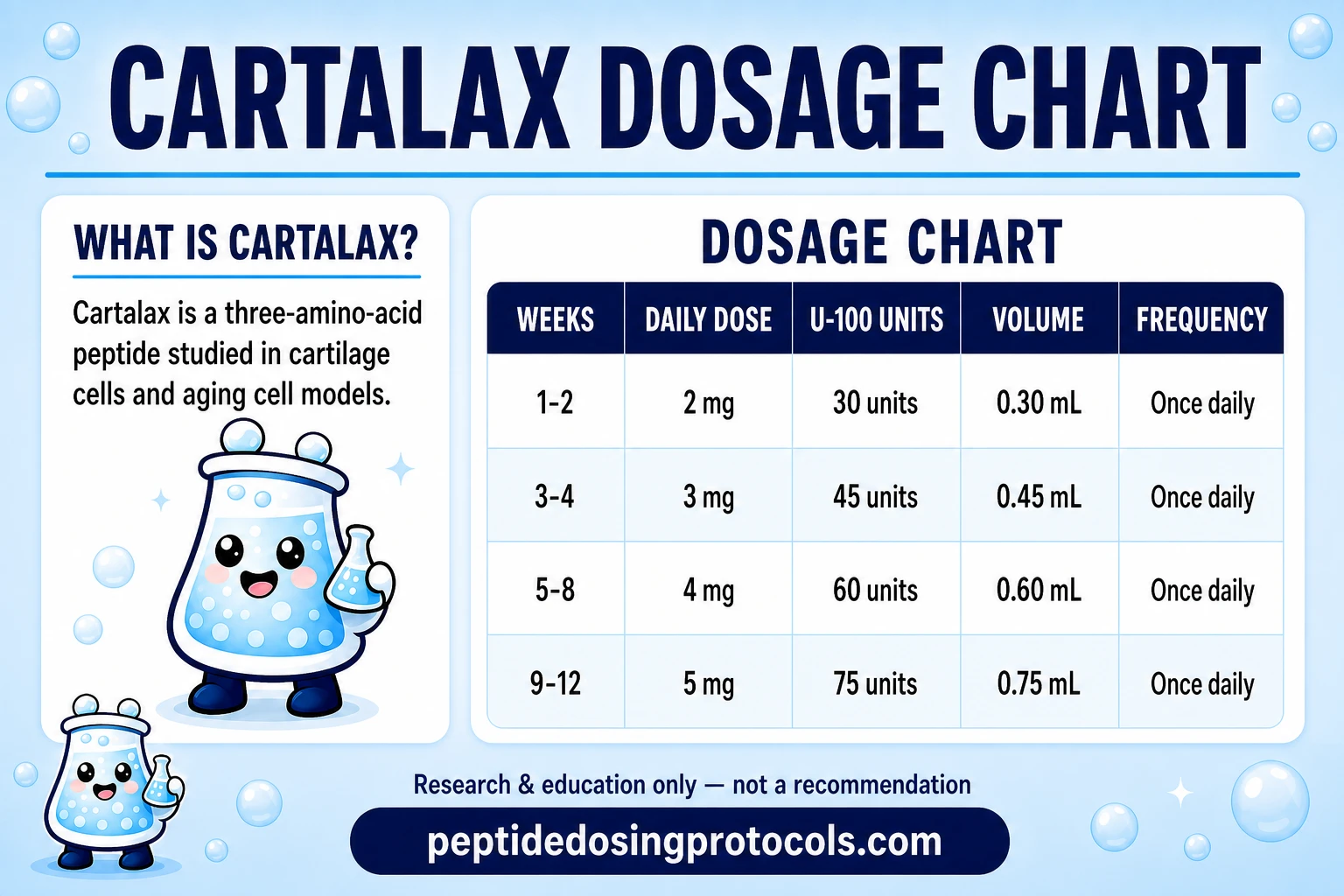
Community-reported amounts
The injectable amounts below come from online research-community schedules. No controlled human trial has established a Cartalax dose, frequency, titration plan, or cycle length.
Community-reported Cartalax dosage chart
The vial-duration math assumes a 20 mg vial. Research and education only.
Daily amount
2 mg
Weekly total
14 mg
20 mg vial duration
10 days
Evidence level
Community-reported starting phase
Daily amount
3 mg
Weekly total
21 mg
20 mg vial duration
About 6.7 days
Evidence level
Community-reported second phase
Daily amount
4 mg
Weekly total
28 mg
20 mg vial duration
5 days
Evidence level
Community-reported middle phase
Daily amount
5 mg
Weekly total
35 mg
20 mg vial duration
4 days
Evidence level
Community-reported later phase
Daily amount
10 mg
Weekly total
70 mg
20 mg vial duration
2 days
Evidence level
Separate 20-day schedule; not clinically validated
| Daily amount | Weekly total | 20 mg vial duration | Evidence level |
|---|---|---|---|
| 2 mg | 14 mg | 10 days | Community-reported starting phase |
| 3 mg | 21 mg | About 6.7 days | Community-reported second phase |
| 4 mg | 28 mg | 5 days | Community-reported middle phase |
| 5 mg | 35 mg | 4 days | Community-reported later phase |
| 10 mg | 70 mg | 2 days | Separate 20-day schedule; not clinically validated |
Vial duration equals 20 mg divided by the listed daily amount. This table shows arithmetic and community context, not an approved dosage.
Staged Cartalax injectable schedule
Weeks
1–2
Daily amount
2 mg
Phase total
28 mg
Running total
28 mg
Weeks
3–4
Daily amount
3 mg
Phase total
42 mg
Running total
70 mg
Weeks
5–8
Daily amount
4 mg
Phase total
112 mg
Running total
182 mg
Weeks
9–12
Daily amount
5 mg
Phase total
140 mg
Running total
322 mg
| Weeks | Daily amount | Phase total | Running total |
|---|---|---|---|
| 1–2 | 2 mg | 28 mg | 28 mg |
| 3–4 | 3 mg | 42 mg | 70 mg |
| 5–8 | 4 mg | 112 mg | 182 mg |
| 9–12 | 5 mg | 140 mg | 322 mg |
This staged schedule is shared by research communities. The reason for each increase has not been tested in a human Cartalax study.
For a full comparison of 8-, 12-, and 16-week schedules, the separate 20-day schedule, cycle breaks, and vial totals, see the Cartalax cycle-length guide.
Why There Is No Standard Cartalax Dose
Online Cartalax dosing claims vary sharply. Some pages describe a few hundred micrograms, while others describe several milligrams per day. This wide spread is a sign that there is no accepted injectable standard.
No controlled human dose study
The published cartilage research does not test a daily injectable dose in people.
No established pharmacokinetics
A reliable human half-life, absorption rate, and clearance profile have not been published.
Different products share the same name
Pure AED, oral peptide complexes, and lyophilized research vials may all be called Cartalax.
Community schedules conflict
Reported injectable amounts differ by more than tenfold across online sources.
No FDA-approved label
There is no approved prescribing information that defines a dose, route, or duration.
Cartalax 20 mg Reconstitution and Vial Math
Calculation-only information
The tables below explain concentration and U-100 syringe math. They do not validate the community protocol or recommend injecting Cartalax.
A U-100 syringe has 100 units in 1 mL. This means one unit equals 0.01 mL. For a 20 mg vial mixed with 3 mL, divide 20 mg by 3 mL to get about 6.67 mg/mL.
20 mg Cartalax dilution comparison
Liquid added
2 mL
Concentration
10 mg/mL
Amount per 0.01 mL
100 mcg
Amount per U-100 unit
100 mcg
Liquid added
3 mL
Concentration
6.67 mg/mL
Amount per 0.01 mL
66.7 mcg
Amount per U-100 unit
66.7 mcg
| Liquid added | Concentration | Amount per 0.01 mL | Amount per U-100 unit |
|---|---|---|---|
| 2 mL | 10 mg/mL | 100 mcg | 100 mcg |
| 3 mL | 6.67 mg/mL | 66.7 mcg | 66.7 mcg |
The community protocol table on this page uses the 3 mL example.
Cartalax U-100 syringe math for a 20 mg vial with 3 mL
Cartalax amount
1 mg
Amount in mcg
1,000 mcg
Volume
0.15 mL
U-100 units
15 units
Cartalax amount
2 mg
Amount in mcg
2,000 mcg
Volume
0.30 mL
U-100 units
30 units
Cartalax amount
3 mg
Amount in mcg
3,000 mcg
Volume
0.45 mL
U-100 units
45 units
Cartalax amount
4 mg
Amount in mcg
4,000 mcg
Volume
0.60 mL
U-100 units
60 units
Cartalax amount
5 mg
Amount in mcg
5,000 mcg
Volume
0.75 mL
U-100 units
75 units
Cartalax amount
10 mg
Amount in mcg
10,000 mcg
Volume
1.50 mL
U-100 units
150 units
| Cartalax amount | Amount in mcg | Volume | U-100 units |
|---|---|---|---|
| 1 mg | 1,000 mcg | 0.15 mL | 15 units |
| 2 mg | 2,000 mcg | 0.30 mL | 30 units |
| 3 mg | 3,000 mcg | 0.45 mL | 45 units |
| 4 mg | 4,000 mcg | 0.60 mL | 60 units |
| 5 mg | 5,000 mcg | 0.75 mL | 75 units |
| 10 mg | 10,000 mcg | 1.50 mL | 150 units |
A 10 mg amount would be more than one full 100-unit syringe at this concentration. This is arithmetic, not support for a 10 mg dose.
- 01
Confirm the vial amount
Use the total milligrams printed on the vial. This example uses 20 mg.
- 02
Confirm the liquid volume
The main example uses 3 mL. A different volume creates a different concentration.
- 03
Calculate milligrams per milliliter
Divide the vial amount by the liquid volume: 20 mg ÷ 3 mL = 6.67 mg/mL.
- 04
Convert to amount per unit
Multiply 6.67 mg/mL by 0.01 mL to get 0.0667 mg, or 66.7 mcg, per U-100 unit.
How Many Cartalax 20 mg Vials Are Needed?
The totals below follow the community titration table on this page. They correct the math by adding each phase separately and rounding up to full 20 mg vials.
Planning totals based only on the community-reported schedule shown above.
Recommended U.S. and Canada Supply
Choose your region
Use discount code SAVE10 at Orbitrex Peptides checkout. See why we love Orbitrex Peptides.
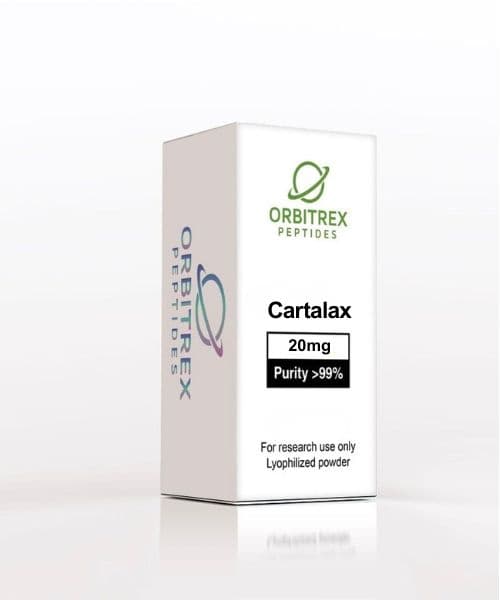
Cartalax
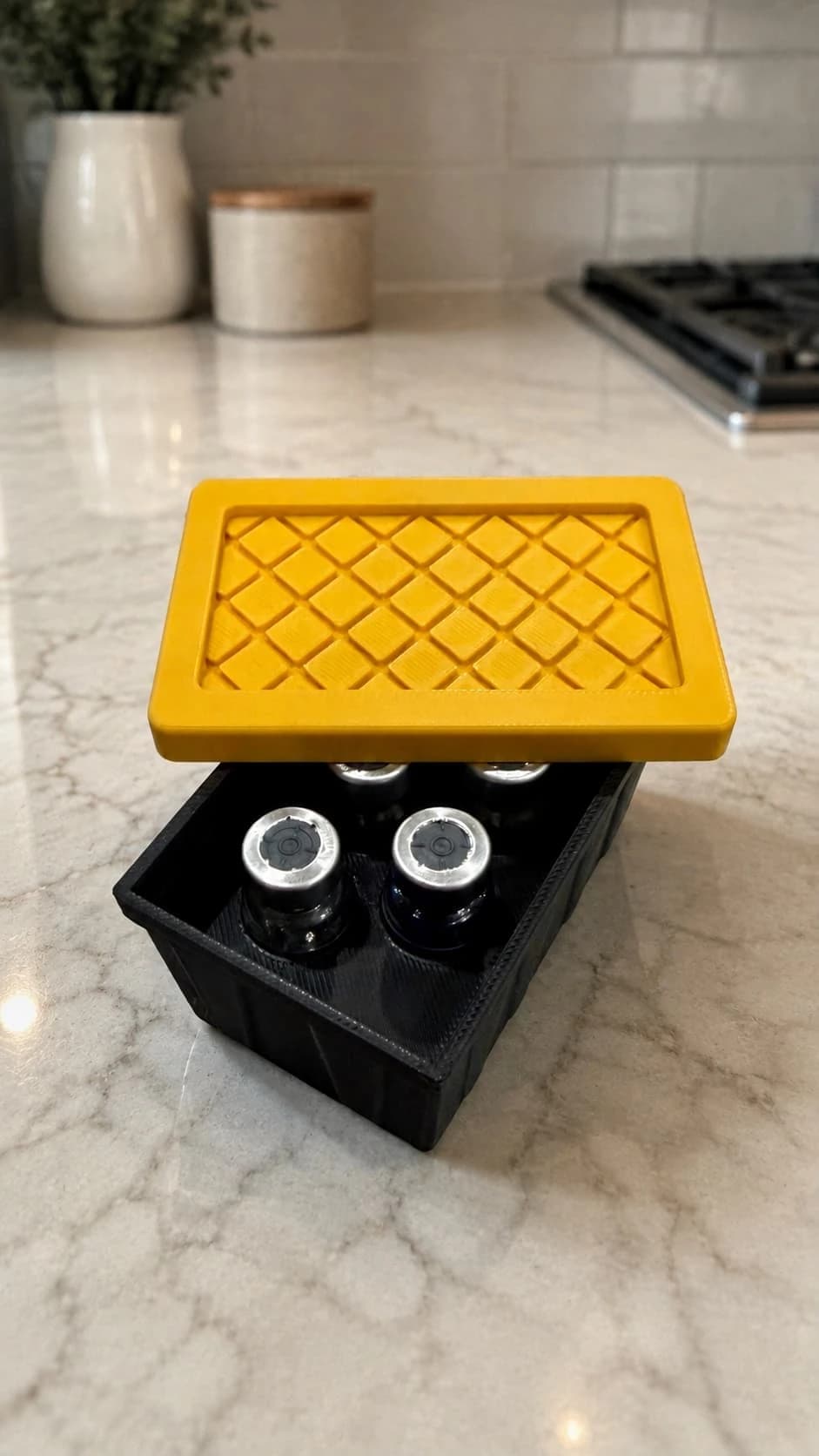
5-Vial Tote Case
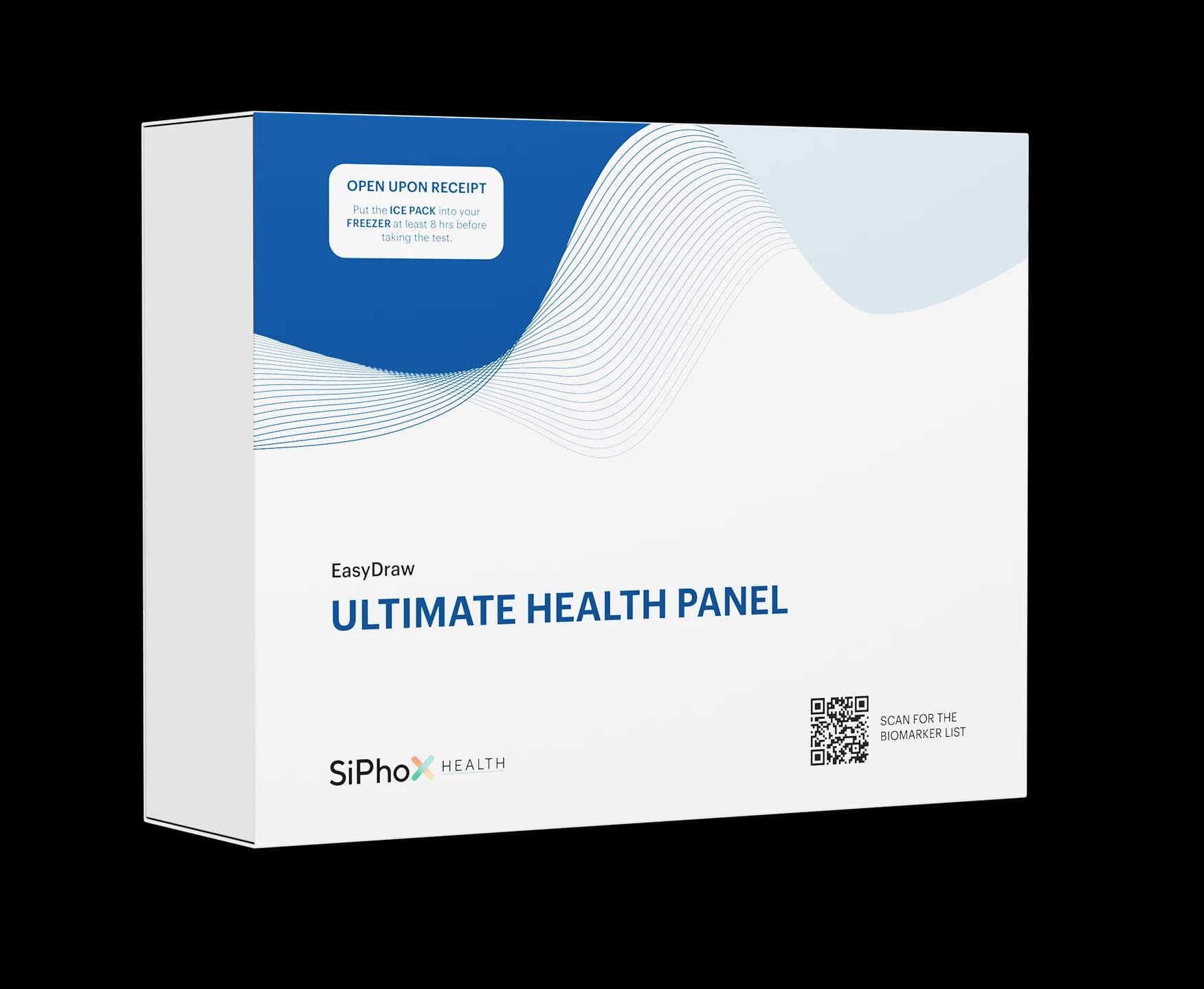
At-Home Blood Test
Research Supplies
Disclosure: supply links may earn PDP a commission at no cost to you.
Cartalax 20 mg Vial Totals
Each total is rounded up because partial vials cannot be counted as a full supply vial.
| Community schedule | Calculation |
|---|---|
8 weeks 10 vials | 28 mg in weeks 1–2 + 42 mg in weeks 3–4 + 112 mg in weeks 5–8 = 182 mg total. |
12 weeks 17 vials | 182 mg through week 8 + 140 mg in weeks 9–12 = 322 mg total. |
16 weeks 24 vials | 322 mg through week 12 + 140 mg at 5 mg daily in weeks 13–16 = 462 mg total. |
10 mg for 20 days 10 vials | 10 mg × 20 days = 200 mg total. This schedule is not supported by a controlled injectable study. |
8 weeks
10 vials
28 mg in weeks 1–2 + 42 mg in weeks 3–4 + 112 mg in weeks 5–8 = 182 mg total.
12 weeks
17 vials
182 mg through week 8 + 140 mg in weeks 9–12 = 322 mg total.
16 weeks
24 vials
322 mg through week 12 + 140 mg at 5 mg daily in weeks 13–16 = 462 mg total.
10 mg for 20 days
10 vials
10 mg × 20 days = 200 mg total. This schedule is not supported by a controlled injectable study.
These totals do not prove that any listed cycle is safe, effective, or appropriate.
Research-community planning math only. No injectable Cartalax cycle has been validated in a controlled human trial.
Companion Supplies & Routine Support
Cartalax Reconstitution Calculator

Powered by PepPal
Cartalax Reconstitution Calculator
Start with the protocol example, then customize every field.
Loaded reference
PDP 20 mg vial example
This calculator does not apply to oral Cartalax products.
Your draw
30units
0.3 mL on a U-100 insulin syringe
- Concentration
- 6.667 mg/mL
- Target in mg
- 2 mg
- Math-only doses per vial
- 10
One free emailed save per person, checked by PepPal.
Educational calculation tool only. The loaded amount is a reference from this page, not a personal dose recommendation. Confirm the vial label, route, syringe type, and actual liquid added before relying on a result.
Is Cartalax Dosed at 10 mg for 20 Days?
A Cartalax dosage of 10 mg per day for 20 days appears on some commercial and community websites. I could not trace this schedule to a controlled human injectable Cartalax trial.
The oral and injectable schedules may have been mixed together
A 20-day course also appears in oral peptide-product directions. That does not prove that 10 mg of injected pure AED has the same dose, absorption, or effect.
At 10 mg daily, a 20-day schedule would use 200 mg of Cartalax, equal to ten 20 mg vials. This is a math example, not an established dosage protocol.
Cartalax Peptide Benefits: What Research Shows
Cartalax benefits are often described more strongly than the evidence allows. The studies measured cultured cells, genes, and proteins. They did not show that Cartalax reduced joint pain, restored cartilage thickness, or improved movement in a controlled human trial.
Chondrogenic differentiation markers
A 2023 study found changes in SOX9, aggrecan, type II collagen, and COMP in aging human mesenchymal stem-cell cultures exposed to AED.
Cultured chondrocyte growth
A rat cell-culture study reported more chondrocytes after exposure to 200 ng/mL AED.
Cell-aging pathways
AED has been studied alongside other short peptides for changes in genes linked with cell aging and stress signaling.
Fibroblast behavior
Aging fibroblast experiments measured proliferation, matrix-remodeling enzymes, and apoptosis markers after short-peptide exposure.
Claim strength for common Cartalax benefits
Common claim
Supports cartilage-cell research
What the evidence supports
Supported as an early laboratory research topic.
Common claim
Changes cartilage-related markers
What the evidence supports
Reported in cultured cells at specific laboratory concentrations.
Common claim
Regenerates human cartilage
What the evidence supports
Not established by controlled human evidence.
Common claim
Relieves joint pain
What the evidence supports
Not established by a Cartalax clinical trial.
Common claim
Improves arthritis
What the evidence supports
Not established as a treatment for osteoarthritis or another disease.
Common claim
Prevents age-related joint decline
What the evidence supports
Unproven. Current evidence is too limited to support this outcome.
| Common claim | What the evidence supports |
|---|---|
| Supports cartilage-cell research | Supported as an early laboratory research topic. |
| Changes cartilage-related markers | Reported in cultured cells at specific laboratory concentrations. |
| Regenerates human cartilage | Not established by controlled human evidence. |
| Relieves joint pain | Not established by a Cartalax clinical trial. |
| Improves arthritis | Not established as a treatment for osteoarthritis or another disease. |
| Prevents age-related joint decline | Unproven. Current evidence is too limited to support this outcome. |
How Does Cartalax Peptide Work?
Cartalax is proposed to influence gene expression in cells linked with cartilage and connective tissue. The exact target, binding pathway, and human pharmacology have not been established.
SOX9
A transcription factor involved in the development and identity of cartilage-forming cells.
Aggrecan
A large cartilage protein that helps the tissue hold water and resist pressure.
Type II collagen
A major structural protein found in cartilage.
COMP
Cartilage oligomeric matrix protein, a marker linked with cartilage structure and cell differentiation.
Cell-aging signals
Other studies measured genes and proteins tied to proliferation, stress, and programmed cell death.
A proposed mechanism is not a proven benefit
A change in a gene or protein marker does not prove that cartilage regrew or that a joint worked better. Clinical outcomes must be tested directly in people.
Cartalax Peptide Studies
Key published research involving AED
Study
Chondrogenic differentiation study, 2023
Model
Aging human mesenchymal stem cells in culture
Finding
AED affected expression and synthesis of cartilage-related markers.
Main limitation
No human dosing or clinical outcome was tested.
Study
Chondrocyte proliferation study, 2023
Model
Cultured cells from young and old rats
Finding
AED at 200 ng/mL increased the number of cultured chondrocytes.
Main limitation
Cell-culture findings do not prove cartilage repair in a living animal or person.
Study
Stem-cell aging study, 2020
Model
Human embryonic bone-marrow stem-cell cultures
Finding
AED and related short peptides altered selected gene-expression pathways.
Main limitation
Several peptides were tested, making peptide-specific conclusions limited.
Study
Fibroblast aging study, 2016
Model
Cultured skin fibroblasts
Finding
AED was linked with changes in proliferation, matrix remodeling, and apoptosis markers.
Main limitation
Skin fibroblasts are not the same as cartilage or a human joint.
| Study | Model | Finding | Main limitation |
|---|---|---|---|
| Chondrogenic differentiation study, 2023 | Aging human mesenchymal stem cells in culture | AED affected expression and synthesis of cartilage-related markers. | No human dosing or clinical outcome was tested. |
| Chondrocyte proliferation study, 2023 | Cultured cells from young and old rats | AED at 200 ng/mL increased the number of cultured chondrocytes. | Cell-culture findings do not prove cartilage repair in a living animal or person. |
| Stem-cell aging study, 2020 | Human embryonic bone-marrow stem-cell cultures | AED and related short peptides altered selected gene-expression pathways. | Several peptides were tested, making peptide-specific conclusions limited. |
| Fibroblast aging study, 2016 | Cultured skin fibroblasts | AED was linked with changes in proliferation, matrix remodeling, and apoptosis markers. | Skin fibroblasts are not the same as cartilage or a human joint. |
Most of the available research comes from a small group of connected researchers. Independent replication is limited.
Cartalax Peptide Side Effects and Safety
Cartalax does not have a well-established human side-effect profile. Most published research involves cultured cells rather than controlled human exposure, so the frequency and severity of possible adverse effects are unknown.
No reliable adverse-event rate
There are no large controlled trials that show how often Cartalax side effects occur.
Unknown long-term effects
Repeated injectable cycles have not been studied well enough to define long-term risk.
Unknown medication interactions
A dependable human interaction profile has not been published.
Product-specific risks
Unapproved injectable products can add risks from incorrect identity, concentration, contamination, or storage.
Injection-related reactions
Redness, pain, swelling, itching, bruising, or infection can occur with injections in general. These are not established Cartalax-specific rates.
Limited evidence does not mean no risk
A short peptide should not be assumed safe simply because published side-effect reports are scarce. The lack of reports may reflect the lack of controlled human research.
Cartalax has not been studied well enough to define who can use it safely. The groups below are listed because reliable human safety data are missing, not because Cartalax has proven contraindications for each group.
Pregnancy and breastfeeding
No dependable Cartalax safety studies were identified for pregnancy or breastfeeding.
Children and teens
A safe pediatric dose, route, and duration have not been established.
Multiple medications
Cartalax does not have a well-defined interaction profile. People taking prescription drugs should review the evidence gap with a licensed clinician.
Serious or unstable medical conditions
There is not enough human evidence to judge Cartalax use alongside major liver, kidney, immune, bleeding, or cardiovascular conditions.
Active skin or injection-site problems
Injecting through irritated, damaged, or infected skin can add risks that are separate from the peptide itself.
Unclear product identity
Research should not proceed when the vial amount, concentration, identity, storage history, or sterility cannot be confirmed.
These are precautionary limits
The absence of human data prevents a reliable risk assessment. It should not be interpreted as proof that Cartalax is safe for groups that have not been studied.
Cartalax Half-Life, Timing, and Frequency
A reliable human Cartalax half-life has not been established. No published pharmacokinetic study was identified that defines how fast injected AED is absorbed, distributed, or cleared in people.
What is known about Cartalax timing
Question
What is the Cartalax half-life?
Evidence-based answer
Unknown in humans.
Question
Should Cartalax be taken in the morning or evening?
Evidence-based answer
No controlled evidence supports a specific time.
Question
Is once-daily dosing proven?
Evidence-based answer
No. Once-daily use comes from community schedules.
Question
Should the dose be divided?
Evidence-based answer
No human study has compared single and divided doses.
Question
How long does Cartalax take to work?
Evidence-based answer
No controlled human outcome study provides a reliable timeline.
| Question | Evidence-based answer |
|---|---|
| What is the Cartalax half-life? | Unknown in humans. |
| Should Cartalax be taken in the morning or evening? | No controlled evidence supports a specific time. |
| Is once-daily dosing proven? | No. Once-daily use comes from community schedules. |
| Should the dose be divided? | No human study has compared single and divided doses. |
| How long does Cartalax take to work? | No controlled human outcome study provides a reliable timeline. |
No controlled human study shows how long Cartalax takes to work. Published experiments measured cell counts, genes, and proteins under laboratory conditions rather than pain, mobility, or cartilage thickness in people.
What can and cannot be tracked during Cartalax research
Topic
Timing
What can be recorded
Dates, schedule changes, and total exposure
Main limit
No validated week-by-week response timeline exists
Topic
Local reactions
What can be recorded
Redness, swelling, itching, bruising, or discomfort
Main limit
These findings do not show whether Cartalax is affecting cartilage
Topic
Pain ratings
What can be recorded
Consistent scores using the same scale
Main limit
Pain can change for many reasons and cannot prove cartilage growth
Topic
Movement
What can be recorded
The same range-of-motion or activity measure over time
Main limit
A change does not prove that Cartalax caused it
Topic
Imaging
What can be recorded
Clinician-ordered imaging when medically appropriate
Main limit
No Cartalax trial defines an expected imaging response
Topic
Laboratory markers
What can be recorded
Only tests chosen and interpreted by a licensed clinician
Main limit
Cell-study markers such as SOX9 are not routine proof of a human response
| Topic | What can be recorded | Main limit |
|---|---|---|
| Timing | Dates, schedule changes, and total exposure | No validated week-by-week response timeline exists |
| Local reactions | Redness, swelling, itching, bruising, or discomfort | These findings do not show whether Cartalax is affecting cartilage |
| Pain ratings | Consistent scores using the same scale | Pain can change for many reasons and cannot prove cartilage growth |
| Movement | The same range-of-motion or activity measure over time | A change does not prove that Cartalax caused it |
| Imaging | Clinician-ordered imaging when medically appropriate | No Cartalax trial defines an expected imaging response |
| Laboratory markers | Only tests chosen and interpreted by a licensed clinician | Cell-study markers such as SOX9 are not routine proof of a human response |
Use the same measurement method and timing when comparing observations. Tracking cannot replace controlled evidence.
- 01
Record the exact formulation
Note the listed peptide identity, vial amount, reconstitution volume, and product lot.
- 02
Set a consistent baseline
Record the same measures before the research period begins.
- 03
Track on a fixed schedule
Use the same questions, scales, and measurement conditions each time.
- 04
Record unwanted effects
Document the timing, severity, duration, and any action taken.
- 05
Avoid outcome assumptions
A change in pain or movement does not confirm cartilage repair or prove that Cartalax caused the change.
There is no proven results timeline
Claims that Cartalax works within a set number of days or weeks are based on commercial or anecdotal reports, not controlled human outcome studies.
Cartalax Storage and Handling
No universal Cartalax stability study was identified for every research product. Storage directions should come from the exact product label or manufacturer documentation.
General Cartalax handling checks
Stage
Before reconstitution
Handling check
Follow the label for temperature and light protection
Why it matters
Heat, moisture, and poor storage may affect peptide stability
Stage
During reconstitution
Handling check
Confirm the vial amount and exact liquid volume
Why it matters
A volume error changes the concentration and every syringe calculation
Stage
After reconstitution
Handling check
Use the product's stated refrigeration and use-by guidance
Why it matters
There is no single proven storage period for every Cartalax product
Stage
Temperature control
Handling check
Limit unnecessary warming and cooling cycles
Why it matters
Repeated temperature changes may affect stability
Stage
Visual inspection
Handling check
Check for unexpected color, cloudiness, particles, or vial damage
Why it matters
A visible change may signal a product or handling problem
Stage
Labeling
Handling check
Write down the mixing date, concentration, and storage details
Why it matters
Clear labels reduce concentration and age-related mistakes
| Stage | Handling check | Why it matters |
|---|---|---|
| Before reconstitution | Follow the label for temperature and light protection | Heat, moisture, and poor storage may affect peptide stability |
| During reconstitution | Confirm the vial amount and exact liquid volume | A volume error changes the concentration and every syringe calculation |
| After reconstitution | Use the product's stated refrigeration and use-by guidance | There is no single proven storage period for every Cartalax product |
| Temperature control | Limit unnecessary warming and cooling cycles | Repeated temperature changes may affect stability |
| Visual inspection | Check for unexpected color, cloudiness, particles, or vial damage | A visible change may signal a product or handling problem |
| Labeling | Write down the mixing date, concentration, and storage details | Clear labels reduce concentration and age-related mistakes |
- Do not assume that every Cartalax vial has the same storage directions.
- Do not use a universal reconstituted shelf life unless the product provides supporting stability information.
- Do not use a vial with a damaged seal or unclear storage history.
- Do not rely on appearance alone to confirm identity, concentration, or sterility.
- Do not freeze or expose a reconstituted vial to heat unless the exact product directions allow it.
Storage cannot fix an uncertain product
Proper refrigeration does not confirm peptide identity, concentration, purity, or sterility. Those are separate product-quality questions.
Cartalax Capsules vs Injection
Cartalax capsules and injectable research vials should not be treated as equal products. They may contain different ingredients, peptide amounts, and formulations.
Cartalax oral and injectable format comparison
Feature
Typical form
Oral products
Capsule, tablet, or lingual product
Injectable research vials
Lyophilized powder in a vial
Feature
Common label context
Oral products
Short commercial courses such as 10–30 days
Injectable research vials
Online community schedules, often using a 20 mg vial
Feature
Active amount
Oral products
May not equal the full capsule weight
Injectable research vials
Usually listed as total milligrams of research material
Feature
Human bioavailability
Oral products
Not clearly established for pure AED
Injectable research vials
Not established in controlled Cartalax studies
Feature
Validated human protocol
Oral products
No widely accepted clinical protocol
Injectable research vials
No validated injectable protocol
| Feature | Oral products | Injectable research vials |
|---|---|---|
| Typical form | Capsule, tablet, or lingual product | Lyophilized powder in a vial |
| Common label context | Short commercial courses such as 10–30 days | Online community schedules, often using a 20 mg vial |
| Active amount | May not equal the full capsule weight | Usually listed as total milligrams of research material |
| Human bioavailability | Not clearly established for pure AED | Not established in controlled Cartalax studies |
| Validated human protocol | No widely accepted clinical protocol | No validated injectable protocol |
Directions from an oral product label cannot validate an injectable dose.
Cartalax vs BPC-157
Cartalax and BPC-157 are often grouped under joint or recovery research, but they are different peptides with different evidence. Neither has an FDA-approved injectable protocol for repairing human cartilage.
Cartalax compared with BPC-157
Feature
Peptide size
Cartalax
Three amino acids
BPC-157
Fifteen amino acids
Feature
Common name
Cartalax
AED or T-31
BPC-157
Body Protection Compound-157
Feature
Main research focus
Cartalax
Cartilage-cell differentiation and gene-expression markers
BPC-157
Injury, tissue-healing, blood-vessel, and gastrointestinal models
Feature
Most direct evidence
Cartalax
Cell-culture studies
BPC-157
Mostly animal and laboratory studies
Feature
Human injectable dose
Cartalax
Not established
BPC-157
Not established as an approved musculoskeletal protocol
Feature
FDA approval
Cartalax
Not FDA approved
BPC-157
Not FDA approved
Feature
Evidence for combining them
Cartalax
No controlled study supports a Cartalax and BPC-157 stack
BPC-157
No controlled study supports a Cartalax and BPC-157 stack
| Feature | Cartalax | BPC-157 |
|---|---|---|
| Peptide size | Three amino acids | Fifteen amino acids |
| Common name | AED or T-31 | Body Protection Compound-157 |
| Main research focus | Cartilage-cell differentiation and gene-expression markers | Injury, tissue-healing, blood-vessel, and gastrointestinal models |
| Most direct evidence | Cell-culture studies | Mostly animal and laboratory studies |
| Human injectable dose | Not established | Not established as an approved musculoskeletal protocol |
| FDA approval | Not FDA approved | Not FDA approved |
| Evidence for combining them | No controlled study supports a Cartalax and BPC-157 stack | No controlled study supports a Cartalax and BPC-157 stack |
Read the separate BPC-157 protocol guide for its research, dosage claims, and evidence limits.
Sigumir vs Cartalax
Cartalax usually refers to the defined synthetic tripeptide Ala-Glu-Asp. Sigumir product listings generally describe a broader peptide or polypeptide complex related to cartilage tissue.
General differences between Sigumir and Cartalax
Feature
Main identity
Cartalax
Synthetic AED tripeptide
Sigumir
Broader cartilage-derived peptide complex in commercial product descriptions
Feature
Defined sequence
Cartalax
Ala-Glu-Asp
Sigumir
May contain a mixture rather than one defined tripeptide
Feature
Research-vial format
Cartalax
Often sold as pure lyophilized AED
Sigumir
More often linked with oral bioregulator products
Feature
Are they interchangeable?
Cartalax
No
Sigumir
No
| Feature | Cartalax | Sigumir |
|---|---|---|
| Main identity | Synthetic AED tripeptide | Broader cartilage-derived peptide complex in commercial product descriptions |
| Defined sequence | Ala-Glu-Asp | May contain a mixture rather than one defined tripeptide |
| Research-vial format | Often sold as pure lyophilized AED | More often linked with oral bioregulator products |
| Are they interchangeable? | No | No |
Product names and formulas may vary by market. The exact ingredient label matters more than the brand name alone.
Is Cartalax FDA Approved?
Cartalax is not an FDA-approved drug, and there is no FDA-approved Cartalax dosage. No approved prescribing label was identified in the FDA drug approval databases.
The FDA maintains resources such as Drugs@FDA and the Orange Book for approved drug products. A research vendor listing or supplement listing does not provide FDA approval.
For sale does not mean approved
Cartalax may be offered online as research material or sold in oral products outside the United States. Availability does not establish safety, effectiveness, product quality, or approval for human use.
Cartalax Protocol Troubleshooting
Common Cartalax protocol and calculation problems
Problem
The syringe units do not match this page
Likely cause
A different reconstitution volume was used
What to check
Recalculate from the actual vial amount and total liquid volume
Problem
The calculated amount is over 100 units
Likely cause
The solution is too dilute for one U-100 syringe
What to check
Recheck the concentration; do not split or change the plan without qualified guidance
Problem
The vial runs out sooner than expected
Likely cause
The daily amount, dead space, or reconstitution volume may differ
What to check
Review the vial label, calculation, and recorded amounts
Problem
The vial total seems too low
Likely cause
One or more dose phases may have been left out
What to check
Add every phase before dividing by 20 mg and round the vial count up
Problem
Oral and injectable directions conflict
Likely cause
Different formulations are being compared
What to check
Keep oral product labels separate from pure AED injectable schedules
Problem
A dose was missed
Likely cause
The community schedule does not provide validated missed-dose rules
What to check
Do not double the next amount based only on an online protocol
Problem
The solution looks cloudy or contains particles
Likely cause
There may be a product, mixing, storage, or contamination problem
What to check
Stop using the vial and seek guidance from the product source or a qualified professional
Problem
An injection reaction occurs
Likely cause
The cause may involve technique, contamination, an ingredient, or the peptide
What to check
Record the timing and severity and seek medical care for a serious or worsening reaction
| Problem | Likely cause | What to check |
|---|---|---|
| The syringe units do not match this page | A different reconstitution volume was used | Recalculate from the actual vial amount and total liquid volume |
| The calculated amount is over 100 units | The solution is too dilute for one U-100 syringe | Recheck the concentration; do not split or change the plan without qualified guidance |
| The vial runs out sooner than expected | The daily amount, dead space, or reconstitution volume may differ | Review the vial label, calculation, and recorded amounts |
| The vial total seems too low | One or more dose phases may have been left out | Add every phase before dividing by 20 mg and round the vial count up |
| Oral and injectable directions conflict | Different formulations are being compared | Keep oral product labels separate from pure AED injectable schedules |
| A dose was missed | The community schedule does not provide validated missed-dose rules | Do not double the next amount based only on an online protocol |
| The solution looks cloudy or contains particles | There may be a product, mixing, storage, or contamination problem | Stop using the vial and seek guidance from the product source or a qualified professional |
| An injection reaction occurs | The cause may involve technique, contamination, an ingredient, or the peptide | Record the timing and severity and seek medical care for a serious or worsening reaction |
Troubleshooting can correct arithmetic and handling errors. It cannot make an unvalidated injectable protocol clinically proven.
Get urgent help for a serious reaction
Trouble breathing, facial or throat swelling, fainting, severe dizziness, widespread hives, chest pain, or rapidly worsening symptoms require urgent medical care.
Limits of the Current Cartalax Research
- No controlled human injectable dosing trial was identified.
- No reliable human half-life or pharmacokinetic study was identified.
- No established human dose-response curve exists.
- No controlled study shows that Cartalax regrows human joint cartilage.
- No large trial defines side effects, medication interactions, or long-term risks.
- Most findings come from cultured cells rather than whole joints.
- Several papers come from the same connected research group.
- Independent replication of the main Cartalax findings is limited.
- Oral product directions and injectable community protocols are often mixed together online.
Cartalax is a valid laboratory research topic, but the evidence is too early to support confident claims about joint repair, pain relief, arthritis treatment, or a standard injectable protocol.
Cartalax Peptide Frequently Asked Questions
Q1: What is Cartalax peptide?
Cartalax is a short synthetic peptide with the amino-acid sequence Ala-Glu-Asp, or AED. It is studied mainly for effects on cartilage-related cells, gene expression, and cellular aging.
Q2: What is Cartalax peptide used for?
Researchers study Cartalax in cartilage cells and aging cell models. It has not been proven to repair cartilage, reduce joint pain, or treat arthritis in controlled human trials.
Q3: What does Cartalax peptide do?
In cell studies, Cartalax affected markers linked with chondrocyte growth and chondrogenic differentiation, including SOX9, aggrecan, type II collagen, and COMP. Human clinical effects remain unknown.
Q4: What is the Cartalax peptide dosage?
There is no approved or clinically validated human Cartalax dosage. Online research communities commonly discuss 2–5 mg once daily, but this schedule has not been confirmed by a controlled human trial.
Q5: What is the Cartalax 20 mg vial protocol?
One community protocol starts at 2 mg daily for two weeks, increases to 3 mg for two weeks, uses 4 mg during weeks 5–8, and 5 mg during weeks 9–12. It is an anecdotal research framework, not a clinical protocol.
Q6: How do you calculate a Cartalax 20 mg vial?
A 20 mg vial mixed with 3 mL contains about 6.67 mg/mL. On a U-100 syringe, one unit is 0.01 mL and contains about 66.7 mcg. This is calculation-only information.
Q7: Is Cartalax dosed at 10 mg for 20 days?
This schedule appears on some commercial and community websites, but it has not been validated in a controlled injectable Cartalax study. It would total 200 mg, or ten 20 mg vials.
Q8: What are the possible Cartalax peptide benefits?
Laboratory studies report changes in cartilage-related cell growth, gene expression, and matrix markers. They do not prove cartilage regeneration, pain relief, or better joint function in people.
Q9: What are the Cartalax peptide side effects?
A reliable human side-effect profile has not been established. Possible injectable-product risks include local reactions, infection, incorrect concentration, contamination, and unknown long-term effects.
Q10: What is the Cartalax half-life?
A reliable human half-life has not been published. Timing and once-daily schedules found online are community practices rather than pharmacokinetic findings.
Q11: Where do people inject Cartalax?
Online protocols commonly describe subcutaneous use, but no controlled human study establishes an injectable route or preferred injection site for Cartalax.
Q12: Are Cartalax capsules the same as injections?
No. Oral products may contain different peptide complexes, fillers, and active amounts. Their label directions should not be converted into a dose for pure injectable AED.
Q13: Is Cartalax a Khavinson peptide?
Yes. Cartalax is commonly grouped with the short peptide bioregulators studied by Vladimir Khavinson and connected research groups.
Q14: What is the difference between Cartalax and BPC-157?
Cartalax is a three-amino-acid peptide studied mainly in cartilage and aging cell models. BPC-157 is a 15-amino-acid peptide studied mainly in animal injury and healing models. Neither has an approved injectable cartilage-repair protocol.
Q15: What is the difference between Sigumir and Cartalax?
Cartalax usually refers to the defined synthetic AED tripeptide. Sigumir product descriptions generally refer to a broader cartilage peptide complex. They are not interchangeable.
Q16: Is Cartalax FDA approved?
No. Cartalax is not an FDA-approved drug, and there is no FDA-approved dosage or prescribing label.
Q17: Can you buy Cartalax in the USA?
Cartalax is sold online by some research-material vendors. A product being for sale does not mean it is FDA approved, clinically validated, or intended for human use.
Q18: Are Cartalax reviews reliable evidence?
No. User reviews can describe personal experiences, but they cannot establish effectiveness, dose accuracy, product identity, or safety.
Q19: How long does Cartalax take to work?
No controlled human study provides a reliable timeline. Claims about results within days or weeks are based on anecdotal reports rather than validated clinical outcomes.
Sources & Research
- 1. Alanyl-glutamyl-aspartic acid PubChem, National Library of Medicine
- 2. Myakisheva SN et al. The Influence of Peptides on the Chondrogenic Differentiation of Human Mesenchymal Stem Cells During Replicative Aging Advances in Gerontology (2023)
- 3. Myakisheva SN et al. Peptides of Cartilage Tissue: Regulation of Chondrocyte Proliferation, Geroprotection and Prospects for Use in Osteoarthrosis Vrach (2023)
- 4. Ashapkin V et al. Gene Expression in Human Mesenchymal Stem Cell Aging Cultures: Modulation by Short Peptides Molecular Biology Reports (2020)
- 5. Lin'kova NS et al. Peptide Regulation of Skin Fibroblast Functions During Their Aging In Vitro Bulletin of Experimental Biology and Medicine (2016)
- 6. Linkova N et al. Peptide Regulation of Chondrogenic Stem Cell Differentiation International Journal of Molecular Sciences (2023)
- 7. Drug Approvals and Databases U.S. Food and Drug Administration
- 8. Cushman CJ et al. Local and Systemic Peptide Therapies for Soft Tissue and Musculoskeletal Conditions Current Reviews in Musculoskeletal Medicine (2024)
Related Dosing Protocols
Educational use only
Peptide Dosing Protocols is an independent educational reference. Nothing here is medical advice or a recommendation for human use. Consult a licensed healthcare provider before considering any compound.
Compare Cartalax with BPC-157 research
Review how BPC-157 differs from Cartalax, including its research models, dosage claims, and evidence limits.

Written by Garret Grant
Founder & Lead Researcher · B.S. Civil Engineering, UCLA
Last updated: August 2026
Human-researched and AI-assisted with full editorial review. I verify sources, protocol interpretation, and final judgments personally. See methodology.
Share this page