

Cerebrolysin Overview
Cerebrolysin is an injectable medicine made from purified pig brain proteins. Those proteins are broken down with enzymes into a mix of small peptides and free amino acids. The result is not one clean molecule. It is a blend, which is why people sometimes call it a "peptide soup."
It has been studied for brain conditions such as stroke, traumatic brain injury (TBI), and dementia. In many countries it is a prescription drug used during recovery. In the United States it is not approved for any medical use.
Form
The standard clinical product is a ready-to-use liquid in sealed ampoules or vials.
Routes studied
Slow IV (into a vein) infusion for higher doses, or IM (into a muscle) injection for lower doses.
How it is used
In short courses, often 10 to 21 days, sometimes repeated every few months.
Status
Not FDA-approved in the U.S. Research-use only there. Approved abroad by prescription.
Educational use only
This page is an educational research reference, not medical advice or a treatment plan. Cerebrolysin is an IV/IM drug given in clinical settings in countries where it is approved. Talk to a qualified clinician before considering any peptide.
Cerebrolysin Dosing Context & Schedule
Clinical Cerebrolysin is dosed in milliliters (mL). The standard liquid has 215.2 mg in each mL, so mL and mg can be converted for that product. Research vials may be listed in mg instead. For those, mL only means something after a specific prep volume is chosen.
The tabs below keep those two scales separate. Trial and label data use the clinical liquid. The community tab shows much smaller mg numbers reported in research circles. Neither is a dosing recommendation.
Cerebrolysin Route Context
Compare the community mg pattern with trial and label routes. This is background, not instructions.
A low-dose mg pattern reported in community discussions.
Some research-community sources share a low-dose weekly ramp. It appears to use a powder-style research vial measured in mg, not the clinical liquid ampoule measured in mL. These amounts are far smaller than clinical courses and do not come from trials.
Community-derived weekly pattern (not from trials)
Week
Week 1
Amount
20 mg (20,000 mcg)
If compared with 215.2 mg/mL liquid
~0.09 mL
Week
Week 2
Amount
24 mg (24,000 mcg)
If compared with 215.2 mg/mL liquid
~0.11 mL
Week
Week 3
Amount
28 mg (28,000 mcg)
If compared with 215.2 mg/mL liquid
~0.13 mL
Week
Week 4+
Amount
32 mg (32,000 mcg)
If compared with 215.2 mg/mL liquid
~0.15 mL
| Week | Amount | If compared with 215.2 mg/mL liquid |
|---|---|---|
| Week 1 | 20 mg (20,000 mcg) | ~0.09 mL |
| Week 2 | 24 mg (24,000 mcg) | ~0.11 mL |
| Week 3 | 28 mg (28,000 mcg) | ~0.13 mL |
| Week 4+ | 32 mg (32,000 mcg) | ~0.15 mL |
Community-derived, not trial-validated. Note the scale gap: these are ~100-300x smaller than clinical infusions (tens of mg vs. thousands of mg).
Different scale, different source
Do not read the community weekly numbers like the clinical courses. They appear to describe a research vial measured in mg, not the clinical ampoule measured in mL.
Used for stroke, TBI, and dementia trials.
For higher doses, Cerebrolysin is diluted in a saline drip and infused slowly into a vein, usually over 20 to 60 minutes. This is done in a clinic or hospital by trained staff.
- Dementia trials: often 5 to 30 mL per day (about 1,076-6,456 mg).
- Acute stroke and TBI trials: often 10 to 60 mL per day (about 2,152-12,912 mg).
- Example: the CASTA stroke trial used 30 mL per day (about 6,456 mg) for 10 days.
- Example: several Alzheimer's trials used 10 to 30 mL per day (about 2,152-6,456 mg) for about 4 weeks.
Giving a large IV dose too quickly has been linked to dizziness or feeling hot. This is one reason it is infused slowly and supervised.
Used for smaller daily amounts.
For smaller amounts, Cerebrolysin can be given as an intramuscular (IM) injection into a large muscle. Labels generally limit a single IM injection to about 5 mL.
- Lower-dose cognitive use in trials: often about 5 to 10 mL (about 1,076-2,152 mg), several days per week.
- Given undiluted, straight from the ampoule.
- Larger total daily amounts use IV instead, because 5 mL (about 1,076 mg) is the practical IM limit.
Cerebrolysin is not designed for the small subcutaneous (under-the-skin) insulin-syringe dosing used with many other peptides.
Course Structure Seen in Trials and Labels
Setting
Acute stroke
Daily volume
10-30 mL IV
Daily amount (mg)
~2,152-6,456 mg
Course length
10-21 days
Repeat pattern
Usually a single early course
Setting
Traumatic brain injury
Daily volume
30-50 mL IV
Daily amount (mg)
~6,456-10,760 mg
Course length
10-21 days
Repeat pattern
Sometimes repeated
Setting
Dementia / cognitive
Daily volume
5-30 mL IV or IM
Daily amount (mg)
~1,076-6,456 mg
Course length
About 4 weeks
Repeat pattern
Cycled every few months
| Setting | Daily volume | Daily amount (mg) | Course length | Repeat pattern |
|---|---|---|---|---|
| Acute stroke | 10-30 mL IV | ~2,152-6,456 mg | 10-21 days | Usually a single early course |
| Traumatic brain injury | 30-50 mL IV | ~6,456-10,760 mg | 10-21 days | Sometimes repeated |
| Dementia / cognitive | 5-30 mL IV or IM | ~1,076-6,456 mg | About 4 weeks | Cycled every few months |
Amounts assume the standard 215.2 mg/mL liquid. Ranges are trial/label context, not a dosing recommendation.
Why the community numbers look so small
The community pattern uses tens of milligrams per day. The clinical courses above use thousands of milligrams per day because the standard liquid is 215.2 mg/mL and trial volumes are much larger. That is why the two tables should not be treated as the same kind of protocol.
Different scale, different source
The community pattern is not trial-backed. It likely describes a research vial measured in mg. The clinical courses describe approved-country liquid ampoules measured in mL.
Not a home peptide protocol
Unlike many research peptides, Cerebrolysin is an infusion drug used in clinical courses. Peptide Dosing Protocols publishes this as research context. It does not tell you to self-administer an IV medicine.
Cerebrolysin Supplies & Course Math
The linked CBP60 research product is listed as a 60 mg vial. For the community-reported ramp, the simple planning math is total milligrams per week: daily amount x 7, then divide by 60 mg and round up. The 3 mL vial capacity is only the most liquid the vial can hold. It is not the dose.
Recommended U.S. and Canada Supply
Choose your region
Use discount code PEPPAL at Ion Peptide checkout. See why we love Ion Peptide.
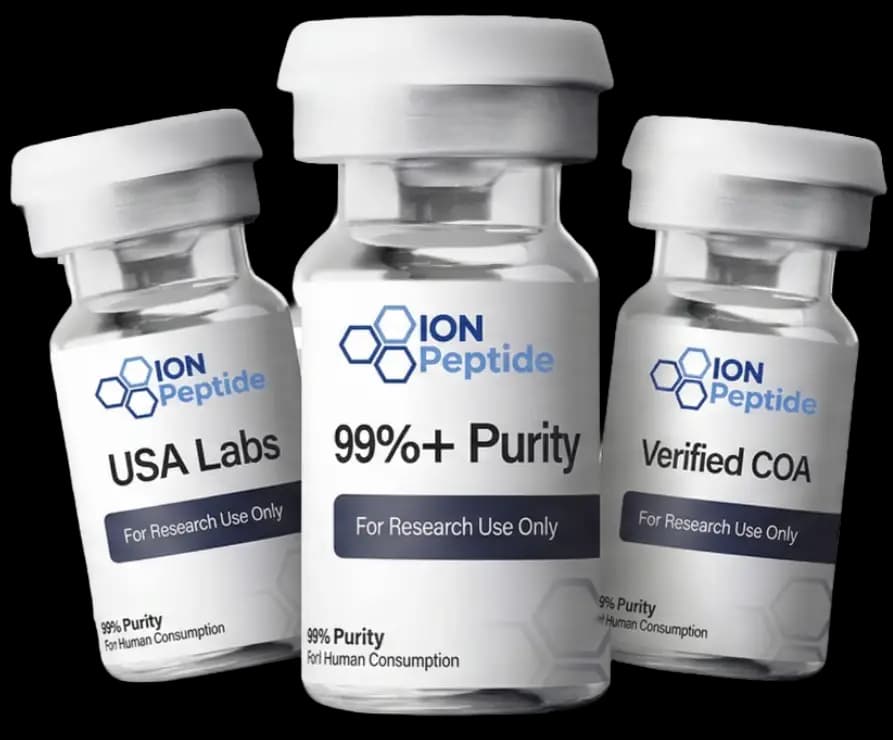
Cerebrolysin Supply
5-Vial Tote Case
At-Home Blood Test
Research Supplies
Disclosure: supply links may earn PDP a commission at no cost to you.
Cerebrolysin 60 mg Research Vials
Whole-vial counts below use the community-reported daily amount and a 60 mg research vial. Round up so the planned week is fully covered.
| Protocol week | Simple math |
|---|---|
Week 1, Week 2 3 x 60 mg vials | Week 1: 20 mg/day x 7 days = 140 mg total; 3 vials provide 180 mg.; Week 2: 24 mg/day x 7 days = 168 mg total; 3 vials provide 180 mg. |
Week 3 4 x 60 mg vials | 28 mg/day x 7 days = 196 mg total; 4 vials provide 240 mg. |
Week 4+ 4 x 60 mg vials per week | 32 mg/day x 7 days = 224 mg per week; 4 vials provide 240 mg. |
Week 1, Week 2
3 x 60 mg vials
Week 1: 20 mg/day x 7 days = 140 mg total; 3 vials provide 180 mg.; Week 2: 24 mg/day x 7 days = 168 mg total; 3 vials provide 180 mg.
Week 3
4 x 60 mg vials
28 mg/day x 7 days = 196 mg total; 4 vials provide 240 mg.
Week 4+
4 x 60 mg vials per week
32 mg/day x 7 days = 224 mg per week; 4 vials provide 240 mg.
3 mL Vial Capacity
Capacity is a container limit, not a dosing instruction. Keep the math in milligrams unless a product insert or qualified clinician gives a specific prep volume.
| Protocol week | Simple math |
|---|---|
Each vial 60 mg total | The vial can hold up to 3 mL. That does not mean 3 mL is required. |
Each vial
60 mg total
The vial can hold up to 3 mL. That does not mean 3 mL is required.
This is research planning math, not a treatment plan. The general injection-supplies card is standard site content and does not mean you should self-administer an IV or IM drug. Round up for spares.
Companion Supplies & Routine Support
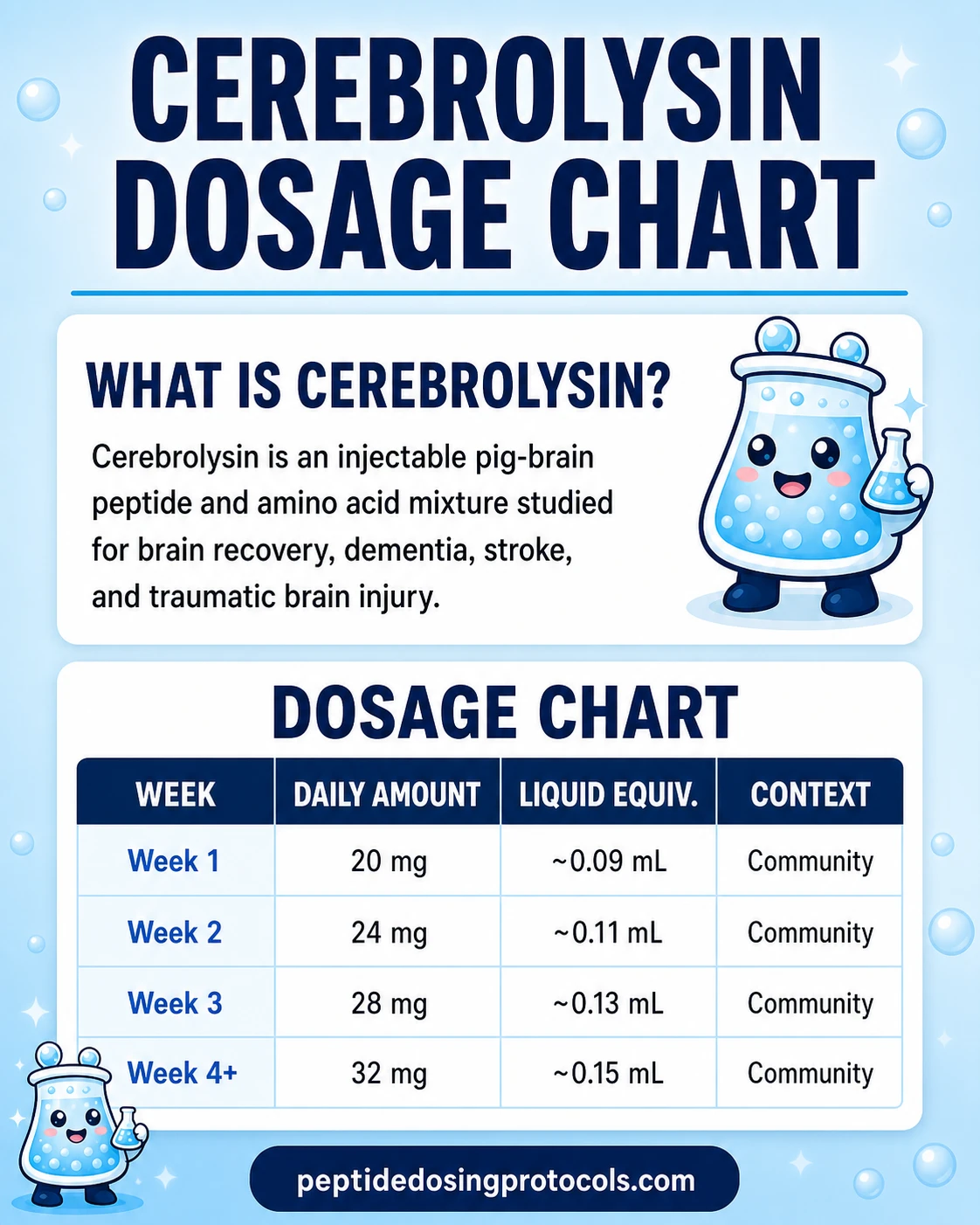
Cerebrolysin Dosage Chart
This Cerebrolysin dosage chart summarizes the community-derived daily mg pattern from 20 mg to 32 mg, with liquid-equivalent context shown for scale only.
Cerebrolysin Form & Administration
The standard EVER Pharma Cerebrolysin product is different from most research peptides. It is not a dry powder. It comes as a clear, slightly yellow liquid already sealed in ampoules or vials. That means the clinical product has no reconstitution step and no bacteriostatic water.
Each 1 mL of the standard liquid contains 215.2 mg of concentrate. Common liquid sizes are 5 mL and 10 mL ampoules and 30 mL vials. Some research sellers list Cerebrolysin-style products by mg instead. Those should not be confused with the clinical ampoule math.
How the Two Routes Are Handled
Route
IV infusion
Preparation
Diluted in saline, infused slowly over 20-60 min
Typical limit
Up to 50-60 mL/day in trials
Route
IM injection
Preparation
Given undiluted from the ampoule
Typical limit
About 5 mL per single injection
| Route | Preparation | Typical limit |
|---|---|---|
| IV infusion | Diluted in saline, infused slowly over 20-60 min | Up to 50-60 mL/day in trials |
| IM injection | Given undiluted from the ampoule | About 5 mL per single injection |
Preparation and administration are done by trained staff in the countries where Cerebrolysin is approved.
Liquid and powder math are different
For the standard liquid, there is no powder to mix and no BAC-water step. If a research product is sold by mg, treat that as a separate product format and do not use clinical mL dosing to guess a draw volume.
How Cerebrolysin Works
In plain terms, Cerebrolysin is meant to act like the brain's own repair signals. The body makes proteins called neurotrophic factors that help brain cells survive, grow, and connect. Cerebrolysin's peptide pieces are described as mimicking that kind of signal.
About one quarter of the mixture is small peptides with this neurotrophic-like activity, said to resemble BDNF, GDNF, NGF, and CNTF. The rest is free amino acids, which are simple building blocks that brain cells can use for energy and repair.
Researchers describe several possible effects: protecting cells from injury, calming brain inflammation, and supporting new connections between neurons. It is important to be clear that much of this comes from lab and animal studies. Showing an effect in a dish or a rat does not prove the same result in people.
- Peptide fraction (about 25%) mimics neurotrophic (repair-signal) activity.
- Amino acid fraction (about 75%) acts as fuel and raw material for neurons.
- Reported lab effects: neuroprotection, less inflammation, support for new connections.
- Main limit: many mechanism claims rest on preclinical (lab/animal) work.
Who Should Avoid Cerebrolysin
Because Cerebrolysin is made from pig brain proteins, allergy is a real concern. Anyone with a known allergy to the product or to porcine-derived material should not use it. Rare but serious allergic reactions, including anaphylaxis, have been reported.
- Known allergy to Cerebrolysin or to pig-derived ingredients.
- Severe kidney problems (label caution in some countries).
- Epilepsy or a seizure disorder — some labels caution against use.
- Pregnancy and breastfeeding — safety is not established.
- Anyone unsure about drug interactions should ask a clinician first.
Allergy and seizure caution
This is not a full contraindication list. Approved-country labels list specific warnings, and a clinician should review personal risk before any use.
Cerebrolysin Side Effects
The manufacturer describes side effects as usually mild and not common. The ones reported most often are dizziness, headache, sweating, and nausea. Some people feel warm or lightheaded if an IV dose is given too fast, which is why it is infused slowly.
Serious reactions are rare but possible. The main one to know is a severe allergic reaction (anaphylaxis), since the product comes from animal tissue. Signs can include trouble breathing, a rash, severe dizziness, or swelling, and need emergency care right away.
One more honest point on safety: the 2023 Cochrane review of acute ischaemic stroke found moderate-certainty evidence of more non-fatal serious adverse events with Cerebrolysin than placebo, even though total serious events were not clearly increased. That is a reason to treat the safety picture as "generally mild, but not fully settled."
- Most common: dizziness, headache, sweating, nausea.
- Fast IV push can cause a hot or lightheaded feeling.
- Rare but serious: allergic reaction / anaphylaxis.
- Cochrane noted a signal of more non-fatal serious adverse events in stroke.
Cerebrolysin Timeline & What Trials Measured
Cerebrolysin is not a fast, same-day compound. It is given in courses, and trials usually measured results at the end of a course and then at follow-up points, often 30 to 90 days later.
In some dementia and Alzheimer's trials, cognitive and global scores improved by the end of a roughly 4-week course, and a few studies reported that effects lasted for several months afterward. In stroke, the timing question is still debated, and the largest trial did not show a clear overall benefit.
- Course-based, not a single dose.
- Trial checkpoints: end of course, then 30-90 day follow-up.
- Some dementia trials reported effects lasting a few months.
- Stroke benefit and best timing remain uncertain.
Cerebrolysin Clinical Evidence
Cerebrolysin has been studied for decades, with large randomized trials. But the results are genuinely mixed, and different high-quality reviews reach different conclusions. Here is the honest split by condition.
Acute ischaemic stroke — mixed, leaning cautious
The 2023 Cochrane review found no clear clinical benefit and a moderate-certainty signal of more non-fatal serious adverse events. The large CASTA trial missed its main goal, though a smaller severe-stroke subgroup showed a favorable trend. Some newer meta-analyses report a small improvement on the NIHSS stroke scale, while functional independence was not clearly better.
Vascular dementia — possible benefit, not proven
A 2013 Cochrane review reported possible gains in cognitive and global function in mild-to-moderate vascular dementia but did not recommend routine use. The 2019 update judged the evidence still insufficient because trials were few, varied, and short.
Alzheimer's disease — some positive trials, early stage
Several RCTs reported improvements in cognitive and global scores, with some effects lasting months. In the U.S., Alzforum lists Cerebrolysin at Phase 2 for Alzheimer's, meaning it is still investigational there.
Traumatic brain injury — supportive signals
Trials such as the CAPTAIN program reported better recovery and mood outcomes in moderate-to-severe TBI, but these are moderate-sized studies rather than definitive proof.
Nootropic / healthy-brain use — little direct evidence
Most rigorous studies are in people with a brain injury or disease. Strong human evidence for cognitive enhancement in healthy adults is limited, so cognitive-boost claims for healthy users should be read with caution.
Why reviews disagree
Some trials had people drop out or reported outcomes selectively, and many were run in regions where Cerebrolysin is popular. Reviewers weigh these limits differently, which is why conclusions vary.
Cerebrolysin Storage & Handling
Cerebrolysin Storage
Temperature
Cerebrolysin (liquid ampoule/vial)
Below 77F (25C), room temperature
Light
Cerebrolysin (liquid ampoule/vial)
Keep in original box, away from light
Freezing
Cerebrolysin (liquid ampoule/vial)
Do not freeze
Appearance
Cerebrolysin (liquid ampoule/vial)
Clear, slightly yellow
After opening
Cerebrolysin (liquid ampoule/vial)
Use right away; single-use ampoules
| Cerebrolysin (liquid ampoule/vial) | |
|---|---|
| Temperature | Below 77F (25C), room temperature |
| Light | Keep in original box, away from light |
| Freezing | Do not freeze |
| Appearance | Clear, slightly yellow |
| After opening | Use right away; single-use ampoules |
Discard any ampoule that looks cloudy, has particles, or has changed color.
For the standard liquid, there is no powder to keep frozen and no mixed solution to save for later. Each ampoule is meant for one use. Research vials may have different storage rules, so check the product label.
Cerebrolysin Troubleshooting
- Cloudy or discolored liquid: do not use it. Cerebrolysin should look clear and slightly yellow.
- Feeling hot or dizzy during an IV: usually linked to infusing too fast; this is managed clinically by slowing the drip.
- Missed a course day: courses are planned as a set, so a missed session is a question for the supervising clinician, not a reason to double up.
- Route confusion: large doses use IV, not IM; a single IM shot is capped around 5 mL. It is not a subcutaneous insulin-syringe peptide.
- Any allergy signs (rash, swelling, trouble breathing): stop and seek emergency care.
Cerebrolysin Regulatory Status
As of July 2026, Cerebrolysin is not approved by the U.S. Food and Drug Administration for any medical use. It cannot be prescribed or sold as a drug in the United States. In the U.S., it exists only as a research-use-only material.
Outside the U.S., it is a different story. Cerebrolysin is a registered prescription drug in more than 40 countries, including Austria (where maker EVER Neuro Pharma is based), Germany, China, Russia, and South Korea. Approval in another country does not mean it is legal to use as a drug in the U.S.
Check your local law
Legal status varies by country and can change. Confirm the current rules where you live before buying or importing anything, and remember that research-use-only material is not meant for human use.
Cerebrolysin vs Similar Compounds
People often compare Cerebrolysin with Semax and with cerebroprotein hydrolysate. They are related in goal but not interchangeable.
Cerebrolysin vs Semax vs Cerebroprotein Hydrolysate
Feature
What it is
Cerebrolysin
Pig-brain peptide + amino acid mix
Semax
Short synthetic peptide
Cerebroprotein hydrolysate
Pig-brain protein hydrolysate
Feature
How given
Cerebrolysin
IV infusion or IM
Semax
Usually intranasal drops/spray
Cerebroprotein hydrolysate
IV or IM
Feature
Main idea
Cerebrolysin
Supplies repair-like signals
Semax
Nudges the body's own BDNF
Cerebroprotein hydrolysate
Similar hydrolysate concept
Feature
Note
Cerebrolysin
Most studied of the three
Semax
Different molecule and route
Cerebroprotein hydrolysate
Similar but not identical to Cerebrolysin
| Feature | Cerebrolysin | Semax | Cerebroprotein hydrolysate |
|---|---|---|---|
| What it is | Pig-brain peptide + amino acid mix | Short synthetic peptide | Pig-brain protein hydrolysate |
| How given | IV infusion or IM | Usually intranasal drops/spray | IV or IM |
| Main idea | Supplies repair-like signals | Nudges the body's own BDNF | Similar hydrolysate concept |
| Note | Most studied of the three | Different molecule and route | Similar but not identical to Cerebrolysin |
These are different products with different evidence and routes. They should not be treated as swaps for each other.
For readers looking at cognitive-focused peptides, see the Semax and Selank protocol pages for how those short peptides differ in route and evidence.
FAQ
Q1: What is Cerebrolysin?
Cerebrolysin is an injectable medicine made from purified pig brain proteins. Those proteins are broken down into a mix of small peptides and free amino acids. It is studied for brain conditions like stroke, traumatic brain injury, and dementia.
Q2: What is Cerebrolysin used for?
In countries where it is approved, it is used during recovery from stroke and traumatic brain injury and in some types of dementia. In the United States it is not approved for any use and is treated as research-use-only.
Q3: How does Cerebrolysin work?
It is thought to act like the brain's own repair signals, called neurotrophic factors. About a quarter of the mixture is peptides with that repair-like activity, and the rest is amino acids the brain can use. Much of the mechanism evidence comes from lab and animal studies.
Q4: Is Cerebrolysin FDA approved?
No. As of July 2026 it is not approved by the FDA for any medical use in the United States. It is approved as a prescription drug in more than 40 other countries, but that does not make it legal to use as a drug in the U.S.
Q5: How is Cerebrolysin dosed in trials?
Trial dosing uses the standard liquid, so it is listed in milliliters. Dementia trials often used 5 to 30 mL per day, and stroke or TBI trials often used 10 to 60 mL per day. At 215.2 mg/mL, those are much larger amounts than the low-dose community mg pattern. These figures are research context, not a recommendation.
Q6: Does Cerebrolysin need to be reconstituted or mixed with BAC water?
The standard EVER Pharma clinical product is a ready-to-use liquid, so it does not use BAC water. Higher IV doses may be diluted in saline in a clinical setting. Research products sold by milligrams may be a different format, so their prep should not be guessed from the clinical liquid.
Q7: How is Cerebrolysin given?
By slow IV infusion into a vein for higher doses, or by intramuscular (IM) injection into a muscle for smaller amounts, with a single IM shot usually capped around 5 mL. It is not designed for the small under-the-skin insulin-syringe dosing used with many other peptides.
Q8: What are the side effects of Cerebrolysin?
The most common are dizziness, headache, sweating, and nausea, usually mild. A fast IV dose can cause a hot or lightheaded feeling. The rare but serious risk is a severe allergic reaction, since it comes from animal tissue.
Q9: Cerebrolysin vs Semax — what is the difference?
Cerebrolysin is a pig-brain peptide and amino acid mixture given by IV or IM. Semax is a short synthetic peptide usually used as intranasal drops that is thought to nudge the body's own BDNF. They are different molecules with different routes and are not interchangeable. See the Semax protocol for more.
Q10: Where can I buy Cerebrolysin, and is it legal?
In the U.S. it is not FDA-approved and is sold only as research-use-only material, not for human use. Legal status varies by country and can change, so confirm your local rules before buying or importing. This page does not endorse a specific seller or price.
Q11: How long is a Cerebrolysin course?
Courses in trials commonly run 10 to 21 days for stroke and TBI, and about 4 weeks for dementia, sometimes repeated every few months. It is used as a time-limited course rather than a daily open-ended medicine.
Q12: Is this page medical advice?
No. This is an educational research reference, not medical advice or a treatment plan. Cerebrolysin is an IV/IM drug used in clinical settings where it is approved. Talk to a qualified clinician before considering any peptide.
Sources & Research
- 1. Ziganshina LE, Abakumova T, Nurkhametova D, Ivanchenko K Cerebrolysin for acute ischaemic stroke. Cochrane Database of Systematic Reviews (2023)
- 2. Cui S, Chen N, Yang M, Guo J, Zhou M, Zhu C, He L Cerebrolysin for vascular dementia (2019 update). Cochrane Database of Systematic Reviews (2019)
- 3. Chen N, Yang M, Guo J, Zhou M, Zhu C, He L Cerebrolysin for vascular dementia. Cochrane Database of Systematic Reviews (2013)
- 4. Systematic review and meta-analysis (14 RCTs, N=2,884) Safety and Efficacy of Cerebrolysin for Neurorecovery After Acute Ischemic Stroke. PMC (Cureus) (2025)
- 5. Meta-analysis of randomized controlled trials Efficacy and Safety of Cerebrolysin for Acute Ischemic Stroke. PubMed / BioMed Research International (2017)
- 6. Alzforur Therapeutics database Cerebrolysin — Therapeutics profile (U.S. Phase 2; approved outside U.S.). Alzforum (2026)
- 7. Wikipedia contributors Cerebrolysin (composition, development code FPF-1070, countries of use). Wikipedia (2026)
- 8. Review of late-stage Alzheimer's drug development Successes and Failures for Drugs in Late-Stage Development for Alzheimer's Disease. PMC (2014)
- 9. Muresanu IA, Grad DA, Muresanu DF, et al. Effect of Cerebrolysin on Anxiety, Depression, and Cognition in TBI (CAPTAIN II analysis). Medicina (2022)
- 10. EVER Neuro Pharma Cerebrolysin FAQ (common adverse reactions: dizziness, headache, sweating, nausea). cerebrolysin.com (manufacturer) (2026)
- 11. Case report on cerebrolysin safety Safety profile of cerebrolysin: severe anaphylactic reaction after IV administration. ResearchGate (peer-reviewed case report) (2013)
- 12. Zupan M, et al. (University Medical Centre Ljubljana) Cerebrolysin in Early Stroke Rehabilitation (registry entry; composition: 215.2 mg/mL). ClinicalTrials.gov (NCT07043686) (2025)
Related Dosing Protocols
Educational use only
This guide is an educational research reference, not medical advice or a treatment plan. Cerebrolysin is not FDA-approved in the United States. Dosing figures describe published trials and approved-country labels and are not recommendations.
Explore more research protocols
Browse other peptide dosing references and comparisons on Peptide Dosing Protocols.

Written by Garret Grant
Founder & Lead Researcher · B.S. Civil Engineering, UCLA
Last updated: July 2026
Human-researched and AI-assisted with full editorial review. I verify sources, protocol interpretation, and final judgments personally. See methodology.
Share this page