DSIP Quick Start
DSIP, or delta sleep-inducing peptide, is a small nine-amino-acid peptide that was first isolated from the cerebral venous blood of sleeping rabbits in the 1970s. It is named for its early observation of promoting delta-wave activity in EEG recordings, the slow brain waves that mark deep non-REM sleep.
The FDA refers to DSIP in the Federal Register as Emideltide. As of September 2023 it is on the FDA's Category 2 list of bulk drug substances that may not be compounded due to significant safety risks, and the agency has scheduled a Pharmacy Compounding Advisory Committee (PCAC) review for July 2026 covering proposed uses in opioid withdrawal, chronic insomnia, and narcolepsy.
Route
Subcutaneous research-use injection is the most commonly described format. Older human trials used short intravenous courses.
Schedule
Most community research planning describes a single evening dose 1-3 hours before intended sleep, run for short cycles.
Measure
Use vial concentration and U-100 syringe units to draw small volumes accurately.
Supplies
Plan vials, U-100 insulin syringes, bacteriostatic water, and alcohol swabs by cycle length.
Research status
Not FDA-approved. Currently on FDA Category 2 with a PCAC review scheduled for July 2026.
Disclaimer
This page is an educational research reference and is not medical advice. DSIP is not FDA-approved and is currently on the FDA Category 2 do-not-compound list. Talk to a qualified clinician before any peptide use.
This page covers DSIP dose planning and protocol notes. Want the larger research view? Read the DSIP research guide. It covers sleep studies, safety notes, and other options.
DSIP Dosing Protocol & Schedule
Two distinct dosing patterns appear in the DSIP literature. The published human trials from the 1980s used 25 nmol/kg intravenously for short courses, typically four to seven nights, in chronic-insomniac volunteers. Community research planning today is mostly subcutaneous and uses much lower doses based on tolerability rather than nmol/kg targets.
The numbers below are reported research-context dose ranges. They are not a recommendation, and there is no modern, well-powered, FDA-recognized human trial that establishes a clinically validated dose.
DSIP Reported Research-Context Dose Ranges
Pattern
Older human trials
Typical Range
25 nmol/kg
Route
IV
Notes
Short 4-7 night courses; published 1981-1987 in middle-aged chronic insomniacs.
Pattern
Lower research planning
Typical Range
100-200 mcg
Route
SubQ
Notes
Most common community range; described in research write-ups, not clinical trials.
Pattern
Higher research planning
Typical Range
200-300 mcg
Route
SubQ
Notes
Used in some research write-ups; tolerability and side-effect data are sparse.
| Pattern | Typical Range | Route | Notes |
|---|---|---|---|
| Older human trials | 25 nmol/kg | IV | Short 4-7 night courses; published 1981-1987 in middle-aged chronic insomniacs. |
| Lower research planning | 100-200 mcg | SubQ | Most common community range; described in research write-ups, not clinical trials. |
| Higher research planning | 200-300 mcg | SubQ | Used in some research write-ups; tolerability and side-effect data are sparse. |
This is not a dosing recommendation. The 25 nmol/kg figure is a published trial protocol, not a community-style mcg dose.
Cycle Guidelines
Cycle Guidelines (Research Planning)
Approach
Short course
Duration
5-7 nights
Review Point
End of week 1
Typical Context
Mirrors published human trial windows.
Approach
Standard cycle
Duration
4 weeks
Review Point
Week 4
Typical Context
General research planning context.
Approach
Extended cycle
Duration
6-8 weeks
Review Point
Week 6
Typical Context
Less common; long-term safety data is limited.
| Approach | Duration | Review Point | Typical Context |
|---|---|---|---|
| Short course | 5-7 nights | End of week 1 | Mirrors published human trial windows. |
| Standard cycle | 4 weeks | Week 4 | General research planning context. |
| Extended cycle | 6-8 weeks | Week 6 | Less common; long-term safety data is limited. |
Long-term human safety has not been formally established. Older reviews note limited side effects but the data set is small.
Boundary
This is not a dosing recommendation. Published human trials of DSIP are decades old, used very small samples, and produced mixed results.
DSIP Supplies Needed
Affiliate disclosure: PDP may earn a commission when you use eligible supplier links, at no extra cost to you. The cycle math below assumes one evening subcutaneous research-use draw per day from a 10 mg vial reconstituted with 2.0 mL bacteriostatic water.
Recommended U.S. and Canada Supply
Choose your region
Use discount code PEPPAL at Peptide Partners checkout. See why we love Peptide Partners.
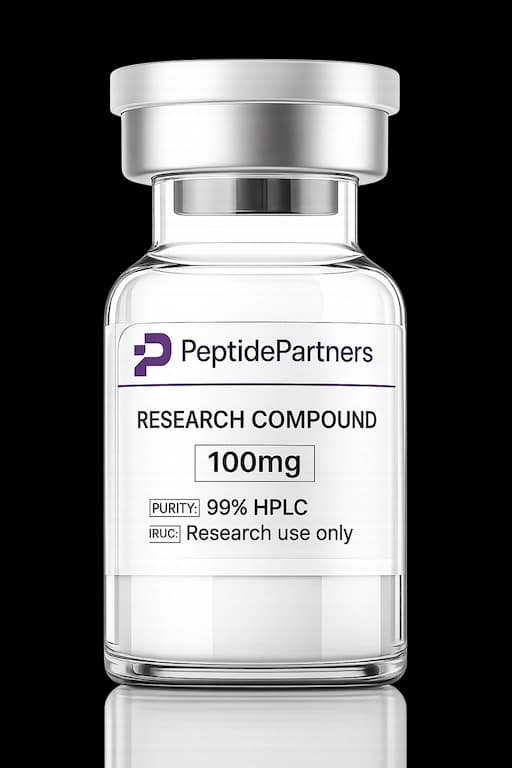
DSIP (5mg vials)
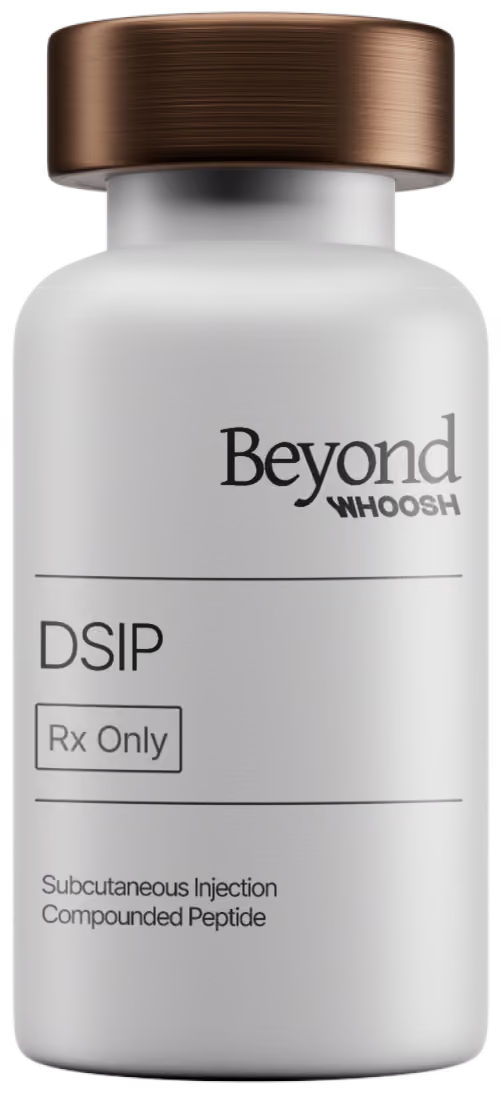
Pharmacy Grade DSIP
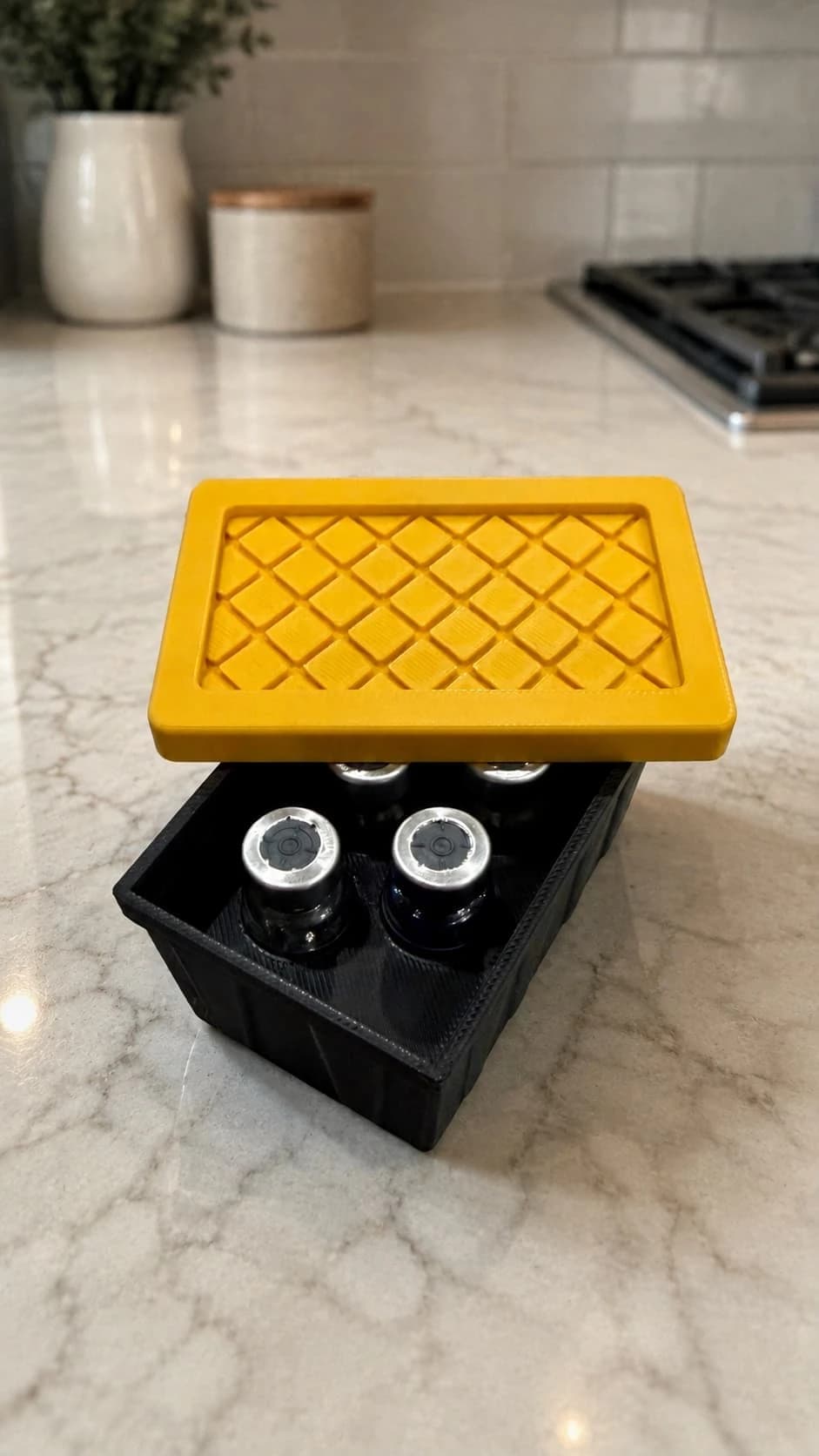
5-Vial Tote Case
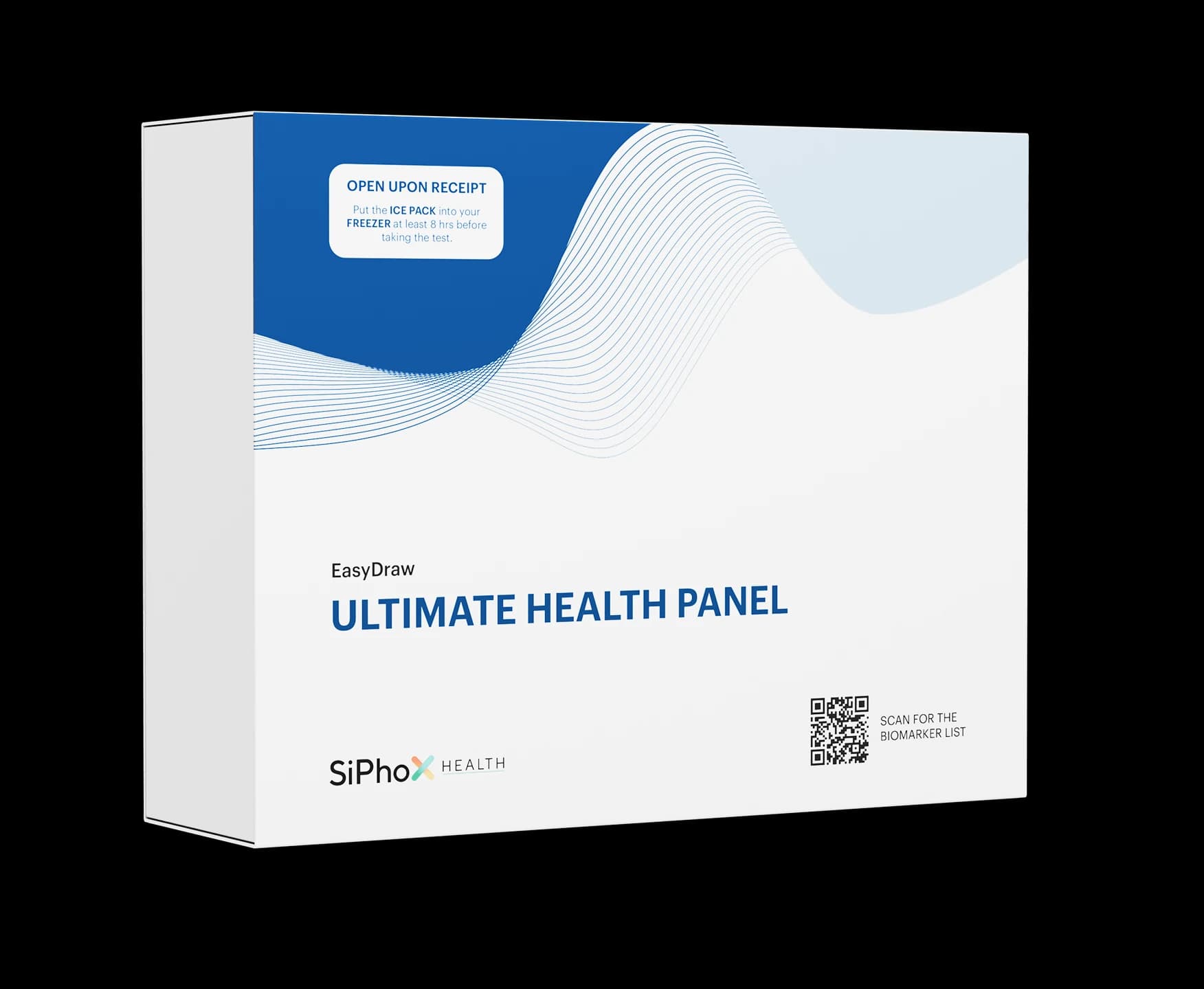
At-Home Blood Test
Research Supplies
Disclosure: supply links may earn PDP a commission at no cost to you.
DSIP Vials
The math below assumes a 10 mg lyophilized vial reconstituted with 2.0 mL BAC water = 5 mg/mL.
| Cycle length | Planning note |
|---|---|
1 week, 4 weeks 1 x 10 mg vial | 1 week: 7 evening draws; comfortable margin for priming losses.; 4 weeks: 28 daily draws; one 10 mg vial covers a standard cycle at ~150-300 mcg/day. |
6-8 weeks 2 x 10 mg vials | 6 weeks: 42 daily draws; second vial adds margin for higher-dose planning.; 8 weeks: 56 daily draws with margin for priming loss. |
1 week, 4 weeks
1 x 10 mg vial
1 week: 7 evening draws; comfortable margin for priming losses.; 4 weeks: 28 daily draws; one 10 mg vial covers a standard cycle at ~150-300 mcg/day.
6-8 weeks
2 x 10 mg vials
6 weeks: 42 daily draws; second vial adds margin for higher-dose planning.; 8 weeks: 56 daily draws with margin for priming loss.
Insulin Syringes (U-100)
0.3 mL / 30-unit syringes are easiest for the small evening draws DSIP usually requires.
| Cycle length | Planning note |
|---|---|
1 week 7 syringes | 1 syringe per injection. |
4 weeks 28 syringes | 1 syringe per injection. |
6 weeks 42 syringes | 1 syringe per injection. |
8 weeks 56 syringes | 1 syringe per injection. |
1 week
7 syringes
1 syringe per injection.
4 weeks
28 syringes
1 syringe per injection.
6 weeks
42 syringes
1 syringe per injection.
8 weeks
56 syringes
1 syringe per injection.
Bacteriostatic Water
2.0 mL BAC water per 10 mg vial gives a clean 5 mg/mL working concentration.
| Cycle length | Planning note |
|---|---|
1 week, 4 weeks, 6 weeks, 8 weeks 1 x 10 mL bottle | 1 week: 1 vial uses 2 mL total; one bottle gives wide margin.; 4 weeks: 1 vial uses 2 mL total.; 6 weeks: 2 vials use 4 mL total.; 8 weeks: 2 vials use 4 mL total. |
1 week, 4 weeks, 6 weeks, 8 weeks
1 x 10 mL bottle
1 week: 1 vial uses 2 mL total; one bottle gives wide margin.; 4 weeks: 1 vial uses 2 mL total.; 6 weeks: 2 vials use 4 mL total.; 8 weeks: 2 vials use 4 mL total.
Round up for priming losses, dropped syringes, damaged swabs, and any protocol adjustments.
Companion Supplies & Routine Support
DSIP Reconstitution Calculator

Powered by PepPal
DSIP Reconstitution Calculator
Start with the protocol example, then customize every field.
Loaded reference
PDP 10 mg vial example
Your draw
2units
0.02 mL on a U-100 insulin syringe
- Concentration
- 5 mg/mL
- Target in mg
- 0.1 mg
- Math-only doses per vial
- 100
One free emailed save per person, checked by PepPal.
Educational calculation tool only. The loaded amount is a reference from this page, not a personal dose recommendation. Confirm the vial label, route, syringe type, and actual liquid added before relying on a result.
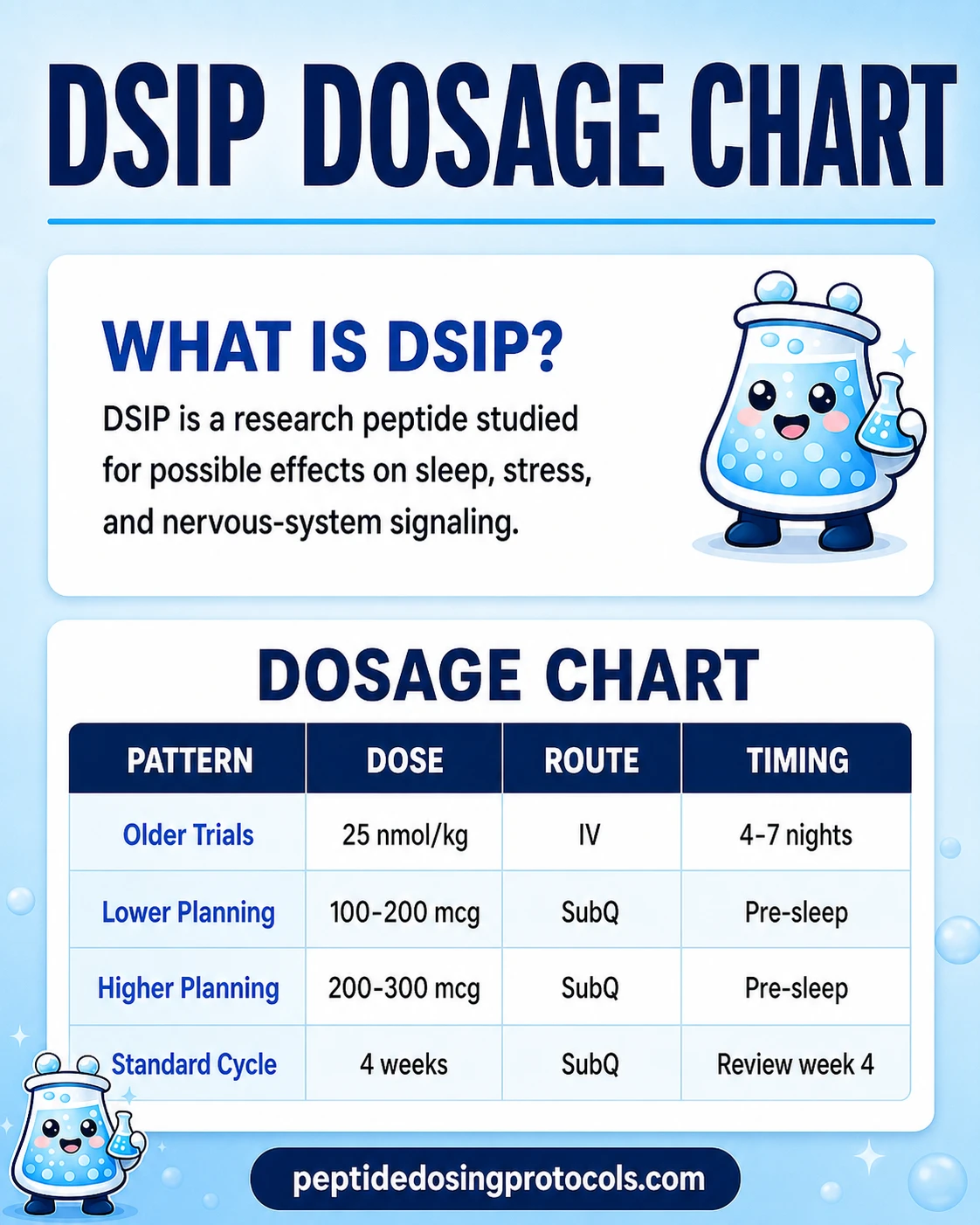
DSIP Dosage Chart
This DSIP dosage chart summarizes the IV trial context and SubQ research-planning ranges from 100 mcg to 300 mcg shown in the dosing section above.
DSIP Reconstitution Guide
Reconstitution turns a lyophilized DSIP vial into a measurable liquid. This guide assumes a 10 mg vial. Adding 2.0 mL of bacteriostatic water gives a 5 mg/mL working concentration, where 100 mcg equals 2 units on a standard U-100 insulin syringe.
DSIP Reconstitution Math (10 mg vial)
Vial
10 mg
BAC water
2.0 mL
Concentration
5.0 mg/mL (5,000 mcg/mL)
100 mcg draw
0.02 mL = 2 units
200 mcg draw
0.04 mL = 4 units
300 mcg draw
0.06 mL = 6 units
| Vial | BAC water | Concentration | 100 mcg draw | 200 mcg draw | 300 mcg draw |
|---|---|---|---|---|---|
| 10 mg | 2.0 mL | 5.0 mg/mL (5,000 mcg/mL) | 0.02 mL = 2 units | 0.04 mL = 4 units | 0.06 mL = 6 units |
Units shown are U-100 insulin-syringe units. 10 units = 0.10 mL.
- 01
Inspect the vial
Check the label, lot number, fill, and powder appearance before reconstitution.
- 02
Wipe both stoppers
Use a fresh alcohol swab on the BAC water vial stopper and the DSIP vial stopper.
- 03
Draw the BAC water
Draw 2.0 mL of bacteriostatic water into a syringe with a sterile drawing needle.
- 04
Add slowly down the side
Inject the BAC water slowly down the inner wall of the DSIP vial. Do not spray it directly onto the powder.
- 05
Swirl gently
Roll or swirl the vial gently until the powder fully dissolves. Do not shake.
- 06
Label and date
Mark the reconstitution date and concentration on the vial.
- 07
Refrigerate
Store reconstituted DSIP at 35.6-46.4F (2-8C) and use within typical research peptide stability windows.
Helpful tool
For unit-conversion math across other vial sizes, use the PepPal reconstitution calculator.
How DSIP Works
DSIP is a small naturally occurring nonapeptide with the amino acid sequence Trp-Ala-Gly-Gly-Asp-Ala-Ser-Gly-Glu and a molecular weight of about 849 daltons. Its name comes from the early observation that infusion produced delta-wave (slow-wave) EEG activity in rabbits.
Despite decades of work, the precise receptor and mechanism are still not fully established. Reviews describe possible interactions with NMDA receptors, alpha-adrenergic signaling, opioid receptors, and the hypothalamic-pituitary-adrenal axis. DSIP-like material has been found in the hypothalamus, limbic system, pituitary, and gut.
Older work characterized DSIP as a sleep-modulating peptide rather than a sedative, with a U-shaped activity curve where small doses or short infusions produced the strongest effect.
Who DSIP Is For and Who Should Avoid It
DSIP is a research-use compound. There is no FDA-approved indication, dose, or population. The points below are general boundaries that show up in the literature and in compounding-pharmacy review.
- Pregnancy and lactation: not studied; should be avoided.
- Children and adolescents: no human pediatric data.
- Untreated obstructive sleep apnea: any sleep-modulating compound deserves clinical oversight.
- Active substance dependence: published trials in opioid- and alcohol-withdrawal contexts were small and used clinical settings, not self-directed protocols.
- Adrenal or thyroid disease: DSIP can interact with HPA-axis signaling; clinical oversight is warranted.
- Anyone on sedating medications: combined effects are not well characterized.
DSIP Side Effects & Safety
Older human trials and reviews report that DSIP appeared well tolerated at the doses tested, with transient effects such as mild headache, nausea, and dizziness in some subjects. Long-term safety has not been formally established.
Reported and Theoretical Risks
- Mild transient headache or nausea reported in some early human studies.
- Possible morning sluggishness or vivid dream effects described in research write-ups.
- Theoretical immunogenicity flagged by FDA in the Category 2 listing.
- Possible interaction with HPA-axis hormones; not characterized in modern trials.
- Quality-control risk for any research-use peptide (purity, contamination, mislabeling).
Quality-control note
Because DSIP is research-use only, batch-level COA review and supplier verification matter. Read PepPal's how-to-read-a-peptide-COA guide before ordering.
DSIP Timeline & What to Monitor
Older trials measured sleep architecture changes within the first or second night of dosing, using polysomnography. Subjective sleep-quality changes were sometimes reported on the first night and built up across short courses.
- Night 1-2: subjective sleep changes are most often reported here.
- Week 1: short-course trials measured sleep architecture and daytime alertness across 5-7 nights.
- Week 4: end of a typical research planning cycle and reasonable review point.
- Long-term: no reliable long-term outcome data exists.
Reasonable things to track during a research cycle include subjective sleep quality, time to fall asleep, number of awakenings, morning alertness, and any side effects. Treatment of an actual sleep disorder belongs with a clinician, not with a research-use peptide.
DSIP Clinical Evidence Context
Human evidence
A handful of small placebo-controlled studies in chronic insomniacs from 1981-1987 reported modest improvements in total sleep time, sleep efficiency, and daytime function. Other studies in the same era found that improvement did not reach clinically significant differences from placebo. Sample sizes were 6-14 subjects.
Withdrawal context
Russian and Eastern-European trials examined DSIP in opioid- and alcohol-withdrawal settings and reported reduced symptom severity in case-series and open-label work. These were not modern double-blind RCTs.
Preclinical evidence
DSIP has been studied in rabbits, rats, mice, and cats; it crosses the blood-CSF barrier; it has been tied to delta-wave EEG activity, neurotransmitter changes, motor recovery in rat stroke models, and HPA-axis signaling.
Evidence gap
There is no modern, large-sample, FDA-recognized RCT establishing DSIP's efficacy in any indication. The PCAC review scheduled for July 2026 is the next formal regulatory review point.
DSIP Storage & Handling
DSIP Storage
State
Lyophilized (Powder Form)
Storage
-4F (-20C) long-term
Notes
Use supplier label and stability data; protect from light.
State
Reconstituted (Liquid Form)
Storage
35.6-46.4F (2-8C)
Notes
Use within typical research peptide stability windows; refer to supplier guidance.
| State | Storage | Notes |
|---|---|---|
| Lyophilized (Powder Form) | -4F (-20C) long-term | Use supplier label and stability data; protect from light. |
| Reconstituted (Liquid Form) | 35.6-46.4F (2-8C) | Use within typical research peptide stability windows; refer to supplier guidance. |
Do not freeze reconstituted DSIP. Discard if cloudy, discolored, or past beyond-use date.
DSIP Protocol Mistakes & Troubleshooting
- Missed evening dose: most research write-ups simply skip and resume the next night rather than doubling up.
- Cloudy vial after reconstitution: do not use; contact the supplier and review the COA.
- Wrong BAC-water volume: recalculate concentration before drawing; do not guess. Use the PepPal calculator.
- Morning grogginess: most research write-ups describe shifting the dose earlier in the evening before lowering the dose itself.
- Site rotation and reconstitution/storage review are standard clinical guidance; persistent reactions warrant medical evaluation.
- Storage mistake: if reconstituted DSIP was left at room temperature, treat the vial as compromised.
DSIP Regulatory Status
As of June 2026, DSIP is not FDA-approved for any human indication. The FDA refers to DSIP in the Federal Register as Emideltide.
DSIP/Emideltide was placed on the FDA's Category 2 list of bulk drug substances that may not be compounded due to significant safety risks in September 2023. The FDA's Pharmacy Compounding Advisory Committee (PCAC) is scheduled to review Emideltide in July 2026 for proposed uses in opioid withdrawal, chronic insomnia, and narcolepsy.
Internationally, DSIP is not formally approved as a drug in the EU, UK, Canada, or Australia. WADA does not list DSIP by name on its prohibited substances list as of 2026.
Status check
Regulatory listings change. Verify the current Category 2 / Emideltide status on the FDA website before making any sourcing decisions.
DSIP vs Melatonin vs Epitalon vs Benzodiazepines
DSIP vs Common Sleep-Adjacent Compounds
Compound
DSIP
What it is
Nonapeptide
Mechanism (in plain English)
Modulates sleep architecture; not a sedative.
Regulatory status (US)
Not FDA-approved · Category 2 (2023) · PCAC July 2026
Compound
Melatonin
What it is
Hormone supplement
Mechanism (in plain English)
Shifts sleep timing via the circadian system.
Regulatory status (US)
OTC supplement
Compound
Epitalon
What it is
Tetrapeptide
Mechanism (in plain English)
Studied for circadian/longevity markers; sleep effects anecdotal.
Regulatory status (US)
Not FDA-approved · research-use
Compound
Benzodiazepines
What it is
Prescription drugs
Mechanism (in plain English)
GABA-A agonists; sedate but degrade sleep architecture.
Regulatory status (US)
FDA-approved prescription drugs
| Compound | What it is | Mechanism (in plain English) | Regulatory status (US) |
|---|---|---|---|
| DSIP | Nonapeptide | Modulates sleep architecture; not a sedative. | Not FDA-approved · Category 2 (2023) · PCAC July 2026 |
| Melatonin | Hormone supplement | Shifts sleep timing via the circadian system. | OTC supplement |
| Epitalon | Tetrapeptide | Studied for circadian/longevity markers; sleep effects anecdotal. | Not FDA-approved · research-use |
| Benzodiazepines | Prescription drugs | GABA-A agonists; sedate but degrade sleep architecture. | FDA-approved prescription drugs |
These compounds work through different mechanisms and are not interchangeable.
DSIP Blood Tests & Monitoring
DSIP is usually discussed in sleep and stress-response research. Routine labs do not directly measure sleep-peptide response, so monitoring is mostly a broad health and medication-context screen.
Blood test markers to discuss with a clinician
Marker
CBC with differential
Why it matters
Screens broad blood-cell patterns that may affect fatigue, infection context, or general health interpretation.
Timing
Baseline
Marker
Comprehensive metabolic panel (CMP)
Why it matters
Reviews liver, kidney, electrolyte, and glucose context before interpreting fatigue or sleep changes.
Timing
Baseline
Marker
TSH and free T4
Why it matters
Thyroid imbalance can affect sleep, energy, and mood.
Timing
Optional
Marker
A1c
Why it matters
Glucose swings and metabolic stress can affect sleep quality and fatigue.
Timing
Optional
| Marker | Why it matters | Timing |
|---|---|---|
| CBC with differential | Screens broad blood-cell patterns that may affect fatigue, infection context, or general health interpretation. | Baseline |
| Comprehensive metabolic panel (CMP) | Reviews liver, kidney, electrolyte, and glucose context before interpreting fatigue or sleep changes. | Baseline |
| TSH and free T4 | Thyroid imbalance can affect sleep, energy, and mood. | Optional |
| A1c | Glucose swings and metabolic stress can affect sleep quality and fatigue. | Optional |
Monitoring guidance is pathway-based because DSIP does not have established clinical lab-monitoring standards.
At-home blood test option
Easy at home option to monitor core metrics during research cycles.
Beyond Whoosh
Pharmacy Grade DSIP
Prescription-grade peptide care through Beyond Whoosh. Whoosh prescribes after a clinician reviews your eligibility.
Partner link: PDP may earn a commission at no cost to you.
Simple timing framework
Baseline
Discuss baseline review before starting, especially with sleep disorders, psychiatric history, sedating medications, liver disease, or kidney disease.
Follow-up
Re-check broad labs after 8-12 weeks if the protocol continues or symptoms change.
Longer term
For recurring sleep-focused protocols, review sleep quality, medication changes, and broad health markers periodically.
How to interpret the labs
- Routine labs do not prove whether DSIP is improving sleep architecture.
- Medication interactions, alcohol use, sleep apnea, anxiety, and depression can all affect sleep more than labs show.
- Sleep tracking and symptom logs may be more useful than repeated broad labs alone.
Do not wait for routine labs
Severe daytime sedation, confusion, breathing pauses during sleep, or worsening mood symptoms need clinical review. New suicidal thoughts or severe anxiety changes require urgent help.
FAQ
Q1: What is DSIP peptide?
DSIP, or delta sleep-inducing peptide, is a nine-amino-acid neuropeptide first isolated in 1974 from the cerebral venous blood of sleeping rabbits. It has been studied for sleep, opioid and alcohol withdrawal, stress, and pain modulation. The FDA refers to it as Emideltide.
Q2: Is DSIP FDA-approved?
No. DSIP is not FDA-approved for any human indication. As of September 2023 it is on the FDA Category 2 list of bulk drug substances that may not be compounded, and a PCAC review is scheduled for July 2026 under the name Emideltide.
Q3: What is a typical DSIP dose used in research?
Two patterns appear in the literature. Older human trials used 25 nmol/kg intravenously for short 4-7 night courses. Community research planning today is mostly subcutaneous in the 100-300 mcg range. This is not a dosing recommendation.
Q4: How is DSIP reconstituted?
A common research approach is to add 2.0 mL of bacteriostatic water to a 10 mg vial, which gives a 5 mg/mL working concentration. On a U-100 insulin syringe, 0.02 mL (2 units) is about 100 mcg, 0.04 mL (4 units) is about 200 mcg, and 0.06 mL (6 units) is about 300 mcg. For other vial sizes, use the PepPal reconstitution calculator.
Q5: When is DSIP usually injected?
Most research write-ups describe a single evening subcutaneous research-use dose 1-3 hours before intended sleep. Older human studies used short intravenous courses given in clinical settings.
Q6: What are the reported side effects of DSIP?
Older trials and reviews report mild transient headache, nausea, and occasional dizziness. The FDA flagged theoretical immunogenicity risk in its Category 2 listing. Long-term safety has not been formally established.
Q7: How does DSIP compare to melatonin?
Melatonin is an OTC hormone supplement that mainly shifts sleep timing through the circadian system. DSIP is a research-use peptide that has been described as modulating sleep architecture (especially slow-wave sleep) rather than acting as a sedative. They work through different pathways and are not interchangeable.
Q8: Is DSIP medical advice?
No. This page is an educational research reference. DSIP is not FDA-approved and is currently on the FDA Category 2 do-not-compound list. Talk to a qualified clinician before any peptide use.
Sources & Research
- 1. Graf MV, Kastin AJ. Delta-sleep-inducing peptide (DSIP): a review. Neuroscience and Biobehavioral Reviews (1984)
- 2. Graf MV, Kastin AJ. Delta-sleep-inducing peptide (DSIP): an update. Peptides (1986)
- 3. Kovalzon VM, Strekalova TV. Delta sleep-inducing peptide (DSIP): a still unresolved riddle. Journal of Neurochemistry (2006)
- 4. Schneider-Helmert D, Schoenenberger GA. The influence of synthetic DSIP (delta-sleep-inducing-peptide) on disturbed human sleep. Experientia (1981)
- 5. Schneider-Helmert D. Effects of delta-sleep-inducing peptide on 24-hour sleep-wake behaviour in severe chronic insomnia. European Neurology (1987)
- 6. Salgado-Puga K, et al. Study of delta sleep-inducing peptide efficacy in improving sleep on short-term administration to chronic insomniacs. European Neurology (1987)
- 7. Khvatova EM, et al. Delta sleep-inducing peptide recovers motor function in SD rats after focal stroke. Molecules (2021)
- 8. Wang Z, et al. Pichia pastoris secreted peptides crossing the blood-brain barrier and DSIP fusion peptide efficacy in PCPA-induced insomnia mouse models. Frontiers in Pharmacology (2024)
- 9. U.S. Food and Drug Administration. Certain bulk drug substances for use in compounding that may present significant safety risks (Category 2). FDA.gov (2023)
- 10. Cox JR. Delta sleep-inducing peptide. European Journal of Anaesthesiology (2001)
Related Dosing Protocols

Written by Garret Grant
Founder & Lead Researcher · B.S. Civil Engineering, UCLA
Last updated: August 2026
Human-researched and AI-assisted with full editorial review. I verify sources, protocol interpretation, and final judgments personally. See methodology.
Share this page