

GLOW Peptide Quick Start
GLOW peptide is a research blend that puts three compounds in one vial: BPC-157, TB-500, and GHK-Cu. Researchers and the broader peptide community group these three together because each one targets a different part of how tissue heals and rebuilds. BPC-157 supports new blood vessel growth at injury sites. TB-500 helps repair cells move to where they are needed. GHK-Cu is a copper-binding peptide tied to collagen, elastin, and skin-quality remodeling.
Most GLOW research products are sold pre-blended with a 5:1:1 ratio (50 mg GHK-Cu, 10 mg TB-500, 10 mg BPC-157). That ratio makes GLOW GHK-Cu-dominant, which is why people often associate it with skin and tissue-quality goals more than heavy injury recovery. Some users instead buy three separate vials and run the compounds independently to keep dose control over each one.
Disclaimer
This page is an educational research reference. It is not medical advice. No published human trial has tested BPC-157 + TB-500 + GHK-Cu together. Dosing structure below is community-derived from individual-compound research. Compounds are not FDA-approved.
Reconstitute
Pre-blend: add 3.0 mL bacteriostatic water → about 23.3 mg/mL total blend.
Schedule
Once-daily subcutaneous injection for the pre-blend; separate-vial schedules vary by compound.
Easy measuring
10 units on a U-100 insulin syringe = 0.10 mL = about 2.33 mg total blend.
Supplies
U-100 insulin syringes, 10 mL bacteriostatic water, alcohol swabs, sharps container.
Research status
Not FDA-approved. BPC-157 and TB-500 are WADA-prohibited for athletes.
Need broader context on combining peptides? See PepPal's stacking safety guide. For supplier and quality-control sourcing, see the PepPal supplier directory.
This page covers Glow Stack dosing, timing, and supply planning. For the broader research view, see the Glow Stack research guide on each compound's role, study context, and safety notes.
What Is GLOW Peptide?
GLOW peptide is the research-community name for a blend of three compounds: BPC-157, TB-500, and GHK-Cu. The name comes from the GHK-Cu component, which is most associated with collagen production and skin-quality changes. But GLOW is more than a skin product. It is a recovery-and-remodeling stack with three distinct biological roles.
Think of it like adding a tissue-quality layer to a basic recovery protocol. The simpler Wolverine Stack uses just BPC-157 and TB-500 for repair. GLOW keeps both of those and adds GHK-Cu so the rebuilt tissue ends up more organized — better collagen, better elastin, and a smoother repair process overall.
What Each Compound Does in the GLOW Blend
BPC-157 is a 15-amino-acid peptide first isolated from gastric juice. In animal studies, it has been linked to blood vessel growth at injury sites and tissue protection. It is the most widely studied of the three, with a large body of preclinical literature on tendons, ligaments, and gut tissue. There is no FDA-approved human trial yet.
TB-500 is a synthetic version of a fragment of Thymosin Beta-4. It modulates actin, a protein that gives cells their structure and helps them move. Because of this, TB-500 has been studied for cell migration and tissue remodeling. Limited Phase I and Phase II human trials have looked at thymosin beta-4 for cardiac and wound-healing endpoints.
GHK-Cu (glycyl-L-histidyl-L-lysine bound to copper) is a tripeptide that is naturally present in human plasma. Plasma levels drop significantly with age. It is the most clinically studied of the three, with topical trials showing collagen, fine-line, and skin-density changes, and a large body of in-vitro work on gene expression and wound healing.
GLOW Peptide Benefits (What People Use It For)
Researchers and the peptide community combine these three compounds because they cover overlapping but distinct steps in healing. The blend has been associated in compound-level research with the following:
- Soft-tissue repair context — combined coverage of blood-vessel growth (BPC-157), repair-cell migration (TB-500), and matrix rebuilding (GHK-Cu).
- Skin and collagen remodeling research — driven mainly by GHK-Cu, with topical clinical evidence for collagen synthesis and skin density.
- Anti-inflammatory pathway overlap — each compound has reported anti-inflammatory effects through different pathways in preclinical models.
- Convergent anti-fibrotic interest — TB-500 and GHK-Cu have both been studied for organized matrix formation rather than disorganized scar tissue.
- Hair-density research — GHK-Cu has been studied for hair follicle effects, which is sometimes cited as a secondary use case for GLOW.
Evidence boundary
These benefit clusters come from compound-level research, not from a published human trial of the three peptides combined. No clinical trial has measured outcomes for BPC-157 + TB-500 + GHK-Cu used together. The combination is a community-derived protocol structure.
GLOW Peptide Dosing Protocol & Schedule
Evidence-level notice
No clinical trial has evaluated BPC-157 + TB-500 + GHK-Cu together. Dose ranges below come from individual-compound research and community protocol structure.
GLOW Peptide Dosing Guide
Choose the format you are using to see the matching schedule.
Convenience-first format using the common 5:1:1 ratio (GHK-Cu dominant).
Blend ratio
5 : 1 : 1 (GHK-Cu : TB-500 : BPC-157)
GHK-Cu dominant
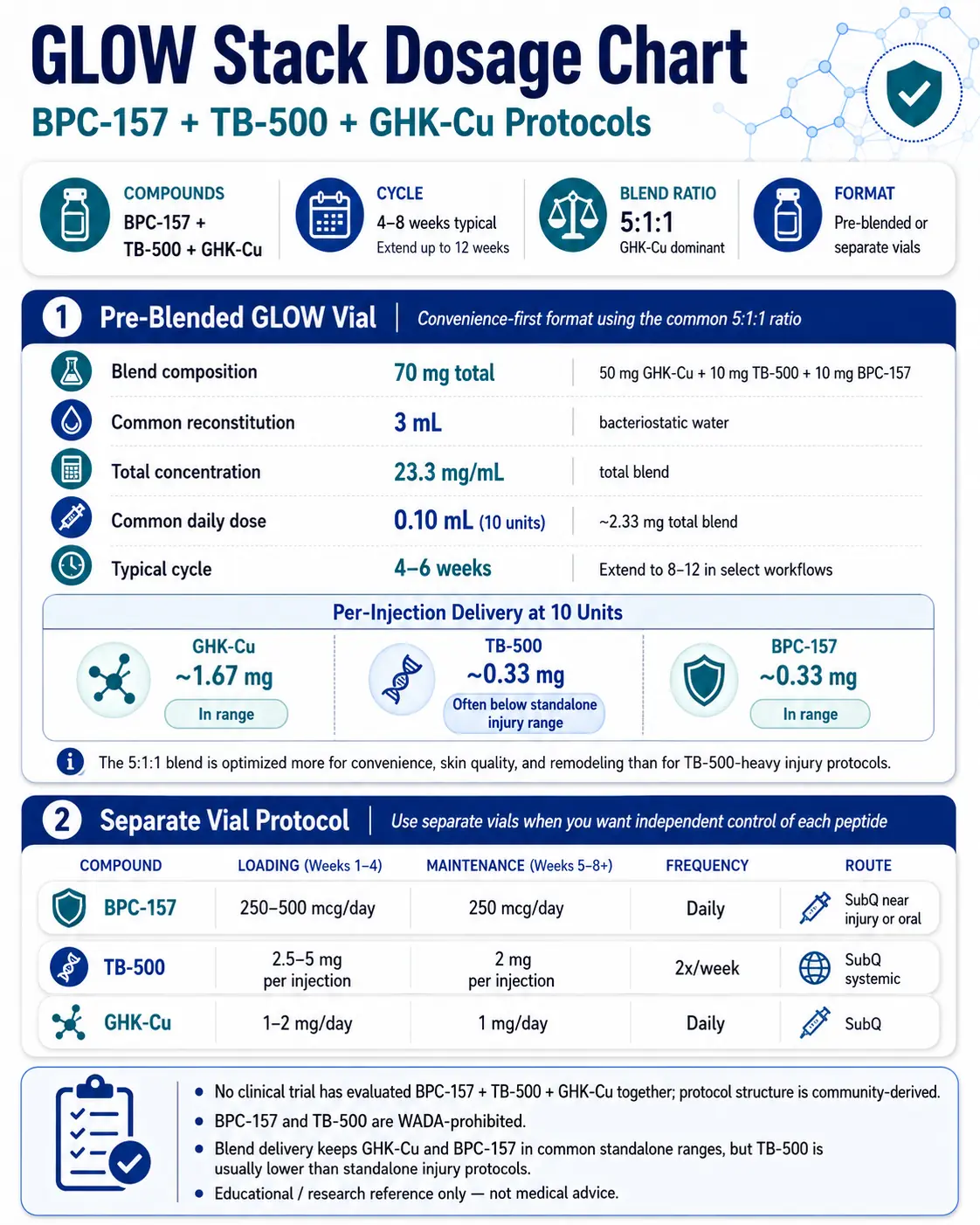
70 mg total per vial: 50 mg GHK-Cu, 10 mg TB-500, and 10 mg BPC-157. Reconstituted with 3 mL bacteriostatic water for a 23.3 mg/mL total-blend concentration.
Reconstitute
3 mL BAC water
Concentration
23.3 mg/mL total blend
Daily draw
10 units = 0.10 mL = ~2.33 mg total
Typical cycle
4-6 weeks
Pre-Blended GLOW Vial Overview
| GHK-Cu | ~1.67 mg |
|---|---|
| BPC-157 | ~0.33 mg |
| TB-500 | ~0.33 mg |
The 5:1:1 blend is GHK-Cu-heavy by weight. That makes it well-suited to skin and general remodeling goals, but it delivers less TB-500 per dose than a standalone injury protocol.
How the 5:1:1 Blend Compares to Standalone Doses
The table below compares what each daily blend injection delivers to typical standalone doses for the same compound. "In range" means the blend matches a common standalone protocol. "Below standalone injury range" means the blend delivers less of that compound than a standalone injury protocol would.
Pre-Blend Dose Assessment (10 units / 0.10 mL daily)
Component
GHK-Cu
Per-dose from Blend
~1.67 mg
Typical Standalone
1-2 mg daily
Assessment
In range
Component
BPC-157
Per-dose from Blend
~0.33 mg
Typical Standalone
0.25-0.5 mg daily
Assessment
In range
Component
TB-500
Per-dose from Blend
~0.33 mg
Typical Standalone
2-5 mg per injection, 2x/week
Assessment
Below standalone injury range
| Component | Per-dose from Blend | Typical Standalone | Assessment |
|---|---|---|---|
| GHK-Cu | ~1.67 mg | 1-2 mg daily | In range |
| BPC-157 | ~0.33 mg | 0.25-0.5 mg daily | In range |
| TB-500 | ~0.33 mg | 2-5 mg per injection, 2x/week | Below standalone injury range |
The 5:1:1 blend is convenience- and skin-focused. For TB-500-heavy injury protocols, separate vials give more dose control.
More injections per session, but full dose control over each compound.
Separate vials let researchers adjust each peptide's dose on its own. That matters for protocols where TB-500 needs to run higher (such as injury-focused work). The trade-off is more injections per session and more reconstitution math.
Separate-vial workflow
Independent dose control across all three compounds
Use separate vials when independent adjustment matters. Daily doses for BPC-157 and GHK-Cu, twice-weekly for TB-500.
Injection burden
2-3 injections per day on TB-500 days
Best for
Dose flexibility, injury-focused work
Cycle driver
GHK-Cu cycling typically sets the cycle length
BPC-157
- Loading
- 250-500 mcg/day (weeks 1-4)
- Frequency
- Daily
- Maintenance
- 250 mcg/day (weeks 5-8+)
- Route
- SubQ near injury or oral
TB-500
- Loading
- 2.5-5 mg per injection (weeks 1-4)
- Frequency
- 2x/week
- Maintenance
- 2 mg per injection (weeks 5-8+)
- Route
- SubQ systemic
GHK-Cu
- Loading
- 1-2 mg/day (weeks 1-4)
- Frequency
- Daily
- Maintenance
- 1 mg/day (weeks 5-8+)
- Route
- SubQ
Weekly Schedule Example
Monday
BPC-157 500 mcg + TB-500 2.5 mg + GHK-Cu 1-2 mg
Tuesday
BPC-157 500 mcg + GHK-Cu 1-2 mg
Wednesday
BPC-157 500 mcg + GHK-Cu 1-2 mg
Thursday
BPC-157 500 mcg + TB-500 2.5 mg + GHK-Cu 1-2 mg
Friday
BPC-157 500 mcg + GHK-Cu 1-2 mg
Saturday
BPC-157 500 mcg + GHK-Cu 1-2 mg
Sunday
BPC-157 500 mcg + GHK-Cu 1-2 mg
Use a separate syringe for each compound. Do not mix separate-vial peptides in one syringe — they have different stability and pH requirements.
Cycle Guidelines
Common GLOW Peptide Cycle Approaches
Approach
Standard
Duration
4-6 weeks
Off Period
2-4 weeks
Best For
Skin and general remodeling research
Approach
Extended
Duration
8-12 weeks
Off Period
4-8 weeks
Best For
Complex recovery contexts
Approach
Skin-focused blend
Duration
4 weeks
Off Period
2-4 weeks
Best For
Anti-aging-priority workflows
| Approach | Duration | Off Period | Best For |
|---|---|---|---|
| Standard | 4-6 weeks | 2-4 weeks | Skin and general remodeling research |
| Extended | 8-12 weeks | 4-8 weeks | Complex recovery contexts |
| Skin-focused blend | 4 weeks | 2-4 weeks | Anti-aging-priority workflows |
GHK-Cu typically governs cycle length because of copper-handling considerations.
Protocol Notes
- Injection burden: Separate vials may require up to 3 injections on TB-500 days and 2 on other days. The pre-blend reduces this to one daily injection.
- Syringe handling: Use a separate syringe for each compound when running separate vials. Do not combine in one syringe.
- Off-cycle option: Some users continue topical GHK-Cu products during the injectable off-cycle to maintain skin-related research goals.
- Cycle driver: GHK-Cu copper cycling (typically 30-60 days on, equal time off) usually governs the entire GLOW cycle.
GLOW Peptide Supplies Needed
Plan based on the pre-blended schedule above: 10 units daily from a 70 mg vial reconstituted with 3.0 mL BAC water. Affiliate disclosure: PDP may earn a commission when you use eligible supplier links, at no extra cost to you. Before checkout, compare current peptide discount codes for eligible research suppliers.
Recommended Supply
Choose your region
Use discount code PEPPAL at Peptide Partners checkout. See why we love Peptide Partners.
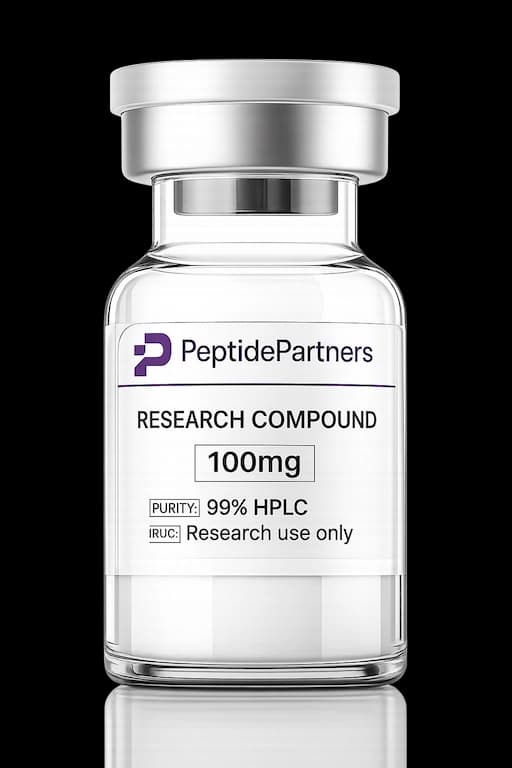
GLOW Blend: BPC-157/TB-500/GHK-Cu (70mg)
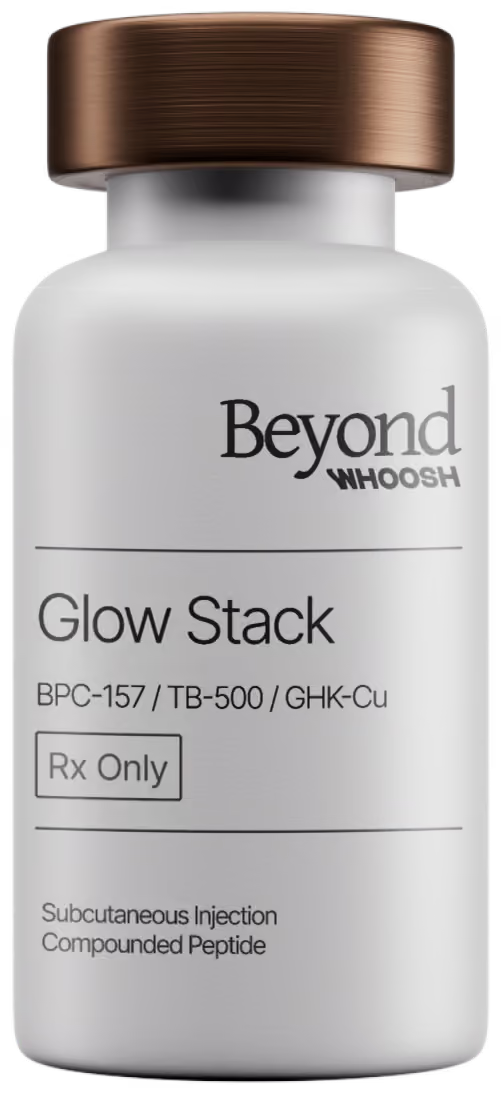
Pharmacy Grade GLOW Stack
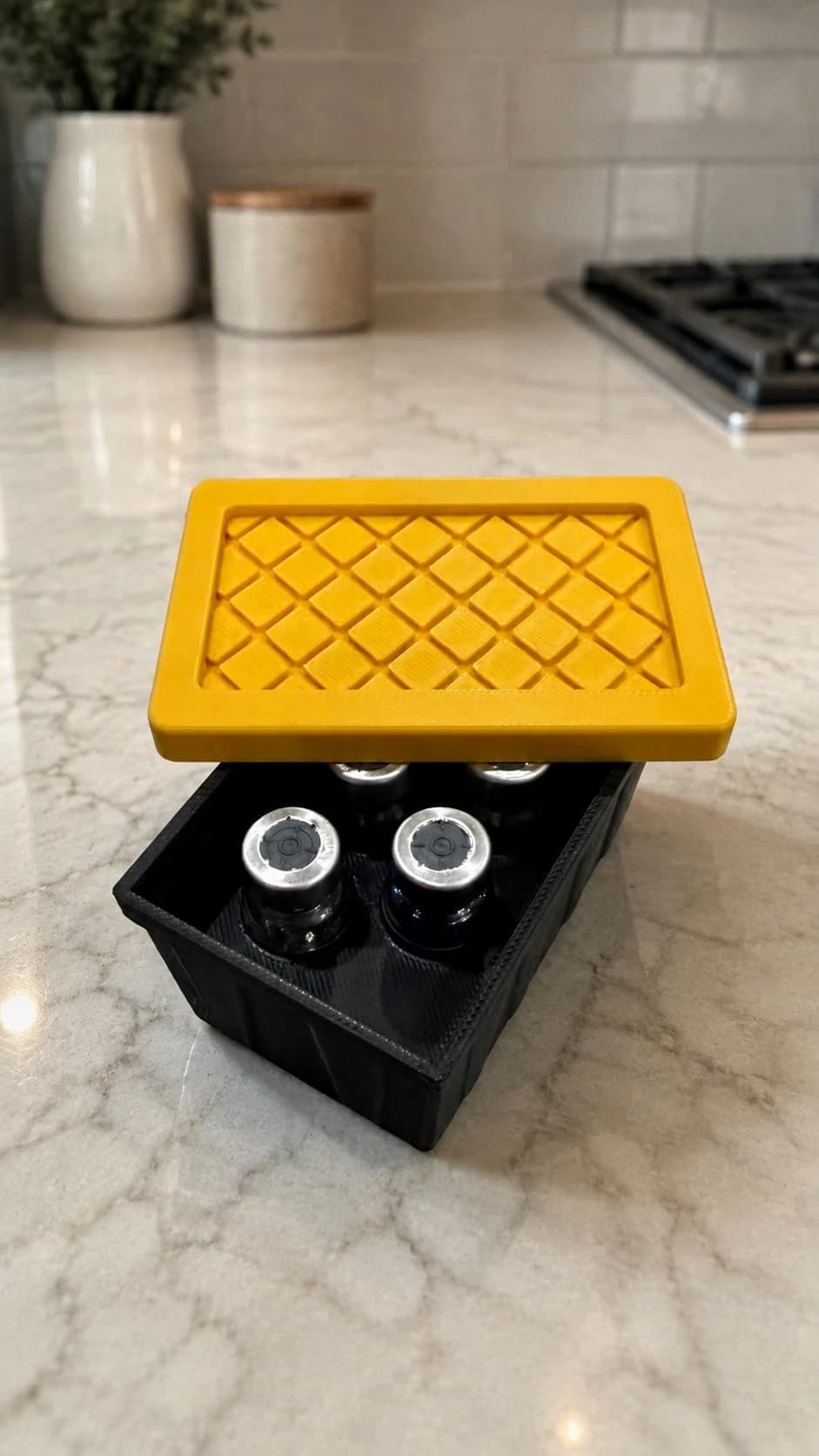
5-Vial Tote Case
At-Home Blood Test
Research Supplies
Disclosure: supply links may earn PDP a commission at no cost to you.
GLOW Blend Vials (70 mg, 5:1:1)
One vial covers about 30 daily 10-unit doses at 3.0 mL reconstitution.
| Cycle length | Planning note |
|---|---|
4 weeks 1 vial | 28 doses needed; 1 vial covers ~30 daily draws. |
6-8 weeks 2 vials | 6 weeks: 42 doses needed; second vial gives margin.; 8 weeks: 56 doses needed; second vial fully covers cycle. |
12 weeks 3 vials | 84 doses needed across the cycle. |
4 weeks
1 vial
28 doses needed; 1 vial covers ~30 daily draws.
6-8 weeks
2 vials
6 weeks: 42 doses needed; second vial gives margin.; 8 weeks: 56 doses needed; second vial fully covers cycle.
12 weeks
3 vials
84 doses needed across the cycle.
Insulin Syringes (U-100)
Prefer 0.3 mL / 30-unit syringes for accurate small daily draws.
| Cycle length | Planning note |
|---|---|
4 weeks 28 syringes | 1 syringe per day. |
6 weeks 42 syringes | 1 syringe per day. |
8 weeks 56 syringes | 1 syringe per day. |
12 weeks 84 syringes | 1 syringe per day. |
4 weeks
28 syringes
1 syringe per day.
6 weeks
42 syringes
1 syringe per day.
8 weeks
56 syringes
1 syringe per day.
12 weeks
84 syringes
1 syringe per day.
Bacteriostatic Water
Each 70 mg vial uses 3.0 mL to reach 23.3 mg/mL.
| Cycle length | Planning note |
|---|---|
4-8 weeks 1 x 10 mL bottle | 4 weeks: 1 vial uses 3 mL; one bottle leaves margin.; 6 weeks: 2 vials use 6 mL; one bottle still covers.; 8 weeks: 2 vials use 6 mL; one bottle still covers. |
12 weeks 2 x 10 mL bottles | 3 vials use 9 mL; second bottle gives margin. |
4-8 weeks
1 x 10 mL bottle
4 weeks: 1 vial uses 3 mL; one bottle leaves margin.; 6 weeks: 2 vials use 6 mL; one bottle still covers.; 8 weeks: 2 vials use 6 mL; one bottle still covers.
12 weeks
2 x 10 mL bottles
3 vials use 9 mL; second bottle gives margin.
Round up for priming losses, dropped syringes, damaged swabs, and protocol adjustments.
Companion Supplies & Routine Support
GLOW Stack Reconstitution Calculators
Calculate each separate vial on its own. Choose a compound below, then enter the amount printed on that vial. If you have a pre-blended vial, use PepPal's Stack & Blend Calculator. It keeps each ingredient matched to the ratio on the vial label.
Open the Stack & Blend Calculator
Powered by PepPal
GHK-Cu Reconstitution Calculator
Start with the protocol example, then customize every field.
Loaded reference
PDP injectable-vial example
This calculator does not apply to topical GHK-Cu formulas.
Your draw
4units
0.04 mL on a U-100 insulin syringe
- Concentration
- 25 mg/mL
- Target in mg
- 1 mg
- Math-only doses per vial
- 50
One free emailed save per person, checked by PepPal.
Educational calculation tool only. The loaded amount is a reference from this page, not a personal dose recommendation. Confirm the vial label, route, syringe type, and actual liquid added before relying on a result.
GLOW Peptide Reconstitution Guide
Choose Your Reconstitution Format
Math is different for the pre-blend versus three separate vials.
One reconstitution. One daily draw.
The standard 70 mg GLOW blend reconstitutes with 3 mL of bacteriostatic water. The table below shows how that math works and what you draw for a daily dose.
Pre-Blend Reconstitution Math (70 mg total)
Metric
Blend composition
Value
50 mg GHK-Cu + 10 mg TB-500 + 10 mg BPC-157
Metric
BAC water added
Value
3 mL
Metric
Total concentration
Value
23.3 mg/mL total blend
Metric
Standard daily dose
Value
0.10 mL (10 units) = ~2.33 mg total
| Metric | Value |
|---|---|
| Blend composition | 50 mg GHK-Cu + 10 mg TB-500 + 10 mg BPC-157 |
| BAC water added | 3 mL |
| Total concentration | 23.3 mg/mL total blend |
| Standard daily dose | 0.10 mL (10 units) = ~2.33 mg total |
Component Delivery at 10 Units
Compound
GHK-Cu
Per-Dose Amount
~1.67 mg
Compound
TB-500
Per-Dose Amount
~0.33 mg
Compound
BPC-157
Per-Dose Amount
~0.33 mg
| Compound | Per-Dose Amount |
|---|---|
| GHK-Cu | ~1.67 mg |
| TB-500 | ~0.33 mg |
| BPC-157 | ~0.33 mg |
TB-500 is the limiting reconstitution-stability window — most workflows use the reconstituted blend within 1-2 weeks.
Reconstitute each compound on its own.
Each GLOW compound is reconstituted separately. Watch the units carefully — BPC-157 is dosed in micrograms (mcg) while TB-500 and GHK-Cu are dosed in milligrams (mg). Mixing them up is the most common math mistake on this stack.
BPC-157 Reconstitution
Vial
5 mg
BAC Water
2 mL
Concentration
2,500 mcg/mL
250 mcg
10 units (0.10 mL)
500 mcg
20 units (0.20 mL)
Vial
10 mg
BAC Water
2 mL
Concentration
5,000 mcg/mL
250 mcg
5 units (0.05 mL)
500 mcg
10 units (0.10 mL)
| Vial | BAC Water | Concentration | 250 mcg | 500 mcg |
|---|---|---|---|---|
| 5 mg | 2 mL | 2,500 mcg/mL | 10 units (0.10 mL) | 20 units (0.20 mL) |
| 10 mg | 2 mL | 5,000 mcg/mL | 5 units (0.05 mL) | 10 units (0.10 mL) |
TB-500 Reconstitution
Vial
5 mg
BAC Water
1 mL
Concentration
5 mg/mL
2.5 mg
50 units (0.50 mL)
5 mg
100 units (1.00 mL)
Vial
10 mg
BAC Water
2 mL
Concentration
5 mg/mL
2.5 mg
50 units (0.50 mL)
5 mg
100 units (1.00 mL)
| Vial | BAC Water | Concentration | 2.5 mg | 5 mg |
|---|---|---|---|---|
| 5 mg | 1 mL | 5 mg/mL | 50 units (0.50 mL) | 100 units (1.00 mL) |
| 10 mg | 2 mL | 5 mg/mL | 50 units (0.50 mL) | 100 units (1.00 mL) |
GHK-Cu Reconstitution
Vial
50 mg
BAC Water
5 mL
Concentration
10 mg/mL
1 mg
10 units (0.10 mL)
2 mg
20 units (0.20 mL)
Vial
100 mg
BAC Water
10 mL
Concentration
10 mg/mL
1 mg
10 units (0.10 mL)
2 mg
20 units (0.20 mL)
| Vial | BAC Water | Concentration | 1 mg | 2 mg |
|---|---|---|---|---|
| 50 mg | 5 mL | 10 mg/mL | 10 units (0.10 mL) | 20 units (0.20 mL) |
| 100 mg | 10 mL | 10 mg/mL | 10 units (0.10 mL) | 20 units (0.20 mL) |
Math Verification
- BPC-157: 5,000 mcg ÷ 2 mL = 2,500 mcg/mL → 500 mcg = 0.20 mL = 20 units.
- TB-500: 5 mg ÷ 1 mL = 5 mg/mL → 2.5 mg = 0.50 mL = 50 units.
- GHK-Cu: 50 mg ÷ 5 mL = 10 mg/mL → 1 mg = 0.10 mL = 10 units.
- GHK-Cu solution may show a faint blue or green tint after reconstitution. That is the copper. It is expected.
Standard 7-Step Reconstitution
- 01
Wipe the stopper
Use an alcohol swab on the rubber stopper and let it dry.
- 02
Draw BAC water
Pull the planned bacteriostatic water volume into a sterile syringe.
- 03
Direct flow against the wall
Aim the water at the inside of the glass, not directly onto the powder.
- 04
Allow gentle flow
Let the water flow slowly down the vial wall onto the powder.
- 05
Roll, do not shake
Roll the vial gently for 30-60 seconds until the powder dissolves. Do not shake.
- 06
Inspect appearance
Look for clarity. GHK-Cu may show a slight blue/green tint; BPC-157 and TB-500 should be clear.
- 07
Label and refrigerate
Mark the vial with the reconstitution date and store at 2-8 °C (35.6-46.4 °F).
Calculator
Use the PepPal reconstitution calculator for fast unit math across all three compounds.
GLOW Peptide Dosage Chart
This GLOW peptide dosage chart summarizes the common pre-blended 70 mg vial schedule, including the 5:1:1 GHK-Cu, TB-500, and BPC-157 ratio, the 3 mL reconstitution setup, and the once-daily 10-unit reference dose.
Why the GLOW Blend Combines BPC-157, TB-500, and GHK-Cu
Foundation: BPC-157 + TB-500 (the Wolverine Layer)
BPC-157 and TB-500 form the same two-compound base used in the Wolverine Stack base protocol. BPC-157 is most associated in animal studies with new blood vessel formation and tissue protection at the injury site. TB-500 modulates actin, the protein that helps cells move, and has been studied for repair-cell migration.
Running them together gives researchers two complementary repair signals: more local blood supply, plus more repair cells that can travel to where they are needed. This is the recovery foundation that GLOW builds on.
Quality Layer: GHK-Cu
GHK-Cu is what makes GLOW different from Wolverine. It is a copper-binding tripeptide that has been studied for collagen and elastin synthesis, the proteins that give skin its firmness and connective tissue its strength. In published gene-expression work, GHK-Cu is associated with broad regulation of repair and matrix-related genes.
The result, in compound-level research terms, is that GLOW is studied not just for repair speed but for repair quality — better collagen organization and matrix remodeling.
Anti-Inflammatory Pathway Overlap
Each compound has reported anti-inflammatory effects through different pathways in preclinical models. Stacking them together creates overlapping anti-inflammatory coverage, which is one of the most common reasons community protocols pair them.
Anti-Fibrotic Convergence
TB-500 has been studied for organizing connective tissue formation. GHK-Cu has been studied for managing matrix breakdown and replacement through matrix metalloproteinase activity. The overlap interest is in supporting a more organized repair process rather than disorganized scar formation.
Reminder
All of the above describes compound-level research. There is no published human trial of the BPC-157 + TB-500 + GHK-Cu combination.
Who GLOW Peptide Is For and Who Should Avoid It
Peptide Dosing Protocols does not provide medical advice. The notes below describe research-context fit and contraindication signals raised in compound-level literature. They are not eligibility rules.
Research-Context Fit
- Researchers studying soft-tissue repair models alongside skin-quality endpoints.
- Workflows where convenience matters and the 5:1:1 GHK-Cu-dominant ratio fits the goal.
- Protocols that already use Wolverine (BPC-157 + TB-500) and want to add a tissue-quality layer.
Contraindication Signals from Compound-Level Research
- Active cancer or strong cancer history. Both BPC-157 and TB-500 promote angiogenesis (blood vessel growth). Tumors require blood supply, and that overlap is a theoretical concern raised in the literature.
- Pregnancy or breastfeeding. None of the three compounds have safety data in this context.
- Wilson's disease or other copper-handling disorders. GHK-Cu adds copper systemically, which is contraindicated for copper-dysregulation conditions.
- WADA-tested athletes. BPC-157 and TB-500 are on the World Anti-Doping Agency prohibited list.
- Active retinal vascular disease or other conditions sensitive to angiogenic signaling.
Clinician oversight
Anyone considering peptide research protocols with active health conditions or current medications should work with a qualified clinician. This page is a research reference, not a medical evaluation.
GLOW Peptide Side Effects & Safety
Each of the three GLOW compounds has a generally favorable safety profile in individual research, but no clinical trial has tested the combination. The notes below describe what to watch for when running all three together.
Compound-Level Safety Notes
- BPC-157 has not produced a lethal dose in animal toxicity studies, and reported adverse events in human anecdotal use are mild and infrequent. There is no FDA-approved human trial.
- TB-500 has been through Phase I and Phase II clinical trials of intravenous thymosin beta-4 with no serious adverse events reported in the published cohorts.
- GHK-Cu has decades of safe use in topical and cosmetic products. Injectable use lacks the same regulatory approval but draws on the same safety mechanisms.
Stack-Specific Considerations
- Angiogenic signal overlap. BPC-157 and TB-500 both promote new blood vessel growth. Running them together amplifies that signal. This is generally desirable for healing research, but it is the main reason people with active cancer or retinal vascular conditions are advised to avoid these compounds.
- Copper accumulation. The copper in GHK-Cu drives its mechanism, but copper can build up over time. This is why GHK-Cu cycling exists — typically 30-60 days on, equal time off. Skipping the off-cycle is the most common GHK-Cu mistake.
- Three-compound quality risk. Every additional compound in a stack adds another opportunity for contamination or under-dosed product. Use COA-verified suppliers for all three.
Reported Side Effects
- Injection-site irritation (redness, mild swelling) — usually resolves within minutes to hours.
- Short-term fatigue during the first 1-2 weeks of TB-500 loading.
- Occasional headache, usually mild and transient.
- GHK-Cu may produce a slight metallic or warming sensation at the injection site in some users.
When to Reassess
If injection-site reactions worsen instead of improving over the first week, if fatigue persists past the loading phase, or if any unusual symptom appears, pause the protocol and consult a qualified clinician. For broader stacking-safety context see the PepPal side-effects guide.
GLOW Peptide Timeline & What to Monitor
Community-reported timelines vary widely because BPC-157, TB-500, and GHK-Cu work on different time scales. The pattern below is a rough composite from compound-level research and protocol notes — not a guarantee of outcomes.
Reported Timeline Patterns (Community + Compound-Level)
Window
Weeks 1-2
What People Often Report
Inflammation-related changes; faster small-wound healing; fatigue during TB-500 loading.
Window
Weeks 3-4
What People Often Report
First skin-quality changes; firmer feel, slight texture improvement.
Window
Weeks 5-8
What People Often Report
Visible skin improvements driven by GHK-Cu; ongoing remodeling work.
Window
Months 3+
What People Often Report
Cumulative skin and connective-tissue changes with cycle continuation.
| Window | What People Often Report |
|---|---|
| Weeks 1-2 | Inflammation-related changes; faster small-wound healing; fatigue during TB-500 loading. |
| Weeks 3-4 | First skin-quality changes; firmer feel, slight texture improvement. |
| Weeks 5-8 | Visible skin improvements driven by GHK-Cu; ongoing remodeling work. |
| Months 3+ | Cumulative skin and connective-tissue changes with cycle continuation. |
Outcomes vary by individual, dose, cycle length, and quality of source material.
What to Track
- Date and dose of each injection. Helps catch dose drift.
- Injection site rotation. Prevents lipohypertrophy and injection-site fatigue.
- Subjective changes: pain, range of motion, skin appearance, and any unusual symptoms.
- Cycle on/off weeks. Especially important for GHK-Cu copper cycling.
What this protocol cannot promise
No published human trial measures GLOW outcomes. Reported timelines come from compound-level research and community use. Individual response varies. Persistent symptoms or no measurable change after a full cycle is a sign to reassess.
GLOW Peptide Clinical Evidence Context
Critical note
No published human trial has evaluated BPC-157 + TB-500 + GHK-Cu as a combined stack. The evidence summary below is compound-level only.
BPC-157
Extensive animal and in-vitro studies on tendon, ligament, and gut tissue. Vasireddi et al. (2025) systematic review covers orthopaedic sports medicine. Sikiric et al. (2024) review documents broad pleiotropic effects in animal models. No FDA-approved human trial.
TB-500 (Thymosin Beta-4)
Phase I and Phase II safety trials of intravenous thymosin beta-4 published in human cohorts (Ruff et al., 2010). Animal studies on tissue repair, angiogenesis, and cardiac repair (Bock-Marquette et al., 2004; Smart et al., 2007).
GHK-Cu
Strong topical clinical evidence for collagen and skin-quality endpoints. Pickart and Margolina (2018) review documents broad gene-expression effects in vitro. Decades of cosmetic use safety data.
BPC-157 + TB-500 + GHK-Cu Stack
No published human or animal trial of all three together. Combination-stack rationale is community-derived from compound-level work.
GLOW Peptide Storage & Handling
Storage Reference (All Three Compounds)
State
Lyophilized (Powder Form)
BPC-157
-4 °F (-20 °C) long-term
TB-500
-4 °F (-20 °C) long-term
GHK-Cu
-4 °F (-20 °C) long-term
State
Reconstituted (Liquid Form)
BPC-157
35.6-46.4 °F (2-8 °C), up to 30 days
TB-500
35.6-46.4 °F (2-8 °C), 1-2 weeks
GHK-Cu
35.6-46.4 °F (2-8 °C), up to 30 days
State
Appearance
BPC-157
Clear
TB-500
Clear
GHK-Cu
May be light blue/green
State
Freeze reconstituted
BPC-157
Aliquots possible
TB-500
Do not freeze
GHK-Cu
Do not freeze
| State | BPC-157 | TB-500 | GHK-Cu |
|---|---|---|---|
| Lyophilized (Powder Form) | -4 °F (-20 °C) long-term | -4 °F (-20 °C) long-term | -4 °F (-20 °C) long-term |
| Reconstituted (Liquid Form) | 35.6-46.4 °F (2-8 °C), up to 30 days | 35.6-46.4 °F (2-8 °C), 1-2 weeks | 35.6-46.4 °F (2-8 °C), up to 30 days |
| Appearance | Clear | Clear | May be light blue/green |
| Freeze reconstituted | Aliquots possible | Do not freeze | Do not freeze |
TB-500 has the shortest reconstituted-stability window. In separate-vial workflows, plan vial sizes around the TB-500 use rate.
GLOW Peptide Protocol Mistakes & Troubleshooting
- 01
Mixing up mcg and mg
BPC-157 is dosed in micrograms. TB-500 and GHK-Cu are in milligrams. Label every vial with both the compound name and dose units to avoid 1,000x errors.
- 02
Skipping the GHK-Cu off-cycle
GHK-Cu protocols typically cycle 30-60 days on with equal time off because of copper handling. Continuous use is the most common mistake on this stack.
- 03
Wrong BAC water volume
Adding too much or too little BAC water changes concentration and your daily draw volume. The pre-blend is 3 mL for 70 mg total — verify before drawing the first dose.
- 04
Cloudy or off-color solution
GHK-Cu may be faintly blue or green — that is the copper. BPC-157 and TB-500 should be clear. A cloudy or particulate solution from any compound is a sign to discard the vial.
- 05
Injection-site reaction worsens
Mild redness or swelling that resolves in minutes is common. Reactions that get worse over the first week, spread, or hurt sharply are a reason to pause and consult a clinician.
- 06
Storage mistake (left out overnight)
Reconstituted vials should stay at 2-8 °C. Brief exposure to room temperature is usually fine, but extended warm-storage shortens shelf life. When in doubt, replace the vial.
- 07
Mixing separate vials in one syringe
Do not pull BPC-157, TB-500, and GHK-Cu into one syringe. Different stability and pH profiles can degrade the solution. Use a fresh sterile syringe for each compound.
GLOW Peptide Regulatory Status
As of June 2026, none of the three GLOW compounds (BPC-157, TB-500, GHK-Cu) are FDA-approved for injectable human use. They are sold for research-only purposes. Pre-blended GLOW products are sold under the same research-only category.
- BPC-157 — Not FDA-approved. WADA-prohibited at all times for in-competition and out-of-competition athletes.
- TB-500 (Thymosin Beta-4) — Not FDA-approved as a finished drug product, though clinical trials have used IV thymosin beta-4. WADA-prohibited.
- GHK-Cu — Approved for cosmetic and topical use globally; injectable use is research-only. Not FDA-approved as an injectable drug.
- Pre-blended GLOW — Sold as a research-use compound. Pre-blending does not change the regulatory status of the individual compounds.
Compounding pharmacy status (US)
BPC-157 has been removed from the FDA's bulk-substance list for compounding. TB-500 has not been added. GHK-Cu remains available through some 503A/503B compounding pharmacies. Verify current status directly with FDA.gov before any clinical use.
GLOW vs Wolverine vs KLOW vs Individual Peptides
Four common GLOW alternatives come up in research planning: the simpler Wolverine Stack, the inflammation-focused KLOW Stack, and running each compound on its own. The table below shows where each one fits.
GLOW vs Common Alternatives
Feature
Compounds
GLOW
BPC-157 + TB-500 + GHK-Cu
Wolverine
BPC-157 + TB-500
KLOW
BPC-157 + TB-500 + GHK-Cu + KPV
Single Peptide
Just one
Feature
Skin / anti-aging research
GLOW
Strong (GHK-Cu)
Wolverine
Limited
KLOW
Strong (GHK-Cu + KPV)
Single Peptide
Varies (GHK-Cu standalone is closest)
Feature
Soft-tissue repair coverage
GLOW
Strong
Wolverine
Strong
KLOW
Strong
Single Peptide
Compound-specific
Feature
Inflammation pathways
GLOW
Multiple
Wolverine
Two pathways
KLOW
Multiple + NF-kB (KPV)
Single Peptide
One
Feature
Complexity
GLOW
High
Wolverine
Moderate
KLOW
High
Single Peptide
Low
Feature
Cost
GLOW
Highest
Wolverine
Moderate
KLOW
Highest+
Single Peptide
Lower
| Feature | GLOW | Wolverine | KLOW | Single Peptide |
|---|---|---|---|---|
| Compounds | BPC-157 + TB-500 + GHK-Cu | BPC-157 + TB-500 | BPC-157 + TB-500 + GHK-Cu + KPV | Just one |
| Skin / anti-aging research | Strong (GHK-Cu) | Limited | Strong (GHK-Cu + KPV) | Varies (GHK-Cu standalone is closest) |
| Soft-tissue repair coverage | Strong | Strong | Strong | Compound-specific |
| Inflammation pathways | Multiple | Two pathways | Multiple + NF-kB (KPV) | One |
| Complexity | High | Moderate | High | Low |
| Cost | Highest | Moderate | Highest+ | Lower |
Choose GLOW when skin/quality remodeling matters alongside repair. Choose Wolverine when only repair matters. Choose KLOW when inflammation is the lead concern. Choose a single peptide when the goal is narrow.
GLOW vs KLOW
KLOW adds KPV (a tripeptide studied for NF-kB anti-inflammatory effects and gut-related research) to the GLOW formula. People typically pick KLOW when inflammation is the dominant goal — for example, gut-research contexts. GLOW is the simpler version focused on skin and tissue-quality remodeling. See the KLOW Stack guide for the full comparison.
GLOW vs Wolverine
The Wolverine Stack is two peptides (BPC-157 + TB-500), so it costs less and uses fewer injections. It does not include the GHK-Cu skin-quality layer. Researchers focused only on repair often start with Wolverine and add GHK-Cu later if skin or matrix-quality endpoints matter.
Glow Stack Blood Tests & Monitoring
The Glow Stack combines BPC-157, TB-500, and GHK-Cu, so monitoring focuses on tissue-repair, inflammation, broad safety, and copper-context review. Routine labs may not show local skin or connective-tissue response.
Blood test markers to discuss with a clinician
Marker
CBC with differential
Why it matters
Screens blood-cell patterns, anemia, infection context, and immune changes.
Timing
Baseline
Marker
Comprehensive metabolic panel (CMP)
Why it matters
Reviews liver, kidney, electrolyte, and glucose context in one broad panel.
Timing
Baseline
Marker
CRP
Why it matters
May help frame systemic inflammation when injury, skin, or tissue-repair symptoms are part of the protocol.
Timing
Optional
Marker
Copper and ceruloplasmin
Why it matters
Adds copper-status context when repeated high-exposure GHK-Cu use is being discussed.
Timing
Optional
| Marker | Why it matters | Timing |
|---|---|---|
| CBC with differential | Screens blood-cell patterns, anemia, infection context, and immune changes. | Baseline |
| Comprehensive metabolic panel (CMP) | Reviews liver, kidney, electrolyte, and glucose context in one broad panel. | Baseline |
| CRP | May help frame systemic inflammation when injury, skin, or tissue-repair symptoms are part of the protocol. | Optional |
| Copper and ceruloplasmin | Adds copper-status context when repeated high-exposure GHK-Cu use is being discussed. | Optional |
Monitoring guidance combines tissue-repair and copper-context pathway logic because this stack lacks established clinical monitoring standards.
At-home blood test option
Easy at home option to monitor core metrics during research cycles.
Beyond Whoosh
Pharmacy Grade GLOW Stack
Prescription-grade peptide care through Beyond Whoosh. Whoosh prescribes after a clinician reviews your eligibility.
Partner link: PDP may earn a commission at no cost to you.
Simple timing framework
Baseline
Discuss baseline labs before starting, especially with active injury, infection concern, liver disease, kidney disease, anemia, or copper metabolism concerns.
Follow-up
Repeat broad markers after 6-12 weeks if systemic use continues or symptoms change.
Longer term
For longer repeated exposure, review broad health and copper-context markers periodically with a clinician.
How to interpret the labs
- Local skin, scar, tendon, or connective-tissue response may not be reflected in routine labs.
- Topical and systemic copper peptide exposure should not be treated the same.
- Infection signs, worsening injuries, or unusual neurologic symptoms need symptom-based review.
Do not wait for routine labs
Fever, spreading redness, severe wound pain, jaundice, allergic symptoms, chest pain, or one-sided leg swelling needs medical review.
FAQ
Q1: What is GLOW peptide?
GLOW peptide is a research blend of three compounds — BPC-157, TB-500, and GHK-Cu — usually sold pre-blended at a 5:1:1 GHK-Cu-dominant ratio. It pairs the soft-tissue repair coverage of BPC-157 and TB-500 with the collagen and matrix-quality remodeling tied to GHK-Cu.
Q2: What is in the GLOW peptide blend?
Most pre-blended GLOW products contain 50 mg GHK-Cu, 10 mg TB-500, and 10 mg BPC-157 in a single 70 mg vial — the 5:1:1 ratio that makes GLOW GHK-Cu-dominant.
Q3: What are the GLOW peptide benefits people research it for?
Compound-level research most associates the GLOW combination with soft-tissue repair coverage, collagen and skin-quality remodeling driven by GHK-Cu, anti-inflammatory pathway overlap, and organized matrix formation. There is no published human trial of the three compounds together.
Q4: How is GLOW peptide commonly dosed?
The most common pre-blended schedule is 0.10 mL (10 units) once daily from a 70 mg vial reconstituted with 3 mL bacteriostatic water. That delivers about 1.67 mg GHK-Cu, 0.33 mg TB-500, and 0.33 mg BPC-157 per injection. Separate-vial schedules use 250-500 mcg BPC-157 daily, 2.5-5 mg TB-500 twice weekly, and 1-2 mg GHK-Cu daily.
Q5: How do you reconstitute the GLOW peptide blend?
For a 70 mg pre-blend vial, add 3 mL of bacteriostatic water against the inside of the glass — do not aim it at the powder. Roll gently for 30-60 seconds. The result is a 23.3 mg/mL total-blend concentration. For separate vials, each compound is reconstituted on its own; see the reconstitution section above for the math. The PepPal calculator handles all three.
Q6: How long should I run a GLOW peptide cycle?
Standard community-protocol cycles run 4-6 weeks on with 2-4 weeks off. GHK-Cu copper cycling typically governs the on/off schedule — most workflows match the GLOW cycle to GHK-Cu's 30-60 days on, equal time off pattern.
Q7: What is the difference between GLOW and Wolverine peptide?
Wolverine is just BPC-157 + TB-500 — two compounds focused on repair. GLOW adds GHK-Cu, which brings collagen and skin-quality remodeling into the protocol. GLOW is more complex and costs more; Wolverine is simpler and repair-only.
Q8: Should I use a pre-blended GLOW vial or three separate vials?
A pre-blended vial is one daily injection at a fixed 5:1:1 ratio — convenient, but no dose flexibility. Separate vials allow independent dose control, which matters for TB-500-heavy injury protocols, but they require more injections per session and three reconstitutions. The dosing section above has both formats.
Q9: Can I inject all three GLOW peptides at once?
In separate-vial workflows, yes — they can be administered in the same session, but each compound goes in its own syringe. Do not combine BPC-157, TB-500, and GHK-Cu in a single syringe. Their stability and pH profiles differ.
Q10: What are the GLOW peptide side effects?
The most commonly reported effects are mild injection-site irritation, short-term fatigue during TB-500 loading, and occasional headache. The main stack-specific consideration is overlap of angiogenic signaling from BPC-157 and TB-500, which is why people with active cancer or vascular disorders are advised to avoid these compounds. See the side-effects section above for the full breakdown.
Q11: Is the GLOW peptide stack FDA-approved?
No. None of the three GLOW compounds are FDA-approved for injectable human use as of June 2026. They are sold for research purposes. BPC-157 and TB-500 are also on the WADA prohibited list.
Q12: Does GLOW help with hair loss or skin anti-aging?
The skin and hair-related research interest in GLOW comes mainly from its GHK-Cu component. GHK-Cu has topical clinical evidence for collagen synthesis and follicular research, and it is the dominant component in the 5:1:1 blend. Outcomes for the combined GLOW blend specifically have not been measured in a published human trial.
Q13: Can I add KPV to GLOW?
Yes. The four-peptide extension is called the KLOW Stack and adds a KPV anti-inflammatory layer on top of GLOW.
Q14: Is GLOW peptide medical advice?
No. This page is an educational research reference. It does not diagnose, treat, or recommend medical use. Consult a qualified clinician for medical questions.
Sources & Research
- 1. Vasireddi N, et al. Emerging Use of BPC-157 in Orthopaedic Sports Medicine: A Systematic Review. Orthopaedic Journal of Sports Medicine (2025)
- 2. Sikiric P, et al. The Stable Gastric Pentadecapeptide BPC 157 Pleiotropic Beneficial Activity. Pharmaceuticals (2024)
- 3. Gwyer D, et al. Gastric pentadecapeptide BPC 157 and its role in accelerating musculoskeletal soft tissue healing. Cell and Tissue Research (2019)
- 4. Ruff D, et al. A randomized, placebo-controlled, single and multiple dose study of intravenous thymosin beta-4 in healthy volunteers. Annals of the New York Academy of Sciences (2010)
- 5. Bock-Marquette I, et al. Thymosin beta-4 activates integrin-linked kinase and promotes cardiac cell migration, survival and cardiac repair. Nature (2004)
- 6. Smart N, et al. Thymosin beta-4 induces adult epicardial progenitor mobilization and neovascularization. Nature (2007)
- 7. Philp D, et al. Thymosin beta-4 promotes angiogenesis, wound healing, and hair growth. FASEB Journal (2004)
- 8. Ehrlich HP, Hazard SW Thymosin beta-4 enhances repair by organizing connective tissue and preventing the appearance of myofibroblasts. Annals of the New York Academy of Sciences (2010)
- 9. Pickart L, Margolina A Regenerative and Protective Actions of the GHK-Cu Peptide in the Light of the New Gene Data. International Journal of Molecular Sciences (2018)
- 10. Pickart L, Vasquez-Soltero JM, Margolina A GHK Peptide as a Natural Modulator of Multiple Cellular Pathways in Skin Regeneration. BioMed Research International (2015)
- 11. Maquart FX, et al. Stimulation of collagen synthesis in fibroblast cultures by the tripeptide-copper complex GHK-Cu. FEBS Letters (1988)
- 12. U.S. FDA List of Bulk Drug Substances for Use in Compounding (503A). FDA.gov (2026)
- 13. World Anti-Doping Agency The Prohibited List 2026. WADA (2026)
Related Dosing Protocols

Written by Garret Grant
Founder & Lead Researcher · B.S. Civil Engineering, UCLA
Last updated: August 2026
Human-researched and AI-assisted with full editorial review. I verify sources, protocol interpretation, and final judgments personally. See methodology.
Share this page