

5-Amino-1MQ Quick Start
5-Amino-1MQ is short for 5-amino-1-methylquinolinium. It is a small molecule, not a true peptide, even though it is often sold alongside research peptides. Researchers study it for two main goals: helping the body shrink fat cells and raising NAD+ levels inside cells without cutting appetite.
It works by blocking an enzyme called NNMT (nicotinamide N-methyltransferase). When NNMT runs too high in fat tissue, it wastes a form of vitamin B3 that the body needs to make NAD+. NAD+ is the cellular energy currency. Block NNMT, save the B3, raise NAD+, and fat cells start working more like lean tissue. That, in plain English, is the whole story.
Most research-context use is oral capsules at 50 to 150 mg per day. A subcutaneous (under-the-skin) vial format exists, but the dose volume math makes injection awkward at common doses. This page covers both, with the oral route first.
Why researchers care
Fat-cell shrinkage and higher NAD+ without appetite suppression.
Class
Small-molecule NNMT inhibitor. Not a peptide.
Most common route
Oral capsule, 50 to 150 mg per day, taken in the morning.
Cycle length
See the 5-Amino-1MQ cycle-length guide for published animal-study durations, community cycles, and evidence limits.
Status
Not FDA-approved as of July 30, 2026. No published human trials.
Educational reference only
This page is a research-context summary, not personal medical advice. 5-Amino-1MQ is sold under research-use-only labeling and is not an FDA-approved treatment. Talk to a qualified clinician before any use.
5-Amino-1MQ Dosing Protocol & Schedule
No human trial has established a typical 5-Amino-1MQ dose. Research community discussions most often use 50 to 150 mg by mouth each day, while subcutaneous examples use much smaller amounts. These ranges come from animal studies and informal reports. They are research context, not proven human dosing.
5-Amino-1MQ Protocol Formats
Choose the format you are researching to see route-specific notes.
Less common. Used when the research compound is sold as a lyophilized vial.
Some research suppliers sell 5-Amino-1MQ as a lyophilized (freeze-dried) 50 mg vial. The subcutaneous route is used at much smaller doses than oral because a 100 mg injection would require two 50 mg vials and about 6 mL of liquid when each vial is mixed with 3.0 mL BAC water, which is too much for one subcutaneous site.
Subcutaneous planning from a 50 mg vial reconstituted with 3.0 mL BAC water (~16.7 mg/mL)
Phase
Days 1–2 (tolerance)
Daily dose
2.5 mg once daily
Units on U-100 syringe
15 units
Volume
0.15 mL
Phase
Days 3+ (standard)
Daily dose
5 mg once daily
Units on U-100 syringe
30 units
Volume
0.30 mL
Phase
Split option (BID)
Daily dose
2.5 mg twice daily
Units on U-100 syringe
15 units each
Volume
0.15 mL each
| Phase | Daily dose | Units on U-100 syringe | Volume |
|---|---|---|---|
| Days 1–2 (tolerance) | 2.5 mg once daily | 15 units | 0.15 mL |
| Days 3+ (standard) | 5 mg once daily | 30 units | 0.30 mL |
| Split option (BID) | 2.5 mg twice daily | 15 units each | 0.15 mL each |
These subcutaneous examples come from informal research discussions. No human study has established a route conversion or shown that they match oral exposure.
A single 50 mg vial lasts roughly 10 to 20 days at these subcutaneous doses. Research community sources commonly describe rotating injection sites (abdomen, outer thigh, back of upper arm) to lower the chance of local irritation. A mild stinging sensation is common with this compound because of its quinolinium chemistry.
The standard route in research community use and in most published guides.
5-Amino-1MQ Oral Dosage and Research Evidence
No human study has established an oral dose for 5-Amino-1MQ. Informal research discussions often reference 50 to 150 mg per day, but those amounts are not clinically validated. A rat study reported 38.4% oral bioavailability. Human oral bioavailability remains unknown.
Oral dosing ranges discussed in research community use
Phase
Weeks 1–2 (start low)
Daily dose
50 mg once daily
Notes
Morning dosing is the pattern most often reported; sleep, energy, and digestion changes are commonly monitored in community reports.
Phase
Weeks 3+ (standard)
Daily dose
100 mg once daily
Notes
The most common research community target dose.
Phase
Weeks 3+ (higher end)
Daily dose
150 mg once daily
Notes
Some sources go this high. Diminishing returns and more side effects are reported above 150 mg.
Phase
Split option
Daily dose
50 mg morning + 50 mg midday
Notes
Some sources prefer split AM dosing because the plasma half-life is short (about 4 to 7 hours in rodent PK).
| Phase | Daily dose | Notes |
|---|---|---|
| Weeks 1–2 (start low) | 50 mg once daily | Morning dosing is the pattern most often reported; sleep, energy, and digestion changes are commonly monitored in community reports. |
| Weeks 3+ (standard) | 100 mg once daily | The most common research community target dose. |
| Weeks 3+ (higher end) | 150 mg once daily | Some sources go this high. Diminishing returns and more side effects are reported above 150 mg. |
| Split option | 50 mg morning + 50 mg midday | Some sources prefer split AM dosing because the plasma half-life is short (about 4 to 7 hours in rodent PK). |
Reflects research community structure scaled from rodent data. This is not a dosing recommendation.
Cycle structure: the common research community cycle is 8 to 12 weeks on, then 4 to 6 weeks off. The off-period gives the body a chance to reset baseline NNMT activity. Research community protocols typically restrict dosing to the morning; evening dosing has been linked to sleep disruption because of the metabolic activation effect.
No human trial dose exists
Every dose number above comes from rodent studies scaled to a human size or from research community use. No human clinical trial of 5-Amino-1MQ has been published. Treat these numbers as research-context structure only.
5-Amino-1MQ Supplies Needed
The supplies math below covers the subcutaneous 50 mg vial route. If you are using oral capsules, you only need the capsules themselves — no syringes or BAC water.
Recommended U.S. and Canada Supply
Choose your region
Use discount code PEPPAL at Peptide Partners checkout. See why we love Peptide Partners.
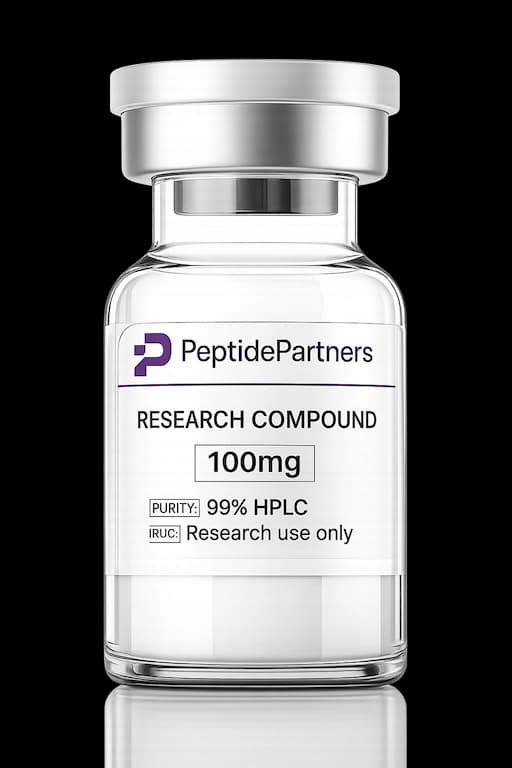
5-Amino-1MQ (10mg vials)
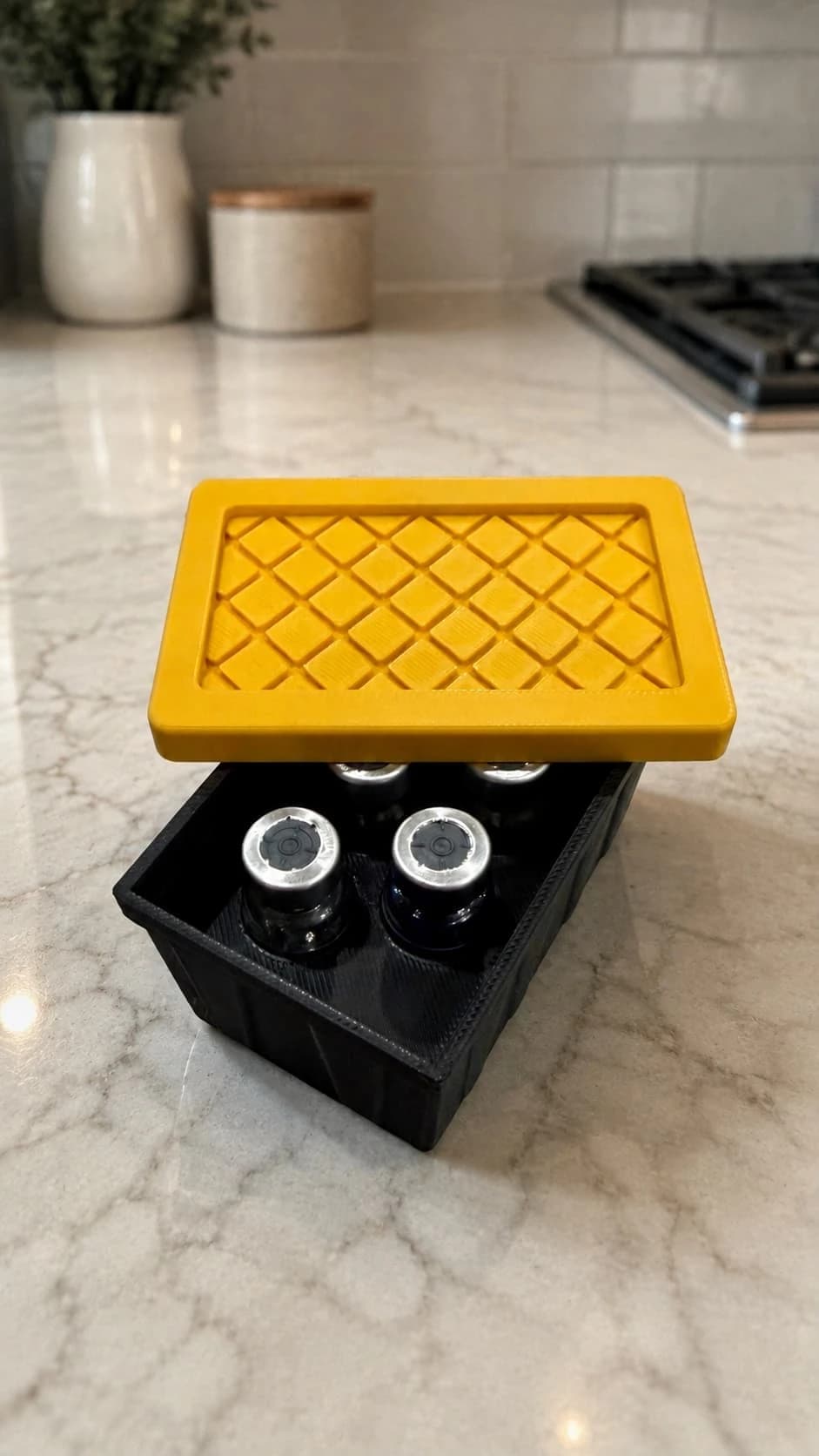
5-Vial Tote Case
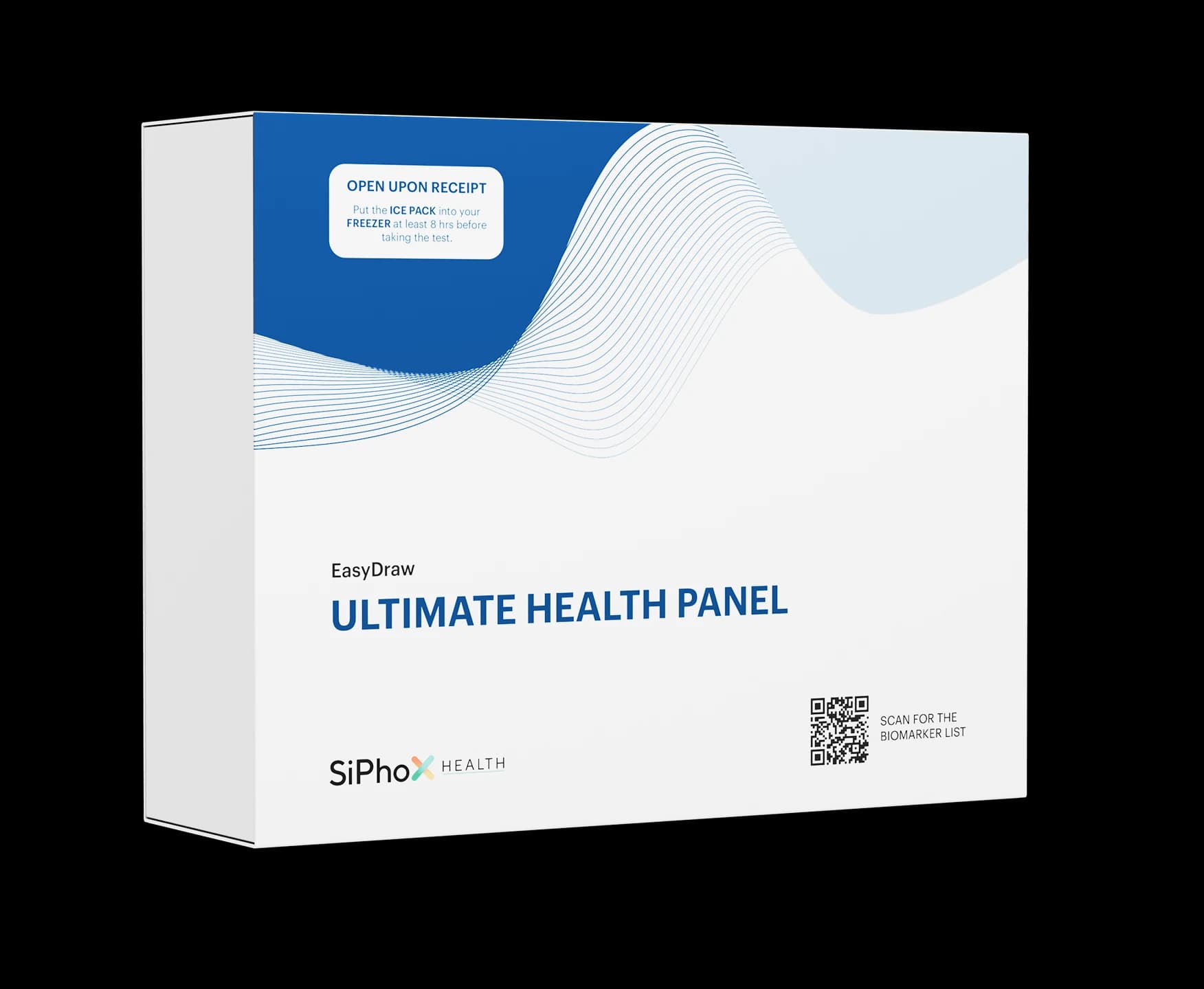
At-Home Blood Test
Research Supplies
Disclosure: supply links may earn PDP a commission at no cost to you.
Vials (50 mg each, subcutaneous route only)
One 50 mg vial lasts about 10 to 20 days at 2.5 to 5 mg per day.
| Cycle length | Planning note |
|---|---|
2 weeks 1 vial | Covers about 10 to 20 days at the example doses. |
4 weeks 2 vials | Roughly one vial every two weeks. |
8 weeks 4 vials | Plan extra margin for priming losses. |
12 weeks 6 vials | Full standard cycle length. |
2 weeks
1 vial
Covers about 10 to 20 days at the example doses.
4 weeks
2 vials
Roughly one vial every two weeks.
8 weeks
4 vials
Plan extra margin for priming losses.
12 weeks
6 vials
Full standard cycle length.
Insulin Syringes (U-100)
One fresh syringe per injection. The example subQ doses fit a 0.5 mL barrel.
| Cycle length | Planning note |
|---|---|
2 weeks 14 syringes | 1 syringe per day at once-daily dosing. |
4 weeks 28 syringes | 1 syringe per day. |
8 weeks 56 syringes | 1 syringe per day. |
12 weeks 84 syringes | 1 syringe per day. Add more if running twice-daily. |
2 weeks
14 syringes
1 syringe per day at once-daily dosing.
4 weeks
28 syringes
1 syringe per day.
8 weeks
56 syringes
1 syringe per day.
12 weeks
84 syringes
1 syringe per day. Add more if running twice-daily.
Bacteriostatic Water
Use up to 3.0 mL per 50 mg vial. One 10 mL bottle covers three vials with margin.
| Cycle length | Planning note |
|---|---|
2-4 weeks 1 × 10 mL bottle | 2 weeks: Uses 3 mL of one bottle.; 4 weeks: Uses 6 mL of one bottle. |
8-12 weeks 2 × 10 mL bottles | 8 weeks: Uses 12 mL across the cycle.; 12 weeks: Uses 18 mL across the cycle. |
2-4 weeks
1 × 10 mL bottle
2 weeks: Uses 3 mL of one bottle.; 4 weeks: Uses 6 mL of one bottle.
8-12 weeks
2 × 10 mL bottles
8 weeks: Uses 12 mL across the cycle.; 12 weeks: Uses 18 mL across the cycle.
Numbers round up for priming losses and small protocol changes. If you are using oral capsules, none of the above applies — you only need the capsules themselves.
Companion Supplies & Routine Support
5-Amino-1MQ Reconstitution Calculator

Powered by PepPal
5-Amino-1MQ Reconstitution Calculator
Start with the protocol example, then customize every field.
Loaded reference
PDP 50 mg vial example
This calculator does not apply to 5-Amino-1MQ capsules.
Your draw
15units
0.15 mL on a U-100 insulin syringe
- Concentration
- 16.667 mg/mL
- Target in mg
- 2.5 mg
- Math-only doses per vial
- 20
One free emailed save per person, checked by PepPal.
Educational calculation tool only. The loaded amount is a reference from this page, not a personal dose recommendation. Confirm the vial label, route, syringe type, and actual liquid added before relying on a result.
Best Time to Take 5-Amino-1MQ: Morning or Night?
Morning is the most commonly discussed time for 5-Amino-1MQ because some informal reports describe warmth, alertness, or trouble sleeping after later use. No human trial has tested the best time, however. Timing should be treated as an unproven research practice, not a medical schedule.
Timing questions and current evidence limits
Question
Morning or evening?
Research-context answer
Morning is more common in community protocols. Evening use may be more likely to disrupt sleep, but this has not been tested in a controlled human study.
Question
With or without food?
Research-context answer
No human study has compared the two. Taking an oral capsule with food may be easier on the stomach, but food could also change absorption.
Question
Once daily or split?
Research-context answer
Once-daily and split morning-to-midday schedules are both discussed. Split timing is based on short rat half-life data, not a proven human benefit.
Question
Oral or subcutaneous timing?
Research-context answer
Oral absorption and injected delivery are different. Rat data cannot establish the best timing for either route in people.
Question
What if a scheduled amount is missed?
Research-context answer
There is no approved missed-dose guidance. Informal protocols generally avoid doubling the next amount because safety and dose limits are unknown.
| Question | Research-context answer |
|---|---|
| Morning or evening? | Morning is more common in community protocols. Evening use may be more likely to disrupt sleep, but this has not been tested in a controlled human study. |
| With or without food? | No human study has compared the two. Taking an oral capsule with food may be easier on the stomach, but food could also change absorption. |
| Once daily or split? | Once-daily and split morning-to-midday schedules are both discussed. Split timing is based on short rat half-life data, not a proven human benefit. |
| Oral or subcutaneous timing? | Oral absorption and injected delivery are different. Rat data cannot establish the best timing for either route in people. |
| What if a scheduled amount is missed? | There is no approved missed-dose guidance. Informal protocols generally avoid doubling the next amount because safety and dose limits are unknown. |
No human study has established a best time, meal rule, or missed-dose plan for 5-Amino-1MQ.
5-Amino-1MQ Oral Capsules vs Injection
Oral capsules are easier to use, while subcutaneous injection requires a vial, bacteriostatic water, and syringe math. Rat research found 38.4% oral bioavailability, but no human study has compared the two routes. Oral and injected amounts are not directly interchangeable, and neither route has a proven human dose.
5-Amino-1MQ oral and subcutaneous route comparison
Factor
Administration
Oral capsules
Capsule taken by mouth
Subcutaneous injection
Reconstituted solution placed under the skin
Factor
Commonly discussed research amounts
Oral capsules
50 to 150 mg per day in community reports
Subcutaneous injection
2.5 to 5 mg per day in community reports
Factor
Frequency
Oral capsules
Once daily or split between morning and midday
Subcutaneous injection
Usually discussed as once daily, with some split examples
Factor
Absorption evidence
Oral capsules
38.4% oral bioavailability in one rat study; human bioavailability is unknown
Subcutaneous injection
Human subcutaneous bioavailability and pharmacokinetics are unknown
Factor
Convenience
Oral capsules
No mixing or syringe math
Subcutaneous injection
Requires reconstitution, sterile supplies, and injection-site planning
Factor
Evidence limits
Oral capsules
No controlled human dose, benefit, or safety trial
Subcutaneous injection
No controlled human dose, benefit, or safety trial
Factor
Can the amounts be treated as equal?
Oral capsules
No. Route changes exposure, and rat data cannot provide a safe conversion.
Subcutaneous injection
No. A smaller injected amount is not proven equal to a larger oral amount.
| Factor | Oral capsules | Subcutaneous injection |
|---|---|---|
| Administration | Capsule taken by mouth | Reconstituted solution placed under the skin |
| Commonly discussed research amounts | 50 to 150 mg per day in community reports | 2.5 to 5 mg per day in community reports |
| Frequency | Once daily or split between morning and midday | Usually discussed as once daily, with some split examples |
| Absorption evidence | 38.4% oral bioavailability in one rat study; human bioavailability is unknown | Human subcutaneous bioavailability and pharmacokinetics are unknown |
| Convenience | No mixing or syringe math | Requires reconstitution, sterile supplies, and injection-site planning |
| Evidence limits | No controlled human dose, benefit, or safety trial | No controlled human dose, benefit, or safety trial |
| Can the amounts be treated as equal? | No. Route changes exposure, and rat data cannot provide a safe conversion. | No. A smaller injected amount is not proven equal to a larger oral amount. |
The listed amounts describe informal research discussions. They are not dosing recommendations or validated route conversions.
5-Amino-1MQ Half-Life and Dosing Frequency
5-Amino-1MQ has no established human half-life. In rats, the reported average was about 3.8 hours after IV dosing and 6.9 hours after oral dosing. Those figures help explain why some informal protocols split timing, but they cannot set a safe or effective schedule for people.
Published 5-Amino-1MQ pharmacokinetic findings
Measure
IV half-life
Published finding
3.80 ± 1.10 hours in rats
What it means
Animal IV data only; it does not describe oral or subcutaneous timing in people.
Measure
Oral half-life
Published finding
6.90 ± 1.20 hours in rats
What it means
Animal oral data only; it is not an established human half-life.
Measure
Oral bioavailability
Published finding
38.4% in rats
What it means
Shows that some oral absorption occurred in that model. Human absorption may differ.
Measure
Subcutaneous half-life
Published finding
Not established in humans
What it means
Skipping the gut may change exposure, but no safe route conversion can be calculated from current data.
| Measure | Published finding | What it means |
|---|---|---|
| IV half-life | 3.80 ± 1.10 hours in rats | Animal IV data only; it does not describe oral or subcutaneous timing in people. |
| Oral half-life | 6.90 ± 1.20 hours in rats | Animal oral data only; it is not an established human half-life. |
| Oral bioavailability | 38.4% in rats | Shows that some oral absorption occurred in that model. Human absorption may differ. |
| Subcutaneous half-life | Not established in humans | Skipping the gut may change exposure, but no safe route conversion can be calculated from current data. |
Source: Awosemo et al., Journal of Pharmaceutical and Biomedical Analysis, 2021.
Some community protocols use a morning and midday split to spread exposure across the day. That idea is an extrapolation from rat data. It has not been shown to improve results or reduce risks in people. Route, food, metabolism, and product quality could all change how long the compound remains in the body.
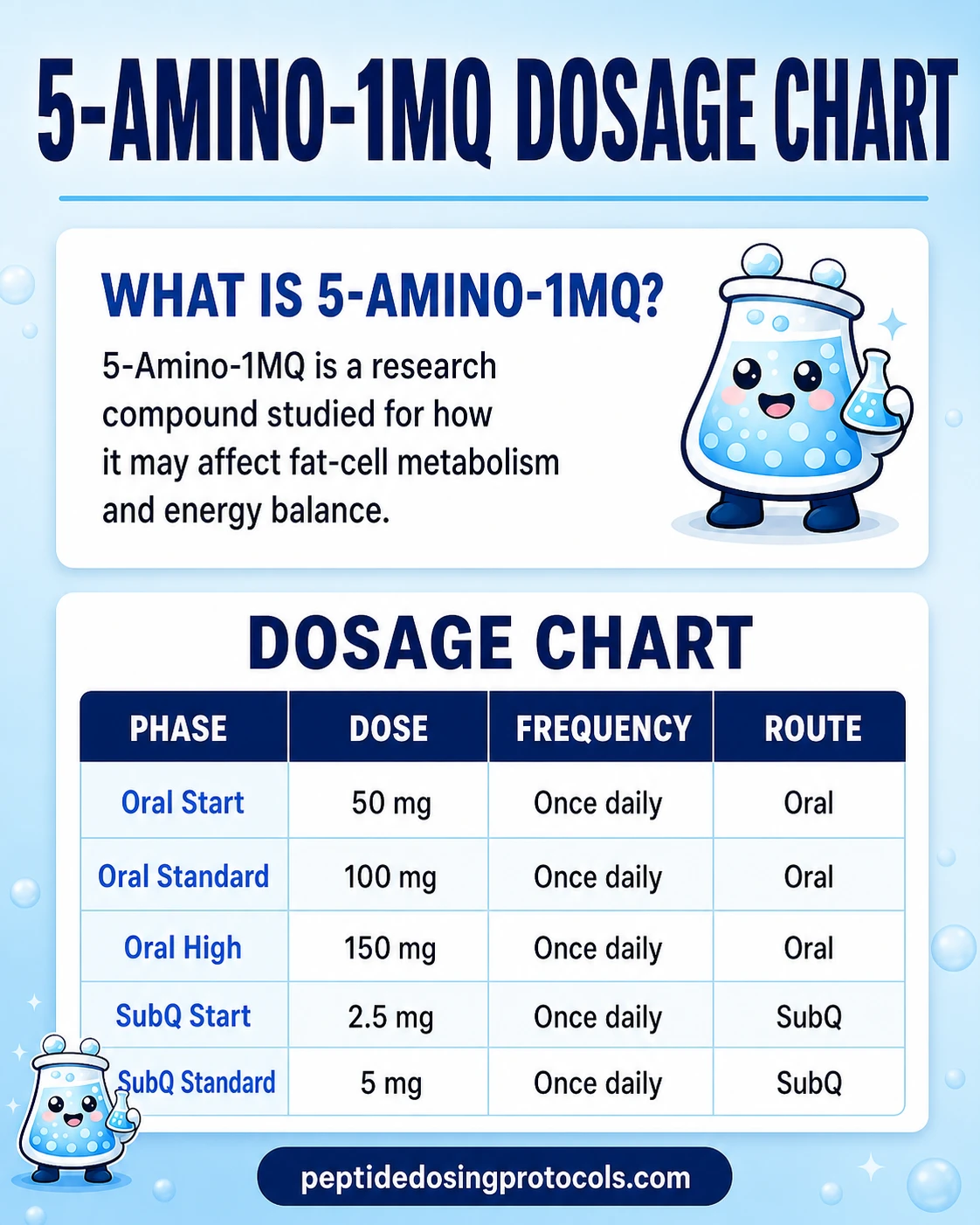
5-Amino-1MQ Dosage Chart
This 5-Amino-1MQ dosage chart summarizes the oral and SubQ research dosing ranges from 2.5 mg to 150 mg shown in the dosing section above.
5-Amino-1MQ Reconstitution Guide
The amount of BAC water depends on the vial strength and the concentration needed. The examples below use 1.0 mL for a 10 mg vial, 2.0 mL for a 20 mg vial, and 3.0 mL for a 50 mg vial. Reconstitution does not apply to oral capsules.
10 mg vial reconstitution math
BAC water added
1.0 mL
Final concentration
10 mg/mL
Research amount
1 mg
Draw volume
0.10 mL
U-100 syringe units
10 units
BAC water added
1.0 mL
Final concentration
10 mg/mL
Research amount
2.5 mg
Draw volume
0.25 mL
U-100 syringe units
25 units
BAC water added
1.0 mL
Final concentration
10 mg/mL
Research amount
5 mg
Draw volume
0.50 mL
U-100 syringe units
50 units
| BAC water added | Final concentration | Research amount | Draw volume | U-100 syringe units |
|---|---|---|---|---|
| 1.0 mL | 10 mg/mL | 1 mg | 0.10 mL | 10 units |
| 1.0 mL | 10 mg/mL | 2.5 mg | 0.25 mL | 25 units |
| 1.0 mL | 10 mg/mL | 5 mg | 0.50 mL | 50 units |
A 5 mg amount uses half of this vial and requires a 0.50 mL draw at this concentration.
20 mg vial reconstitution math
BAC water added
2.0 mL
Final concentration
10 mg/mL
Research amount
1 mg
Draw volume
0.10 mL
U-100 syringe units
10 units
BAC water added
2.0 mL
Final concentration
10 mg/mL
Research amount
2.5 mg
Draw volume
0.25 mL
U-100 syringe units
25 units
BAC water added
2.0 mL
Final concentration
10 mg/mL
Research amount
5 mg
Draw volume
0.50 mL
U-100 syringe units
50 units
| BAC water added | Final concentration | Research amount | Draw volume | U-100 syringe units |
|---|---|---|---|---|
| 2.0 mL | 10 mg/mL | 1 mg | 0.10 mL | 10 units |
| 2.0 mL | 10 mg/mL | 2.5 mg | 0.25 mL | 25 units |
| 2.0 mL | 10 mg/mL | 5 mg | 0.50 mL | 50 units |
The same 10 mg/mL concentration makes the syringe math match the 10 mg vial example above.
50 mg vial reconstitution math
BAC water added
3.0 mL
Final concentration
16.7 mg/mL
Research amount
1 mg
Draw volume
0.06 mL
U-100 syringe units
6 units
BAC water added
3.0 mL
Final concentration
16.7 mg/mL
Research amount
2.5 mg
Draw volume
0.15 mL
U-100 syringe units
15 units
BAC water added
3.0 mL
Final concentration
16.7 mg/mL
Research amount
5 mg
Draw volume
0.30 mL
U-100 syringe units
30 units
BAC water added
3.0 mL
Final concentration
16.7 mg/mL
Research amount
10 mg
Draw volume
0.60 mL
U-100 syringe units
60 units
| BAC water added | Final concentration | Research amount | Draw volume | U-100 syringe units |
|---|---|---|---|---|
| 3.0 mL | 16.7 mg/mL | 1 mg | 0.06 mL | 6 units |
| 3.0 mL | 16.7 mg/mL | 2.5 mg | 0.15 mL | 15 units |
| 3.0 mL | 16.7 mg/mL | 5 mg | 0.30 mL | 30 units |
| 3.0 mL | 16.7 mg/mL | 10 mg | 0.60 mL | 60 units |
The values are rounded. A 0.60 mL draw may be unusually large for one subcutaneous site. This table is math, not a dosing recommendation.
- 01
Bring the vial to room temperature
Take the vial out of the freezer and let it sit on the counter for 15 to 20 minutes. This prevents condensation when the seal opens.
- 02
Wipe the vial top
Use a fresh alcohol swab on the rubber stopper of both the 5-Amino-1MQ vial and the BAC water vial.
- 03
Draw BAC water
Use a clean syringe to draw the BAC-water volume shown for your vial strength in the tables above.
- 04
Add slowly
Insert the needle and let the water run down the inside wall of the vial. Do not blast it directly onto the powder.
- 05
Swirl, do not shake
Gently swirl or roll the vial between your hands until the powder dissolves into a clear solution.
- 06
Inspect
The solution should be clear with no cloudy particles. If it looks off, do not use the vial.
- 07
Label and refrigerate
Write the reconstitution date on the vial. Store at 2 to 8 °C (35.6 to 46.4 °F). Use within 2 to 4 weeks.
- 08
Draw your dose
Match the draw volume and U-100 syringe units to the table for the vial strength and concentration you prepared.
How 5-Amino-1MQ Works
5-Amino-1MQ blocks one enzyme: NNMT (nicotinamide N-methyltransferase). That single block sets off a chain of changes inside fat cells.
Here is the plain-English version. Your body uses a form of vitamin B3 called nicotinamide to build NAD+, the energy currency that powers mitochondria and many cell-repair processes. NNMT is an enzyme that grabs nicotinamide and methylates it, turning it into a waste product called 1-MNA that gets cleared from the body. In obesity, NNMT activity is unusually high in fat cells, which means a lot of nicotinamide gets thrown out before it can be turned into NAD+.
5-Amino-1MQ stops that waste step. With NNMT blocked, nicotinamide stays in the cell, NAD+ levels climb, and fat cells start burning more fuel instead of storing it. Researchers also observed shifts in glucose uptake and sirtuin activity (the SIRT1 longevity protein family) when NNMT was blocked.
Blocks NNMT in fat cells
In 3T3-L1 mouse fat cells, 30 µM of 5-Amino-1MQ for 24 hours strongly lowered 1-MNA levels — direct proof of NNMT inhibition (Neelakantan et al., Biochemical Pharmacology, 2018).
Raises NAD+ and SAM
The same study showed that NAD+ and S-adenosyl-methionine (SAM) both went up after NNMT inhibition. LC-MS/MS measurements confirmed both cofactors rose.
Shrinks fat cells in mice
In diet-induced obese mice, 11 days of 5-Amino-1MQ (subcutaneous, around 34 mg/kg/day) reduced body weight, total fat mass, and plasma cholesterol with no drop in food intake or lean mass.
Confirmed at 28 days
A follow-up 28-day study (Babula et al., 2024) extended the finding: 5-Amino-1MQ dose-dependently limited body weight and fat mass gain without changing food intake, and it improved liver markers in obese mice.
Looking for outcomes rather than protocol math? See the 5-Amino-1MQ results and benefits guide for a closer look at animal findings, reported timelines, before-and-after claims, and the limits of current human evidence.
5-Amino-1MQ Human Clinical Trials and FDA Status
Current evidence
No published human dosing trial has established a 5-Amino-1MQ dose, cycle, safety profile, or treatment benefit. The research used to support this protocol is mainly preclinical, including cell and animal studies.
Searches for 5-Amino-1MQ human clinical trials often lead to animal research being presented as if it were human evidence. That is an important distinction. The key published studies behind 5-Amino-1MQ used laboratory models and mice, not controlled dosing trials in people.
What has been studied with 5-Amino-1MQ?
Evidence type
Cell research
What is available
Laboratory studies have tested NNMT inhibition and related biological effects.
What it can establish
Mechanism and cellular effects only. Cell studies cannot establish a human dose or cycle.
Evidence type
Animal research
What is available
Published mouse studies have tested 5-Amino-1MQ across treatment periods ranging from days to several weeks.
What it can establish
Preclinical effects and study-specific exposure. Animal doses and schedules should not be transferred directly to humans.
Evidence type
Human clinical dosing trials
What is available
No published human dosing trial was identified in the evidence used for this protocol.
What it can establish
No validated human dose, frequency, cycle length, or expected outcome can be established.
Evidence type
FDA-approved use
What is available
No FDA-approved 5-Amino-1MQ use is established in the sources reviewed here.
What it can establish
Community protocols should not be described as FDA-approved dosing.
| Evidence type | What is available | What it can establish |
|---|---|---|
| Cell research | Laboratory studies have tested NNMT inhibition and related biological effects. | Mechanism and cellular effects only. Cell studies cannot establish a human dose or cycle. |
| Animal research | Published mouse studies have tested 5-Amino-1MQ across treatment periods ranging from days to several weeks. | Preclinical effects and study-specific exposure. Animal doses and schedules should not be transferred directly to humans. |
| Human clinical dosing trials | No published human dosing trial was identified in the evidence used for this protocol. | No validated human dose, frequency, cycle length, or expected outcome can be established. |
| FDA-approved use | No FDA-approved 5-Amino-1MQ use is established in the sources reviewed here. | Community protocols should not be described as FDA-approved dosing. |
Absence of established human dosing evidence is why this page keeps published animal research separate from community-reported protocols.
What does the FDA say about 5-Amino-1MQ?
In a January 20, 2026 warning letter, the FDA specifically named 5-amino-1-methylquinolinium iodide (5-Amino-1MQ). The agency said it did not appear on the 503B bulks list and was not being used to compound a drug on the FDA drug-shortage list. Because of that, products compounded with it at the facility discussed in the letter were not eligible for the exemptions provided under section 503B.
503B status is not the same as a human dosing study
The FDA warning letter is regulatory evidence, not clinical evidence. It does not provide a 5-Amino-1MQ dose, cycle, safety standard, or proof of benefit. It does show why 5-Amino-1MQ should not be described as an FDA-approved human protocol.
Why animal doses do not become human doses
Published 5-Amino-1MQ studies can help explain the compound's mechanism and how researchers designed animal experiments. They cannot establish a human protocol. Species, route, metabolism, dose scaling, treatment length, and study goals can all change how an experiment is designed.
- A mouse dose is not a validated human dose.
- A rodent treatment period is not a proven human cycle.
- Animal pharmacokinetics do not establish a human half-life.
- Changes measured in mice do not guarantee the same outcome in people.
- Community-reported schedules remain unvalidated unless tested in appropriate human research.
For that reason, the dosage, timing, and cycle information elsewhere on this page is labeled by evidence level. Published preclinical research is presented separately from community-reported practices rather than combining them into one supposedly proven protocol.
Who 5-Amino-1MQ Is For and Who Should Avoid It
5-Amino-1MQ has no FDA-approved use, so there is no formal eligibility list. The list below reflects how the published rodent studies were set up and what is known about NNMT in human biology.
- Pregnancy and breastfeeding: not studied. Avoid.
- Active cancer or recent cancer history: NNMT plays a complex role in cancer biology. In some tumor types, NNMT activity helps the tumor grow; in others, the picture is less clear. Until human safety data exists, anyone with a cancer history should avoid 5-Amino-1MQ outside formal oncology research.
- Liver disease: liver enzyme monitoring is recommended in community use, and a baseline ALT/AST check is reasonable before starting.
- Children and teenagers: no safety data exists.
- Anyone taking methyl-donor-sensitive medications (some psychiatric drugs, methotrexate, methylated B-vitamin protocols at high doses): NNMT shares the methyl donor SAM, so theoretical interactions exist.
- People with known sleep disorders: the metabolic activation effect can worsen insomnia if dosed late in the day.
If any of those apply, talk to a qualified clinician before considering 5-Amino-1MQ for any reason.
5-Amino-1MQ Side Effects, Risks and Safety
Possible side effects are not well defined because no controlled human safety trial has been published. Informal reports mention sleep trouble, warmth, a faster resting heart rate, stomach upset, and injection-site stinging. Their true frequency and cause are unknown, and long-term risks, drug interactions, and safe-use groups have not been established.
What is known and unknown about 5-Amino-1MQ safety
Reported or proposed issue
Sleep trouble, warmth, or a faster resting heart rate
Evidence source
Informal community reports
Known or theoretical?
Reported, but not confirmed in a controlled study
Important limits
Frequency, dose link, and cause are unknown. Other stimulants may add to these effects.
Reported or proposed issue
Stomach upset with oral capsules
Evidence source
Informal community reports
Known or theoretical?
Reported, but not confirmed
Important limits
Food effects and human oral tolerability have not been studied.
Reported or proposed issue
Stinging or irritation after injection
Evidence source
Informal route-specific reports
Known or theoretical?
Reported, but not confirmed
Important limits
Could relate to the compound, concentration, sterility, or injection method.
Reported or proposed issue
Liver or metabolic changes
Evidence source
Animal studies and pathway theory
Known or theoretical?
Human risk is unknown
Important limits
Animal studies cannot establish safe liver effects or monitoring rules for people.
Reported or proposed issue
Drug or supplement interactions
Evidence source
Mechanism-based theory
Known or theoretical?
Theoretical
Important limits
No controlled interaction studies exist. Concerns may be higher with drugs that affect metabolism, blood sugar, sleep, or methyl-group pathways.
Reported or proposed issue
Pregnancy, breastfeeding, children, liver disease, or cancer history
Evidence source
No direct human safety data
Known or theoretical?
Unknown
Important limits
These groups are not covered by established human research and should not be treated as proven safe-use groups.
Reported or proposed issue
Long-term or repeated-cycle effects
Evidence source
No long-term human trial
Known or theoretical?
Unknown
Important limits
No established long-term human safety data exists.
| Reported or proposed issue | Evidence source | Known or theoretical? | Important limits |
|---|---|---|---|
| Sleep trouble, warmth, or a faster resting heart rate | Informal community reports | Reported, but not confirmed in a controlled study | Frequency, dose link, and cause are unknown. Other stimulants may add to these effects. |
| Stomach upset with oral capsules | Informal community reports | Reported, but not confirmed | Food effects and human oral tolerability have not been studied. |
| Stinging or irritation after injection | Informal route-specific reports | Reported, but not confirmed | Could relate to the compound, concentration, sterility, or injection method. |
| Liver or metabolic changes | Animal studies and pathway theory | Human risk is unknown | Animal studies cannot establish safe liver effects or monitoring rules for people. |
| Drug or supplement interactions | Mechanism-based theory | Theoretical | No controlled interaction studies exist. Concerns may be higher with drugs that affect metabolism, blood sugar, sleep, or methyl-group pathways. |
| Pregnancy, breastfeeding, children, liver disease, or cancer history | No direct human safety data | Unknown | These groups are not covered by established human research and should not be treated as proven safe-use groups. |
| Long-term or repeated-cycle effects | No long-term human trial | Unknown | No established long-term human safety data exists. |
A lack of reported harm is not proof of safety. Human side-effect rates and interaction risks are not established.
Quality-control risks
Products sold under research-use-only labels do not carry the same approval review as FDA-approved drugs. Identity, purity, strength, and sterility may vary. A lot-matched certificate of analysis can add context, but it does not prove that a product is safe for people. Both product quality and the compound's own risks remain uncertain.
How Long Does 5-Amino-1MQ Take to Work?
There is no proven human timeline for 5-Amino-1MQ. Informal reports sometimes describe body-composition changes after 4 to 6 weeks, but these reports are not controlled evidence. Animal studies measured changes over 11 to 28 days. Those findings cannot predict when, or whether, a person would notice a result.
- Days 1–28 in animal research: mouse studies reported metabolic and fat-mass changes during this window.
- Weeks 4–6 in informal reports: some community accounts describe early waist or body-fat changes, but other causes cannot be ruled out.
- Weeks 8–12 in informal cycles: often described as a full research cycle, not as a proven time to peak results.
- Before-and-after claims: diet, training, other compounds, lighting, and selection bias can all change the picture. Treat these claims cautiously.
Animal and human bodies absorb, break down, and respond to compounds in different ways. A mouse result cannot be converted into a human promise by scaling time or dose. There is also no validated clinical marker that shows 5-Amino-1MQ is working in a person.
5-Amino-1MQ Benefits and Results: What the Evidence Shows
The possible benefits of 5-Amino-1MQ come from cell and animal research, not controlled human trials. Studies in obese mice reported changes in fat mass and metabolic markers after NNMT inhibition. These findings support more research, but they do not show that 5-Amino-1MQ causes weight loss, more energy, or better health in people.
Evidence behind common 5-Amino-1MQ benefit claims
Claimed outcome
Fat-mass changes
Evidence level
Animal evidence
What research currently shows
Obese mouse studies reported less body-weight gain, lower fat mass, or smaller fat cells after NNMT inhibition.
Claimed outcome
NAD+ changes
Evidence level
Cell and animal evidence
What research currently shows
Blocking NNMT can preserve nicotinamide, a building block used to make NAD+. Higher cellular NAD+ was reported in preclinical work.
Claimed outcome
Appetite reduction
Evidence level
Limited evidence
What research currently shows
Mouse changes occurred without lower food intake. That suggests appetite suppression was not the main mechanism in those studies.
Claimed outcome
Human weight loss
Evidence level
Not established
What research currently shows
No controlled human trial has shown that 5-Amino-1MQ causes weight loss.
Claimed outcome
Energy changes
Evidence level
Preclinical or anecdotal
What research currently shows
NAD+ biology offers a possible mechanism, and informal reports vary. Human benefit and side-effect rates are unknown.
| Claimed outcome | Evidence level | What research currently shows |
|---|---|---|
| Fat-mass changes | Animal evidence | Obese mouse studies reported less body-weight gain, lower fat mass, or smaller fat cells after NNMT inhibition. |
| NAD+ changes | Cell and animal evidence | Blocking NNMT can preserve nicotinamide, a building block used to make NAD+. Higher cellular NAD+ was reported in preclinical work. |
| Appetite reduction | Limited evidence | Mouse changes occurred without lower food intake. That suggests appetite suppression was not the main mechanism in those studies. |
| Human weight loss | Not established | No controlled human trial has shown that 5-Amino-1MQ causes weight loss. |
| Energy changes | Preclinical or anecdotal | NAD+ biology offers a possible mechanism, and informal reports vary. Human benefit and side-effect rates are unknown. |
Evidence from cells and animals can show a research signal. It cannot establish a safe or effective human outcome.
Changes appeared within 11 to 28 days in mouse studies. There is no matching human timeline. People and mice differ in metabolism, body size, route exposure, and disease biology, so animal results cannot predict a person's outcome.
Before-and-after photos and personal stories should be treated with care. They rarely control for diet, exercise, water weight, other compounds, camera conditions, or who chose to share a result. Our 5-Amino-1MQ results and benefits guide takes a closer look at reported timelines, before-and-after claims, and the gaps in human evidence.
5-Amino-1MQ Storage & Handling
Capsules and vials follow different storage rules.
5-Amino-1MQ storage by format
Form
Capsules (sealed container)
Temperature
Room temperature
Note
Keep in a cool, dry, dark place. Stable up to 12 months at room temperature.
Form
Lyophilized vial (long-term)
Temperature
-4 °F (-20 °C) or colder
Note
Best for long storage. Stable up to 24 months.
Form
Lyophilized vial (short-term)
Temperature
35.6 to 46.4 °F (2 to 8 °C)
Note
Acceptable for short transit and short holds.
Form
Reconstituted vial
Temperature
35.6 to 46.4 °F (2 to 8 °C)
Note
Refrigerate. Use within 2 to 4 weeks. Do not refreeze.
Form
Appearance
Temperature
Clear after mixing
Note
Cloudy or particulate solution means stop using it.
| Form | Temperature | Note |
|---|---|---|
| Capsules (sealed container) | Room temperature | Keep in a cool, dry, dark place. Stable up to 12 months at room temperature. |
| Lyophilized vial (long-term) | -4 °F (-20 °C) or colder | Best for long storage. Stable up to 24 months. |
| Lyophilized vial (short-term) | 35.6 to 46.4 °F (2 to 8 °C) | Acceptable for short transit and short holds. |
| Reconstituted vial | 35.6 to 46.4 °F (2 to 8 °C) | Refrigerate. Use within 2 to 4 weeks. Do not refreeze. |
| Appearance | Clear after mixing | Cloudy or particulate solution means stop using it. |
Capsules at room temperature is fine. Reconstituted vials should never be left out for more than a few hours.
5-Amino-1MQ Protocol Mistakes & Troubleshooting
I can't sleep after starting
Insomnia is most often linked in reports to evening or midday dosing rather than morning dosing.
I missed a daily dose
Community protocols generally do not double up after a missed dose; the next scheduled dose resumes as normal.
I am not seeing fat loss at week 4
There is no proven human timeline or response rate. Informal reports cannot show whether 5-Amino-1MQ caused a change, and animal timelines should not be converted into human expectations.
The vial looks cloudy after mixing
Stop using it. Cloudy solution can mean degradation or contamination. Reconstituted 5-Amino-1MQ should be clear.
A high amount requires a very large draw
At 16.7 mg/mL, a 100 mg amount would require about 6 mL. That is far beyond the static subcutaneous examples on this page and shows why oral and injected amounts should not be treated as interchangeable.
My resting heart rate went up 5 bpm
Reported as a mild stimulant-like effect in the first 1 to 2 weeks. If it climbs higher, stays elevated past 2 weeks, or causes symptoms, stop and consult a clinician.
5-Amino-1MQ vs AOD-9604 vs Semaglutide vs NAD+
5-Amino-1MQ is often compared to fat-loss peptides and to NAD+ boosters. The four below sit closest to it in research community use.
Fat-loss and metabolic compound comparison
Compound
5-Amino-1MQ
Mechanism
NNMT inhibitor; raises NAD+, shrinks fat cells
Route
Oral capsule (50–150 mg/day)
Acts on appetite?
No
FDA status
Not FDA-approved
Compound
AOD-9604
Mechanism
Modified GH fragment; promotes fat oxidation
Route
Subcutaneous injection
Acts on appetite?
No
FDA status
Not FDA-approved
Compound
Semaglutide
Mechanism
GLP-1 receptor agonist; suppresses appetite
Route
Subcutaneous injection or oral
Acts on appetite?
Yes (strong)
FDA status
FDA-approved (T2D and obesity)
Compound
NAD+ (intravenous or subcutaneous)
Mechanism
Direct NAD+ supplementation
Route
IV infusion or subcutaneous
Acts on appetite?
No
FDA status
Not FDA-approved as a drug
| Compound | Mechanism | Route | Acts on appetite? | FDA status |
|---|---|---|---|---|
| 5-Amino-1MQ | NNMT inhibitor; raises NAD+, shrinks fat cells | Oral capsule (50–150 mg/day) | No | Not FDA-approved |
| AOD-9604 | Modified GH fragment; promotes fat oxidation | Subcutaneous injection | No | Not FDA-approved |
| Semaglutide | GLP-1 receptor agonist; suppresses appetite | Subcutaneous injection or oral | Yes (strong) | FDA-approved (T2D and obesity) |
| NAD+ (intravenous or subcutaneous) | Direct NAD+ supplementation | IV infusion or subcutaneous | No | Not FDA-approved as a drug |
These compounds are not interchangeable. Each has its own evidence base and safety boundary.
Plain-English summary: 5-Amino-1MQ and AOD-9604 both target fat without touching appetite. Semaglutide works on appetite but does not directly raise NAD+. NAD+ supplementation adds NAD+ from the outside; 5-Amino-1MQ helps the body make and keep more NAD+ from the inside. Some research community protocols stack 5-Amino-1MQ with AOD-9604 or with a GLP-1 drug, but no human study has tested those combinations.
FAQ
Q1: What is 5-Amino-1MQ?
5-Amino-1MQ is short for 5-amino-1-methylquinolinium. It is a small synthetic molecule, not a peptide. It blocks an enzyme called NNMT, which helps control how cells use nicotinamide. Researchers are studying this pathway for possible effects on fat tissue, NAD+, and metabolism, but human benefits are not established.
Q2: Is 5-Amino-1MQ a peptide?
No. 5-Amino-1MQ is a small molecule, not a chain of amino acids. It is often sold alongside research peptides because it fits the same metabolic research space, but chemically it is closer to a small-molecule drug than to peptides like BPC-157 or semaglutide.
Q3: Is 5-Amino-1MQ FDA approved?
No. 5-Amino-1MQ was not listed as an FDA-approved drug when this page was checked on July 30, 2026. It is an experimental research compound, not an approved treatment. A missing FDA listing does not prove that a product is safe, effective, or made to drug-quality standards.
Q4: What is the typical research dosage for 5-Amino-1MQ?
No typical human dose has been established. Research community discussions often mention 50 to 150 mg per day by mouth and 2.5 to 5 mg per day by subcutaneous injection. These ranges come from animal-data extrapolation and informal reports, not controlled human trials, and the two routes are not directly interchangeable.
Q5: Is there a different 5-Amino-1MQ dosage for women?
No sex-specific human dose has been established for 5-Amino-1MQ. Published research has not validated a separate dosing schedule for women. Any amounts discussed elsewhere should be treated as research-context or community-reported information, not a proven female-specific dose.
Q6: How much BAC water should be added to 5-Amino-1MQ?
BAC-water volume depends on vial strength and the concentration needed. The examples on this page use 1.0 mL for a 10 mg vial, 2.0 mL for a 20 mg vial, and 3.0 mL for a 50 mg vial. These are static math examples, not mixing instructions for human use.
Q7: When is the best time to take 5-Amino-1MQ: morning or night?
Morning is the most common timing in informal research protocols because later use is sometimes linked to alertness or sleep trouble. No controlled human trial has established a best time, however. Morning-versus-night timing should be treated as an unproven research practice, not a medical schedule.
Q8: What is the half-life of 5-Amino-1MQ?
No human half-life has been established. In rats, the reported average was about 3.8 hours after IV dosing and 6.9 hours after oral dosing. These animal findings may help explain split timing in informal protocols, but they cannot set a safe dosing frequency or predict subcutaneous timing in people.
Q9: What is the injection dose for 5-Amino-1MQ?
Subcutaneous use is uncommon and dose-limited. A 50 mg vial mixed with 3.0 mL of bacteriostatic water gives about 16.7 mg/mL, and the example subcutaneous range is 2.5 to 5 mg per day. Anything higher than that quickly becomes too much volume for one subQ site, which is why oral capsules are the standard route.
Q10: Oral capsule or subcutaneous injection — which is better?
Neither route is proven better in people. A rat study reported 38.4% oral bioavailability, while human oral and subcutaneous exposure remain unknown. Capsules are more convenient, but injection requires reconstitution and sterile supplies. The commonly discussed amounts differ greatly and should not be treated as equal or directly converted.
Q11: What are the possible side effects of 5-Amino-1MQ?
Possible side effects are not well defined because no controlled human safety trial exists. Informal reports mention sleep trouble, warmth, a faster resting heart rate, stomach upset, and injection-site stinging. Their true frequency and cause are unknown. Drug interactions, long-term risks, and safe-use groups have not been established.
Q12: Who should avoid 5-Amino-1MQ?
Pregnant or breastfeeding people, anyone with active cancer or a recent cancer history, anyone with liver disease, children and teenagers, and anyone with known sleep disorders should avoid 5-Amino-1MQ outside formal research supervision.
Q13: How long does it take to work?
There is no proven human timeline. Informal reports sometimes describe body-composition changes after 4 to 6 weeks, while animal studies measured changes over 11 to 28 days. Animal findings cannot predict when, or whether, a person would notice a result, and before-and-after claims often leave out other important factors.
Q14: How long should a 5-Amino-1MQ cycle be?
Common research community cycles run 8 to 12 weeks on, followed by 4 to 6 weeks off. The off-period gives baseline NNMT activity a chance to reset before the next cycle.
Q15: Can 5-Amino-1MQ be stacked with semaglutide or AOD-9604?
Some research community protocols combine 5-Amino-1MQ with AOD-9604 (fat oxidation) or with a GLP-1 drug like semaglutide (appetite suppression), since the mechanisms do not overlap. No human study has tested these combinations.
Q16: Is this page medical advice?
No. This page is an educational research-context reference. 5-Amino-1MQ is not FDA-approved and is not a supplement. Talk to a qualified clinician before considering any use.
Sources & Research
- 1. Neelakantan H, Vance V, Wetzel MD, et al. Selective and membrane-permeable small molecule inhibitors of nicotinamide N-methyltransferase reverse high fat diet-induced obesity in mice. Biochemical Pharmacology (2018)
- 2. Babula JJ, Bui D, Stevenson HL, Watowich SJ, Neelakantan H. Nicotinamide N-methyltransferase inhibition mitigates obesity-related metabolic dysfunction. PubMed (peer-reviewed) (2024)
- 3. Awosemo O, Neelakantan H, Watowich S, et al. Development & validation of LC-MS/MS assay for 5-amino-1-methyl quinolinium in rat plasma: Application to pharmacokinetic and oral bioavailability studies. Journal of Pharmaceutical and Biomedical Analysis (2021)
- 4. Kraus D, Yang Q, Kong D, et al. Nicotinamide N-methyltransferase knockdown protects against diet-induced obesity. Nature (2014)
- 5. Sampson CM, Dimet AL, Neelakantan H, et al. Combined nicotinamide N-methyltransferase inhibition and lean-diet substitution reduces body weight and liver fat in obese mice. Scientific Reports (2021)
- 6. Neelakantan H, Brightwell CR, Graber TG, et al. Small molecule nicotinamide N-methyltransferase inhibitor activates muscle stem cells and progenitor cell function. Biochemical Pharmacology (2019)
- 7. Pissios P. Nicotinamide N-Methyltransferase: More Than a Vitamin B3 Clearance Enzyme. Trends in Endocrinology and Metabolism (2017)
- 8. National Center for Biotechnology Information. PubChem Compound Summary for 5-Amino-1-methylquinolinium (5-Amino-1MQ). PubChem (2026)
- 9. U.S. Food and Drug Administration. Drugs@FDA: FDA-approved drug database checked for 5-Amino-1MQ on July 30, 2026. FDA.gov (2026)
- 10. U.S. Food and Drug Administration. Development & Approval Process | Drugs. FDA.gov (2026)
- 11. U.S. Food and Drug Administration. GenoGenix LLC Warning Letter 718739. FDA.gov (2026)
- 12. ClinicalTrials.gov. Search results for 5-Amino-1MQ, checked July 30, 2026. ClinicalTrials.gov (2026)
Related Dosing Protocols
Educational use only
This guide is an educational research reference, not medical advice or a treatment plan. 5-Amino-1MQ is not FDA-approved for human use.
Calculate vial math
Use the calculator for custom vial size, BAC-water volume, and syringe-unit math.

Written by Garret Grant
Founder & Lead Researcher · B.S. Civil Engineering, UCLA
Last updated: August 2026
Human-researched and AI-assisted with full editorial review. I verify sources, protocol interpretation, and final judgments personally. See methodology.
Share this page