

Lipo-C Overview
Lipo-C is a compounded lipotropic injection. It is a blend of amino acids and vitamin-like nutrients that a compounding pharmacy mixes together, usually for weight-management programs. A very common formula pairs methionine, inositol, choline (the "MIC" core), and L-carnitine with vitamin B1 (thiamine) and vitamin B5 (dexpanthenol). Some clinics add vitamin B12.
Even though it is often searched as "lipo c peptide," Lipo-C is not a peptide. Methionine and carnitine are amino acids, choline and inositol are vitamin-like nutrients, and the B-vitamins are vitamins. None of them form a peptide chain. This matters because a lot of online storage advice claims Lipo-C "denatures" like a peptide, which is not how these ingredients actually behave.
"Lipotropic" means a substance that helps the body move or process fat, mostly in the liver. Clinics market Lipo-C as a fat-metabolism and energy support shot. The honest framing: it is a low-risk adjunct layered on top of the things that actually drive results — a calorie deficit, food quality, and physical activity.
Educational use only
This page is an educational research and dosing-context reference, not medical advice or a treatment plan. Lipo-C is a compounded product that is not FDA-approved. Talk to a qualified clinician before starting any injection.
Lipo-C Dosing Context & Schedule
Lipo-C has no standardized, FDA-approved dose. Because it is compounded, the exact strengths and schedule vary by pharmacy and prescriber. The numbers below describe commonly reported compounded practice, not a recommendation. A clinician sets any actual plan.
Compounding-pharmacy references commonly describe Lipo-C as a 1 mL injection given once or twice weekly, by subcutaneous (SubQ) or intramuscular (IM) route. Research-market guides sometimes describe 0.5–1.0 mL two to three times weekly. The ingredient strengths are printed on the vial as mg/mL, so the total nutrients per shot depend on that specific formula.
Reported compounded Lipo-C administration context (not medical advice)
Item
Route
Commonly reported context
Subcutaneous or intramuscular
Item
Volume per injection
Commonly reported context
About 0.5–1 mL, per the compounded label
Item
Frequency
Commonly reported context
Once or twice weekly (some plans 2–3x weekly)
Item
Example formula strength
Commonly reported context
Methionine/Inositol/Choline/L-Carnitine/B1/B5 at 15/50/50/50/15/5 mg/mL (Empower-style)
Item
Cycle framing
Commonly reported context
Used as an ongoing adjunct alongside diet and exercise
| Item | Commonly reported context |
|---|---|
| Route | Subcutaneous or intramuscular |
| Volume per injection | About 0.5–1 mL, per the compounded label |
| Frequency | Once or twice weekly (some plans 2–3x weekly) |
| Example formula strength | Methionine/Inositol/Choline/L-Carnitine/B1/B5 at 15/50/50/50/15/5 mg/mL (Empower-style) |
| Cycle framing | Used as an ongoing adjunct alongside diet and exercise |
Strengths and schedule vary by pharmacy. Always follow the exact compounded label and prescriber instructions.
Evidence boundary
No controlled trial has tested this combination at any dose for weight loss. Any weight change reported by users is driven mainly by the diet and exercise plan the shot is paired with, not by the injection itself.
Lipo-C Supplies
Most compounded Lipo-C arrives as a ready-to-use refrigerated solution, so the supply list is simple: the vial, syringes, and swabs. BAC water is only relevant for lyophilized research-market vials that ship as powder. This is a planning checklist, not dose math or medical advice.
Recommended Supply
Choose your region
Use discount code SAVE10 at Orbitrex Peptides checkout. See why we love Orbitrex Peptides.
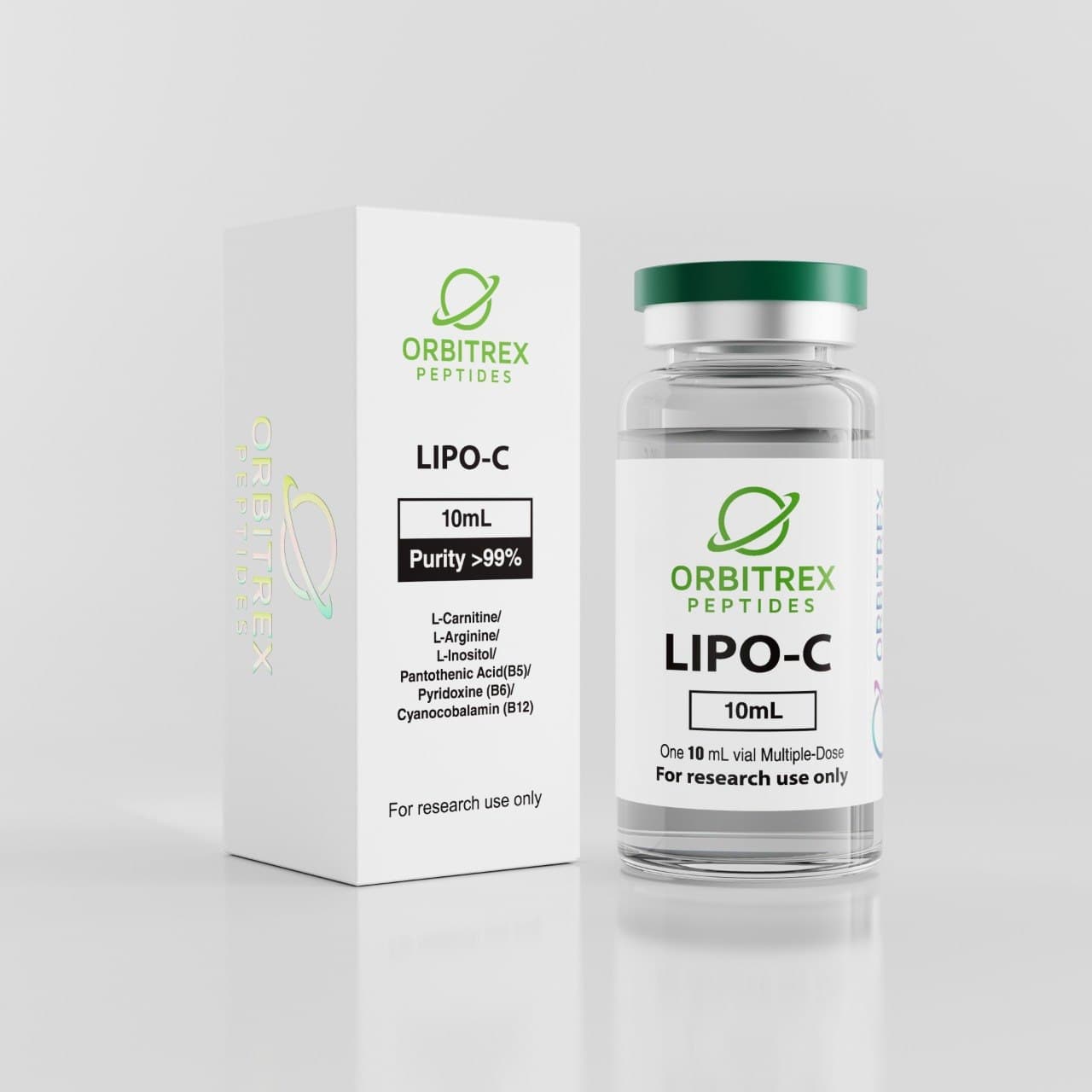
Lipo-C
5-Vial Tote Case
At-Home Blood Test
Research Supplies
Disclosure: supply links may earn PDP a commission at no cost to you.
Lipo-C Vials (pre-mixed)
Based on a 1 mL injection given twice weekly from a ready-to-use vial.
| Plan length | Planning note |
|---|---|
5 weeks 1 x 10 mL vial | 10 doses at 1 mL each |
10 weeks 2 x 10 mL vials | 20 doses at 1 mL each |
15 weeks 1 x 30 mL vial | 30 doses at 1 mL each |
5 weeks
1 x 10 mL vial
10 doses at 1 mL each
10 weeks
2 x 10 mL vials
20 doses at 1 mL each
15 weeks
1 x 30 mL vial
30 doses at 1 mL each
Insulin Syringes (U-100)
One syringe per injection. Prefer 1 mL / 100-unit syringes for a 1 mL draw.
| Plan length | Planning note |
|---|---|
5 weeks 10 syringes | 2 per week |
10 weeks 20 syringes | 2 per week |
5 weeks
10 syringes
2 per week
10 weeks
20 syringes
2 per week
Round up for priming losses, dropped syringes, and site rotation. If your vial is lyophilized powder, add BAC water and follow the reconstitution tab.
Companion Supplies & Routine Support
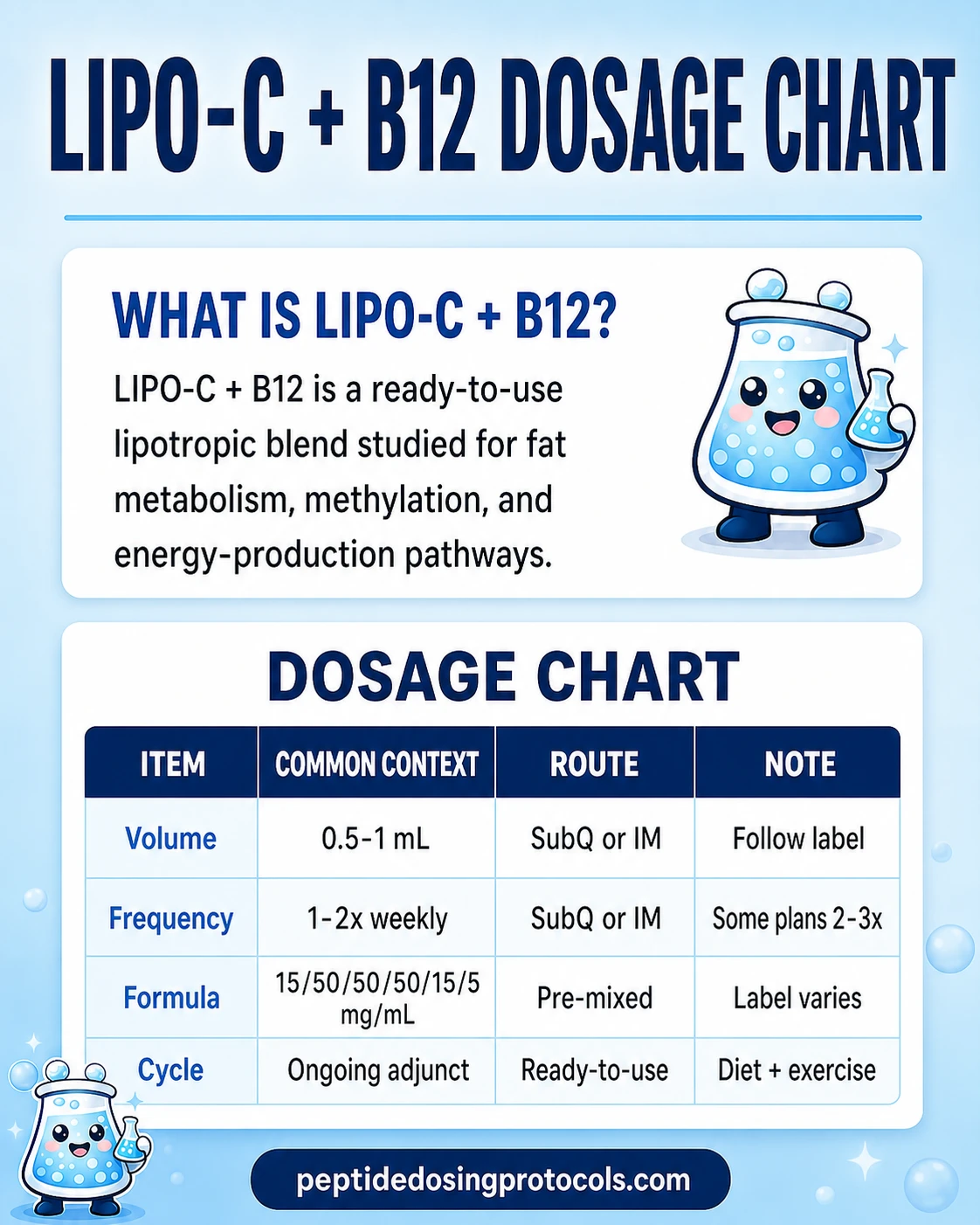
Lipo-C + B12 Dosage Chart
This Lipo-C + B12 dosage chart summarizes the ready-to-use, pre-mixed administration context from the dosing section: common volume, frequency, route, and formula-strength notes.
Lipo-C Format & Reconstitution
Do you need to mix your Lipo-C?
Choose the format you received. Most pharmacy Lipo-C is already mixed.
Ready-to-use pharmacy solution.
Compounded Lipo-C from pharmacies like Empower, Defy, or Medivera is dispensed as a ready-to-use liquid. There is nothing to reconstitute. The strengths are already fixed at mg/mL on the label, and the vial is kept refrigerated. You simply draw the labeled volume into a syringe.
At a common strength, 1 mL = the full labeled mg of each ingredient, and on a U-100 syringe 50 units = 0.5 mL, 100 units = 1 mL. This is measurement math only, not a dose recommendation.
Powder that must be mixed with BAC water.
Some research-market vials arrive as a freeze-dried powder that must be mixed with bacteriostatic water before use. Bacteriostatic water (not plain sterile water) contains a preservative that allows multi-dose storage.
Use the calculator for custom vials
If your powder vial lists a total mg amount, use the calculator to convert vial size, BAC water volume, and target amount into mL and U-100 syringe units.
How Lipo-C Is Supposed to Work
The plain-English idea: each ingredient plays a small role in how the body handles fat and energy, so clinics combine them into one shot. The biology of each nutrient is real. What is missing is proof that injecting them speeds up fat loss in people who already eat enough of these nutrients.
Methionine
An amino acid that donates methyl groups, helping the liver package and export fat.
Choline
Helps the liver move fat out and supports cell membranes; deficiency can cause fatty liver.
Inositol
A vitamin-like sugar tied to insulin signaling; studied mostly in PCOS and insulin resistance.
L-carnitine
Shuttles long-chain fats into mitochondria so they can be burned for energy.
B1 / B5 (± B12)
Support the enzymes and coenzyme A that keep fat and energy metabolism running.
Here is the key caveat: most of this mechanism is extrapolated from individual ingredients, often studied as oral supplements and sometimes only in animals or specific patient groups. There is no direct evidence that the combined injection meaningfully increases fat loss on its own.
Who Should Be Cautious
- Anyone who is pregnant or breastfeeding, unless a clinician specifically approves it.
- People with a known allergy or sensitivity to any ingredient, or to preservatives like benzyl alcohol in the diluent.
- People with liver or kidney conditions, who should have a clinician review the plan first.
- Anyone taking other medications, since a prescriber should check for interactions before adding a compounded injection.
Talk to a qualified clinician
This is general information, not a screening tool. A licensed prescriber should review your history, medications, and labs before you use any compounded injection.
Lipo-C Side Effects
Reported side effects are usually mild, and the most common is injection-site reaction — soreness, redness, warmth, or a small lump. This is expected with frequent shots and improves with site rotation.
Why does Lipo-C burn? A brief sting for 10–15 minutes after the shot is common. It comes from tissue stretching as the fluid goes in and from the pH difference between the solution and body tissue. Burning or pain that lasts well beyond that, or swelling that grows over hours, can mean the shot went too deep (IM instead of SubQ) or a reaction to the preservative — reasons to check technique and talk to your provider.
- Injection-site soreness, redness, warmth, or lumps (most common).
- Short-lived stinging or burning right after injection.
- Nausea, GI upset, or a temporary fishy body odor at high choline exposure.
- Rarely, allergic reactions — stop and seek care for rash, swelling, or trouble breathing.
A note on choline
Very high choline intake can raise TMAO, a marker linked to cardiovascular risk in observational studies. A causal link is not established, but it is a reason to keep a clinician involved rather than self-escalating.
What to Expect
Many users report a short-term energy or mood lift, especially if a B12 or B-vitamin component corrects a real deficiency. That is separate from fat loss.
For weight and body composition, honest expectation-setting matters: the injection does not create weight loss on its own. Any "before and after" results people share come from the overall program — the calorie deficit, food quality, activity, and often GLP-1 medications used alongside it. If diet and exercise do not change, the shot alone is not expected to move the scale.
If a clinician is tracking anything objective, the more relevant markers are things like liver enzymes or metabolic labs over weeks to months, not day-to-day scale changes.
What the Evidence Actually Shows
Direct evidence for Lipo-C is essentially absent. No published randomized controlled trial has tested the methionine-inositol-choline-carnitine-B-vitamin combination as an injection for weight loss. Everything below is ingredient-level evidence, mostly from oral supplements.
L-carnitine — modest, shrinking effect
A 2016 meta-analysis of 9 RCTs (n=911) found carnitine users lost about 1.33 kg more than controls, and a larger 2020 meta-analysis of 37 RCTs (n=2,292) found roughly 1.21 kg. Both note the effect is small and fades over time.
Inositol — metabolic signals, mainly in PCOS
Myo-inositol can improve insulin sensitivity and some metabolic markers in PCOS, but a 2023–2024 systematic review for the international PCOS guidelines called the evidence limited and inconclusive, and weight/waist measures often did not improve.
Choline & methionine — hepatic roles, not weight-loss proof
Both support the liver's ability to export fat, and deficiency can cause fatty liver. But major guidance does not recommend supplementing them to treat fatty liver or to drive weight loss in people who already get enough.
B12 injections — no weight-loss edge
Studies comparing injected vs oral B12 during calorie-restricted diets found no difference in objective weight or body-composition outcomes, though the injection group sometimes reported more subjective energy.
Bottom line: individual ingredients have real biochemistry and, for carnitine, a small measurable effect. That does not add up to proof that the injected blend produces meaningful fat loss beyond diet and exercise.
Lipo-C Storage & Handling
Does Lipo-C need to be refrigerated? Yes. Compounded Lipo-C is kept in the refrigerator, and pharmacies typically list a beyond-use date around 30 days from dispensing. Follow the exact date on your label.
Lipo-C storage
State
Pre-mixed pharmacy solution
Storage
36–46°F (2–8°C) refrigerated; use by the label's beyond-use date (~30 days)
State
Lyophilized powder (unmixed)
Storage
Cold storage per supplier; stable much longer while dry
State
After mixing (lyophilized vials)
Storage
36–46°F (2–8°C); protect from heat and light
State
Appearance
Storage
Should stay clear; discard if cloudy or discolored
| State | Storage |
|---|---|
| Pre-mixed pharmacy solution | 36–46°F (2–8°C) refrigerated; use by the label's beyond-use date (~30 days) |
| Lyophilized powder (unmixed) | Cold storage per supplier; stable much longer while dry |
| After mixing (lyophilized vials) | 36–46°F (2–8°C); protect from heat and light |
| Appearance | Should stay clear; discard if cloudy or discolored |
Keep vials out of heat. The real degradation issue is methionine oxidation over time, not 'denaturation' — Lipo-C has no peptide structure to denature.
Common Lipo-C Questions & Mistakes
- "It stopped working." More often this is expectation mismatch — the injection was never the main driver of weight change. Reassess the diet and activity plan with a clinician.
- Cloudy solution. A clear solution that turns cloudy or discolored should be discarded. Do not inject it.
- Persistent site pain. Rotate sites, confirm SubQ vs IM depth, and ask your provider about preservative sensitivity if pain repeats across sites.
- Left out of the fridge. Prolonged room-temperature storage degrades the amino acids even when the liquid still looks normal; when in doubt, check with the dispensing pharmacy.
Lipo-C Regulatory Status
As of July 2026, Lipo-C is not FDA-approved. There is no FDA-approved fixed-dose Lipo-C product and no approved weight-loss indication for the combination. It is a compounded preparation, made by a pharmacy from bulk ingredients based on a prescriber's order.
The individual ingredients are legal nutrients, but "compounded" means the specific formula is not reviewed by the FDA for safety, effectiveness, or quality the way an approved drug is. That is why formula strengths differ between pharmacies and why insurance usually does not cover it. Quality depends heavily on the compounding pharmacy and the supervising clinician.
Lipo-C vs Lipo-B, MIC & GLP-1 Medications
Lipo-B vs Lipo-C: both are lipotropic shots. "Lipo-B" formulas lean more on B-vitamins, while Lipo-C typically adds L-carnitine and sometimes vitamin C-style branding. Exact contents vary by pharmacy, so read the label rather than the name.
How Lipo-C compares
Option
Lipo-C
What it is
Amino-acid + B-vitamin lipotropic injection
Evidence for weight loss
Weak; no combination trials
Option
Basic MIC
What it is
Methionine, inositol, choline only
Evidence for weight loss
Weak; ingredient-level only
Option
Lipo-B / B12 shots
What it is
B-vitamin-forward lipotropic
Evidence for weight loss
Helps energy if deficient; not a weight-loss driver
Option
GLP-1 (semaglutide, tirzepatide)
What it is
FDA-approved weight-management drugs
Evidence for weight loss
Strong RCT evidence (SURMOUNT, STEP)
| Option | What it is | Evidence for weight loss |
|---|---|---|
| Lipo-C | Amino-acid + B-vitamin lipotropic injection | Weak; no combination trials |
| Basic MIC | Methionine, inositol, choline only | Weak; ingredient-level only |
| Lipo-B / B12 shots | B-vitamin-forward lipotropic | Helps energy if deficient; not a weight-loss driver |
| GLP-1 (semaglutide, tirzepatide) | FDA-approved weight-management drugs | Strong RCT evidence (SURMOUNT, STEP) |
Lipo-C sits at the low-evidence end. GLP-1 medications sit at the opposite, well-studied end. They are not interchangeable, and no trial has tested Lipo-C added to a GLP-1.
FAQ
Q1: What is Lipo-C?
Lipo-C is a compounded lipotropic injection used mainly in weight-management programs. A common formula blends methionine, inositol, choline, and L-carnitine with B-vitamins like B1 and B5, and sometimes B12. It is marketed as fat-metabolism and energy support alongside diet and exercise.
Q2: Is Lipo-C a peptide?
No. It is often searched as 'lipo c peptide,' but it does not contain peptides. Its ingredients are amino acids (methionine, carnitine), vitamin-like nutrients (choline, inositol), and vitamins (B1, B5, sometimes B12). There is no peptide chain, so claims that it 'denatures like a peptide' are inaccurate.
Q3: What is in Lipo-C?
A widely used formula is methionine, inositol, choline chloride, L-carnitine, thiamine (B1), and dexpanthenol (B5), often around 15/50/50/50/15/5 mg/mL. Some clinics add vitamin B12. Exact contents vary by compounding pharmacy, so check the label.
Q4: Does Lipo-C actually work for weight loss?
The injection itself is not proven to drive weight loss. No controlled trial has tested the combination, and the strongest ingredient evidence (L-carnitine) shows only about 1–1.3 kg average difference. Any real-world results come mostly from the diet, exercise, and other medications it is paired with.
Q5: How is Lipo-C commonly dosed?
There is no standardized dose because it is compounded. Pharmacy references commonly describe about 1 mL once or twice weekly, given subcutaneously or intramuscularly. This is reported context, not a recommendation. Follow your compounded label and prescriber.
Q6: Does Lipo-C need to be refrigerated?
Yes. Compounded Lipo-C is stored in the refrigerator at about 36–46°F (2–8°C), and pharmacies usually list a beyond-use date around 30 days from when you receive it. Keep it out of heat and light, and discard it if the liquid turns cloudy.
Q7: Why does Lipo-C burn when injected?
A short sting for 10–15 minutes is common and comes from tissue stretching and the pH difference between the solution and your tissue. Burning or swelling that lasts much longer can mean the shot went too deep or a reaction to the preservative, which is worth reviewing with your provider.
Q8: What is the difference between Lipo-B and Lipo-C?
Both are lipotropic shots. Lipo-B formulas usually emphasize B-vitamins, while Lipo-C typically adds L-carnitine and other lipotropic nutrients. Because the recipes vary by pharmacy, the label matters more than the name.
Q9: Is Lipo-C FDA-approved?
No. As of July 2026 there is no FDA-approved Lipo-C product and no approved weight-loss indication for the combination. It is a compounded preparation, so its formula is not FDA-reviewed for safety, effectiveness, or quality the way an approved drug is.
Q10: Is this page medical advice?
No. This is an educational research and dosing-context reference. It does not diagnose, treat, or recommend a dose. Talk to a qualified clinician before using any compounded injection.
Sources & Research
- 1. Empower Pharmacy Lipo-C Injection (formulation, mechanism, compounded status). Empower Pharmacy (2026)
- 2. MediVera Compounding Pharmacy Lipo-C Injection (ingredients, storage, beyond-use date, administration context). MediVera Rx (2026)
- 3. Defy Medical What is in Lipo-C? Defy Medical (2026)
- 4. Pooyandjoo M, Nouhi M, Shab-Bidar S, et al. The effect of (L-)carnitine on weight loss in adults: a systematic review and meta-analysis of randomized controlled trials. Obesity Reviews (2016)
- 5. Talenezhad N, Mohammadi M, Ramezani-Jolfaie N, et al. Effects of L-carnitine supplementation on weight loss and body composition: a systematic review and meta-analysis of 37 RCTs. Clinical Nutrition ESPEN (PubMed) (2020)
- 6. Greff D, Juhász AE, Váncsa S, et al. Inositol for polycystic ovary syndrome: a systematic review and meta-analysis for the 2023 international PCOS guidelines. Journal of Clinical Endocrinology & Metabolism (2024)
- 7. Minozzi M, D'Andrea G, Unfer V, et al. A potential therapeutic role of myo-inositol in the metabolic and cardiovascular profile of PCOS women. PMC (NCBI) (2016)
- 8. Fella Health Lipo C and Tirzepatide: Safety and Clinical Evidence Review (unapproved compounded status; no combination trials). Fella Health (2026)
- 9. GLPbase Lipo C (Lipotropic Injections): The Complete Guide (FDA status, evidence boundary). GLPbase (2026)
- 10. Empire Medical Training MIC & Lipotropic Injections for Weight Loss: A Clinical Guide (adjunct positioning, evidence note). Empire Medical Training (2026)
- 11. Bolt Pharmacy Choline, Inositol & Fatty Liver: Evidence, Dosage and Guidance (choline UL, TMAO association, NICE guidance). Bolt Pharmacy (2026)
Related Dosing Protocols
Educational use only
This guide is an educational research and dosing-context reference, not medical advice or a treatment plan. Lipo-C is a compounded product that is not FDA-approved. Talk to a qualified clinician before using any injection.
Calculate vial math
For lyophilized research vials, use the calculator to convert vial size, BAC-water volume, and target amount into mL and syringe units.

Written by Garret Grant
Founder & Lead Researcher · B.S. Civil Engineering, UCLA
Last updated: July 2026
Human-researched and AI-assisted with full editorial review. I verify sources, protocol interpretation, and final judgments personally. See methodology.
Share this page