

What Is Adamax Peptide?
Adamax is a synthetic research peptide related to Semax. Semax comes from a short part of adrenocorticotropic hormone, also called ACTH. Adamax keeps a Semax-related core but adds chemical changes that are claimed to improve stability.
Those changes do not make Adamax a proven or improved form of Semax. No published human, animal, or laboratory study has directly tested Adamax. Most descriptions of its effects come from Semax research, chemical theory, seller descriptions, or personal reports.
Class
A synthetic ACTH and Semax-related research peptide.
Common formats
Adamax is commonly sold as a freeze-dried vial or a ready-made nasal spray.
Common routes
Online protocols discuss intranasal and subcutaneous use, but neither route has a tested Adamax dose.
Evidence
No direct published Adamax study was found. Semax studies do not prove that Adamax works the same way.
Status
Adamax is not an FDA-approved drug and has no approved medical use.
Adamax and Semax are not interchangeable
Adamax is often described as a modified Semax analog. A modified molecule can have different absorption, breakdown, activity, and risks. Findings from Semax should be labeled as parent-peptide evidence, not Adamax evidence.
Adamax Dosing Context and Schedule
No clinical trial has established an Adamax dose, schedule, route, or cycle length. The amounts below come from community protocols and commercial dosing pages. They are included to explain commonly published patterns, not to recommend use.
This is not a tested titration schedule
The week-by-week increases below have not been studied in people or animals. There is no evidence showing that increasing the amount every two weeks improves results, lowers risk, or prevents tolerance.
Adamax Route Context
Compare how the two common research-use routes are discussed.
Common in nootropics communities.
Like Semax, Adamax is often discussed as nose drops or a nasal spray. This route avoids injections, but a spray product has its own concentration and dose per pump.
- Sold either as a pre-made nasal spray or mixed by the user from powder.
- Community amounts are small, often a few hundred micrograms (mcg) per dose.
- Some users split a daily amount into morning and midday doses.
- A pre-made spray should be evaluated by its stated concentration, not by the SubQ vial math below.
The default route for the vial math on this page.
The SubQ route uses reconstituted powder drawn with a small U-100 insulin syringe. The weekly pattern below is written for this setup.
Syringe units depend on concentration. In the example below, 100 units equals 1 mL, and each unit contains about 33 mcg after mixing 10 mg with 3 mL BAC water.
Community SubQ titration pattern
Community-derived weekly pattern (not from trials)
Weeks
Weeks 1-2
Daily dose
300 mcg (0.3 mg)
Volume
0.09 mL
Insulin units
9 units
Weeks
Weeks 3-4
Daily dose
500 mcg (0.5 mg)
Volume
0.15 mL
Insulin units
15 units
Weeks
Weeks 5-6
Daily dose
750 mcg (0.75 mg)
Volume
0.23 mL
Insulin units
23 units
Weeks
Weeks 7-8
Daily dose
1000 mcg (1.0 mg)
Volume
0.30 mL
Insulin units
30 units
| Weeks | Daily dose | Volume | Insulin units |
|---|---|---|---|
| Weeks 1-2 | 300 mcg (0.3 mg) | 0.09 mL | 9 units |
| Weeks 3-4 | 500 mcg (0.5 mg) | 0.15 mL | 15 units |
| Weeks 5-6 | 750 mcg (0.75 mg) | 0.23 mL | 23 units |
| Weeks 7-8 | 1000 mcg (1.0 mg) | 0.30 mL | 30 units |
Volumes and units assume a 10 mg vial in 3 mL BAC water (about 3.33 mg/mL). Community-derived and not trial-validated.
The table assumes a 10 mg vial mixed with 3 mL of BAC water. At that concentration, the vial contains about 3.33 mg per mL and about 33 mcg per U-100 syringe unit. Changing the vial size or water volume changes every unit calculation.
No tested dose exists
Because Adamax has not been studied directly, these amounts should not be treated as proven safe or effective. This is research-context dosing information only.
Adamax Supplies and Course Math
The planning math below follows the full eight-week community titration table shown on this page. It is supply math only and does not make the schedule tested or recommended.
Recommended U.S. and Canada Supply
Choose your region
Use discount code SAVE10 at Orbitrex Peptides checkout. See why we love Orbitrex Peptides.
Adamax Supply
5-Vial Tote Case
At-Home Blood Test
Research Supplies
Disclosure: supply links may earn PDP a commission at no cost to you.
Adamax Vials
Each vial contains 10 mg. The full eight-week schedule uses 35.7 mg before normal measurement or transfer loss.
| Cycle phase | Calculation |
|---|---|
Weeks 1–2 4.2 mg | 0.3 mg daily × 14 days = 4.2 mg. |
Weeks 3–4 7 mg | 0.5 mg daily × 14 days = 7 mg. |
Weeks 5–6 10.5 mg | 0.75 mg daily × 14 days = 10.5 mg. |
Weeks 7–8 14 mg | 1 mg daily × 14 days = 14 mg. |
Full 8 weeks 4 × 10 mg vials | The schedule uses 35.7 mg. Four vials provide 40 mg before normal losses. |
Weeks 1–2
4.2 mg
0.3 mg daily × 14 days = 4.2 mg.
Weeks 3–4
7 mg
0.5 mg daily × 14 days = 7 mg.
Weeks 5–6
10.5 mg
0.75 mg daily × 14 days = 10.5 mg.
Weeks 7–8
14 mg
1 mg daily × 14 days = 14 mg.
Full 8 weeks
4 × 10 mg vials
The schedule uses 35.7 mg. Four vials provide 40 mg before normal losses.
Bacteriostatic Water
The example concentration uses 3 mL of BAC water for every 10 mg vial.
| Cycle phase | Calculation |
|---|---|
Full 8 weeks 12 mL total | 4 vials × 3 mL per vial = 12 mL. Plan for 2 × 10 mL bottles. |
Full 8 weeks
12 mL total
4 vials × 3 mL per vial = 12 mL. Plan for 2 × 10 mL bottles.
U-100 Syringes
The schedule is shown as once daily for 56 days.
| Cycle phase | Calculation |
|---|---|
Full 8 weeks 56 syringes | 1 fresh syringe per day × 56 days. A 100-count box provides extra margin. |
Full 8 weeks
56 syringes
1 fresh syringe per day × 56 days. A 100-count box provides extra margin.
Round supply totals up for normal transfer, priming, and measurement loss.
Companion Supplies & Routine Support
Adamax Reconstitution Calculator

Powered by PepPal
Adamax Reconstitution Calculator
Start with the protocol example, then customize every field.
Loaded reference
PDP SubQ vial example
This calculator does not apply to premixed nasal sprays.
Your draw
9units
0.09 mL on a U-100 insulin syringe
- Concentration
- 3.333 mg/mL
- Target in mg
- 0.3 mg
- Math-only doses per vial
- 33.3
One free emailed save per person, checked by PepPal.
Educational calculation tool only. The loaded amount is a reference from this page, not a personal dose recommendation. Confirm the vial label, route, syringe type, and actual liquid added before relying on a result.
Adamax Nasal Spray vs SubQ Injection
Adamax is commonly discussed as either a nasal product or a reconstituted vial. No study has compared the two routes, measured Adamax absorption, or established a dose conversion between them.
Adamax nasal and SubQ route comparison
Topic
Format
Intranasal Adamax
Ready-made spray, nasal drops, or powder mixed for nasal use
SubQ Adamax
Freeze-dried vial mixed with bacteriostatic water
Topic
Measurement
Intranasal Adamax
Depends on the listed concentration and amount delivered by each spray
SubQ Adamax
Depends on vial strength, BAC-water volume, and U-100 syringe units
Topic
Common community pattern
Intranasal Adamax
Small amounts discussed once or more per day
SubQ Adamax
A few hundred micrograms per day with some titration schedules
Topic
Direct Adamax evidence
Intranasal Adamax
No route-specific study
SubQ Adamax
No route-specific study
Topic
Main practical issue
Intranasal Adamax
Different spray products may deliver different amounts per pump
SubQ Adamax
Mixing errors can change the amount contained in each syringe unit
Topic
Can the doses be converted?
Intranasal Adamax
No tested conversion exists
SubQ Adamax
No tested conversion exists
| Topic | Intranasal Adamax | SubQ Adamax |
|---|---|---|
| Format | Ready-made spray, nasal drops, or powder mixed for nasal use | Freeze-dried vial mixed with bacteriostatic water |
| Measurement | Depends on the listed concentration and amount delivered by each spray | Depends on vial strength, BAC-water volume, and U-100 syringe units |
| Common community pattern | Small amounts discussed once or more per day | A few hundred micrograms per day with some titration schedules |
| Direct Adamax evidence | No route-specific study | No route-specific study |
| Main practical issue | Different spray products may deliver different amounts per pump | Mixing errors can change the amount contained in each syringe unit |
| Can the doses be converted? | No tested conversion exists | No tested conversion exists |
The listed patterns describe community discussions. They are not approved dosing instructions.
Do not use SubQ math for a nasal spray
A spray must be calculated from its own concentration and the amount delivered per pump. The 10 mg vial and U-100 syringe table does not show how much Adamax is delivered by a nasal product.
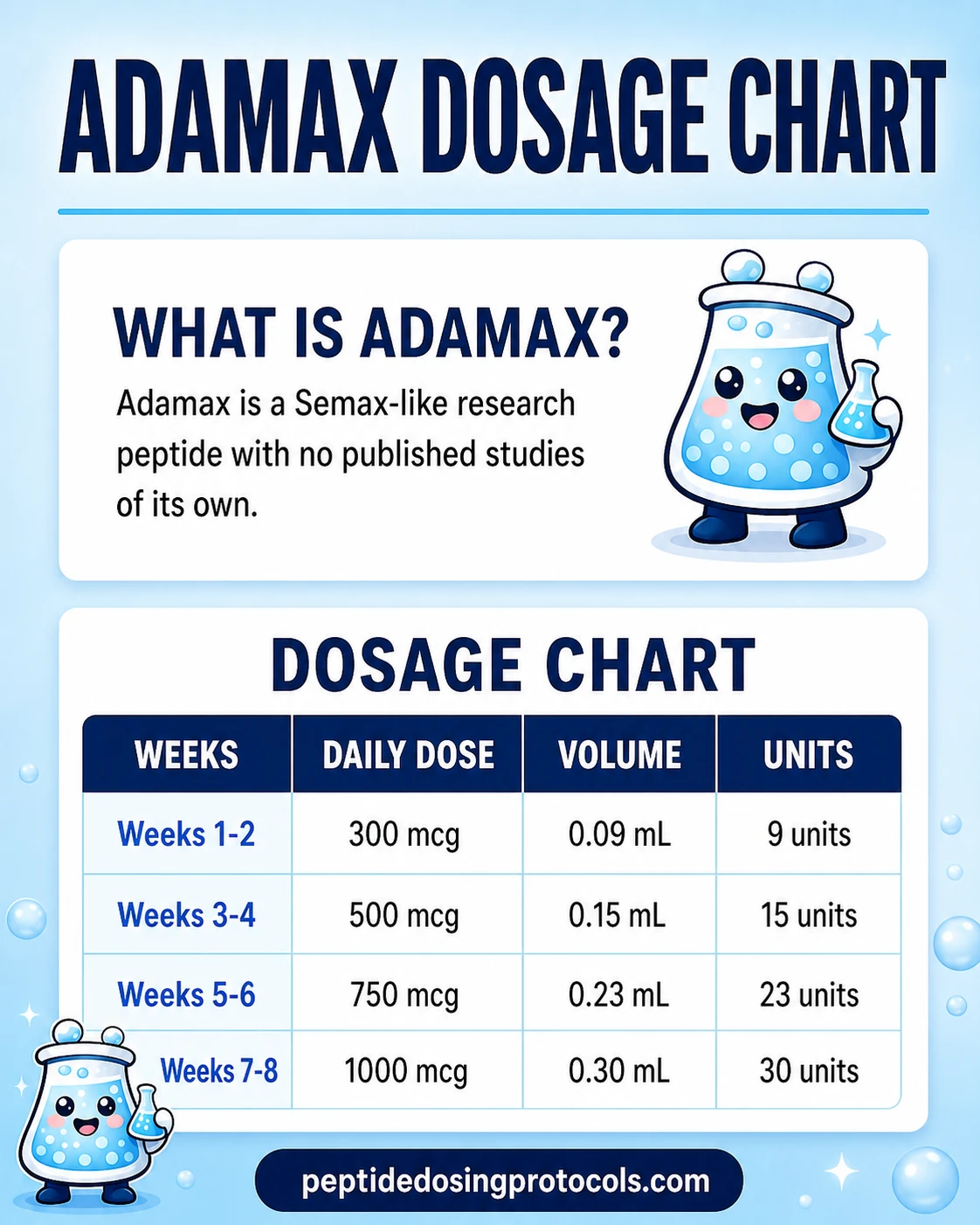
Adamax Dosage Chart
This Adamax dosage chart turns the SubQ titration pattern above into a quick visual reference, using the same 10 mg vial plus 3 mL BAC-water setup.
Adamax Reconstitution Guide
Reconstitution means adding liquid to freeze-dried powder so it can be measured as a solution. Only powder vials need this step. A pre-made nasal spray is already mixed.
The SubQ pattern on this page assumes a 10 mg vial plus 3.0 mL BAC water. That creates about 3.33 mg/mL, so each insulin unit (0.01 mL) contains roughly 33 mcg.
- 01
Wipe both stoppers
Swab the Adamax vial top and the BAC water vial top with alcohol.
- 02
Draw the water
Pull 3.0 mL of BAC water into a syringe.
- 03
Add it slowly
Let the water run down the inside wall of the vial, not straight onto the powder.
- 04
Do not shake
Swirl gently until the powder dissolves. Shaking can damage the peptide.
- 05
Check the liquid
It should look clear. Discard it if it stays cloudy or has floating bits.
- 06
Store it
Keep the mixed vial in the fridge and use it within a few weeks.
- 07
Draw your dose
The unit count corresponds to the strength shown in the dosing table above for the mixed concentration.
Change the water, change the units
If the vial size or BAC-water volume changes, the mcg per unit changes too. Recalculate before copying the table.
Adamax Half-Life and How Long It May Last
Adamax does not have a published human or animal half-life. No study has measured how quickly it enters the blood, reaches the brain, breaks down, or leaves the body.
Adamax is often claimed to last longer than Semax because of its added chemical groups. That idea may be chemically reasonable, but it has not been confirmed with Adamax pharmacokinetic research.
What is known about Adamax duration
Question
What is the Adamax half-life?
Best supported answer
Unknown. No Adamax pharmacokinetic study has been published.
Question
Does Adamax last longer than Semax?
Best supported answer
Often claimed, but no direct comparison has tested this.
Question
Does an adamantane group prove longer action?
Best supported answer
No. A chemical modification may change stability, but its effect must still be measured.
Question
How long do reported effects last?
Best supported answer
User reports vary and cannot establish a biological half-life.
Question
Can Semax timing be used for Adamax?
Best supported answer
Not as a proven conversion. Adamax is a different molecule.
| Question | Best supported answer |
|---|---|
| What is the Adamax half-life? | Unknown. No Adamax pharmacokinetic study has been published. |
| Does Adamax last longer than Semax? | Often claimed, but no direct comparison has tested this. |
| Does an adamantane group prove longer action? | No. A chemical modification may change stability, but its effect must still be measured. |
| How long do reported effects last? | User reports vary and cannot establish a biological half-life. |
| Can Semax timing be used for Adamax? | Not as a proven conversion. Adamax is a different molecule. |
Reported duration is not half-life
A person feeling focused for several hours does not show how much Adamax remains in the blood or brain. Half-life requires controlled testing with measured samples.
Adamax Peptide Benefits: Claims vs Evidence
Adamax is commonly discussed for focus, memory, learning, motivation, and mental energy. None of these claimed benefits has been confirmed in an Adamax clinical trial.
The claims usually come from three places: research on Semax, theories about Adamax's chemical changes, and personal reports from nootropics communities. These sources can explain why Adamax attracts interest, but they cannot prove a benefit.
Adamax claims and the evidence behind them
Claim
Improved focus
Where the claim comes from
User reports and comparison with Semax
Adamax evidence
No direct Adamax study
Claim
Better memory or learning
Where the claim comes from
Semax and ACTH-fragment research
Adamax evidence
No direct Adamax study
Claim
Higher BDNF activity
Where the claim comes from
Semax studies in cells and animals
Adamax evidence
Not confirmed for Adamax
Claim
Longer duration than Semax
Where the claim comes from
Chemical theory and seller descriptions
Adamax evidence
No direct half-life comparison
Claim
Better brain entry
Where the claim comes from
Claims about the added adamantane-related modification
Adamax evidence
No Adamax absorption or brain-distribution study
Claim
Neuroprotective effects
Where the claim comes from
Parent-peptide and animal research involving Semax
Adamax evidence
Not confirmed for Adamax
| Claim | Where the claim comes from | Adamax evidence |
|---|---|---|
| Improved focus | User reports and comparison with Semax | No direct Adamax study |
| Better memory or learning | Semax and ACTH-fragment research | No direct Adamax study |
| Higher BDNF activity | Semax studies in cells and animals | Not confirmed for Adamax |
| Longer duration than Semax | Chemical theory and seller descriptions | No direct half-life comparison |
| Better brain entry | Claims about the added adamantane-related modification | No Adamax absorption or brain-distribution study |
| Neuroprotective effects | Parent-peptide and animal research involving Semax | Not confirmed for Adamax |
Evidence about Semax should remain labeled as Semax evidence.
Bottom line
Adamax has several claimed cognitive benefits but no direct proof. The current evidence supports describing it as an experimental Semax-related compound, not a proven nootropic.
Adamax Results and Expected Timeline
There is no research-based Adamax timeline. No study has measured when effects begin, when they peak, how long they last, or whether repeated use changes the response.
Same-day reports
Some users describe changes in focus, alertness, or motivation within hours. These are personal reports and may be affected by expectation, other substances, sleep, or normal daily changes.
First-week reports
Community posts sometimes describe a clearer or more stable response after several days. No controlled data confirms this pattern.
Longer cycles
Some online schedules run for several weeks. There is no evidence showing that benefits build over time or that longer cycles are safer.
No response
Anecdotal reports also include little or no noticeable effect. Product identity, dose accuracy, route, and expectation can all affect reports.
Before-and-after claims are weak evidence
Changes in focus, memory, mood, or productivity are hard to measure without a controlled test. Personal reports cannot prove that Adamax caused the change.
How Adamax Is Thought to Work
Adamax does not have a confirmed mechanism. Most explanations begin with Semax, a peptide related to the ACTH(4–10) fragment. Semax has been studied for effects on gene activity, BDNF signaling, and brain responses in animal and laboratory research.
Adamax adds chemical modifications to a Semax-related structure. These changes are claimed to improve stability and how the molecule moves through fatty tissue. No Adamax study has shown that these changes improve brain entry, extend half-life, or produce stronger effects.
Parent-peptide theory
Semax research provides the main theory used to explain Adamax.
BDNF claims
Semax has affected BDNF-related signaling in animal and cell research. This has not been confirmed for Adamax.
Stability claims
Adamax is designed around chemical changes that may affect breakdown, but the result has not been measured.
Brain-entry claims
No study has measured Adamax levels in human or animal brain tissue.
Adamax Clinical Evidence
No published human, animal, or laboratory study has directly tested Adamax. There is no clinical evidence for an Adamax dose, benefit, half-life, route, cycle length, or safety profile.
Adamax-specific research
No direct published Adamax study was found.
Government recognition
A 2025 Medsafe review listed Adamax and Semax as examples of synthetic ACTH analogues. The review said clinical research on this group is limited and little is known about side effects or long-term effects.
Semax animal and laboratory research
Semax has been studied for BDNF, gene expression, and brain signaling. Those findings belong to Semax, not Adamax.
Semax human history
Semax has a history of medical and research use outside the United States. That history does not validate Adamax.
Community reports
Personal reports may help identify common questions, but they cannot establish safety or effectiveness.
Check what each citation actually tested
A source about Semax, ACTH, BDNF, or another peptide is not an Adamax study. Every reference should be labeled by the exact compound that was tested.
Evidence conclusion
Adamax should be described as an experimental compound with a theoretical link to Semax. It should not be described as a proven cognitive enhancer or a longer-lasting form of Semax.
Adamax vs Semax: What Is the Difference?
Adamax and Semax are related, but they are not the same peptide. Semax has a direct research history. Adamax is a later modified compound with almost no direct evidence.
Adamax and Semax comparison
Feature
What it is
Adamax
Modified Semax-related synthetic peptide
Semax
Synthetic ACTH(4–10)-related peptide
Feature
Direct published research
Adamax
No direct studies found
Semax
Animal, laboratory, and some human research exists
Feature
Measured half-life
Adamax
Not established
Semax
Semax timing has been studied more, but results depend on route and study design
Feature
Claimed duration
Adamax
Often claimed to last longer
Semax
Usually described as shorter acting
Feature
Proof of longer action
Adamax
No direct comparison
Semax
Not applicable
Feature
Common format
Adamax
Nasal product or freeze-dried vial
Semax
Most closely linked with intranasal use
Feature
FDA status
Adamax
Not FDA-approved
Semax
Not FDA-approved in the United States
Feature
Main evidence limit
Adamax
Almost every benefit claim is indirect
Semax
Research exists, but it does not prove that Adamax has the same effects
| Feature | Adamax | Semax |
|---|---|---|
| What it is | Modified Semax-related synthetic peptide | Synthetic ACTH(4–10)-related peptide |
| Direct published research | No direct studies found | Animal, laboratory, and some human research exists |
| Measured half-life | Not established | Semax timing has been studied more, but results depend on route and study design |
| Claimed duration | Often claimed to last longer | Usually described as shorter acting |
| Proof of longer action | No direct comparison | Not applicable |
| Common format | Nasal product or freeze-dried vial | Most closely linked with intranasal use |
| FDA status | Not FDA-approved | Not FDA-approved in the United States |
| Main evidence limit | Almost every benefit claim is indirect | Research exists, but it does not prove that Adamax has the same effects |
Semax is the better-studied molecule. Adamax is the more experimental option. More chemical modification does not automatically mean better effects, better brain entry, or better safety.
Semax Protocol
Review the parent peptide, published Semax research, dosage context, and evidence limits.
Selank Protocol
See another Russian-developed research peptide commonly discussed beside Semax.
Russian Nootropic Stack
Review how Semax and Selank are commonly discussed together.
Adamax Side Effects and Safety Gaps
Adamax does not have a published side-effect dataset. It is not possible to calculate common, uncommon, or long-term risks from the current evidence.
Online reports mention headache, irritability, sleep changes, nasal irritation, and injection-site reactions. These reports are not controlled data and may not prove that Adamax caused the problem.
- Nasal irritation, dryness, or throat discomfort with nasal products
- Redness, soreness, bruising, or swelling with injected products
- Headache, restlessness, irritability, or trouble sleeping in personal reports
- Allergic reactions or reactions to an unknown ingredient
- Unknown effects from repeated or long-term exposure
Unknown does not mean safe
A lack of published Adamax harm reports mostly shows that the compound has not been studied. It does not prove that serious or long-term risks are absent.
Who Should Avoid Adamax
Because Adamax has no direct safety research, the practical assumption should be more caution, not less.
- Anyone pregnant or breastfeeding (no safety data).
- Anyone under 18.
- People with a known allergy to Adamax or any component.
- People with a medical condition or prescription medicines unless a clinician has reviewed the risk.
- Anyone who cannot verify the product's source and testing.
Unknown safety
A lack of published harm reports is not proof of safety. Adamax has not been studied enough to rule out unknown risks.
Adamax Regulatory Status
Adamax is not an FDA-approved drug and has no approved medical use in the United States. It is commonly sold under research-use-only labeling.
A 2025 New Zealand Medsafe review listed Adamax and Semax as synthetic ACTH analogues and recommended that this group be treated as prescription medicines in New Zealand. Rules differ by country and can change.
Research-use labeling is not medical approval
A product being available online does not show that it has been approved, tested, or found safe for personal use.
Adamax Storage and Handling
Adamax Storage
Unopened / long-term
Adamax powder
-4F (-20C) freezer
Adamax (mixed) / spray
N/A
In use
Adamax powder
35.6-46.4F (2-8C) fridge
Adamax (mixed) / spray
35.6-46.4F (2-8C) fridge
Light
Adamax powder
Keep dark, original vial
Adamax (mixed) / spray
Keep dark
Appearance
Adamax powder
White powder
Adamax (mixed) / spray
Clear liquid
| Adamax powder | Adamax (mixed) / spray | |
|---|---|---|
| Unopened / long-term | -4F (-20C) freezer | N/A |
| In use | 35.6-46.4F (2-8C) fridge | 35.6-46.4F (2-8C) fridge |
| Light | Keep dark, original vial | Keep dark |
| Appearance | White powder | Clear liquid |
Discard mixed solution or spray that turns cloudy, changes color, or has particles.
Keep freeze-dried powder cold and protected from light. Once mixed with BAC water, keep it refrigerated and use it within a short window. Even if Adamax is marketed as more stable than Semax, careful cold storage is still the right assumption.
FAQ
Q1: What is Adamax peptide?
Adamax is a synthetic research peptide related to Semax and the ACTH peptide family. It includes chemical changes that are claimed to improve stability, but Adamax itself has not been directly studied.
Q2: What are the claimed benefits of Adamax?
Adamax is commonly discussed for focus, memory, learning, motivation, and mental energy. These benefits have not been confirmed in an Adamax clinical trial.
Q3: What is the Adamax half-life?
The Adamax half-life is unknown. No human or animal study has measured its absorption, blood levels, brain levels, breakdown, or clearance.
Q4: Does Adamax last longer than Semax?
Adamax is often claimed to last longer because of its chemical modifications. No published study has directly compared Adamax and Semax duration.
Q5: Is Adamax the same as Semax?
No. Adamax is related to Semax but has additional chemical modifications. Research on Semax cannot automatically be applied to Adamax.
Q6: Is Adamax the same as N-Acetyl Semax?
No. Both are modified Semax-related compounds, but they are different molecules. They should not be treated as interchangeable.
Q7: Is Adamax used as a nasal spray?
Adamax is sold in some nasal products and is also sold as freeze-dried powder. No study has established a nasal Adamax dose or measured nasal absorption.
Q8: Can nasal and SubQ Adamax doses be converted?
No tested conversion exists. A nasal product must be calculated from its listed concentration and amount per spray, while SubQ math depends on vial strength and BAC-water volume.
Q9: What is the typical Adamax dosage?
No typical human dose has been established. Online protocols commonly list amounts in the low hundreds of micrograms, but those numbers come from community and commercial sources rather than trials.
Q10: How long is an Adamax cycle?
Online schedules commonly describe several-week cycles, but no study has established a safe or effective cycle length.
Q11: How soon do Adamax results appear?
Some users report same-day changes in focus or alertness. These are anecdotes, not controlled results, and Adamax does not have a research-based onset timeline.
Q12: Is there direct research on Adamax?
No direct published human, animal, or laboratory Adamax study was found. Most research used to explain Adamax is actually research on Semax.
Q13: Is Adamax FDA-approved?
No. Adamax is not an FDA-approved drug and has no approved medical use in the United States.
Q14: What are the side effects of Adamax?
Adamax has no published side-effect dataset. Online reports mention headache, irritation, poor sleep, and route-related reactions, but long-term and Adamax-specific risks remain unknown.
Q15: Does one 10 mg Adamax vial last eight weeks?
Not under the full daily titration table shown on this page. That eight-week schedule totals 35.7 mg, so it would require four 10 mg vials before normal measurement loss.
References
- 1. New Zealand Medicines and Medical Devices Safety Authority Classification of Unscheduled Peptides Medsafe (2025)
- 2. Dolotov OV, Karpenko EA, Inozemtseva LS, et al. Semax Regulates BDNF and TrkB Expression in the Rat Hippocampus [Parent peptide: Semax, not Adamax] Brain Research (2006)
- 3. Dolotov OV, et al. Semax, an analogue of ACTH(4-10), binds specifically and increases BDNF protein in rat basal forebrain. [Parent peptide: Semax, not Adamax] Journal of Neurochemistry (2006)
- 4. Shadrina MI, Dolotov OV, Grivennikov IA, et al. Rapid and efficient NGF and BDNF mRNA induction in rat glial cell cultures by ACTH(4-10) analog Semax. [Parent peptide context] Neuroscience Letters (308:115-118) (2001)
- 5. Springer (Journal of Molecular Neuroscience) Comparison of the temporal dynamics of NGF and BDNF gene expression under Semax action. [Parent peptide context] Journal of Molecular Neuroscience (2009)
- 6. Ceretropic founder statement (reported) Adamax was developed with no human clinical research or research of any kind; treat as a research compound. Jay Campbell (creator quote and Adamax/Ceretropic history) (2026)
- 7. SemaxPolska (educational overview) Adamax is an experimental concept, lacks significant human clinical trials, and many reported effects are anecdotal. semaxpolska.com (2026)
- 8. Medsbase (educational guide) Adamax structure and research-use framing [Commercial educational context, not pharmacology evidence] medsbase.com (2026)
- 9. Research-chemical vendor listing Adamax product forms [Commercial form and research-use labeling context only] Vendor product page (2026)
Related Dosing Protocols
Educational use only
This guide is an educational research reference, not medical advice or a treatment plan. Adamax has no clinical trials. Dosing figures are community-reported, not validated, and not recommendations.
Calculate vial math
Use the calculator for custom vial size, BAC-water volume, and syringe-unit math.

Written by Garret Grant
Founder & Lead Researcher · B.S. Civil Engineering, UCLA
Last updated: August 2026
Human-researched and AI-assisted with full editorial review. I verify sources, protocol interpretation, and final judgments personally. See methodology.
Share this page