

FOXO4-DRI Quick Start
FOXO4-DRI is a lab-made peptide studied as a senolytic — a compound meant to clear out senescent cells. Senescent cells are old, damaged cells that stop dividing but refuse to die, and they can leak inflammatory signals into nearby tissue. FOXO4-DRI is sometimes written FOX04-DRI (with a zero) and is sold by some research vendors under the name Proxofim.
The name 'DRI' stands for D-retro-inverso. In plain terms, the peptide is built from mirror-image amino acids in reverse order. That design makes it much harder for the body to break down, so it lasts longer than a normal peptide.
What it targets
Disrupts the FOXO4-p53 interaction so p53 can trigger apoptosis in senescent cells.
Evidence level
Mouse and cell studies only. No human trials as of June 2026.
Published protocol
Mouse: 5 mg/kg intraperitoneal, repeated over weeks (Baar et al., 2017).
Reconstitute
A 10 mg vial with 3.0 mL BAC water gives about 3.33 mg/mL.
Measuring
With a 10 mg vial plus 3.0 mL BAC water, 7.5 units is about 250 mcg, 11.25 units is about 375 mcg, and 15 units is about 500 mcg.
Regulatory status
Not FDA-approved. Research use only.
Read this first
FOXO4-DRI has never been tested in a human clinical trial. Every number on this page comes from animal research or community self-reports. This is an educational research reference, not medical advice or a dosing recommendation.
FOXO4-DRI Dosing Context & Schedule
There is no validated human dose for FOXO4-DRI. To stay honest about the evidence, this section splits dosing into two clearly labeled tabs: the published animal protocol (the only peer-reviewed dosing data) and the community-derived structure (what researchers and forums report using, with no clinical backing).
FOXO4-DRI Dosing Reference
Pick the reference you want to read. Neither tab is a human dosing recommendation.
What the research-use community reports. No clinical validation.
Outside formal studies, FOXO4-DRI is usually discussed as a daily SubQ schedule that starts low and increases in stages. The structure below is reported community context only; it has not been tested in a human clinical trial.
Community-derived FOXO4-DRI daily dosing ladder
Week
Weeks 1-4
Daily Dose
250 mcg
Week
Weeks 5-8
Daily Dose
375 mcg
Week
Weeks 9-12
Daily Dose
500 mcg
Week
Weeks 13-16
Daily Dose
500 mcg
| Week | Daily Dose |
|---|---|
| Weeks 1-4 | 250 mcg |
| Weeks 5-8 | 375 mcg |
| Weeks 9-12 | 500 mcg |
| Weeks 13-16 | 500 mcg |
Reported community dosing only. No human clinical trial has validated this schedule, route, or dose.
No safety data behind this
Community SubQ use was never tested for bioavailability, safety, or effect in humans. Treat the schedule above as reported use, not a recommendation. Senescent cells also play useful roles in wound healing and tumor suppression, so clearing them is not automatically beneficial.
The only peer-reviewed dosing data, from mouse studies.
In the foundational 2017 Cell study, naturally aged mice and chemotherapy-treated mice received FOXO4-DRI at 5 mg/kg by intraperitoneal (IP) injection, given on an intermittent schedule (about three times per week) across several weeks. Treated aged mice showed restored coat density, better kidney markers, and improved physical activity.
Later mouse work used similar amounts. One Leydig-cell study gave 5 mg/kg IP every other day for three doses; a spermatogenesis study used 5 mg/kg/day for 30 days. These are animal doses by body weight and do not convert into a safe human dose.
Animal data only
Scaling a mouse 5 mg/kg dose to a person involves large uncertainty. No direct human trial has evaluated any FOXO4-DRI dose. Treat these figures as research background, not a protocol to copy.
How FOXO4-DRI is generally discussed (research context, not a recommendation)
Approach
Reported community dosing
Pattern
250 -> 375 -> 500 mcg daily, SubQ
Duration
16 weeks
Notes
Reported only; no human validation
Approach
Published mouse regimen
Pattern
5 mg/kg IP, ~3x/week
Duration
Several weeks
Notes
Animal only; not human-equivalent
| Approach | Pattern | Duration | Notes |
|---|---|---|---|
| Reported community dosing | 250 -> 375 -> 500 mcg daily, SubQ | 16 weeks | Reported only; no human validation |
| Published mouse regimen | 5 mg/kg IP, ~3x/week | Several weeks | Animal only; not human-equivalent |
FOXO4-DRI community schedules differ heavily between sources. The ladder above is not a validated human dose.
FOXO4-DRI Supplies Needed
The supply math below uses a 10 mg vial reconstituted with 3.0 mL BAC water (about 3.33 mg/mL) and the 16-week community-derived daily ladder shown above. Because FOXO4-DRI stability after reconstitution is uncertain, plan conservatively and avoid mixing more than you can use promptly.
Recommended U.S. and Canada Supply
Choose your region
Use discount code PEPPAL at Peptide Partners checkout. See why we love Peptide Partners.
Peptide Partners Shop
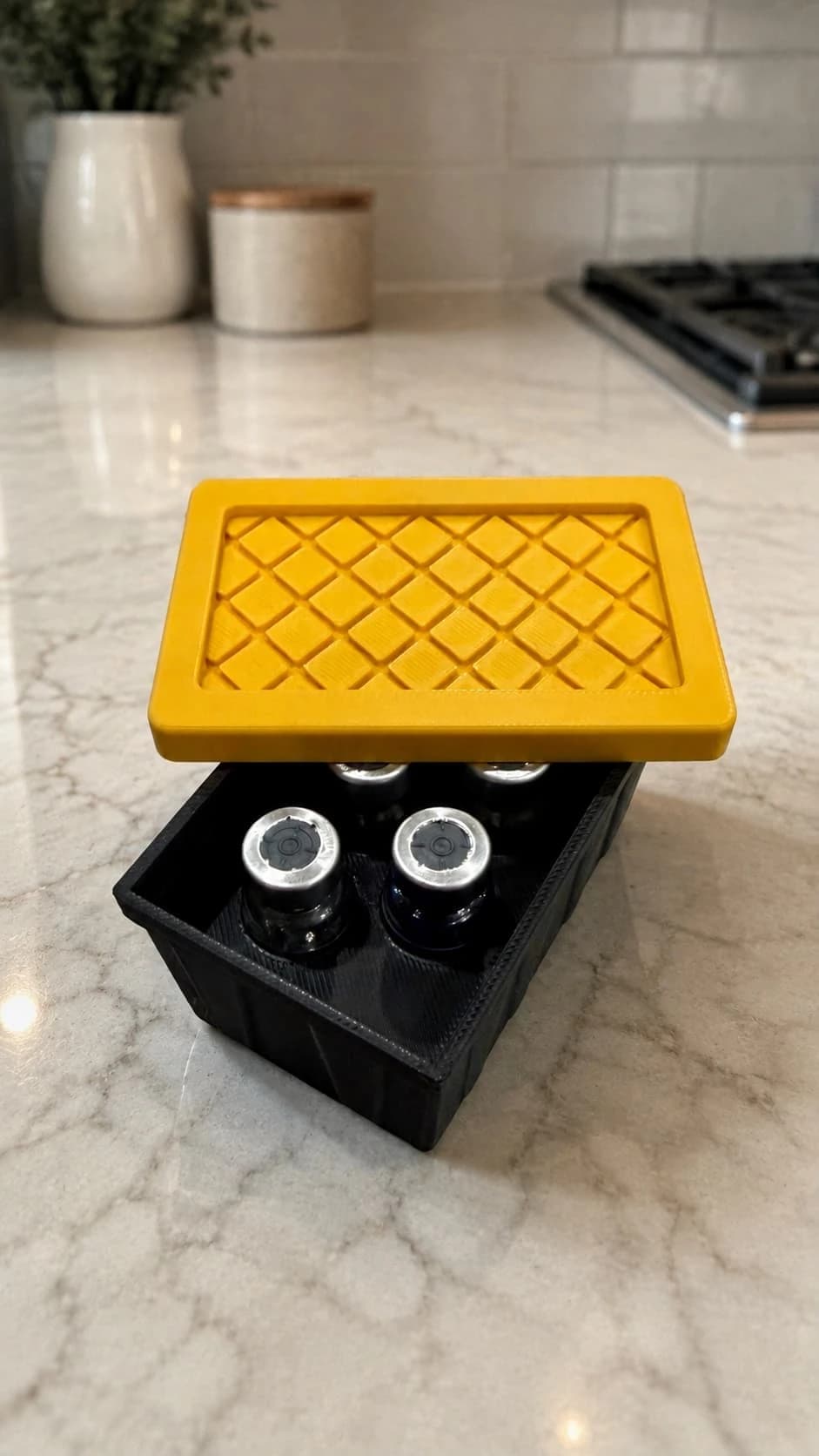
5-Vial Tote Case
At-Home Blood Test
Research Supplies
Disclosure: supply links may earn PDP a commission at no cost to you.
Peptide Vials (10 mg)
A 10 mg vial contains enough material for 40 days at 250 mcg/day, about 26 days at 375 mcg/day, or 20 days at 500 mcg/day. Real-world vial count depends on how conservatively you handle reconstituted storage.
| Cycle structure | Planning note |
|---|---|
Weeks 1-4 1 vial | About 7 mg used at 250 mcg/day. |
Weeks 5-8, Weeks 9-12, Weeks 13-16 2 vials | Weeks 5-8: About 10.5 mg used at 375 mcg/day.; Weeks 9-12: About 14 mg used at 500 mcg/day.; Weeks 13-16: About 14 mg used at 500 mcg/day. |
Full 16-week ladder 5-7 vials | About 45.5 mg total used; round up if discarding partially used reconstituted vials. |
Weeks 1-4
1 vial
About 7 mg used at 250 mcg/day.
Weeks 5-8, Weeks 9-12, Weeks 13-16
2 vials
Weeks 5-8: About 10.5 mg used at 375 mcg/day.; Weeks 9-12: About 14 mg used at 500 mcg/day.; Weeks 13-16: About 14 mg used at 500 mcg/day.
Full 16-week ladder
5-7 vials
About 45.5 mg total used; round up if discarding partially used reconstituted vials.
Insulin Syringes (U-100)
Prefer 0.3 mL / 30-unit syringes for the small daily draws.
| Cycle structure | Planning note |
|---|---|
Weeks 1-4, Weeks 5-8 28 syringes | 1 syringe per daily administration. |
Weeks 9-16 56 syringes | 1 syringe per daily administration. |
Full 16-week ladder 112 syringes | Round up for dropped or damaged syringes. |
Weeks 1-4, Weeks 5-8
28 syringes
1 syringe per daily administration.
Weeks 9-16
56 syringes
1 syringe per daily administration.
Full 16-week ladder
112 syringes
Round up for dropped or damaged syringes.
Bacteriostatic Water
Use 3.0 mL per 10 mg vial for reconstitution.
| Cycle structure | Planning note |
|---|---|
Full 16-week ladder 15-21 mL | 5-7 vials x 3.0 mL each; round up based on vial handling. |
Full 16-week ladder
15-21 mL
5-7 vials x 3.0 mL each; round up based on vial handling.
Round up for priming losses, dropped syringes, and damaged swabs. Reconstituted FOXO4-DRI is best used fresh, so do not over-reconstitute for storage.
Companion Supplies & Routine Support
FOXO4-DRI Reconstitution Calculator

Powered by PepPal
FOXO4-DRI Reconstitution Calculator
Start with the protocol example, then customize every field.
Loaded reference
PDP community-context example
Your draw
7.5units
0.075 mL on a U-100 insulin syringe
- Concentration
- 3.333 mg/mL
- Target in mg
- 0.25 mg
- Math-only doses per vial
- 40
One free emailed save per person, checked by PepPal.
Educational calculation tool only. The loaded amount is a reference from this page, not a personal dose recommendation. Confirm the vial label, route, syringe type, and actual liquid added before relying on a result.
FOXO4-DRI Reconstitution Guide
Reconstitution means adding sterile bacteriostatic (BAC) water to the dry peptide powder. For a 10 mg FOXO4-DRI vial, adding 3.0 mL of BAC water gives a concentration of about 3.33 mg/mL (3,333 mcg/mL).
On a U-100 insulin syringe, 1 mL equals 100 units, so each unit holds about 33.3 mcg. The table below converts common draw sizes into milligrams at this concentration.
10 mg vial + 3.0 mL BAC water (about 3.33 mg/mL)
Draw (units)
7.5 units
Volume
0.075 mL
Amount delivered
about 0.25 mg (250 mcg)
Draw (units)
10 units
Volume
0.10 mL
Amount delivered
about 0.33 mg (333 mcg)
Draw (units)
11.25 units
Volume
0.1125 mL
Amount delivered
about 0.375 mg (375 mcg)
Draw (units)
15 units
Volume
0.15 mL
Amount delivered
about 0.5 mg (500 mcg)
Draw (units)
30 units
Volume
0.30 mL
Amount delivered
about 1.0 mg (1,000 mcg)
| Draw (units) | Volume | Amount delivered |
|---|---|---|
| 7.5 units | 0.075 mL | about 0.25 mg (250 mcg) |
| 10 units | 0.10 mL | about 0.33 mg (333 mcg) |
| 11.25 units | 0.1125 mL | about 0.375 mg (375 mcg) |
| 15 units | 0.15 mL | about 0.5 mg (500 mcg) |
| 30 units | 0.30 mL | about 1.0 mg (1,000 mcg) |
Amounts are rounded. Use the calculator for a different vial size or water volume.
- 01
Sanitize
Wipe the vial stopper and BAC water stopper with separate alcohol swabs.
- 02
Draw water
Pull 3.0 mL of BAC water into a syringe.
- 03
Add slowly
Aim the water down the inside wall of the vial, not directly onto the powder.
- 04
Do not shake
Swirl gently and let the powder dissolve. Shaking can damage the peptide.
- 05
Inspect
The solution should look clear. Discard if cloudy or full of particles.
- 06
Label
Write the date on the vial so you can track freshness.
- 07
Refrigerate
Store reconstituted solution cold and use it within a short window (see storage).
Run your own numbers
Use the PepPal calculator for any vial size, BAC-water volume, or target dose.
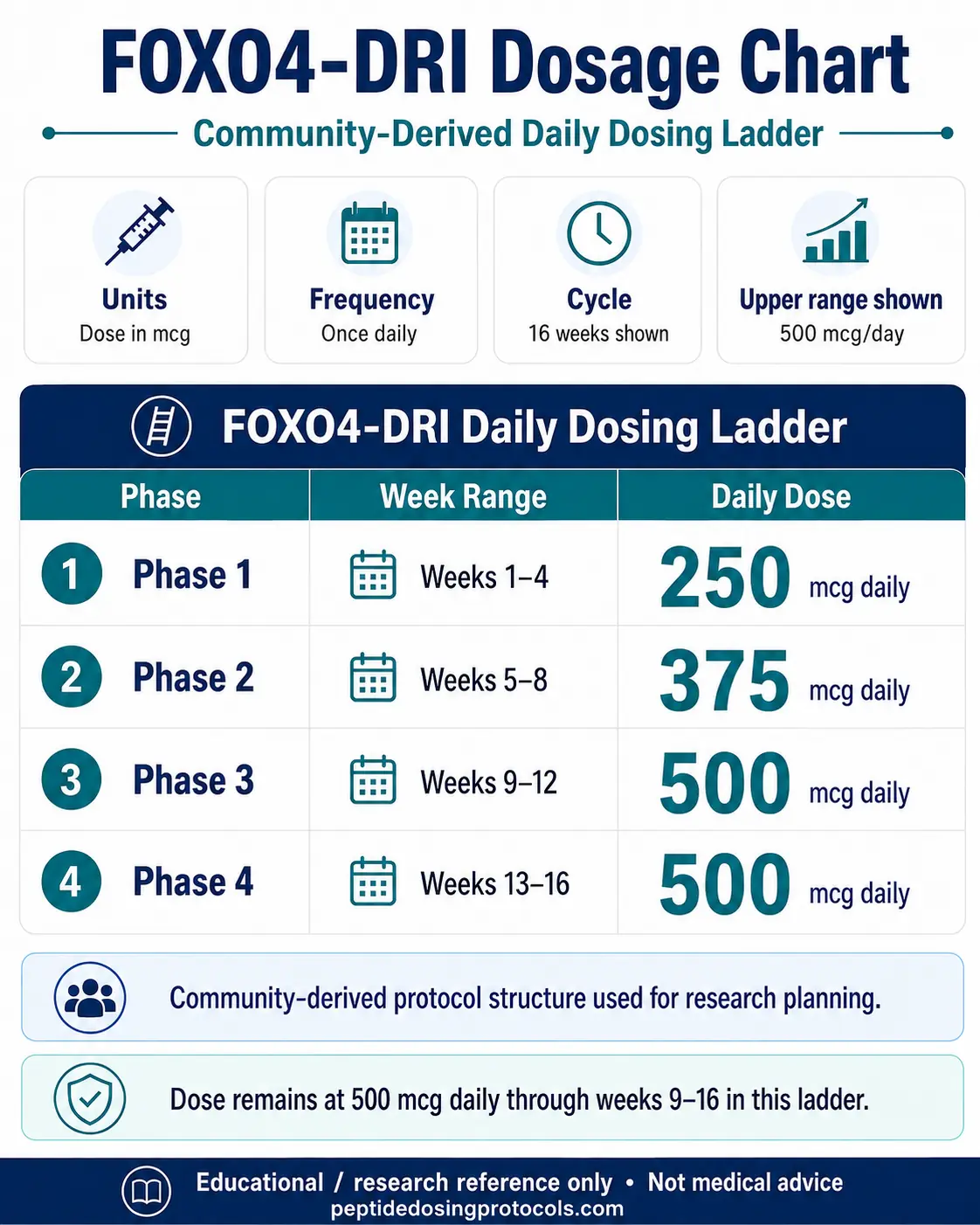
FOXO4-DRI Dosage Chart
This FOXO4-DRI dosage chart summarizes the reported community dosing schedule by week range, stepping from 250 mcg daily to 500 mcg daily across a 16-week structure.
How FOXO4-DRI Works
In plain English: senescent cells survive by holding the protein p53 hostage. They use another protein, FOXO4, to keep p53 stuck in the nucleus so it cannot trigger cell death. FOXO4-DRI acts as a decoy that competes with FOXO4 for p53.
Once p53 is freed, it moves out of the nucleus toward the mitochondria and sets off the intrinsic apoptosis pathway (a caspase-driven self-destruct program). Healthy cells do not lean on the FOXO4-p53 link for survival, which is why the effect is reported as selective for senescent cells.
This mechanism was first described in mice and cell cultures. A 2025 Nature Communications paper mapped the binding to the disordered transactivation domain of p53, adding structural detail to how FOXO4-DRI engages its target.
- Target: the FOXO4-p53 protein interaction in senescent cells.
- Result: p53 nuclear exclusion, mitochondrial translocation, and apoptosis.
- Main limitation: selectivity figures (such as an in-vitro ~11.7-fold preference for senescent cells) come from cell models, not humans.
Who Should Be Cautious With FOXO4-DRI
Because there is no human safety data, the cautions below are drawn from the compound's mechanism and from general research practice, not from clinical findings.
- Anyone with active cancer or undergoing cancer treatment — p53 and senescence pathways interact with tumor biology in complex ways.
- Pregnancy and breastfeeding — no data exist, and apoptosis-inducing agents are a clear unknown.
- Active infection, recent surgery, or wound healing — senescent cells assist tissue repair, so clearing them could theoretically interfere.
- Anyone who is immunocompromised — clearance of dying cells depends on immune function.
Talk to a qualified clinician
These are theoretical cautions, not a complete safety list. A licensed clinician should weigh any decision involving an unapproved research compound.
FOXO4-DRI Side Effects & Safety
There are no documented human side effects because FOXO4-DRI has not been tested in people. In mouse studies, researchers reported improved health markers rather than obvious toxicity, but mouse safety does not predict human safety.
Theoretical and reported concerns
- Off-target cell death: no compound is perfectly selective, so healthy cells with temporarily high FOXO4 could be affected in theory.
- Immune or clearance burden: a rapid wave of dying cells must be cleared, which could stress the system.
- Impaired healing: senescent cells help wound repair, so clearing them at the wrong time may not be wanted.
- Injection-site issues: redness, swelling, or irritation are common to any SubQ injection and are made worse by poor technique or low-quality product.
Product quality is its own risk. As a D-amino acid peptide, FOXO4-DRI is costly to synthesize, and a wrong amino acid at the binding site can sharply cut activity. Unverified material may not contain what the label claims.
FOXO4-DRI Expected Timeline
Any timeline for FOXO4-DRI is extrapolated from animal data and community reports. No controlled human data exists, so treat the sequence below as a rough biology timeline, not a promised outcome.
Mechanistic timeline (extrapolated, not human-confirmed)
Window
Hours
What is proposed to happen
Peptide enters circulation; competes with FOXO4 for p53 in senescent cells.
Window
1-3 days
What is proposed to happen
Freed p53 reaches mitochondria; senescent cells begin apoptosis.
Window
3-14 days
What is proposed to happen
Immune system clears apoptotic debris; SASP inflammatory signaling declines.
Window
2-6 weeks
What is proposed to happen
Tissue microenvironment improves in animal models as inflammation drops.
| Window | What is proposed to happen |
|---|---|
| Hours | Peptide enters circulation; competes with FOXO4 for p53 in senescent cells. |
| 1-3 days | Freed p53 reaches mitochondria; senescent cells begin apoptosis. |
| 3-14 days | Immune system clears apoptotic debris; SASP inflammatory signaling declines. |
| 2-6 weeks | Tissue microenvironment improves in animal models as inflammation drops. |
In mice, effects were seen within roughly 10-14 days. Human timing is unknown.
Useful markers for senescence biology in a research context include hs-CRP, IL-6, and IGF-1, alongside a comprehensive metabolic panel. These track inflammation and general health, not FOXO4-DRI activity directly.
FOXO4-DRI Clinical Evidence Context
There is no direct human evidence yet. As of June 2026, FOXO4-DRI has no completed or registered human clinical trial. Everything known comes from animal models and cell cultures.
Foundational mouse study (Baar et al., 2017, Cell)
Designed FOXO4-DRI and showed selective senescent-cell clearance, with restored fitness, fur density, and kidney function in aged and chemotherapy-treated mice.
Leydig cell aging (Zhang et al., 2020, Aging)
FOXO4-DRI improved testosterone secretion and the testicular microenvironment in aged mice by clearing senescent Leydig cells.
Human chondrocytes in vitro (Huang/Zhu et al., 2021)
Selectively removed senescent cells from expanded human chondrocyte cultures, suggesting cartilage-repair relevance — in a dish, not a person.
Endothelial senescence (2025, PMC)
Reported FOXO4-DRI clearing senescent endothelial cells via a p53/BCL-2/caspase-3 pathway in animal and cell models.
Mechanism mapping (Nature Communications, 2025)
Identified the disordered p53 transactivation domain as the binding target, adding structural detail to the mechanism.
The missing pieces are big: no human dosing, no human pharmacokinetics, no controlled human safety data, and no long-term outcome data in any species. The biotech developing it (Cleara Biotech, from Erasmus University research) has discussed disease targets, but that is development interest, not proof.
FOXO4-DRI Storage & Handling
Store the dry (lyophilized) powder frozen for long-term holding and keep reconstituted solution cold. FOXO4-DRI is reported to be sensitive to oxidation and repeated freeze-thaw cycles, so reconstituted material is best used fresh rather than stored for months.
Storage reference
Lyophilized (powder)
FOXO4-DRI
-4F (-20C) long-term; colder is better
Reconstituted (liquid)
FOXO4-DRI
35.6-46.4F (2-8C); use within a short window
Appearance
FOXO4-DRI
Clear solution after mixing
| FOXO4-DRI | |
|---|---|
| Lyophilized (powder) | -4F (-20C) long-term; colder is better |
| Reconstituted (liquid) | 35.6-46.4F (2-8C); use within a short window |
| Appearance | Clear solution after mixing |
Discard reconstituted solution that turns cloudy or develops particles.
FOXO4-DRI Troubleshooting
- Cloudy or particle-filled vial: do not use it. Clear solution is expected after gentle mixing.
- Over-reconstituting: a common error is mixing more than will be used promptly, then storing it too long. Reconstitute closer to what the cycle needs.
- No noticeable effect: in research terms, FOXO4-DRI only acts where senescent cells are present, and degraded or mislabeled product loses activity. Product quality is a frequent confounder.
- Site rotation and fresh supplies are commonly cited research-handling practices associated with less irritation.
- Route confusion: animal studies used IP/IV; community use is SubQ with unknown bioavailability differences. Do not assume routes are interchangeable.
FOXO4-DRI Regulatory Status
As of June 2026, FOXO4-DRI is not approved by the FDA or any other regulatory agency for human use. It has no approved indication and no established legal pathway for prescription or pharmacy compounding in the United States. It is sold only as a research-use-only chemical, sometimes under the name Proxofim.
Research use only
Research-use-only products are not intended for human consumption. Laws and enforcement vary by region, so verify your local rules before purchasing.
FOXO4-DRI vs Other Senolytics
FOXO4-DRI is one of several approaches to clearing senescent cells, and they are not interchangeable.
FOXO4-DRI vs nearby senolytics
Option
FOXO4-DRI
Type
D-retro-inverso peptide
Human trial stage
None (preclinical only)
Option
Dasatinib + Quercetin (D+Q)
Type
Small-molecule drug + flavonoid
Human trial stage
Early human trials (e.g., Alzheimer's)
Option
Navitoclax
Type
BCL-2 family inhibitor
Human trial stage
Later-stage trials (e.g., myelofibrosis)
| Option | Type | Human trial stage |
|---|---|---|
| FOXO4-DRI | D-retro-inverso peptide | None (preclinical only) |
| Dasatinib + Quercetin (D+Q) | Small-molecule drug + flavonoid | Early human trials (e.g., Alzheimer's) |
| Navitoclax | BCL-2 family inhibitor | Later-stage trials (e.g., myelofibrosis) |
D+Q and navitoclax are further along in humans but can affect healthy cells (e.g., low platelets). FOXO4-DRI's selectivity claims are from cell and animal models.
FAQ
Q1: What is FOXO4-DRI?
FOXO4-DRI is a synthetic D-retro-inverso peptide studied as a senolytic, meaning it is designed to selectively clear senescent cells. It works by disrupting the FOXO4-p53 interaction so that p53 can trigger apoptosis in those cells. It is also written FOX04-DRI and sold by some vendors as Proxofim.
Q2: What is FOXO4-DRI used for in research?
It is investigated mainly for cellular senescence and aging. Mouse and cell studies have looked at clearing senescent cells in aged tissue, testosterone-producing Leydig cells, cartilage chondrocytes, and blood-vessel endothelial cells. All current uses are preclinical research contexts, not approved treatments.
Q3: How is FOXO4-DRI dosed?
The only published dosing protocol is from mouse studies: 5 mg/kg by intraperitoneal injection, given intermittently over weeks. No human dose has been established and no human trials exist. Community sources report a 16-week subcutaneous ladder of 250 mcg daily for Weeks 1-4, 375 mcg daily for Weeks 5-8, and 500 mcg daily for Weeks 9-16, but this is reported research context, not a recommendation.
Q4: How do you reconstitute a 10 mg FOXO4-DRI vial?
Adding 3.0 mL of bacteriostatic water to a 10 mg vial gives about 3.33 mg/mL. On a U-100 insulin syringe, 7.5 units is about 250 mcg, 11.25 units is about 375 mcg, 15 units is about 500 mcg, and 30 units is about 1 mg. Use the calculator at peppal.app/calculator for other vial sizes.
Q5: Is there a FOXO4-DRI dosage chart?
Yes, this guide includes a community-derived 16-week daily dosing ladder and a reconstitution chart for a 10 mg vial reconstituted with 3.0 mL of BAC water. It converts syringe units into micrograms and milligrams. Any chart is a research reference only, since no human dose has been validated.
Q6: What are the side effects of FOXO4-DRI?
There are no documented human side effects because it has not been tested in people. Theoretical concerns include off-target cell death, immune burden from clearing many cells at once, impaired wound healing, and injection-site irritation. Product quality is a separate risk with this expensive-to-make peptide.
Q7: Are there any FOXO4-DRI human trials?
No. As of June 2026 there are no completed or registered human clinical trials for FOXO4-DRI. All evidence comes from mouse models and cell cultures. ClinicalTrials.gov is the authoritative place to check if that ever changes.
Q8: Is FOXO4-DRI FDA approved or legal?
FOXO4-DRI is not FDA approved and has no approved human indication. It is sold only as a research-use-only chemical and is not intended for human consumption. Laws vary by region, so verify local rules before purchasing.
Q9: What is the FOXO4-DRI peptide sequence?
FOXO4-DRI is a D-retro-inverso peptide built from a FOXO4 fragment that binds p53, joined to a cell-penetrating sequence, with a molecular weight near 4.8 kDa. Published descriptions vary slightly in reported length, so for the exact chemical identity check the PubChem entry rather than relying on a single secondary source.
Q10: Is FOXO4-DRI the same as Proxofim?
Proxofim is a name used by some research vendors for FOXO4-DRI. It refers to the same senolytic peptide. Listings sometimes appear as Proxofim 10 mg.
Q11: Can FOXO4-DRI treat cancer?
No such claim can be made. Some preclinical work explores FOXO4-p53-targeting peptides against senescent cancer cells, and the developer has discussed cancer as a research interest, but there is no human evidence that FOXO4-DRI treats cancer. People with active cancer should be especially cautious.
Q12: Is this page medical advice?
No. This is an educational research reference about FOXO4-DRI, not medical advice or a treatment plan. Talk with a qualified clinician before making decisions about any unapproved research compound.
Sources & Research
- 1. Baar MP, Brandt RMC, Putavet DA, et al. Targeted apoptosis of senescent cells restores tissue homeostasis in response to chemotoxicity and aging. Cell (2017)
- 2. Madl T, et al. The disordered p53 transactivation domain is the target of FOXO4 and the senolytic compound FOXO4-DRI. Nature Communications (2025)
- 3. Zhang C, Xie Y, Chen H, et al. FOXO4-DRI alleviates age-related testosterone secretion insufficiency by targeting senescent Leydig cells in aged mice. Aging (Albany NY) (2020)
- 4. Huang Y, He Y, Makarcyzk MJ, Lin H. Senolytic Peptide FOXO4-DRI Selectively Removes Senescent Cells From in vitro Expanded Human Chondrocytes. Frontiers in Cell and Developmental Biology (PMC8116695) (2021)
- 5. Zhang H, et al. FOXO4-DRI regulates endothelial cell senescence via the p53 signaling pathway. PMC12852416 (2025)
- 6. Yang Y, et al. FOXO4-DRI improves spermatogenesis in aged mice through reducing SASP secretion from Leydig cells. Mechanisms of Ageing and Development (2024)
- 7. American Association for Cancer Research (Research Watch). A FOXO4 Inhibitory Peptide Limits Chemotoxicity in Mice. Cancer Discovery (2017)
- 8. Le HH, et al. Molecular modelling of the FOXO4-TP53 interaction to design senolytic peptides for the elimination of senescent cancer cells. EBioMedicine (2021)
- 9. National Center for Biotechnology Information. FOXO4-DRI (PubChem CID 167312269) — compound identity and molecular formula. PubChem (2026)
- 10. U.S. National Library of Medicine. ClinicalTrials.gov registry — FOXO4-DRI search (no registered human trials as of June 2026). ClinicalTrials.gov (2026)
- 11. Lifespan.io Rejuvenation Roadmap. Cleara Biotech — FOXO4-DRI development status. Lifespan.io (industry/development context) (2026)
Related Dosing Protocols
Educational use only
This guide is an educational research reference about FOXO4-DRI, not medical advice or a treatment plan. FOXO4-DRI is not FDA-approved and has not been tested in humans.
Calculate vial math
Use the calculator for custom vial size, BAC-water volume, and syringe-unit math.

Written by Garret Grant
Founder & Lead Researcher · B.S. Civil Engineering, UCLA
Last updated: August 2026
Human-researched and AI-assisted with full editorial review. I verify sources, protocol interpretation, and final judgments personally. See methodology.
Share this page