
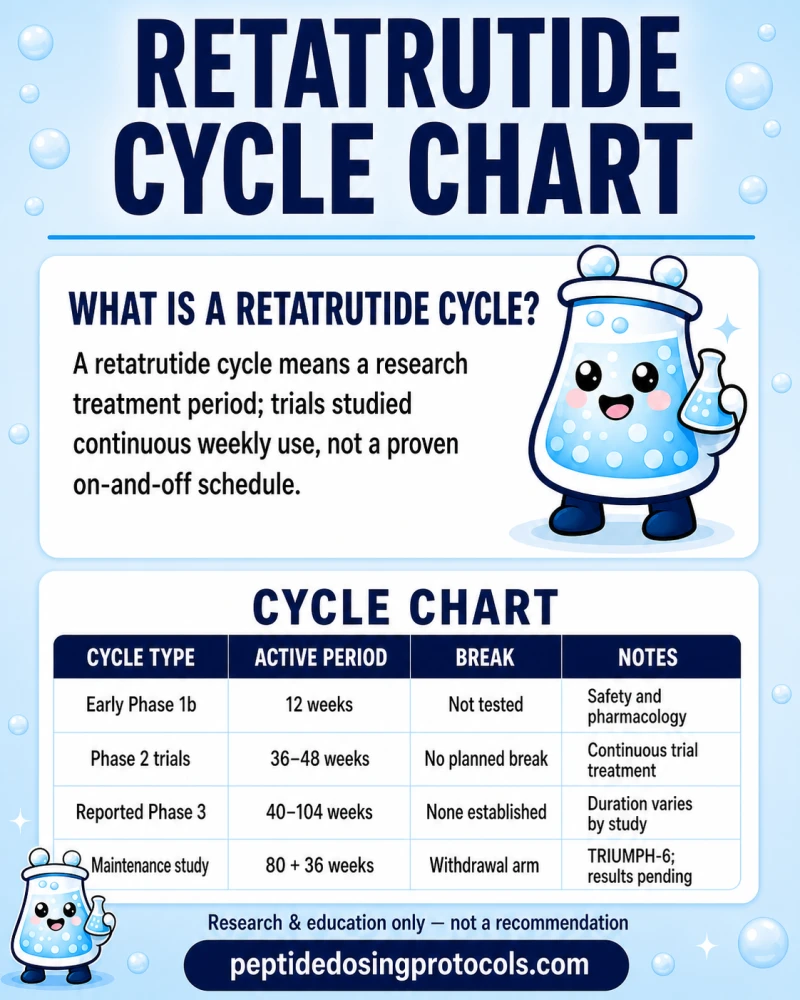
How Long Is a Retatrutide Cycle?
There is no clinically established retatrutide cycle length. Retatrutide is still investigational, and its clinical trials have generally studied continuous once-weekly treatment for a set research period rather than short on/off cycles.
Direct answer
A 12-week retatrutide study was completed early in development, but later efficacy studies ran much longer. Published and reported research now includes 36-, 40-, 48-, 68-, 80-, and 104-week treatment periods. None of these studies established an 8-week, 12-week, or 16-week cycle followed by a standard break.
A trial duration is not a recommended cycle
Clinical-trial timelines show how long researchers studied retatrutide in a defined population. They do not prove that the same duration is safe, ideal, or appropriate outside that study.
Retatrutide Cycle Length Chart
The research timeline has grown as retatrutide moved from early safety studies into larger Phase 2 and Phase 3 trials. The table below focuses on treatment duration, not dose selection.
Retatrutide study durations by development stage
These are clinical research periods, not personal-use cycle recommendations.
Duration
12 weeks
Study
Phase 1b in adults with type 2 diabetes
What the duration means
Early proof-of-concept study focused on safety, tolerability, pharmacokinetics, and pharmacodynamics. It did not establish a 12-week cycle standard.
Duration
36 weeks
Study
Phase 2 type 2 diabetes trial
What the duration means
Later Phase 2 efficacy and safety outcomes were assessed through week 36.
Duration
40 weeks
Study
TRANSCEND-T2D-1 Phase 3
What the duration means
Phase 3 treatment period in adults with type 2 diabetes inadequately controlled with diet and exercise.
Duration
48 weeks
Study
Phase 2 obesity trial
What the duration means
Treatment continued for 48 weeks, even though the primary weight endpoint was measured earlier at week 24.
Duration
68 weeks
Study
TRIUMPH-4 Phase 3
What the duration means
Primary Phase 3 evaluation period in adults with obesity or overweight and knee osteoarthritis without diabetes.
Duration
80 weeks
Study
TRIUMPH-1, TRIUMPH-2, and TRIUMPH-3
What the duration means
Primary Phase 3 outcome period used across several large obesity studies with different participant groups.
Duration
104 weeks
Study
TRIUMPH-1 extension
What the duration means
A pre-specified blinded extension followed a subgroup with baseline BMI of at least 35 through two years of treatment.
Duration
80 + 36 weeks
Study
TRIUMPH-6 maintenance study
What the duration means
Ongoing study with an 80-week retatrutide lead-in followed by 36 weeks of continued retatrutide, a different retatrutide dose, or placebo. Results are not yet available.
| Duration | Study | What the duration means |
|---|---|---|
| 12 weeks | Phase 1b in adults with type 2 diabetes | Early proof-of-concept study focused on safety, tolerability, pharmacokinetics, and pharmacodynamics. It did not establish a 12-week cycle standard. |
| 36 weeks | Phase 2 type 2 diabetes trial | Later Phase 2 efficacy and safety outcomes were assessed through week 36. |
| 40 weeks | TRANSCEND-T2D-1 Phase 3 | Phase 3 treatment period in adults with type 2 diabetes inadequately controlled with diet and exercise. |
| 48 weeks | Phase 2 obesity trial | Treatment continued for 48 weeks, even though the primary weight endpoint was measured earlier at week 24. |
| 68 weeks | TRIUMPH-4 Phase 3 | Primary Phase 3 evaluation period in adults with obesity or overweight and knee osteoarthritis without diabetes. |
| 80 weeks | TRIUMPH-1, TRIUMPH-2, and TRIUMPH-3 | Primary Phase 3 outcome period used across several large obesity studies with different participant groups. |
| 104 weeks | TRIUMPH-1 extension | A pre-specified blinded extension followed a subgroup with baseline BMI of at least 35 through two years of treatment. |
| 80 + 36 weeks | TRIUMPH-6 maintenance study | Ongoing study with an 80-week retatrutide lead-in followed by 36 weeks of continued retatrutide, a different retatrutide dose, or placebo. Results are not yet available. |
TRIUMPH-6 lasts about 125 weeks including study visits and follow-up. Participants who remain on retatrutide through both treatment phases can receive study treatment for 116 weeks.
Is a 12-Week Retatrutide Cycle Supported by Research?
A 12-week retatrutide study exists, but it should not be read as proof of a standard 12-week cycle. The 2022 Phase 1b trial enrolled 72 adults with type 2 diabetes and was designed to study early safety, tolerability, drug levels, and biological effects.
Later studies were much longer. Phase 2 research extended to 36 or 48 weeks, while reported Phase 3 studies reached 40, 68, or 80 weeks. TRIUMPH-1 also reported a 104-week extension in a subgroup.
What 12 weeks does and does not show
Twelve weeks is a real early research duration for retatrutide. It does not establish that 12 weeks on, followed by time off, is a clinically tested cycle pattern.
How Long Was Retatrutide Studied in Phase 2?
Retatrutide had two important Phase 2 timelines. The type 2 diabetes trial assessed later outcomes at 36 weeks, while the obesity trial continued treatment through 48 weeks.
36-week type 2 diabetes trial
The Phase 2 diabetes study measured its primary A1C endpoint at week 24 and continued key efficacy and safety assessments through week 36.
48-week obesity trial
The Phase 2 obesity study used a week-24 primary endpoint, but treatment continued through week 48. That difference matters because a primary endpoint is not always the end of treatment.
No planned short off-cycle phase
Neither Phase 2 trial was designed around a repeating short cycle such as 8 weeks on and 8 weeks off.
For exact starting doses, target doses, and escalation details from these studies, use the Retatrutide Protocol Guide. This page keeps the focus on total research duration.
How Long Are Phase 3 Retatrutide Trials?
Reported Phase 3 retatrutide studies now cover 40 to 80 weeks for their main treatment periods, with a TRIUMPH-1 extension reaching 104 weeks. The exact duration depends on the study population and research question.
40 weeks — TRANSCEND-T2D-1
This completed Phase 3 trial studied retatrutide in adults with type 2 diabetes inadequately controlled with diet and exercise.
68 weeks — TRIUMPH-4
This Phase 3 trial studied adults with obesity or overweight and knee osteoarthritis without diabetes.
80 weeks — TRIUMPH-1
The main TRIUMPH-1 obesity trial reported its primary and key secondary outcomes at week 80.
80 weeks — TRIUMPH-2 and TRIUMPH-3
TRIUMPH-2 studied obesity or overweight with type 2 diabetes. TRIUMPH-3 studied severe obesity with established cardiovascular disease. Both reported primary outcomes at week 80.
104 weeks — TRIUMPH-1 extension
A pre-specified blinded extension followed a subgroup with higher baseline BMI beyond the 80-week main endpoint to week 104.
These different timelines should not be ranked as better or worse cycles. The trials enrolled different populations and answered different questions.
Does Retatrutide Use On-and-Off Cycles?
The clinical trials summarized here do not establish a repeating on-and-off retatrutide cycle. They generally use continuous once-weekly study treatment for a protocol-defined period rather than planned patterns such as 8 weeks on and 8 weeks off.
No evidence-based off-cycle period exists
There is no published retatrutide rule that says a researcher should stop for 2, 4, 8, or any other number of weeks between cycles. A break length should not be invented from the drug's half-life or from schedules used with other compounds.
Stopping treatment for a study withdrawal, an adverse event, or a participant decision is also different from a planned off-cycle phase. Those events do not create a validated cycle schedule.
Retatrutide Maintenance and Withdrawal Research
TRIUMPH-6 is the most relevant current study for questions about long-term maintenance and stopping. It is designed to test what happens after a long period of retatrutide treatment rather than assuming that a short cycle and break are appropriate.
- 01
80-week lead-in
All participants receive retatrutide during the first 80 weeks of the study.
- 02
36-week randomized phase
Participants are then assigned to continue retatrutide, move to another retatrutide dose, or switch to placebo for 36 weeks.
- 03
Maintenance outcome
The study will measure how much of the weight reduction achieved by week 80 is maintained through week 116.
- 04
Results still pending
The trial is ongoing as of August 2026, so it cannot yet tell us what happens after withdrawal or which maintenance approach is best.
TRIUMPH-6 is expected to run into 2028. Until results are available, claims about a proven retatrutide maintenance cycle, taper, or off-cycle period go beyond the evidence.
Retatrutide Cycle Supplies Needed
Plan supplies from the exact study arm, vial size, and concentration rather than from cycle length alone. The trial durations on this page do not establish a personal supply plan.
Recommended U.S. and Canada Supply
Choose your region
Use discount code PEPPAL at Peptide Partners checkout. See why we love Peptide Partners.
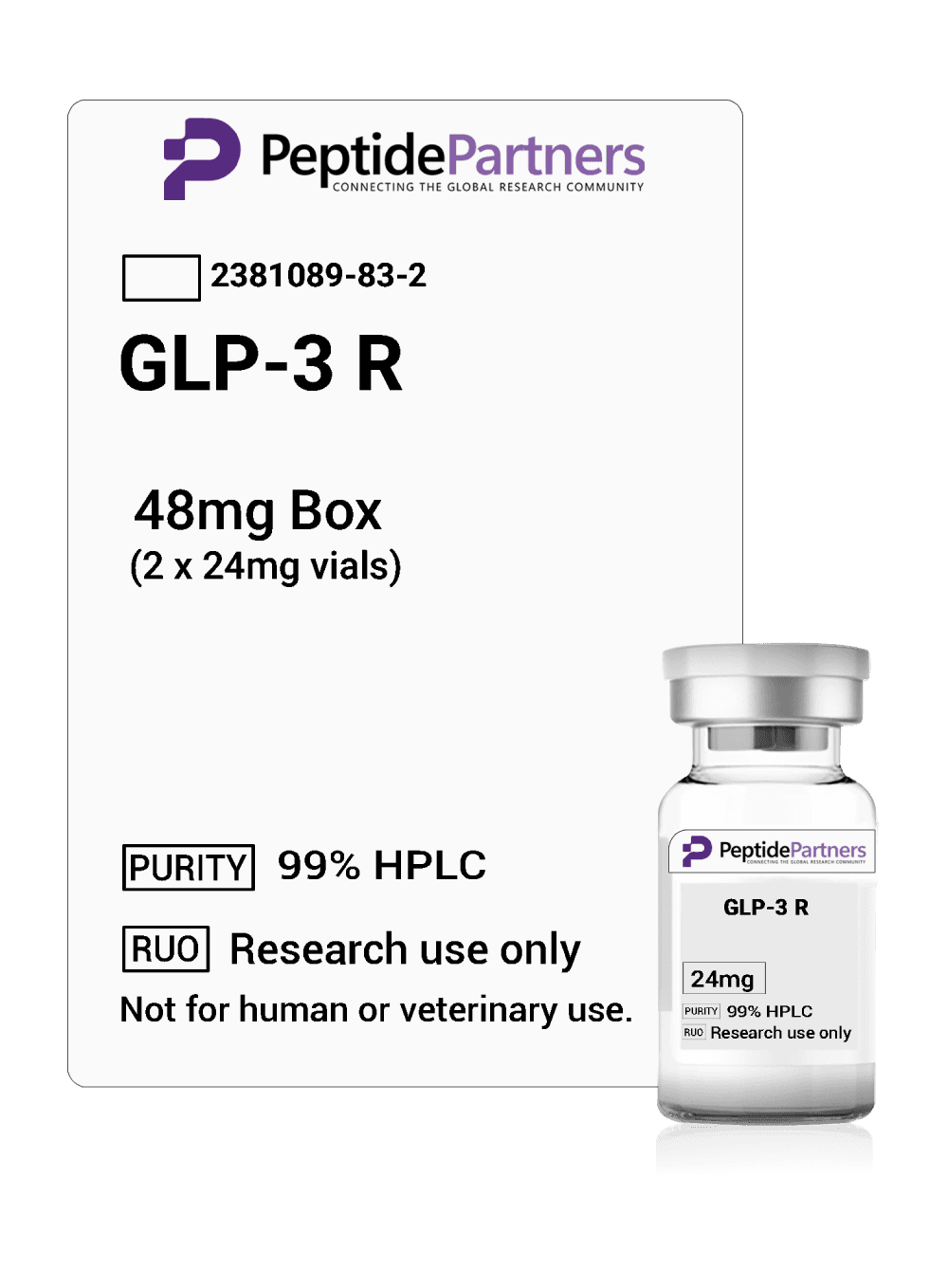
Retatrutide Research Supply
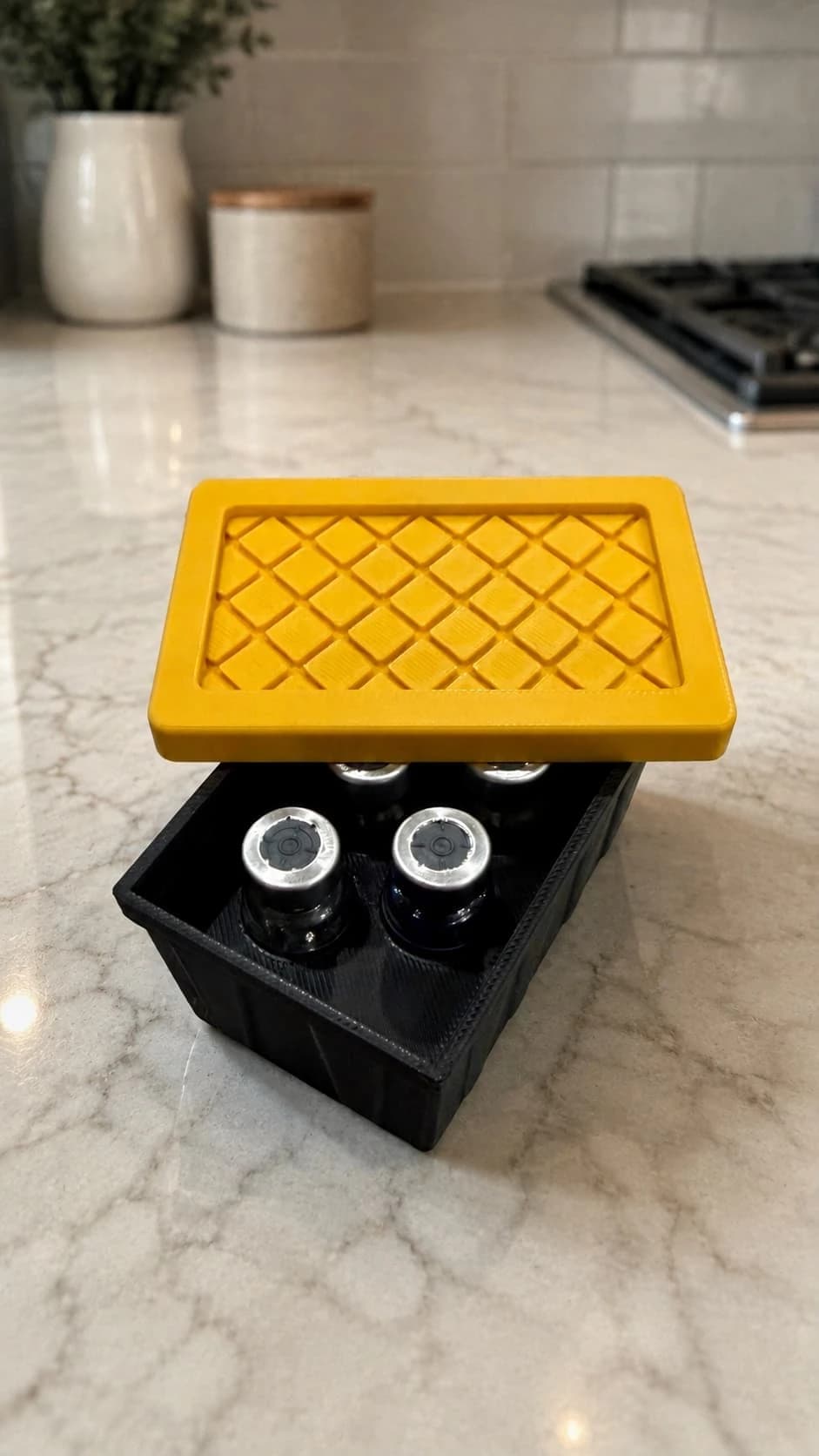
5-Vial Tote Case
At-Home Blood Test
Research Supplies
Disclosure: supply links may earn PDP a commission at no cost to you.
Study-Specific Supply Planning
A treatment duration does not determine vial count without the assigned dose arm and vial concentration.
| Research context | Evidence note |
|---|---|
12-week Phase 1b Study-specific materials | This early study used multiple ascending doses and does not establish a standard 12-week vial plan. |
36- or 48-week Phase 2 Assigned-arm math required | Phase 2 trials used different populations, target doses, and study designs. |
40- to 104-week Phase 3 Trial-site supply only | These research periods are not personal purchasing plans or validated cycle lengths. |
80 + 36-week TRIUMPH-6 Results pending | The maintenance and withdrawal design should not be converted into a supply plan before results are available. |
12-week Phase 1b
Study-specific materials
This early study used multiple ascending doses and does not establish a standard 12-week vial plan.
36- or 48-week Phase 2
Assigned-arm math required
Phase 2 trials used different populations, target doses, and study designs.
40- to 104-week Phase 3
Trial-site supply only
These research periods are not personal purchasing plans or validated cycle lengths.
80 + 36-week TRIUMPH-6
Results pending
The maintenance and withdrawal design should not be converted into a supply plan before results are available.
Calculation and Record-Keeping
Keep cycle duration separate from dose, concentration, and syringe-unit calculations.
| Research context | Evidence note |
|---|---|
Vial calculations Use the protocol guide | The Retatrutide Protocol page shows dose-arm, reconstitution, concentration, and vial arithmetic. |
U-100 conversions 100 units = 1 mL | Use the Retatrutide Peptide Calculator for calculation-only conversions with a chosen vial size and BAC water volume. |
Study tracking One record per study week | Keep the trial name, assigned arm, active period, follow-up, and any withdrawal phase clearly separated. |
Vial calculations
Use the protocol guide
The Retatrutide Protocol page shows dose-arm, reconstitution, concentration, and vial arithmetic.
U-100 conversions
100 units = 1 mL
Use the Retatrutide Peptide Calculator for calculation-only conversions with a chosen vial size and BAC water volume.
Study tracking
One record per study week
Keep the trial name, assigned arm, active period, follow-up, and any withdrawal phase clearly separated.
These rows organize research supplies and records. They do not recommend retatrutide use or turn a clinical-trial duration into a personal cycle.
Companion Supplies & Routine Support
Retatrutide Cycle Length vs Titration
Cycle length and titration answer different questions. Cycle length is the total period of treatment or observation. Titration is the planned change in dose during part of that period.
Retatrutide cycle-length intent vs dosing intent
Question
How long was retatrutide studied?
Best page
This cycle guide
What belongs there
12-, 36-, 40-, 48-, 68-, 80-, and 104-week research timelines
Question
Is a 12-week cycle supported?
Best page
This cycle guide
What belongs there
What the 12-week Phase 1b study can and cannot establish
Question
How much time off is supported?
Best page
This cycle guide
What belongs there
Maintenance, withdrawal, and the lack of a validated off-cycle period
Question
What was the Phase 3 starting dose?
Best page
Retatrutide Protocol Guide
What belongs there
Starting dose and trial-specific dose design
Question
What is the titration schedule?
Best page
Retatrutide Protocol Guide
What belongs there
Dose escalation and target-dose arms
Question
How do vial and syringe calculations work?
Best page
Retatrutide Protocol Guide
What belongs there
Reconstitution, concentration, and U-100 calculation examples
| Question | Best page | What belongs there |
|---|---|---|
| How long was retatrutide studied? | This cycle guide | 12-, 36-, 40-, 48-, 68-, 80-, and 104-week research timelines |
| Is a 12-week cycle supported? | This cycle guide | What the 12-week Phase 1b study can and cannot establish |
| How much time off is supported? | This cycle guide | Maintenance, withdrawal, and the lack of a validated off-cycle period |
| What was the Phase 3 starting dose? | Retatrutide Protocol Guide | Starting dose and trial-specific dose design |
| What is the titration schedule? | Retatrutide Protocol Guide | Dose escalation and target-dose arms |
| How do vial and syringe calculations work? | Retatrutide Protocol Guide | Reconstitution, concentration, and U-100 calculation examples |
Keeping these topics separate helps this page answer cycle-length searches without duplicating the main dosing guide.
Retatrutide Protocol Guide
Use the protocol page for starting dose, Phase 2 and Phase 3 titration, reconstitution, concentration charts, and vial math.
Cagrilintide + Retatrutide Stack
Review the separate evidence boundaries, cycle discussion, and supply planning for this community-reported two-compound stack.
Retatrutide + MOTS-c Stack
See how the Retatrutide trial timeline differs from the shorter community-reported MOTS-c pulse periods used in this stack.
Advanced Recomp Stack
Compare the Retatrutide research period with the separate CJC-1295 and Ipamorelin schedule used in this community-derived stack.
Peptide Cycle Guides
Browse other cycle-length pages that separate published evidence from community-reported schedules.
Does a Longer Retatrutide Cycle Mean Better Results?
No trial has shown that simply choosing a longer retatrutide cycle is better. A 40-week diabetes trial, a 68-week osteoarthritis trial, and an 80-week obesity trial were built for different populations and endpoints.
Longer exposure is not the only difference
Trials can differ in participant health, target doses, endpoints, lifestyle programs, and rules for handling treatment changes.
Cross-trial comparisons have limits
A result at week 80 cannot be cleanly compared with a result at week 48 and blamed on treatment length alone.
Longer follow-up adds safety information
Longer trials provide more time to observe adverse events and durability, but they do not prove that indefinite use is safe.
The longest reported extension is not a lifetime limit
A 104-week extension shows that some participants were studied for two years. It does not establish two years as an ideal maximum or a safe stopping point.
What Is Known About Long-Term Retatrutide Use?
As of August 2026, the longest reported retatrutide extension result is 104 weeks from TRIUMPH-1. Ongoing trials are designed to follow participants longer, but completed long-term results beyond that point are still limited.
That means the evidence is stronger than it was after the original 12-, 36-, and 48-week studies, but important questions remain. Researchers are still studying maintenance, withdrawal, longer exposure, and outcomes in several obesity-related conditions.
Research is still moving
TRIUMPH-6 and other ongoing Phase 3 studies extend the research timeline beyond the first reported trials. This page should be updated when those results are released rather than filling the gap with community assumptions.
How to Read Retatrutide Cycle Claims Online
Retatrutide cycle claims often mix early trial durations, later Phase 3 timelines, and informal peptide-community language. A few checks can keep those ideas separate.
- Check whether the number of weeks comes from a named clinical trial or from an informal schedule.
- Check whether the source is describing total treatment time, a primary endpoint, a dose-escalation period, or follow-up after treatment.
- Do not treat a 12-week Phase 1 study as proof that 12 weeks is the standard retatrutide cycle.
- Do not turn a 48-, 68-, 80-, or 104-week trial into a recommendation to use retatrutide for that long.
- Look for a planned withdrawal or maintenance phase before making claims about time off. TRIUMPH-6 is studying this question, but results are still pending.
- Use the main protocol page for dose and reconstitution questions instead of blending dosing math into cycle-length claims.
Retatrutide Cycle Length FAQ
Q1: How long is a retatrutide cycle?
There is no clinically established retatrutide cycle length. Research has ranged from a 12-week Phase 1b study to 36- and 48-week Phase 2 trials, 40- to 80-week Phase 3 treatment periods, and a 104-week TRIUMPH-1 extension.
Q2: Is a 12-week retatrutide cycle supported by clinical research?
A 12-week Phase 1b retatrutide study was completed in adults with type 2 diabetes, but it was an early safety and pharmacology study. It did not establish 12 weeks as a standard cycle or validate a planned off-cycle period afterward.
Q3: Was retatrutide studied for 48 weeks?
Yes. The Phase 2 obesity trial treated participants for 48 weeks. Its primary weight endpoint was at week 24, but treatment and additional outcomes continued through week 48.
Q4: How long are the Phase 3 retatrutide trials?
Reported Phase 3 treatment periods include 40 weeks in TRANSCEND-T2D-1, 68 weeks in TRIUMPH-4, and 80 weeks in TRIUMPH-1, TRIUMPH-2, and TRIUMPH-3. TRIUMPH-1 also reported a 104-week extension in a subgroup.
Q5: What is the longest retatrutide study reported so far?
As of August 2026, the longest reported retatrutide extension result is 104 weeks in a pre-specified TRIUMPH-1 subgroup. Ongoing studies are designed to follow treatment and maintenance for longer periods.
Q6: Can retatrutide be cycled 8 weeks on and 8 weeks off?
The clinical trials summarized on this page do not use an 8-weeks-on, 8-weeks-off schedule. No published retatrutide study has established that pattern as a validated cycle.
Q7: How much time off should there be between retatrutide cycles?
No evidence-based off-cycle period has been established for retatrutide. Research has not validated a standard 2-, 4-, or 8-week break between repeated cycles.
Q8: Is there a retatrutide maintenance study?
Yes. TRIUMPH-6 uses an 80-week retatrutide lead-in followed by a 36-week randomized phase in which participants continue retatrutide, change to another retatrutide dose, or switch to placebo. Results are still pending as of August 2026.
Q9: What happens when retatrutide is stopped?
A dedicated Phase 3 maintenance and withdrawal study is underway, but results are not yet available. It is too early to claim a proven taper, stopping schedule, or expected outcome after withdrawal.
Q10: Is retatrutide cycle length the same as the titration schedule?
No. Cycle length refers to total treatment or study time. Titration refers to changes in dose during part of that period. The Retatrutide Protocol Guide covers starting dose and titration in detail.
Q11: What does a Reta cycle mean?
Reta is an informal abbreviation for retatrutide. A 'Reta cycle' usually means a planned period of retatrutide exposure, but clinical trials describe treatment periods rather than a proven on-and-off cycle system.
Q12: Is retatrutide FDA-approved?
No. Retatrutide remains investigational and is not FDA-approved as of August 2026. Its safety, efficacy, maintenance strategy, and longer-term use are still being studied in clinical trials.
References
- 1. Urva S, Coskun T, Loh MT, Du Y, Thomas MK, Gurbuz S, Haupt A, Benson CT, Hernandez-Illas M, D'Alessio DA, Milicevic Z LY3437943, a novel triple GIP, GLP-1, and glucagon receptor agonist in people with type 2 diabetes: a phase 1b, multicentre, double-blind, placebo-controlled, randomised, multiple-ascending dose trial The Lancet (2022)
- 2. Rosenstock J, Frias J, Jastreboff AM, Du Y, Lou J, Gurbuz S, Thomas MK, Hartman ML, Haupt A, Milicevic Z, Coskun T Retatrutide, a GIP, GLP-1 and glucagon receptor agonist, for people with type 2 diabetes: a randomised, double-blind, placebo and active-controlled, parallel-group, phase 2 trial conducted in the USA The Lancet (2023)
- 3. Jastreboff AM, et al. Triple-Hormone-Receptor Agonist Retatrutide for Obesity The New England Journal of Medicine (2023)
- 4. Bajaj HS, et al. Efficacy and safety of retatrutide in people with type 2 diabetes and inadequate glycaemic control with diet and exercise (TRANSCEND-T2D-1): a double-blind, randomised, phase 3 trial The Lancet (2026)
- 5. Lilly's triple agonist, retatrutide, delivered weight loss of up to an average of 71.2 lbs along with substantial relief from osteoarthritis pain in first successful Phase 3 trial Eli Lilly and Company (2025)
- 6. Lilly's triple agonist, retatrutide, delivered powerful weight loss in pivotal Phase 3 obesity trial Eli Lilly and Company (2026)
- 7. Lilly's triple agonist, retatrutide, successful in two additional Phase 3 obesity trials, delivering significant improvements in weight and A1C Eli Lilly and Company (2026)
- 8. A Study of Retatrutide (LY3437943) in the Maintenance of Weight Reduction in Individuals With Obesity (TRIUMPH-6) Eli Lilly Clinical Trials (2026)
- 9. What to know about retatrutide Eli Lilly and Company (2026)
Related Dosing Protocols
Educational use only
Peptide Dosing Protocols is an independent educational reference. Nothing here is medical advice or a recommendation for human use. Consult a licensed healthcare provider before considering any compound.
Need the Retatrutide Dosing Research?
Use the main protocol page for Phase 2 and Phase 3 dose design, starting-dose context, titration, reconstitution, concentration charts, and calculation examples.

Written by Garret Grant
Founder & Lead Researcher · B.S. Civil Engineering, UCLA
Last updated: August 2026
Human-researched and AI-assisted with full editorial review. I verify sources, protocol interpretation, and final judgments personally. See methodology.
Share this page