
How Long Is an AOD-9604 Cycle?
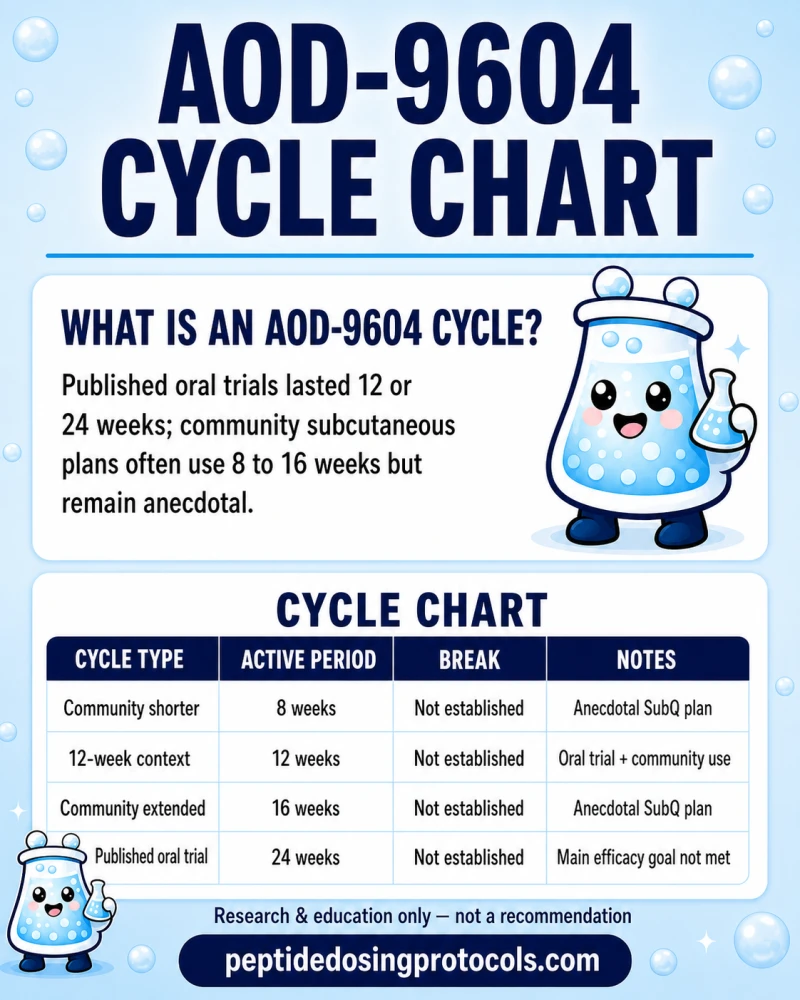
Published AOD-9604 research included a 12-week oral study and a 24-week oral study. Community research plans often use an 8- to 16-week window, but those schedules were not tested in controlled human trials.
The most important detail is the route. The human trials used oral tablets or short intravenous dosing. The common 300 to 500 mcg subcutaneous schedule comes from community practice, not a published human cycle study.
Evidence boundary
An 8-, 12-, or 16-week subcutaneous schedule should not be described as clinically proven. It is a community research model provided for education only, not a recommendation for human use.
AOD-9604 cycle lengths at a glance
Timeline
8 weeks
Where it comes from
Community research planning
Route studied or discussed
Usually discussed as subcutaneous
Evidence level
Anecdotal
Timeline
12 weeks
Where it comes from
METAOD005 human trial and community planning
Route studied or discussed
Trial was oral; community model is usually subcutaneous
Evidence level
Published duration, but different routes and doses
Timeline
16 weeks
Where it comes from
Community research planning
Route studied or discussed
Usually discussed as subcutaneous
Evidence level
Anecdotal
Timeline
24 weeks
Where it comes from
METAOD006 human trial
Route studied or discussed
Oral tablets
Evidence level
Published duration; primary efficacy goal was not met
| Timeline | Where it comes from | Route studied or discussed | Evidence level |
|---|---|---|---|
| 8 weeks | Community research planning | Usually discussed as subcutaneous | Anecdotal |
| 12 weeks | METAOD005 human trial and community planning | Trial was oral; community model is usually subcutaneous | Published duration, but different routes and doses |
| 16 weeks | Community research planning | Usually discussed as subcutaneous | Anecdotal |
| 24 weeks | METAOD006 human trial | Oral tablets | Published duration; primary efficacy goal was not met |
A published trial duration does not validate a different route, dose, or community cycle.
What the Published AOD-9604 Trials Studied
AOD-9604 has more human trial history than many research peptides, but most of that research studied oral or intravenous forms. The trial record is summarized in Stier, Vos, and Kenley’s 2013 paper.
METAOD005 lasted 12 weeks
This randomized trial included 300 adults with obesity. It tested oral AOD-9604 doses of 1, 5, 10, 20, or 30 mg once per day after a two-week placebo run-in period.
METAOD006 lasted 24 weeks
This larger randomized trial enrolled 534 adults, with 502 receiving a study treatment. It tested oral doses of 0.25, 0.5, or 1 mg per day against placebo.
Earlier studies were much shorter
The earlier Phase 1 and Phase 2a studies used single intravenous or oral doses, or oral treatment for seven days. They do not support a long injectable cycle.
The largest efficacy study was unsuccessful
Peer-reviewed obesity reviews report that the 24-week trial did not show enough weight loss compared with placebo. Development for obesity ended in 2007.
Main human AOD-9604 treatment timelines
Study
METAOD004
Participants
36
Route
Oral
Treatment length
7 days
Dose range
9, 27, or 54 mg/day
Main lesson
Short safety and tolerability study
Study
METAOD005
Participants
300
Route
Oral
Treatment length
12 weeks
Dose range
1 to 30 mg/day
Main lesson
Earlier weight-loss trial with a non-linear dose response
Study
METAOD006
Participants
502 randomized
Route
Oral
Treatment length
24 weeks
Dose range
0.25, 0.5, or 1 mg/day
Main lesson
Primary weight-loss goal was not met
| Study | Participants | Route | Treatment length | Dose range | Main lesson |
|---|---|---|---|---|---|
| METAOD004 | 36 | Oral | 7 days | 9, 27, or 54 mg/day | Short safety and tolerability study |
| METAOD005 | 300 | Oral | 12 weeks | 1 to 30 mg/day | Earlier weight-loss trial with a non-linear dose response |
| METAOD006 | 502 randomized | Oral | 24 weeks | 0.25, 0.5, or 1 mg/day | Primary weight-loss goal was not met |
The oral milligram doses in these trials cannot be converted into subcutaneous microgram doses.
Why the route matters
A 24-week oral trial does not prove that a 24-week subcutaneous cycle has the same exposure, safety, or results. Published human pharmacokinetic data for subcutaneous AOD-9604 is not available.
Community AOD-9604 Cycle Chart
The table below shows schedules commonly shared in research communities. These schedules are not taken from a controlled human trial. They are included to explain what researchers may see online and how the timelines differ.
Common community research schedules
Anecdotal research planning only; not a clinical protocol.
Cycle
8 weeks
Weeks 1–4
300 mcg once daily
Later weeks
500 mcg once daily during weeks 5–8
Review points
Weeks 4 and 8
Evidence label
Community standard
Cycle
12 weeks
Weeks 1–4
300 mcg once daily
Later weeks
500 mcg once daily during weeks 5–12
Review points
Weeks 4, 8, and 12
Evidence label
Community standard
Cycle
16 weeks
Weeks 1–4
300 mcg once daily
Later weeks
500 mcg once daily during weeks 5–16
Review points
Every 4 weeks
Evidence label
Community standard
| Cycle | Weeks 1–4 | Later weeks | Review points | Evidence label |
|---|---|---|---|---|
| 8 weeks | 300 mcg once daily | 500 mcg once daily during weeks 5–8 | Weeks 4 and 8 | Community standard |
| 12 weeks | 300 mcg once daily | 500 mcg once daily during weeks 5–12 | Weeks 4, 8, and 12 | Community standard |
| 16 weeks | 300 mcg once daily | 500 mcg once daily during weeks 5–16 | Every 4 weeks | Community standard |
No controlled human study has tested these subcutaneous schedules. The step from 300 to 500 mcg is a community practice, not a proven titration method.
Why community plans often start lower
Community schedules often use the first four weeks as an observation period. The lower amount is meant to make it easier to track tolerance before changing the plan. For a simple way to organize dates, review points, and notes, see our peptide tracker app guide. There is no human trial showing that this step-up structure improves results or lowers risk.
Why 12 weeks is commonly discussed
Twelve weeks appears often because one human AOD-9604 trial used that duration. However, that trial used oral milligram doses. A 12-week subcutaneous cycle only borrows the timeline; it does not copy the tested treatment.
Why a 16-week cycle has less support
Sixteen weeks is mainly a community planning window. It falls between the published 12- and 24-week studies, but that does not make it an evidence-based subcutaneous cycle.
8-Week AOD-9604 Cycle
Community model
Four weeks at 300 mcg per day followed by four weeks at 500 mcg per day. This schedule is anecdotal and was not tested in the published human trials.
8-week community planning example
Phase
Observation phase
Weeks
1–4
Daily amount
300 mcg
Phase total
8.4 mg
Phase
Later phase
Weeks
5–8
Daily amount
500 mcg
Phase total
14 mg
Phase
Full cycle
Weeks
1–8
Daily amount
Mixed schedule
Phase total
22.4 mg
| Phase | Weeks | Daily amount | Phase total |
|---|---|---|---|
| Observation phase | 1–4 | 300 mcg | 8.4 mg |
| Later phase | 5–8 | 500 mcg | 14 mg |
| Full cycle | 1–8 | Mixed schedule | 22.4 mg |
The math assumes daily research with no missed days. It does not show a recommended human dose.
An eight-week plan is shorter than either long Phase 2 trial. It may be used as an early review window, but there is no controlled evidence showing that eight weeks is enough to produce a meaningful effect.
12-Week AOD-9604 Cycle
Community model
Four weeks at 300 mcg per day followed by eight weeks at 500 mcg per day. The duration matches one oral trial, but the route and amounts do not.
12-week community planning example
Phase
Observation phase
Weeks
1–4
Daily amount
300 mcg
Phase total
8.4 mg
Phase
Later phase
Weeks
5–12
Daily amount
500 mcg
Phase total
28 mg
Phase
Full cycle
Weeks
1–12
Daily amount
Mixed schedule
Phase total
36.4 mg
| Phase | Weeks | Daily amount | Phase total |
|---|---|---|---|
| Observation phase | 1–4 | 300 mcg | 8.4 mg |
| Later phase | 5–12 | 500 mcg | 28 mg |
| Full cycle | 1–12 | Mixed schedule | 36.4 mg |
METAOD005 also lasted 12 weeks, but it tested oral doses from 1 to 30 mg per day. It did not test this subcutaneous schedule.
A 12-week review point is easier to compare with the earlier human trial record. Still, the study results cannot be used to predict the outcome of a community subcutaneous cycle.
16-Week AOD-9604 Cycle
Community model
Four weeks at 300 mcg per day followed by 12 weeks at 500 mcg per day. This is a community extension and has not been tested as a human subcutaneous protocol.
16-week community planning example
Phase
Observation phase
Weeks
1–4
Daily amount
300 mcg
Phase total
8.4 mg
Phase
Later phase
Weeks
5–16
Daily amount
500 mcg
Phase total
42 mg
Phase
Full cycle
Weeks
1–16
Daily amount
Mixed schedule
Phase total
50.4 mg
| Phase | Weeks | Daily amount | Phase total |
|---|---|---|---|
| Observation phase | 1–4 | 300 mcg | 8.4 mg |
| Later phase | 5–16 | 500 mcg | 42 mg |
| Full cycle | 1–16 | Mixed schedule | 50.4 mg |
A longer timeline should not be treated as proof of greater benefit.
The main reason to be cautious with a 16-week plan is that there is no clinical subcutaneous evidence to guide the extension. If a research goal has not changed by earlier review points, adding more time does not have a proven benefit.
What the 24-Week AOD-9604 Trial Means
The longest major human AOD-9604 study lasted 24 weeks. It tested oral tablets at 0.25, 0.5, and 1 mg per day in adults with obesity. It did not test reconstituted vials or daily subcutaneous injections.
The study is important because it gives researchers a longer safety window, but it also found that the treatment did not produce enough weight loss compared with placebo. Reviews in Clinical Pharmacology & Therapeutics and Obesity Pharmacotherapy report that development ended after this result.
Do not copy the timeline without the context
The 24-week study does not support a 24-week injectable cycle. It used a different route, different dose scale, and a controlled trial design. Its main efficacy goal was not met.
- The trial provides oral treatment data through 24 weeks.
- It does not provide human subcutaneous exposure data.
- It does not prove that longer use leads to better results.
- It does not support treatment beyond 24 weeks.
AOD-9604 Cycle and Vial Math
The table below converts the community planning models into total milligrams and 5 mg vial counts. This is supply math only. It does not validate the schedule.
Community cycle math using 5 mg vials
Cycle length
8 weeks
300 mcg phase
28 days × 0.3 mg = 8.4 mg
500 mcg phase
28 days × 0.5 mg = 14 mg
Total amount
22.4 mg
5 mg vials
5 vials
Cycle length
12 weeks
300 mcg phase
28 days × 0.3 mg = 8.4 mg
500 mcg phase
56 days × 0.5 mg = 28 mg
Total amount
36.4 mg
5 mg vials
8 vials
Cycle length
16 weeks
300 mcg phase
28 days × 0.3 mg = 8.4 mg
500 mcg phase
84 days × 0.5 mg = 42 mg
Total amount
50.4 mg
5 mg vials
11 vials
| Cycle length | 300 mcg phase | 500 mcg phase | Total amount | 5 mg vials |
|---|---|---|---|---|
| 8 weeks | 28 days × 0.3 mg = 8.4 mg | 28 days × 0.5 mg = 14 mg | 22.4 mg | 5 vials |
| 12 weeks | 28 days × 0.3 mg = 8.4 mg | 56 days × 0.5 mg = 28 mg | 36.4 mg | 8 vials |
| 16 weeks | 28 days × 0.3 mg = 8.4 mg | 84 days × 0.5 mg = 42 mg | 50.4 mg | 11 vials |
Vial counts are rounded up to the next full 5 mg vial. The totals do not include spills, testing losses, damaged material, or schedule changes.
Keep dosage math on the protocol page
For reconstitution tables, U-100 syringe units, and BAC water calculations, use the full AOD-9604 dosage and reconstitution guide.
AOD-9604 Cycle Supplies Needed
Plan based on the community research model of 300 mcg per day for four weeks, followed by 500 mcg per day, using 5 mg vials mixed with 3 mL of bacteriostatic water.
Recommended U.S. and Canada Supply
Choose your region
Use discount code PEPPAL at Peptide Partners checkout. See why we love Peptide Partners.
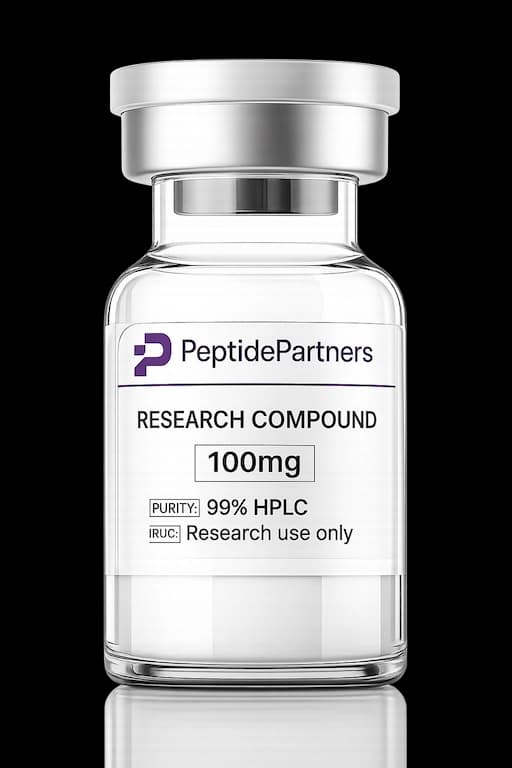
AOD-9604 (10mg vials)
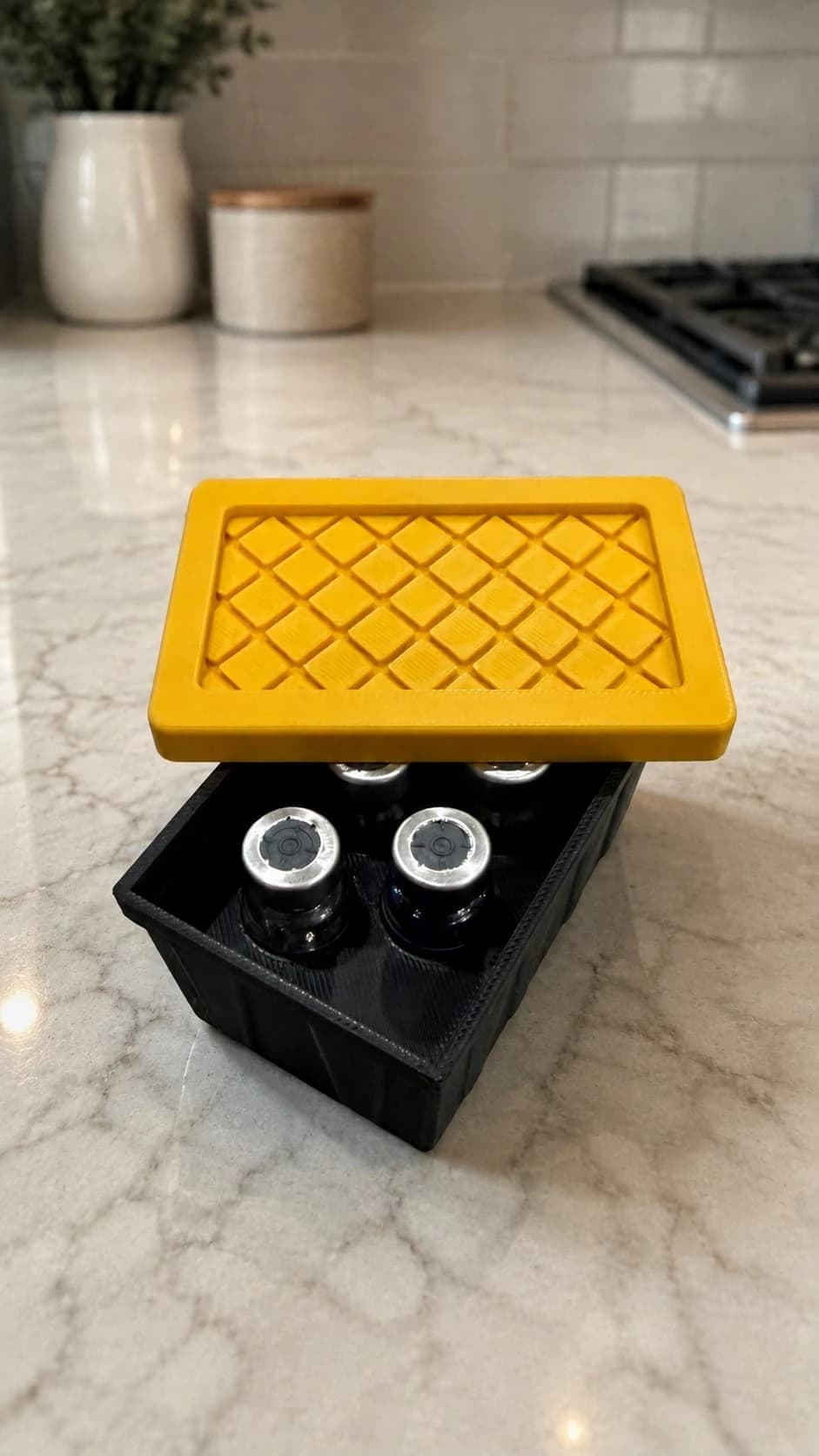
5-Vial Tote Case
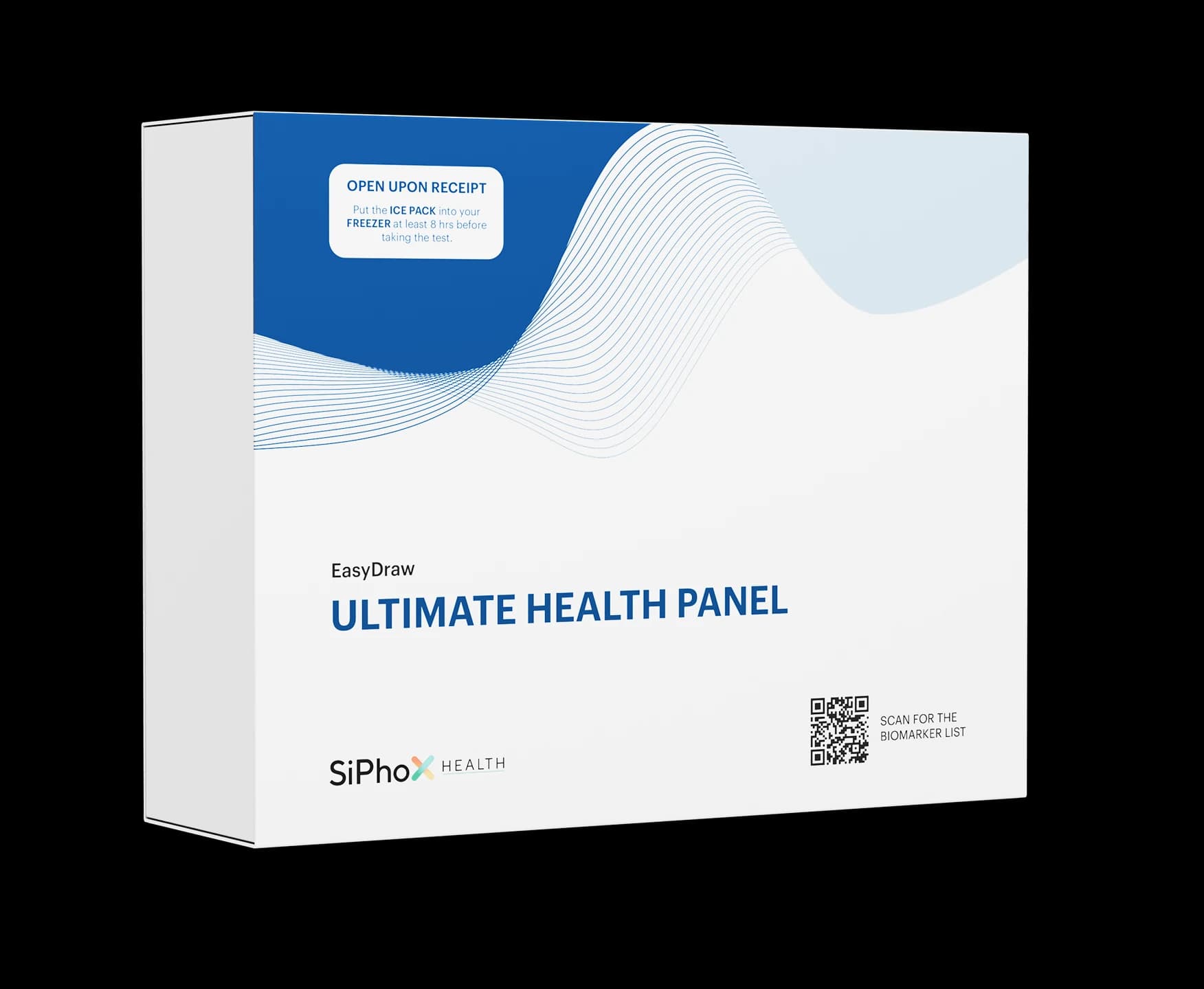
At-Home Blood Test
Research Supplies
Disclosure: supply links may earn PDP a commission at no cost to you.
Peptide Vials
5 mg AOD-9604 vials. The totals follow the community cycle examples shown above and are not clinical recommendations.
| Cycle length | Planning note |
|---|---|
8 weeks 5 vials | Covers a 4-week 300 mcg phase plus a 4-week 500 mcg phase. |
12 weeks 8 vials | Covers a 4-week 300 mcg phase plus 8 weeks at 500 mcg. |
16 weeks 11 vials | Covers a 4-week 300 mcg phase plus 12 weeks at 500 mcg. |
8 weeks
5 vials
Covers a 4-week 300 mcg phase plus a 4-week 500 mcg phase.
12 weeks
8 vials
Covers a 4-week 300 mcg phase plus 8 weeks at 500 mcg.
16 weeks
11 vials
Covers a 4-week 300 mcg phase plus 12 weeks at 500 mcg.
Insulin Syringes (U-100)
The community model uses one new U-100 syringe for each daily research draw.
| Cycle length | Planning note |
|---|---|
8 weeks 56 syringes | 1 syringe per day across 8 weeks. |
12 weeks 84 syringes | 1 syringe per day across 12 weeks. |
16 weeks 112 syringes | 1 syringe per day across 16 weeks. |
8 weeks
56 syringes
1 syringe per day across 8 weeks.
12 weeks
84 syringes
1 syringe per day across 12 weeks.
16 weeks
112 syringes
1 syringe per day across 16 weeks.
Bacteriostatic Water
The example math uses 3 mL per 5 mg vial. Ten-milliliter bottles are a common research-supply size.
| Cycle length | Planning note |
|---|---|
8 weeks 2 x 10 mL bottles | 5 vials use 15 mL total; the second bottle leaves a small margin. |
12 weeks 3 x 10 mL bottles | 8 vials use 24 mL total; the third bottle leaves a small margin. |
16 weeks 4 x 10 mL bottles | 11 vials use 33 mL total; the fourth bottle leaves a small margin. |
8 weeks
2 x 10 mL bottles
5 vials use 15 mL total; the second bottle leaves a small margin.
12 weeks
3 x 10 mL bottles
8 vials use 24 mL total; the third bottle leaves a small margin.
16 weeks
4 x 10 mL bottles
11 vials use 33 mL total; the fourth bottle leaves a small margin.
Round up for testing losses, damaged supplies, spills, and changes to the research plan. These totals explain community planning models and are not recommendations for human use.
Companion Supplies & Routine Support
What to Review During an AOD-9604 Research Cycle
A research timeline should have planned review points. Extending a cycle just because the calendar has not ended can make the plan harder to judge.
- 01
Set a baseline
Record the research question, starting measurements, route, concentration, storage conditions, and planned timeline before the first observation.
- 02
Review at week 4
Check for unexpected reactions, handling problems, missed observations, and whether the research plan is still being followed.
- 03
Review at week 8
Compare the current data with the baseline. Avoid changing several variables at once because that makes the result difficult to interpret.
- 04
Review at week 12
Decide whether the research question has been answered. A longer cycle should not be automatic when the data is unclear or unchanged.
- 05
Treat any extension as a new decision
A 16- or 24-week timeline adds more exposure but does not have proven added value for a subcutaneous schedule.
Simple cycle review framework
Review point
Baseline
What to check
Research goal, measurements, route, and materials
Reason
Creates a clear starting point
Review point
Week 4
What to check
Tolerance, handling, and protocol consistency
Reason
Finds early problems
Review point
Week 8
What to check
Trend compared with baseline
Reason
Tests whether the plan is producing useful data
Review point
Week 12
What to check
Full review of benefits, limits, and uncertainty
Reason
Prevents an automatic extension
Review point
Week 16 or later
What to check
Reason for continuing and remaining evidence gaps
Reason
Longer subcutaneous timelines are not clinically established
| Review point | What to check | Reason |
|---|---|---|
| Baseline | Research goal, measurements, route, and materials | Creates a clear starting point |
| Week 4 | Tolerance, handling, and protocol consistency | Finds early problems |
| Week 8 | Trend compared with baseline | Tests whether the plan is producing useful data |
| Week 12 | Full review of benefits, limits, and uncertainty | Prevents an automatic extension |
| Week 16 or later | Reason for continuing and remaining evidence gaps | Longer subcutaneous timelines are not clinically established |
When a Longer Cycle Is Not Supported
There is no published evidence showing that extending AOD-9604 beyond 12 or 16 weeks improves the outcome of a community subcutaneous plan. The largest oral trial already showed that a longer study did not guarantee a better result.
- Do not assume that no change means the amount should be raised.
- Do not assume that a 24-week oral study validates a 24-week injection plan.
- Do not carry a cycle past 24 weeks and describe it as research-backed.
- Do not combine several research compounds and then credit any change to AOD-9604.
- Do not ignore unexpected reactions in order to finish a planned timeline.
Current FDA concern
The FDA says compounded AOD-9604 may carry immunogenicity risks for some routes and may have problems linked to peptide impurities and product characterization. The agency also notes that safety information for proposed routes is limited.
Published Evidence vs Community Protocols
Where each AOD-9604 cycle claim comes from
Claim
AOD-9604 was studied for 12 weeks
Published human support
Yes, using oral doses
Community support
Often used as a community timeline
How it should be described
Published duration, but not a proven SubQ cycle
Claim
AOD-9604 was studied for 24 weeks
Published human support
Yes, using oral tablets
Community support
Sometimes used to justify longer plans
How it should be described
Published oral trial; efficacy goal was not met
Claim
300–500 mcg per day
Published human support
No controlled human SubQ study
Community support
Commonly reported
How it should be described
Community research amount
Claim
Start at 300 mcg and increase after four weeks
Published human support
No
Community support
Commonly reported
How it should be described
Anecdotal step-up model
Claim
8- or 16-week SubQ cycle
Published human support
No
Community support
Commonly reported
How it should be described
Community timeline only
Claim
Use beyond 24 weeks
Published human support
No
Community support
Scattered reports
How it should be described
Unsupported by published long-term evidence
| Claim | Published human support | Community support | How it should be described |
|---|---|---|---|
| AOD-9604 was studied for 12 weeks | Yes, using oral doses | Often used as a community timeline | Published duration, but not a proven SubQ cycle |
| AOD-9604 was studied for 24 weeks | Yes, using oral tablets | Sometimes used to justify longer plans | Published oral trial; efficacy goal was not met |
| 300–500 mcg per day | No controlled human SubQ study | Commonly reported | Community research amount |
| Start at 300 mcg and increase after four weeks | No | Commonly reported | Anecdotal step-up model |
| 8- or 16-week SubQ cycle | No | Commonly reported | Community timeline only |
| Use beyond 24 weeks | No | Scattered reports | Unsupported by published long-term evidence |
AOD-9604 is not an FDA-approved drug. An FDA warning letter states that AOD-9604 is not a component of an FDA-approved human drug. FDA’s current compounding information also lists specific safety and quality concerns.
Community protocols can be useful for understanding real-world research discussions. They should still be labeled as anecdotal and kept separate from published trial designs.
Cycle Guide vs Dosage Guide
Use this cycle guide for
8-, 12-, 16-, and 24-week timelines, published trial durations, community cycle models, review points, and total vial planning.
Use the protocol guide for
Daily dosage context, reconstitution, BAC water amounts, syringe units, storage, side effects, and regulatory details.
Keeping these topics separate helps avoid mixing cycle length with dose calculations. The protocol page gives the basic cycle answer, while this page covers timeline planning in more detail.
AOD-9604 Cycle Questions
Q1: How long is an AOD-9604 cycle?
Published oral AOD-9604 trials lasted 12 or 24 weeks. Community subcutaneous plans often last 8 to 16 weeks, but those schedules are anecdotal and have not been tested in controlled human studies.
Q2: Is an 8-week AOD-9604 cycle supported by clinical research?
No controlled human trial tested an eight-week subcutaneous AOD-9604 cycle. Eight weeks is a community research timeline, not a clinically proven protocol.
Q3: Was AOD-9604 studied for 12 weeks?
Yes. METAOD005 tested oral AOD-9604 for 12 weeks in 300 adults with obesity. The trial used oral milligram doses, not the subcutaneous microgram schedules discussed in current research communities.
Q4: Was AOD-9604 studied for 24 weeks?
Yes. METAOD006 tested oral AOD-9604 for 24 weeks. The study did not meet its main weight-loss goal, and the results do not validate a 24-week subcutaneous cycle.
Q5: What is the common community AOD-9604 cycle?
A common community model uses 300 mcg per day for four weeks, followed by 500 mcg per day for the rest of an 8- to 16-week timeline. This schedule is anecdotal and is not a recommendation for human use.
Q6: How many 5 mg vials are used in an 8-week community cycle?
The example schedule on this page totals 22.4 mg across eight weeks. That equals five 5 mg vials after rounding up, but this is supply math for an anecdotal research model.
Q7: How many 5 mg vials are used in a 12-week community cycle?
The example schedule totals 36.4 mg across 12 weeks. That equals eight 5 mg vials after rounding up.
Q8: How many 5 mg vials are used in a 16-week community cycle?
The example schedule totals 50.4 mg across 16 weeks. That equals eleven 5 mg vials after rounding up.
Q9: Does a longer AOD-9604 cycle work better?
There is no published evidence showing that a longer subcutaneous cycle works better. The largest 24-week oral trial did not show enough benefit compared with placebo.
Q10: Can oral trial doses be converted into injection doses?
No. Oral milligram doses and subcutaneous microgram amounts are not directly equal. The routes have different absorption, and human subcutaneous pharmacokinetic data is not available.
Q11: Can AOD-9604 be combined with other research peptides?
Community discussions sometimes combine AOD-9604 with other compounds, but controlled human trials have not tested those combinations. A combined cycle makes it harder to tell which compound caused a change.
Q12: Is AOD-9604 FDA-approved?
No. AOD-9604 is not an FDA-approved drug for any therapeutic use. FDA has also published safety and quality concerns about compounded AOD-9604.
References
- 1. Stier H, Vos E, Kenley D Safety and Tolerability of the Hexadecapeptide AOD9604 in Humans Journal of Endocrinology and Metabolism (2013)
- 2. Valentino MA, Lin JE, Waldman SA Central and Peripheral Molecular Targets for Anti-Obesity Pharmacotherapy Clinical Pharmacology & Therapeutics (2010)
- 3. Misra M Obesity Pharmacotherapy: Current Perspectives and Future Directions Current Cardiology Reviews (2013)
- 4. Witkamp RF Current and Future Drug Targets in Weight Management Pharmaceutical Research (2011)
- 5. Heffernan M, Summers RJ, Thorburn A, et al. The Effects of Human GH and Its Lipolytic Fragment AOD9604 on Lipid Metabolism Following Chronic Treatment in Obese Mice and Beta-3-AR Knockout Mice Endocrinology (2001)
- 6. Ng FM, Sun J, Sharma L, et al. Metabolic Studies of a Synthetic Lipolytic Domain AOD9604 of Human Growth Hormone Hormone Research (2000)
- 7. December 4, 2024 Pharmacy Compounding Advisory Committee Meeting U.S. Food and Drug Administration (2024)
- 8. Certain Bulk Drug Substances for Use in Compounding That May Present Significant Safety Risks U.S. Food and Drug Administration (2026)
- 9. Tailor Made Compounding LLC Warning Letter U.S. Food and Drug Administration (2020)
Related Dosing Protocols
Educational use only
Peptide Dosing Protocols is an independent educational reference. Nothing here is medical advice or a recommendation for human use. AOD-9604 is not FDA-approved for any therapeutic use. Published oral and intravenous research must not be treated as proof for community subcutaneous schedules. Consult a licensed healthcare provider before considering any compound.
Review the Full AOD-9604 Protocol
See the main protocol page for daily dosage context, reconstitution tables, syringe-unit math, storage details, safety findings, and regulatory information.

Written by Garret Grant
Founder & Lead Researcher · B.S. Civil Engineering, UCLA
Last updated: July 2026
Human-researched and AI-assisted with full editorial review. I verify sources, protocol interpretation, and final judgments personally. See methodology.
Share this page