
GLOW Stack Quick Start
GLOW is a three-peptide repair-plus-remodeling stack that combines BPC-157, TB-500, and GHK-Cu. BPC-157 and TB-500 cover the tissue-repair foundation, while GHK-Cu adds collagen, elastin, and extracellular-matrix support for skin and connective-tissue quality.
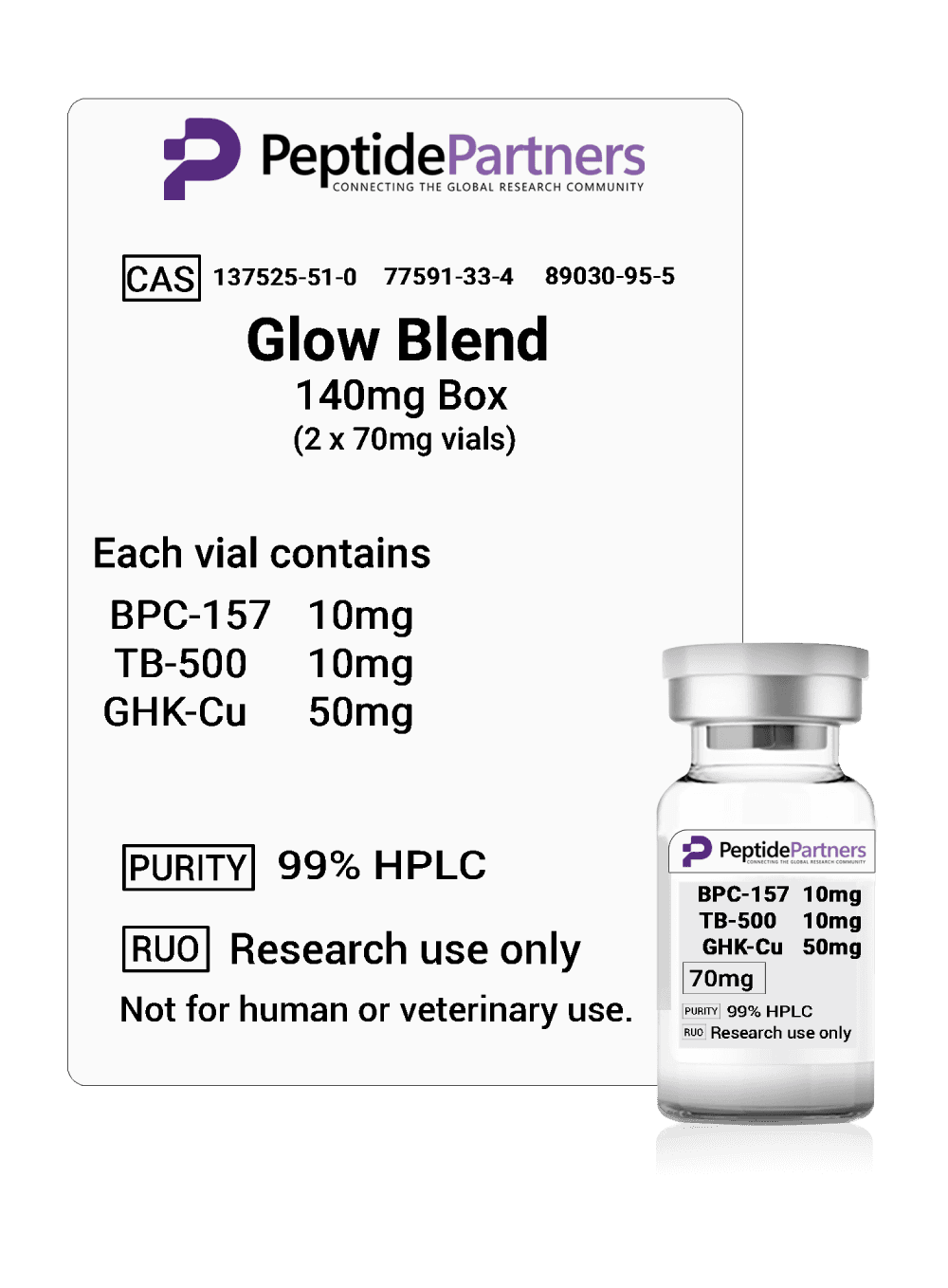
The simplest version uses a pre-blended 70 mg vial with a 50/10/10 ratio: 50 mg GHK-Cu, 10 mg TB-500, and 10 mg BPC-157. That makes the blend convenience-first and GHK-Cu dominant, with one daily draw instead of separate compound math.
Reconstitute
Add 3.0 mL bacteriostatic water to the 70 mg GLOW blend -> about 23.3 mg/mL total blend concentration.
Research schedule
Common blended-vial planning uses 10 units once daily, usually for 4-8 weeks depending on the research workflow.
Easy measuring
At 3.0 mL reconstitution, 10 units = 0.10 mL = about 2.33 mg total blend.
Supplies
Plan roughly 1 vial for 4 weeks, 2 vials for 6-8 weeks, and 3 vials for 12 weeks.
Research status
BPC-157, TB-500, and injectable GHK-Cu are not FDA-approved for this use, and no clinical trial has evaluated the three-peptide combination.
Disclaimer
BPC-157, TB-500, and GHK-Cu are not FDA-approved for injection. No clinical trials have evaluated the three-peptide combination. This page is an educational research reference and is not medical advice.
GLOW Stack Dosing Protocol & Schedule
GLOW Stack Dosing Guide
Choose the vial format you are using to see the matching instructions.
The pre-blended 50/10/10 GLOW vial is the simplest way to run this stack: one vial, one daily draw, and no separate compound math.
Blend ratio
50 / 10 / 10 mg
GHK-Cu dominant
70 mg total per vial: 50 mg GHK-Cu, 10 mg TB-500, and 10 mg BPC-157.
Reconstitute
3 mL BAC water
Concentration
23.3 mg/mL total blend
Daily draw
10 units = about 2.33 mg total
Typical cycle
4-6 weeks
Dose selector
Component Delivery
| GHK-Cu | 1.67 mg |
|---|---|
| BPC-157 | 0.33 mg |
| TB-500 | 0.33 mg |
The 50/10/10 blend prioritizes convenience and skin/remodeling goals more than TB-500-heavy injury protocols.
Separate vials allow independent dose control. This format requires more injections per session but lets each compound be adjusted to the protocol goal.
Separate-vial workflow
Independent dose control
Use separate vials when you want to adjust BPC-157, TB-500, and GHK-Cu independently or keep BPC-157 targeted near an injury site.
Injection burden
1-3 injections/session
Best for
Dose flexibility
Cycle driver
GHK-Cu cycling
BPC-157
- Loading
- 250-500 mcg
- Frequency
- Daily
- Maintenance
- 250 mcg
- Route
- SubQ
TB-500
- Loading
- 2.5-5 mg
- Frequency
- 2x/week
- Maintenance
- 2 mg
- Route
- SubQ
GHK-Cu
- Loading
- 1-2 mg
- Frequency
- Daily
- Maintenance
- 1 mg
- Route
- SubQ
Weekly Schedule Example
Monday
BPC-157 500 mcg + TB-500 2.5 mg + GHK-Cu 1-2 mg
Tuesday-Wednesday
BPC-157 500 mcg + GHK-Cu 1-2 mg
Thursday
BPC-157 500 mcg + TB-500 2.5 mg + GHK-Cu 1-2 mg
Friday-Sunday
BPC-157 500 mcg + GHK-Cu 1-2 mg
Use separate syringes for separate-vial compounds. Do not mix them in one syringe.
Cycle Guidelines
Approach
Standard
Duration
4-6 weeks
Off Period
2-4 weeks
Best For
Skin + general healing
Approach
Extended
Duration
8-12 weeks
Off Period
4-8 weeks
Best For
Complex recovery
Approach
Skin-focused blend
Duration
4 weeks
Off Period
2-4 weeks
Best For
Anti-aging priority
| Approach | Duration | Off Period | Best For |
|---|---|---|---|
| Standard | 4-6 weeks | 2-4 weeks | Skin + general healing |
| Extended | 8-12 weeks | 4-8 weeks | Complex recovery |
| Skin-focused blend | 4 weeks | 2-4 weeks | Anti-aging priority |
GLOW Stack Supplies Needed
Plan based on the pre-blended GLOW schedule above: 10 units daily from a 70 mg vial reconstituted with 3.0 mL BAC water.
Recommended Supply
PEPPAL applies to eligible supplier checkout links, including Peptide Partners.
Peptide Vials
GLOW Blend, 70 mg total per vial: 50 mg GHK-Cu + 10 mg TB-500 + 10 mg BPC-157.
| Cycle length | Planning note |
|---|---|
4 weeks 1 vial | 28 doses needed; one 3 mL vial provides about 30 daily doses |
6-8 weeks 2 vials | 6 weeks: 42 doses needed; two vials provide about 60 daily doses; 8 weeks: 56 doses needed; two vials provide about 60 daily doses |
12 weeks 3 vials | 84 doses needed; three vials provide about 90 daily doses |
4 weeks
1 vial
28 doses needed; one 3 mL vial provides about 30 daily doses
6-8 weeks
2 vials
6 weeks: 42 doses needed; two vials provide about 60 daily doses; 8 weeks: 56 doses needed; two vials provide about 60 daily doses
12 weeks
3 vials
84 doses needed; three vials provide about 90 daily doses
Insulin Syringes (U-100)
Prefer 0.3 mL / 30-unit syringes for smaller daily draws.
| Cycle length | Planning note |
|---|---|
4 weeks 28 syringes | 1 syringe per day |
6 weeks 42 syringes | 1 syringe per day |
8 weeks 56 syringes | 1 syringe per day |
12 weeks 84 syringes | 1 syringe per day |
4 weeks
28 syringes
1 syringe per day
6 weeks
42 syringes
1 syringe per day
8 weeks
56 syringes
1 syringe per day
12 weeks
84 syringes
1 syringe per day
Bacteriostatic Water
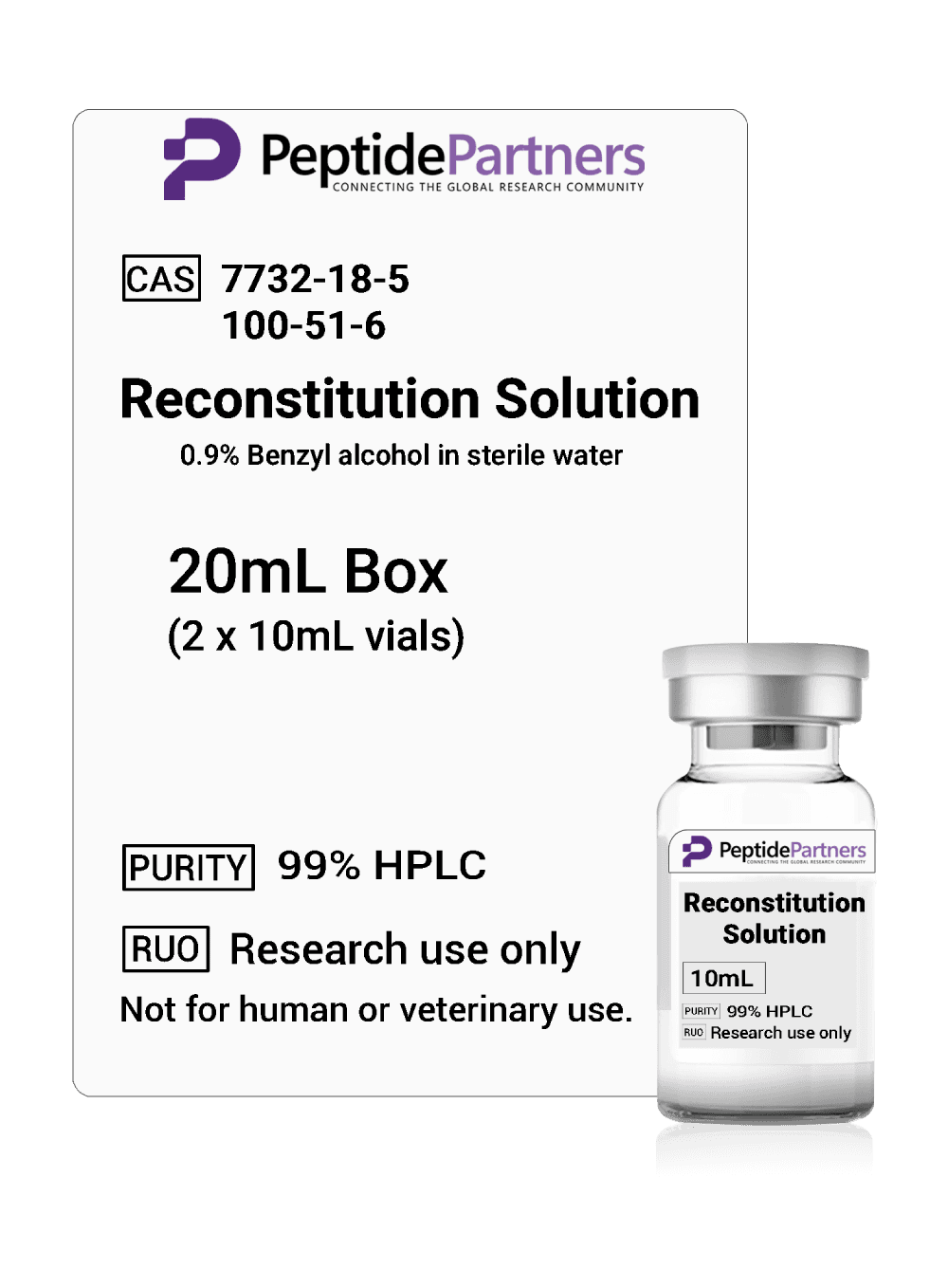
Use 3.0 mL per 70 mg blend vial for reconstitution.
| Cycle length | Planning note |
|---|---|
4-8 weeks 1 x 10 mL bottle | 4 weeks: 1 vial uses 3 mL total; 6 weeks: 2 vials use 6 mL total; 8 weeks: 2 vials use 6 mL total |
12 weeks 1-2 x 10 mL bottles | 3 vials use 9 mL total; a second bottle gives margin |
4-8 weeks
1 x 10 mL bottle
4 weeks: 1 vial uses 3 mL total; 6 weeks: 2 vials use 6 mL total; 8 weeks: 2 vials use 6 mL total
12 weeks
1-2 x 10 mL bottles
3 vials use 9 mL total; a second bottle gives margin
Alcohol Swabs
Use one swab for the vial stopper and one for the injection site each day.
| Cycle length | Planning note |
|---|---|
4 weeks 56 swabs | 2 per day; recommend 1 x 100-count box |
6 weeks 84 swabs | 2 per day; recommend 1 x 100-count box |
8 weeks 112 swabs | 2 per day; recommend 2 x 100-count boxes |
12 weeks 168 swabs | 2 per day; recommend 2 x 100-count boxes |
4 weeks
56 swabs
2 per day; recommend 1 x 100-count box
6 weeks
84 swabs
2 per day; recommend 1 x 100-count box
8 weeks
112 swabs
2 per day; recommend 2 x 100-count boxes
12 weeks
168 swabs
2 per day; recommend 2 x 100-count boxes
Round up for priming losses, dropped syringes, damaged swabs, and any protocol adjustments.
GLOW Stack Reconstitution Guide
Reconstitution Format Options
Choose the vial format you are using to see the matching reconstitution math.
The standard 70 mg 5:1:1 GLOW blend comes as a single vial and is reconstituted once.
Pre-blended GLOW vial
70 mg total
3 mL BAC water
One 70 mg vial contains 50 mg GHK-Cu, 10 mg TB-500, and 10 mg BPC-157. Reconstitute once, then draw the blended solution.
BAC water added
3 mL
Total concentration
23.3 mg/mL
10-unit draw
0.10 mL
Total per 10 units
About 2.33 mg
Reconstitution math
| GHK-Cu at 10 units | About 1.67 mg |
|---|---|
| TB-500 at 10 units | About 0.33 mg |
| BPC-157 at 10 units | About 0.33 mg |
Independent reconstitution of BPC-157, TB-500, and GHK-Cu allows maximum dosing flexibility.
Each GLOW Stack compound is reconstituted separately. BPC-157 doses are in micrograms, while TB-500 and GHK-Cu doses are in milligrams. Double-check units before drawing.
Separate-Vial Reconstitution Math
Compound
BPC-157
Vial
5 mg
BAC Water
2 mL
Concentration
2,500 mcg/mL
Common Draw
250 mcg = 10 units; 500 mcg = 20 units
Compound
BPC-157
Vial
10 mg
BAC Water
2 mL
Concentration
5,000 mcg/mL
Common Draw
250 mcg = 5 units; 500 mcg = 10 units
Compound
TB-500
Vial
5 mg
BAC Water
1 mL
Concentration
5 mg/mL
Common Draw
2.5 mg = 50 units; 5 mg = 100 units
Compound
TB-500
Vial
10 mg
BAC Water
2 mL
Concentration
5 mg/mL
Common Draw
2.5 mg = 50 units; 5 mg = 100 units
Compound
GHK-Cu
Vial
50 mg
BAC Water
5 mL
Concentration
10 mg/mL
Common Draw
1 mg = 10 units; 2 mg = 20 units
Compound
GHK-Cu
Vial
100 mg
BAC Water
10 mL
Concentration
10 mg/mL
Common Draw
1 mg = 10 units; 2 mg = 20 units
| Compound | Vial | BAC Water | Concentration | Common Draw |
|---|---|---|---|---|
| BPC-157 | 5 mg | 2 mL | 2,500 mcg/mL | 250 mcg = 10 units; 500 mcg = 20 units |
| BPC-157 | 10 mg | 2 mL | 5,000 mcg/mL | 250 mcg = 5 units; 500 mcg = 10 units |
| TB-500 | 5 mg | 1 mL | 5 mg/mL | 2.5 mg = 50 units; 5 mg = 100 units |
| TB-500 | 10 mg | 2 mL | 5 mg/mL | 2.5 mg = 50 units; 5 mg = 100 units |
| GHK-Cu | 50 mg | 5 mL | 10 mg/mL | 1 mg = 10 units; 2 mg = 20 units |
| GHK-Cu | 100 mg | 10 mL | 10 mg/mL | 1 mg = 10 units; 2 mg = 20 units |
Use separate sterile syringes for each separate-vial compound. Do not combine separate-vial compounds in one syringe.
Standard 7-Step Reconstitution
- Wipe stopper with alcohol and allow to dry.
- Draw BAC water volume into a sterile syringe.
- Direct water against the vial wall, not onto powder.
- Allow gentle flow down the glass.
- Roll 30-60 seconds; do not shake.
- Inspect for expected clarity and color.
- Label and refrigerate at 35.6-46.4F (2-8C).
Calculator
Use the Peptide Reconstitution Calculator for three-vial GLOW math.
Why the GLOW Stack Adds GHK-Cu to Wolverine
Foundation: Wolverine (BPC-157 + TB-500)
The Wolverine Stack already provides two things the body needs after an injury: blood flow to the damaged area through BPC-157 and repair-cell migration support through TB-500. GLOW keeps both pathways and adds a third.
Quality Layer: GHK-Cu
GHK-Cu is the reason this stack exists as a separate protocol. It uses copper to stimulate collagen and elastin production - the structural proteins that give skin firmness and connective tissue strength. It also influences extracellular-matrix remodeling and gene-expression patterns tied to tissue quality.
Anti-Inflammatory Convergence
All three peptides are discussed in inflammation contexts, but they do not work through the exact same pathway. Running them together creates overlapping coverage that may support a more favorable repair environment.
Anti-Fibrotic Convergence
When tissue heals, the body can over-produce scar tissue. TB-500 and GHK-Cu are often discussed together because TB-500 supports connective-tissue organization while GHK-Cu is tied to matrix turnover and replacement.
GLOW Stack Side Effects & Safety
Each of the three GLOW Stack peptides has a generally favorable safety profile in individual research, but no clinical trial has tested them as a combined stack.
What to Watch For
- Blood vessel growth effects may overlap. BPC-157 and TB-500 both appear in angiogenesis discussions.
- GHK-Cu adds copper exposure. This is why cycling and off-periods matter.
- Three compounds means three quality-control risks. Every additional peptide adds another sourcing and handling variable.
- Common reports include injection-site irritation, short-term fatigue, and occasional mild headache.
When to Reassess
If injection-site reactions worsen, fatigue persists beyond the loading phase, or unusual symptoms appear, pause the protocol and consult a healthcare provider.
GLOW Stack Clinical Evidence Context
Critical Note
No published studies evaluate BPC-157 + TB-500 + GHK-Cu as a combined stack.
BPC-157
Most evidence comes from animal and lab-based studies, with ongoing debate around translation to humans.
TB-500 / Thymosin beta-4
There is some human safety and early-stage clinical context, but injectable research protocols remain limited.
GHK-Cu
GHK-Cu has topical and molecular research support tied to collagen, skin quality, and gene-expression pathways.
The reason researchers combine these three comes down to coverage: BPC-157 supports blood-vessel formation at the repair site, TB-500 supports repair-cell movement, and GHK-Cu supports the quality of tissue that gets rebuilt.
GLOW Stack Storage & Handling
Lyophilized (Powder Form)
BPC-157
-4F (-20C) long-term
TB-500
-4F (-20C) long-term
GHK-Cu
-4F (-20C) long-term
Reconstituted (Liquid Form)
BPC-157
35.6-46.4F (2-8C)
TB-500
35.6-46.4F (2-8C)
GHK-Cu
35.6-46.4F (2-8C)
Appearance
BPC-157
Clear
TB-500
Clear
GHK-Cu
May be light blue/green
| BPC-157 | TB-500 | GHK-Cu | |
|---|---|---|---|
| Lyophilized (Powder Form) | -4F (-20C) long-term | -4F (-20C) long-term | -4F (-20C) long-term |
| Reconstituted (Liquid Form) | 35.6-46.4F (2-8C) | 35.6-46.4F (2-8C) | 35.6-46.4F (2-8C) |
| Appearance | Clear | Clear | May be light blue/green |
GLOW vs Wolverine vs Individual Peptides
Choose GLOW if skin quality matters alongside repair, Wolverine if you want a simpler injury-focused protocol, or an individual peptide if the goal is narrow and specific.
Feature
Mechanisms
GLOW
Repair + migration + collagen remodeling
Wolverine
Repair + migration
BPC-157
Local repair
TB-500
Systemic migration
GHK-Cu
Collagen/ECM quality
Feature
Skin/Anti-Aging
GLOW
Excellent
Wolverine
Moderate
BPC-157
Low
TB-500
Low
GHK-Cu
Excellent
Feature
Injury Repair
GLOW
Excellent
Wolverine
Excellent
BPC-157
Good
TB-500
Good
GHK-Cu
Moderate
Feature
Complexity
GLOW
High
Wolverine
Moderate
BPC-157
Low
TB-500
Low
GHK-Cu
Low
Feature
Cost
GLOW
Highest
Wolverine
Moderate
BPC-157
Lower
TB-500
Lower
GHK-Cu
Lower
| Feature | GLOW | Wolverine | BPC-157 | TB-500 | GHK-Cu |
|---|---|---|---|---|---|
| Mechanisms | Repair + migration + collagen remodeling | Repair + migration | Local repair | Systemic migration | Collagen/ECM quality |
| Skin/Anti-Aging | Excellent | Moderate | Low | Low | Excellent |
| Injury Repair | Excellent | Excellent | Good | Good | Moderate |
| Complexity | High | Moderate | Low | Low | Low |
| Cost | Highest | Moderate | Lower | Lower | Lower |
FAQ
Q1: What is the GLOW Stack?
The GLOW Stack combines BPC-157 Protocol, TB-500 Protocol, and GHK-Cu Protocol to pair tissue-repair pathways with collagen and matrix-quality remodeling.
Q2: How do you dose the GLOW Stack?
Typical separate-vial dosing is BPC-157 daily, TB-500 twice weekly, and GHK-Cu daily, with cycle length often governed by GHK-Cu cycling.
Q3: What is the 5:1:1 ratio in the GLOW blend?
It is the common pre-blend weight ratio of GHK-Cu : TB-500 : BPC-157, which makes the GLOW blend GHK-Cu dominant.
Q4: How does GLOW differ from Wolverine?
GLOW adds GHK-Cu Protocol to the Wolverine Stack, introducing a dedicated tissue-quality and collagen-remodeling layer.
Q5: How do you reconstitute three separate peptides for the GLOW Stack?
Each peptide is reconstituted separately with BAC water directed against the vial wall. Unit handling matters most: BPC-157 is dosed in mcg, while TB-500 and GHK-Cu are dosed in mg. Label each vial and account for TB-500's shorter 1-2 week stability window. For syringe math, use the PepPal Reconstitution Calculator.
Q6: What results can be expected from the GLOW Stack?
Community reporting generally places early inflammation and pain improvements in 1-2 weeks, visible skin-quality improvements in 2-4 weeks, and deeper remodeling over 4-8+ weeks, especially from the GHK-Cu portion of the stack.
Q7: Is the GLOW Stack safe?
Individual peptide safety profiles are generally favorable, but no trial has evaluated the triple combination. Key considerations are combined angiogenic signaling, copper cycling requirements from GHK-Cu, and supplier quality controls when sourcing a pre-blended GLOW product or separate vials.
Q8: How long should you run the GLOW Stack?
Common planning is 4-6 weeks on with 2-4 weeks off, with extended options in selected cases. GHK-Cu cycling requirements usually set the overall cycle length.
Q9: Should you use a pre-blended GLOW vial or separate vials?
Separate vials provide dose flexibility and are usually preferred for injury-focused workflows; a pre-blended GLOW vial prioritizes convenience and skin-focused use cases. If you want independent control, run BPC-157, TB-500, and GHK-Cu as separate products.
Q10: Can you inject all three peptides at the same time?
Yes. All three can be used in the same session, but separate syringes are preferred for separate-vial workflows with BPC-157, TB-500, and GHK-Cu.
Q11: Does the GLOW Stack help with skin anti-aging?
Yes. This is a primary reason people use GLOW, mainly due to the GHK-Cu Protocol component and its collagen/remodeling role.
Q12: Can you add KPV to the GLOW Stack?
Yes. The four-peptide extension is often called KLOW for inflammation-heavy contexts and adds the KPV Protocol.
Q13: What calculator should I use?
Use the PepPal calculator.
Q14: Is this medical advice?
No. This is an educational research reference.
Sources & Research
- 1. Vasireddi N, et al. Emerging Use of BPC-157 in Orthopaedic Sports Medicine: A Systematic Review. Orthopaedic Journal of Sports Medicine (2025)
- 2. Ruff D, et al. A randomized, placebo-controlled, single and multiple dose study of intravenous thymosin beta4 in healthy volunteers. Annals of the New York Academy of Sciences (2010)
- 3. Pickart L, Margolina A. Regenerative and Protective Actions of the GHK-Cu Peptide in the Light of the New Gene Data. International Journal of Molecular Sciences (2018)
- 4. Bock-Marquette I, et al. Thymosin beta4 activates integrin-linked kinase and promotes cardiac cell migration, survival and cardiac repair. Nature (2004)
- 5. Smart N, et al. Thymosin beta4 induces adult epicardial progenitor mobilization and neovascularization. Nature (2007)
- 6. Pickart L, et al. GHK Peptide as a Natural Modulator of Multiple Cellular Pathways in Skin Regeneration. BioMed Research International (2015)
- 7. Yuvan Research / McGill University Epigenetic mechanisms activated by GHK-Cu increase skin collagen density in clinical trial. EurekAlert (2024)
- 8. Ehrlich HP, Hazard SW. Thymosin beta4 enhances repair by organizing connective tissue and preventing the appearance of myofibroblasts. Annals of the New York Academy of Sciences (2010)
- 9. Gwyer D, et al. Gastric pentadecapeptide BPC 157 and its role in accelerating musculoskeletal soft tissue healing. Cell and Tissue Research (2019)
- 10. Philp D, et al. Thymosin beta4 promotes angiogenesis, wound healing, and hair growth. FASEB Journal (2004)
- 11. Sikiric P, et al. The Stable Gastric Pentadecapeptide BPC 157 Pleiotropic Beneficial Activity. Pharmaceuticals (2024)
- 12. Broad Institute Connectivity Map Gene expression analysis of GHK-Cu. CLUE (2024)
Related Dosing Protocols

Written by Garret Grant
Founder & Lead Researcher · B.S. Civil Engineering, UCLA
Last updated: May 2026
Human-researched and AI-assisted with full editorial review. I verify sources, protocol interpretation, and final judgments personally. See methodology.
Share this page