
How Long Is a Wolverine Stack Cycle?
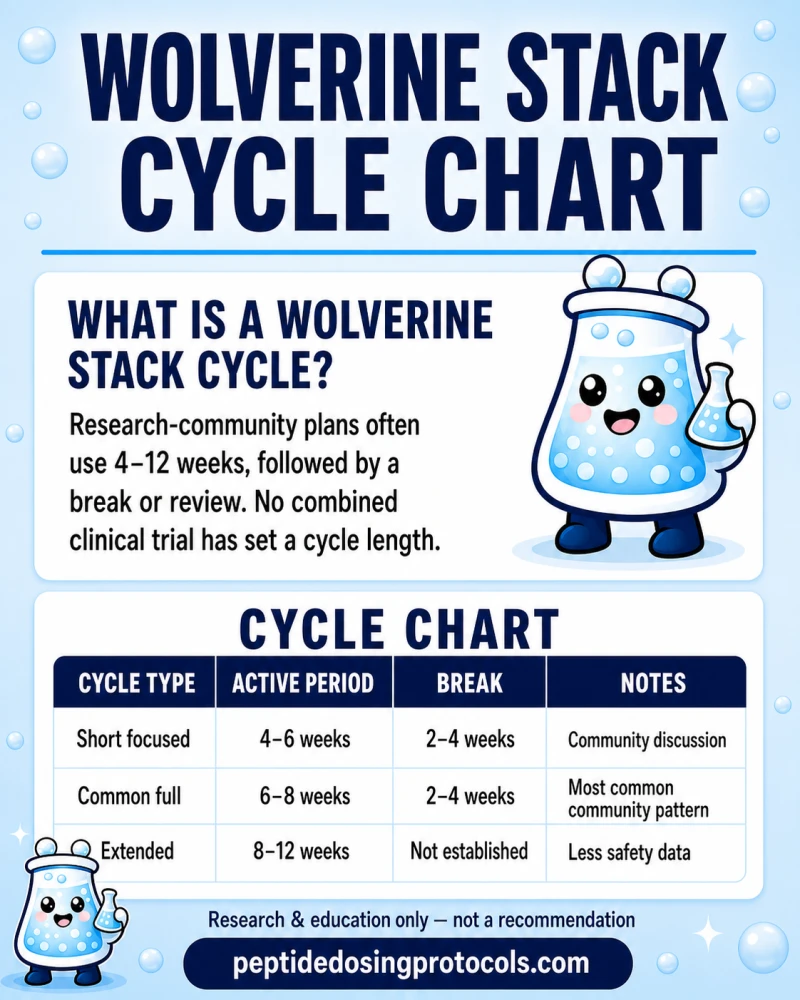
The most common community answer is 6 to 8 weeks. Some schedules stop after 4 to 6 weeks, while extended plans may run for 8 to 12 weeks. These are community patterns, not tested medical protocols.
Direct answer
A typical Wolverine Stack cycle is often described as 6–8 weeks, with the first 4 weeks treated as a loading phase and later weeks treated as maintenance. No published trial has proven that this timing is safe or effective.
No clinically proven cycle exists
No human clinical trial has tested BPC-157 and TB-500 together. The cycle lengths on this page come from common research-community schedules and should not be treated as medical guidance.
Wolverine Stack Cycle Length Chart
Community schedules usually fall into four broad ranges. A longer cycle does not mean better results, and it also creates more time for unknown risks to matter.
Common community Wolverine Stack cycle lengths
These ranges are anecdotal research conventions, not approved treatment schedules.
Cycle length
4–6 weeks
How it is usually described
Short focused cycle or early loading-only plan
Evidence note
Common in community discussions; not tested as a combined clinical protocol
Cycle length
6–8 weeks
How it is usually described
Most common full cycle with loading and maintenance phases
Evidence note
Community standard; no controlled human trial
Cycle length
8–12 weeks
How it is usually described
Extended plan for slower or longer research timelines
Evidence note
Less consistent and supported by even less safety data
Cycle length
More than 12 weeks
How it is usually described
Long-term or repeated use
Evidence note
No established human safety basis for the combined stack
| Cycle length | How it is usually described | Evidence note |
|---|---|---|
| 4–6 weeks | Short focused cycle or early loading-only plan | Common in community discussions; not tested as a combined clinical protocol |
| 6–8 weeks | Most common full cycle with loading and maintenance phases | Community standard; no controlled human trial |
| 8–12 weeks | Extended plan for slower or longer research timelines | Less consistent and supported by even less safety data |
| More than 12 weeks | Long-term or repeated use | No established human safety basis for the combined stack |
The calendar alone cannot show whether tissue has recovered or whether continued exposure is safe.
Loading and Maintenance Phases
The words loading and maintenance come from community use. They do not come from a Wolverine Stack clinical trial. The terms describe how frequency may change during a cycle.
Common community phase structure
Phase
Loading phase
Typical timing
Weeks 1–4
Community description
The highest-frequency part of the plan. Separate-vial schedules often use daily BPC-157 and less frequent TB-500.
Phase
Maintenance phase
Typical timing
Weeks 5–8
Community description
BPC-157 may stay on a daily schedule while TB-500 frequency is often reduced.
Phase
Extended phase
Typical timing
Weeks 9–12
Community description
Some community plans continue a lower-frequency pattern, but evidence for this extension is weak.
Phase
Off-cycle period
Typical timing
After the active cycle
Community description
Community plans often include time without either compound, but no validated washout period exists.
| Phase | Typical timing | Community description |
|---|---|---|
| Loading phase | Weeks 1–4 | The highest-frequency part of the plan. Separate-vial schedules often use daily BPC-157 and less frequent TB-500. |
| Maintenance phase | Weeks 5–8 | BPC-157 may stay on a daily schedule while TB-500 frequency is often reduced. |
| Extended phase | Weeks 9–12 | Some community plans continue a lower-frequency pattern, but evidence for this extension is weak. |
| Off-cycle period | After the active cycle | Community plans often include time without either compound, but no validated washout period exists. |
For exact blend math and separate-vial dose examples, use the full Wolverine Stack dosing guide.
A phase change should not be read as proof that a compound has started working. There are no validated blood tests, scans, or symptom timelines that confirm a Wolverine Stack response.
Pre-Blended vs Separate-Vial Cycles
A pre-blended vial fixes BPC-157 and TB-500 into one ratio. Separate vials allow each compound to follow its own schedule. This changes the cycle structure even when both plans last the same number of weeks.
How vial format changes cycle planning
Format
Pre-blended 1:1 vial
Common schedule pattern
One combined draw on a regular schedule across the cycle
Main limitation
The dose ratio stays fixed, so one compound cannot be changed without changing the other
Format
Separate BPC-157 and TB-500 vials
Common schedule pattern
Daily BPC-157 with less frequent TB-500, often followed by a lower-frequency phase
Main limitation
More complex math and more chances for schedule errors
| Format | Common schedule pattern | Main limitation |
|---|---|---|
| Pre-blended 1:1 vial | One combined draw on a regular schedule across the cycle | The dose ratio stays fixed, so one compound cannot be changed without changing the other |
| Separate BPC-157 and TB-500 vials | Daily BPC-157 with less frequent TB-500, often followed by a lower-frequency phase | More complex math and more chances for schedule errors |
The page on BPC-157 dosing and the page on TB-500 dosing explain the individual compounds in more detail.
Cycle length and dose frequency are different
A cycle may last 8 weeks even when one compound is discussed daily and the other is discussed once or twice per week. When compounds follow different schedules, a peptide cycle tracker can help keep the timing and notes together. Do not use the total cycle length as a shortcut for dose math.
Wolverine Stack Cycle Supplies Needed
These supply examples use a pre-blended 20 mg Wolverine vial with 10 mg BPC-157 and 10 mg TB-500. The planning example uses 1 mg of total blend per day, so one vial provides about 20 daily draws. These totals are community research references, not a recommended schedule.
Recommended U.S. and Canada Supply
Choose your region
Use discount code PEPPAL at Peptide Partners checkout. See why we love Peptide Partners.
Combo Vial: BPC-157/TB-500 (20mg vials)
Pharmacy Grade Wolverine
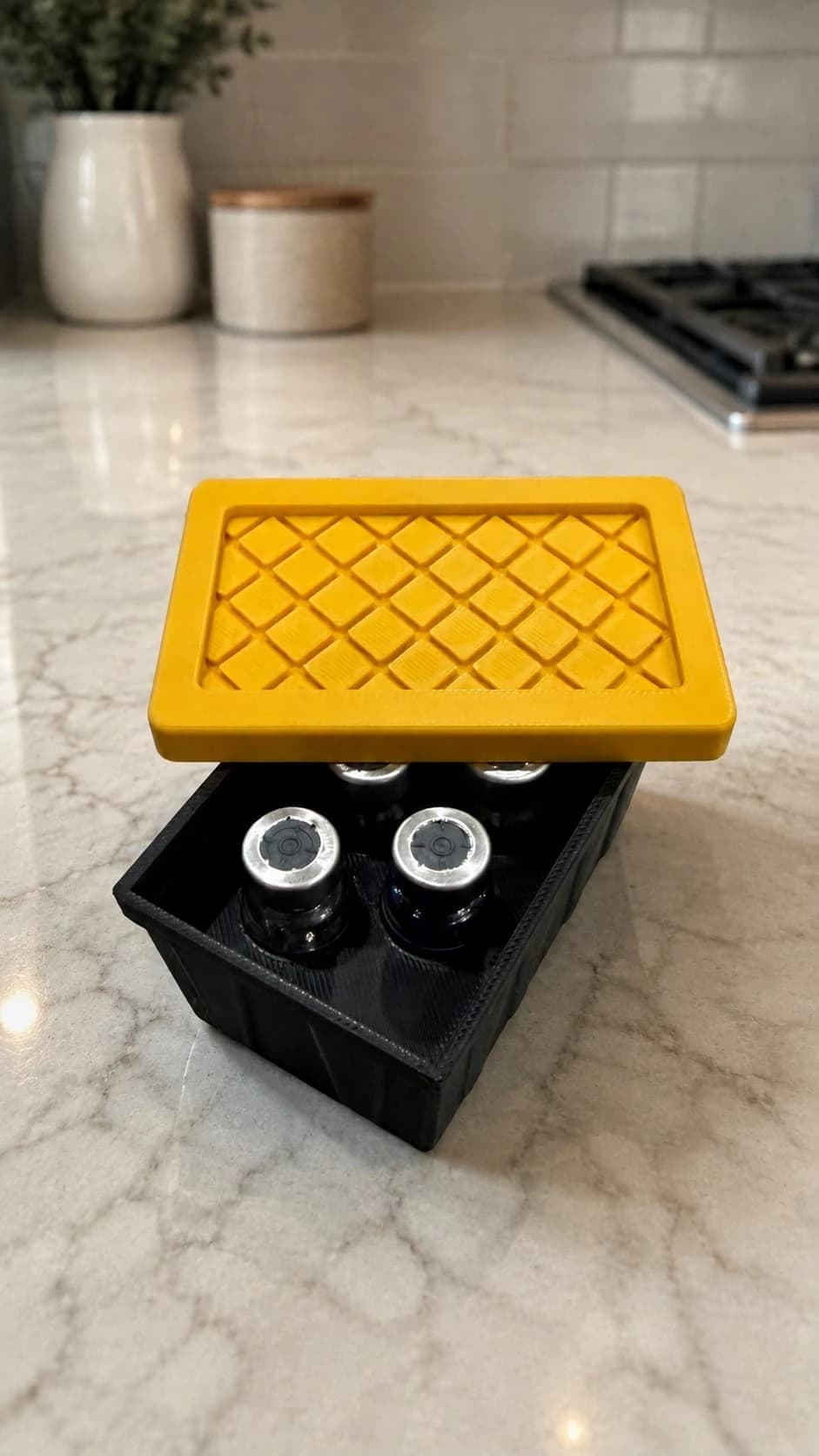
5-Vial Tote Case
At-Home Blood Test
Research Supplies
Disclosure: supply links may earn PDP a commission at no cost to you.
Pre-Blended Wolverine Vials (20 mg total, 1:1)
One 20 mg vial holds 10 mg BPC-157 and 10 mg TB-500. At 1 mg of total blend per day, each vial provides about 20 daily draws.
| Cycle length | Planning note |
|---|---|
4 weeks 2 vials | 28 daily draws; 40 mg total supply leaves about 12 mg. |
6-8 weeks 3 vials | 6 weeks: 42 daily draws; 60 mg total supply leaves about 18 mg.; 8 weeks: 56 daily draws; 60 mg total supply leaves about 4 mg. |
12 weeks 5 vials | 84 daily draws; 100 mg total supply leaves about 16 mg. |
4 weeks
2 vials
28 daily draws; 40 mg total supply leaves about 12 mg.
6-8 weeks
3 vials
6 weeks: 42 daily draws; 60 mg total supply leaves about 18 mg.; 8 weeks: 56 daily draws; 60 mg total supply leaves about 4 mg.
12 weeks
5 vials
84 daily draws; 100 mg total supply leaves about 16 mg.
U-100 Insulin Syringes
This example uses one syringe for each daily draw.
| Cycle length | Planning note |
|---|---|
4 weeks 28 syringes | One syringe per daily draw. |
6 weeks 42 syringes | One syringe per daily draw. |
8 weeks 56 syringes | One syringe per daily draw. |
12 weeks 84 syringes | A 100-count box gives a small margin. |
4 weeks
28 syringes
One syringe per daily draw.
6 weeks
42 syringes
One syringe per daily draw.
8 weeks
56 syringes
One syringe per daily draw.
12 weeks
84 syringes
A 100-count box gives a small margin.
Bacteriostatic Water
This example uses 2 mL of BAC water per 20 mg vial.
| Cycle length | Planning note |
|---|---|
4-12 weeks 1 × 10 mL bottle | 4 weeks: Two vials use 4 mL total.; 6 weeks: Three vials use 6 mL total.; 8 weeks: Three vials use 6 mL total.; 12 weeks: Five vials use 10 mL total; allow for normal loss. |
4-12 weeks
1 × 10 mL bottle
4 weeks: Two vials use 4 mL total.; 6 weeks: Three vials use 6 mL total.; 8 weeks: Three vials use 6 mL total.; 12 weeks: Five vials use 10 mL total; allow for normal loss.
Round up for normal transfer loss, damaged supplies, and measurement differences. Separate-vial schedules need separate math because their vial use and draw counts are different.
Companion Supplies & Routine Support
Why There Is No Evidence-Based Stop Point
There is no proven rule for stopping a Wolverine Stack cycle. Pain, swelling, and range of motion may change before a tendon, ligament, or muscle has fully recovered.
Symptoms are not a full tissue test
Feeling better does not confirm that tissue strength or structure has returned to normal.
Time alone is not enough
Finishing 6 or 8 weeks does not prove that an injury has healed or that continued use is safe.
Rehab still matters
A peptide cycle should not replace diagnosis, physical therapy, load testing, imaging, or return-to-sport guidance.
Long-term safety is unknown
Human data is too limited to define a safe total exposure, repeat-cycle limit, or year-round plan.
Anyone dealing with an injury should use a licensed clinician to judge healing and activity readiness. A calendar-based peptide plan cannot replace that review.
Time Off Between Wolverine Stack Cycles
Community discussions often mention 2 to 4 weeks off after a cycle. That break is a convention, not a tested safety standard. No study has compared different off-cycle lengths for BPC-157 and TB-500 together.
A break does not remove unknown risk
Taking time off does not prove that long-term effects, immune reactions, contamination risk, or other safety concerns have cleared.
There is also no evidence-based limit for the number of Wolverine Stack cycles per year. Repeated cycling increases total exposure to compounds that still lack strong human safety data.
What the Research Actually Supports
The research explains why people discuss BPC-157 and TB-500 together, but it does not prove the cycle schedules used online.
BPC-157 evidence is mostly preclinical
BPC-157 has been studied in cell and animal models involving tendons, muscles, blood vessels, and other tissues. Recent reviews still describe the human evidence as very limited.
TB-500 is not full-length thymosin beta-4
TB-500 is commonly identified as the short Ac-LKKTETQ fragment of thymosin beta-4. Human studies of full-length thymosin beta-4 cannot automatically be applied to the shorter TB-500 fragment.
The combination has not been tested
No published controlled human trial has studied a Wolverine Stack made from BPC-157 plus TB-500.
No study defines a cycle
There is no trial comparing 4, 6, 8, or 12 weeks, and no research has established a loading phase, maintenance phase, or off-cycle period for the stack.
A 6–8 week schedule may be common in the peptide community, but popularity is not the same as clinical proof.
Regulatory and Sport Status
BPC-157 and TB-500 are not FDA-approved drugs. In July 2026, the FDA Pharmacy Compounding Advisory Committee reviewed both substances for possible use in compounding. An advisory review or recommendation is not the same as FDA approval.
FDA has also said that human safety information is limited for BPC-157 and that it has not identified human exposure data for the TB-500 fragment. These gaps make long-term and repeated-cycle claims especially uncertain.
Athletes and drug testing
BPC-157 and TB-500 are prohibited under World Anti-Doping Agency rules. Athletes should not use a cycle calendar to estimate when testing risk has ended.
What Belongs on This Cycle Page
This page answers how long community Wolverine Stack cycles usually run and how those weeks are divided. It does not replace the main dosage and reconstitution guide.
Wolverine Stack Dosing Guide
Review blend ratios, separate-vial schedules, reconstitution math, syringe units, and the main dosage chart.
BPC-157 Protocol
See the individual BPC-157 evidence, community schedule, reconstitution, and research limits.
TB-500 Protocol
Review the TB-500 fragment, common loading and maintenance language, and the difference from full-length thymosin beta-4.
Wolverine Stack Cycle Length FAQ
Q1: How long is a typical Wolverine Stack cycle?
The most common community schedule is 6–8 weeks. Shorter 4–6 week and longer 8–12 week plans also appear. None of these cycle lengths has been tested in a controlled human trial.
Q2: Is a 4-week Wolverine Stack cycle long enough?
Some community plans use 4 weeks as a short cycle or loading phase. Research has not shown whether 4 weeks is effective or safer than a longer schedule.
Q3: Can a Wolverine Stack cycle last 12 weeks?
Some extended community schedules run for 8–12 weeks. There is no clinical evidence showing that a 12-week cycle is safe, more effective, or needed.
Q4: What is the loading phase of a Wolverine Stack cycle?
Loading is a community term for the first 4 weeks, when schedules are often more frequent. It is not a phase established by a clinical trial.
Q5: What is the maintenance phase?
Maintenance usually means a lower-frequency period after the first 4 weeks. Separate-vial plans often reduce TB-500 frequency while BPC-157 remains on its original schedule.
Q6: Is a pre-blended Wolverine Stack taken on the same schedule as separate vials?
Not usually. A pre-blended vial keeps both compounds in one fixed ratio. Separate vials allow BPC-157 and TB-500 to follow different schedules.
Q7: How much time should be taken off between cycles?
Community discussions often mention 2–4 weeks off, but no study has established a safe washout period for the combined stack.
Q8: Should a cycle stop when pain improves?
Pain relief does not prove that tissue has fully recovered. Injury healing and return-to-activity decisions should be reviewed by a licensed clinician.
Q9: Can the Wolverine Stack be used year-round?
There is no human evidence supporting year-round use. Long-term and repeated exposure to the combined stack has not been studied.
Q10: Is the Wolverine Stack cycle clinically proven?
No. No published human clinical trial has tested BPC-157 and TB-500 together or compared different cycle lengths.
Q11: Are BPC-157 and TB-500 FDA-approved?
No. Neither compound is an FDA-approved drug. A July 2026 advisory committee review did not make either substance FDA-approved.
Q12: Is the Wolverine Stack banned in sport?
Yes. BPC-157 and TB-500 are prohibited under World Anti-Doping Agency rules.
References
- 1. Vasireddi N, Hahamyan H, Salata MJ, Karns M, Calcei JG, Voos JE, Apostolakos JM Emerging Use of BPC-157 in Orthopaedic Sports Medicine: A Systematic Review HSS Journal (2025)
- 2. McGuire FP, et al. Regeneration or Risk? A Narrative Review of BPC-157 for Musculoskeletal Healing Current Reviews in Musculoskeletal Medicine (2025)
- 3. Chang CH, Tsai WC, Lin MS, Hsu YH, Pang JH The Promoting Effect of Pentadecapeptide BPC 157 on Tendon Healing Involves Tendon Outgrowth, Cell Survival, and Cell Migration Journal of Applied Physiology (2011)
- 4. Kleinman HK, Sosne G Thymosin β4 Promotes Dermal Healing Vitamins and Hormones (2016)
- 5. Esposito S, Deventer K, Goeman J, Van der Eycken J, Van Eenoo P Synthesis and Characterization of the N-Terminal Acetylated 17-23 Fragment of Thymosin Beta 4 Identified in TB-500 Drug Testing and Analysis (2012)
- 6. Certain Bulk Drug Substances for Use in Compounding That May Present Significant Safety Risks U.S. Food and Drug Administration (2026)
- 7. July 23-24, 2026 Meeting of the Pharmacy Compounding Advisory Committee U.S. Food and Drug Administration (2026)
- 8. The Prohibited List World Anti-Doping Agency (2026)
Related Dosing Protocols
Educational use only
Peptide Dosing Protocols is an independent educational reference. Nothing here is medical advice or a recommendation for human use. Consult a licensed healthcare provider before considering any compound.
Review the Full Wolverine Stack Guide
See the main dosage chart, blend and separate-vial schedules, reconstitution math, research evidence, and safety limits.

Written by Garret Grant
Founder & Lead Researcher · B.S. Civil Engineering, UCLA
Last updated: July 2026
Human-researched and AI-assisted with full editorial review. I verify sources, protocol interpretation, and final judgments personally. See methodology.
Share this page