
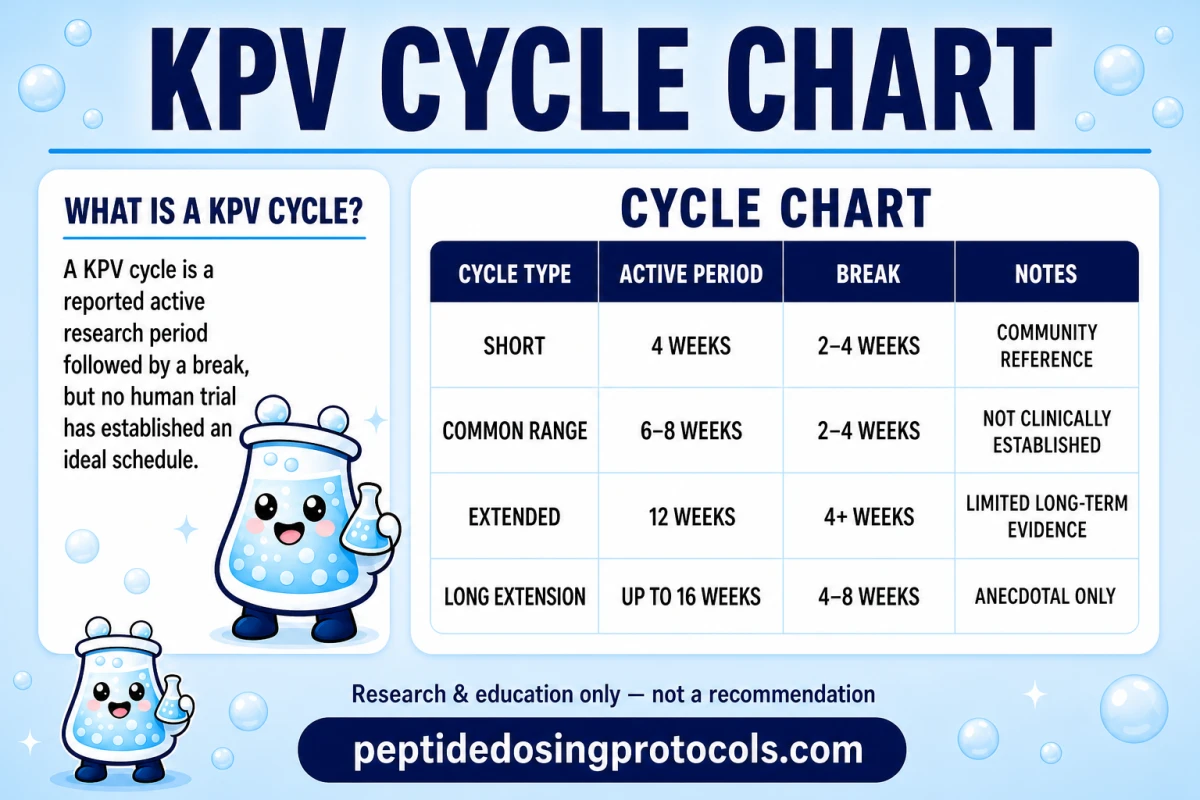
How Long Is a KPV Cycle?
There is no proven KPV cycle length
Community protocols most often describe 4–8 weeks, while 8–12 week schedules are also reported. Some discussions extend to 16 weeks, but no human trial has compared these durations or shown that one is better, safer, or more effective.
The published KPV literature does not provide a standard human cycle. Most studies involve cells or animals, use different routes and formulations, and last days rather than months. Their study lengths should not be converted into a human protocol.
Research and education only
This page documents published study durations and community-reported cycle frameworks. It does not recommend starting, extending, or repeating a KPV cycle. KPV is not FDA-approved, and human safety data remain limited.
For KPV dosage-chart values, 5 mg and 10 mg reconstitution math, routes, storage, and syringe units, use the main KPV protocol. This page stays focused on cycle length, breaks, timelines, and vial planning.
KPV Cycle Length Chart
The chart below separates commonly reported community frameworks from established evidence. These are research references, not recommended schedules.
Community-reported KPV cycle frameworks
No human trial has validated these active periods or breaks.
Framework
Short cycle
Reported active period
4 weeks
Reported break
2–4 weeks
Evidence level
Common community reference; no controlled human trial
Framework
Standard community range
Reported active period
6–8 weeks
Reported break
2–4 weeks
Evidence level
Frequently discussed; not clinically established
Framework
Extended cycle
Reported active period
12 weeks
Reported break
About 4 weeks or longer
Evidence level
Reported extension with limited long-term evidence
Framework
Long extension
Reported active period
Up to 16 weeks
Reported break
4–8 weeks
Evidence level
Anecdotal; no KPV trial validates this duration
| Framework | Reported active period | Reported break | Evidence level |
|---|---|---|---|
| Short cycle | 4 weeks | 2–4 weeks | Common community reference; no controlled human trial |
| Standard community range | 6–8 weeks | 2–4 weeks | Frequently discussed; not clinically established |
| Extended cycle | 12 weeks | About 4 weeks or longer | Reported extension with limited long-term evidence |
| Long extension | Up to 16 weeks | 4–8 weeks | Anecdotal; no KPV trial validates this duration |
A reported cycle is not the same as a research-proven cycle. Longer schedules do not have stronger evidence.
KPV Supplies Needed
The planning table below uses a 10 mg vial and a calculation-only example of 500 mcg once daily. It is included to keep vial and supply totals consistent across the 4-, 6-, 8-, 12-, and 16-week frameworks.
Recommended U.S. and Canada Supply
Choose your region
Use discount code PEPPAL at Peptide Partners checkout. See why we love Peptide Partners.
KPV (10mg vials)
5-Vial Tote Case
At-Home Blood Test
Research Supplies
Disclosure: supply links may earn PDP a commission at no cost to you.
KPV Vials
10 mg vials with 20 calculated 500 mcg portions per vial.
| Cycle Length | Planning Notes |
|---|---|
4 weeks 2 x 10 mg vials | 28 days × 0.5 mg = 14 mg; round up to 20 mg. |
6-8 weeks 3 x 10 mg vials | 6 weeks: 42 days × 0.5 mg = 21 mg; round up to 30 mg.; 8 weeks: 56 days × 0.5 mg = 28 mg; round up to 30 mg. |
12 weeks 5 x 10 mg vials | 84 days × 0.5 mg = 42 mg; round up to 50 mg. |
16 weeks 6 x 10 mg vials | 112 days × 0.5 mg = 56 mg; round up to 60 mg. |
4 weeks
2 x 10 mg vials
28 days × 0.5 mg = 14 mg; round up to 20 mg.
6-8 weeks
3 x 10 mg vials
6 weeks: 42 days × 0.5 mg = 21 mg; round up to 30 mg.; 8 weeks: 56 days × 0.5 mg = 28 mg; round up to 30 mg.
12 weeks
5 x 10 mg vials
84 days × 0.5 mg = 42 mg; round up to 50 mg.
16 weeks
6 x 10 mg vials
112 days × 0.5 mg = 56 mg; round up to 60 mg.
U-100 Syringes
One new syringe per daily SubQ research exposure, rounded to common package sizes.
| Cycle Length | Planning Notes |
|---|---|
4 weeks 30 syringes | 28 daily exposures; 2 extra syringes provide margin. |
6 weeks 45 syringes | 42 daily exposures; round up for handling loss. |
8 weeks 60 syringes | 56 daily exposures; 4 extra syringes provide margin. |
12 weeks 90 syringes | 84 daily exposures; round up to 90. |
16 weeks 120 syringes | 112 daily exposures; round up to 120. |
4 weeks
30 syringes
28 daily exposures; 2 extra syringes provide margin.
6 weeks
45 syringes
42 daily exposures; round up for handling loss.
8 weeks
60 syringes
56 daily exposures; 4 extra syringes provide margin.
12 weeks
90 syringes
84 daily exposures; round up to 90.
16 weeks
120 syringes
112 daily exposures; round up to 120.
Bacteriostatic Water
Assumes 2 mL is added to each 10 mg vial. Check the full reconstitution guide before doing any vial math.
| Cycle Length | Planning Notes |
|---|---|
4-8 weeks 1 x 10 mL bottle | 4 weeks: 2 vials × 2 mL = 4 mL total.; 6 weeks: 3 vials × 2 mL = 6 mL total.; 8 weeks: 3 vials × 2 mL = 6 mL total. |
12-16 weeks 2 x 10 mL bottles | 12 weeks: 5 vials × 2 mL = 10 mL; a second bottle provides margin.; 16 weeks: 6 vials × 2 mL = 12 mL total. |
4-8 weeks
1 x 10 mL bottle
4 weeks: 2 vials × 2 mL = 4 mL total.; 6 weeks: 3 vials × 2 mL = 6 mL total.; 8 weeks: 3 vials × 2 mL = 6 mL total.
12-16 weeks
2 x 10 mL bottles
12 weeks: 5 vials × 2 mL = 10 mL; a second bottle provides margin.; 16 weeks: 6 vials × 2 mL = 12 mL total.
These totals are calculation-only planning based on the stated example, not a KPV dosing recommendation. Oral research workflows may not require injection syringes or site-prep swabs.
Companion Supplies & Routine Support
Community KPV Cycles vs. Research Study Durations
A community cycle describes how KPV is discussed in protocol groups. A study duration describes how long scientists observed a specific cell or animal model. Those are different types of information.
KPV cycle claims compared with published research timelines
Source
Community protocols
Example duration
4–8 weeks
What was studied
Oral or SubQ research frameworks
What it tells us
Shows a commonly discussed schedule, not a validated cycle
Source
Extended community protocols
Example duration
8–12 weeks
What was studied
Longer research planning
What it tells us
Documents an extension, not proof that longer is better
Source
Dalmasso et al. (2008)
Example duration
48 hours to 8 days
What was studied
Mouse colitis models and PepT1 transport
What it tells us
Supports short preclinical research, not a human cycle
Source
Kannengiesser et al. (2008)
Example duration
Days in murine colitis models
What was studied
KPV in DSS and transfer-colitis models
What it tells us
Shows animal anti-inflammatory research only
Source
Xiao et al. (2017)
Example duration
Daily treatment in a short DSS model
What was studied
Oral KPV-loaded nanoparticles in mice
What it tells us
Supports a delivery-system experiment, not free-KPV cycle guidance
Source
Dalmasso et al. (2016)
Example duration
Repeated DSS periods with recovery windows
What was studied
Colitis-associated cancer model in mice
What it tells us
Shows a longer animal design, not a continuous human protocol
| Source | Example duration | What was studied | What it tells us |
|---|---|---|---|
| Community protocols | 4–8 weeks | Oral or SubQ research frameworks | Shows a commonly discussed schedule, not a validated cycle |
| Extended community protocols | 8–12 weeks | Longer research planning | Documents an extension, not proof that longer is better |
| Dalmasso et al. (2008) | 48 hours to 8 days | Mouse colitis models and PepT1 transport | Supports short preclinical research, not a human cycle |
| Kannengiesser et al. (2008) | Days in murine colitis models | KPV in DSS and transfer-colitis models | Shows animal anti-inflammatory research only |
| Xiao et al. (2017) | Daily treatment in a short DSS model | Oral KPV-loaded nanoparticles in mice | Supports a delivery-system experiment, not free-KPV cycle guidance |
| Dalmasso et al. (2016) | Repeated DSS periods with recovery windows | Colitis-associated cancer model in mice | Shows a longer animal design, not a continuous human protocol |
Species, route, formulation, disease model, and outcome all change what a study duration means.
Research duration is not a dosing recommendation
A seven-day animal experiment does not prove that a seven-day KPV cycle is ideal. A repeated mouse model also does not validate a 12- or 16-week human schedule.
Where Do KPV Cycle Lengths Come From?
Most KPV cycle numbers come from community protocol patterns rather than direct clinical research. They are often built by combining short animal studies, general peptide-cycling habits, and anecdotal reports.
Preclinical studies
Cell and animal studies explain why KPV is being researched, but they do not establish a human dose or cycle.
Community schedules
Four- to eight-week ranges appear often in protocol discussions, but no controlled KPV trial has tested them.
General cycling habits
Some off periods are borrowed from other peptide discussions even though KPV-specific recovery data are missing.
Anecdotal extensions
Twelve- and 16-week schedules are reported, but longer exposure has less direct support and more unknowns.
PDP includes these numbers because readers search for them and may encounter them elsewhere. Listing a schedule does not mean it has been clinically proven or recommended.
What Does a 4-Week KPV Cycle Mean?
A four-week framework represents 28 days of active research before stopping or beginning a reported off period. It is one of the shorter KPV schedules found in community protocol discussions.
No study has shown that four weeks is an ideal stopping point. Its main feature is simply a shorter total exposure period than a six-, eight-, or 12-week framework.
Four-week planning reference
At the calculation-only example of 500 mcg once daily, 28 days equals 14 mg total. That requires two 10 mg vials before allowing for normal handling losses.
What About a 6- to 8-Week KPV Cycle?
Six to eight weeks sits inside the most commonly discussed community range. Many protocol references pair this active period with a two- to four-week break.
The range is a community convention, not the result of a trial comparing six weeks with eight weeks. There is also no controlled evidence showing that a break prevents tolerance or reduces a known KPV-specific risk.
Calculation-only vial planning at 500 mcg per day
Active period
6 weeks
Days
42
Total KPV
21 mg
10 mg vials
3 vials
Active period
8 weeks
Days
56
Total KPV
28 mg
10 mg vials
3 vials
| Active period | Days | Total KPV | 10 mg vials |
|---|---|---|---|
| 6 weeks | 42 | 21 mg | 3 vials |
| 8 weeks | 56 | 28 mg | 3 vials |
The 500 mcg amount is used only to show transparent math. It is not an established or recommended human dose.
Can a KPV Cycle Last 12 Weeks?
Twelve-week KPV schedules are reported as extended community protocols. They create a longer exposure window, but there is no human KPV trial showing that 12 weeks produces a better result than four, six, or eight weeks.
A 12-week schedule should not be justified by pointing to a short mouse study or a study that used a KPV-loaded carrier. Those experiments answer different research questions and do not establish long-term free-KPV use.
Twelve-week planning reference
At 500 mcg once daily, 84 days equals 42 mg total. The calculation rounds to five 10 mg vials, leaving 8 mg before normal handling losses.
Are 16-Week KPV Cycles Reported?
Yes. Some anecdotal KPV schedules extend to about 16 weeks. PDP documents this range because readers may encounter it, not because controlled research supports it.
Longer is not better studied
A 16-week schedule moves farther beyond the short animal experiments that make up most of the KPV literature. No controlled human study has established the safety, value, or ideal monitoring plan for this duration.
Sixteen-week planning reference
At 500 mcg once daily, 112 days equals 56 mg total. The calculation rounds to six 10 mg vials, leaving 4 mg before normal handling losses.
Does KPV Need to Be Cycled?
Research has not shown that KPV must be cycled. No study has compared continuous exposure with a cycle-and-break approach, and no ideal KPV off period has been established.
Community protocols often describe two to four weeks off after a shorter cycle and four weeks or longer after an extended cycle. These breaks may make a research schedule easier to separate into active and observation periods, but they are not proven recovery or tolerance-reset windows.
Commonly reported KPV off periods
Active framework
4 weeks
Reported break
2–4 weeks
Evidence note
Community convention; no trial comparison
Active framework
6–8 weeks
Reported break
2–4 weeks
Evidence note
Commonly discussed; no proven reset period
Active framework
12 weeks
Reported break
About 4 weeks or longer
Evidence note
Extended community pattern; not clinically established
Active framework
16 weeks
Reported break
4–8 weeks
Evidence note
Anecdotal framework with major evidence gaps
| Active framework | Reported break | Evidence note |
|---|---|---|
| 4 weeks | 2–4 weeks | Community convention; no trial comparison |
| 6–8 weeks | 2–4 weeks | Commonly discussed; no proven reset period |
| 12 weeks | About 4 weeks or longer | Extended community pattern; not clinically established |
| 16 weeks | 4–8 weeks | Anecdotal framework with major evidence gaps |
Does the KPV Route Change the Cycle Length?
There is no proven oral, SubQ, or topical KPV cycle. Route changes how a compound reaches the research target, but the available evidence does not define a standard duration for any route.
KPV route and cycle evidence
Route
Oral
What is discussed
Gut-focused community frameworks and animal PepT1 studies
Cycle evidence
No established human oral cycle
Route
SubQ
What is discussed
Systemic community protocols
Cycle evidence
No completed human SubQ dose or cycle trial
Route
Topical
What is discussed
Formulation-specific skin research
Cycle evidence
No standard concentration or cycle across formulations
| Route | What is discussed | Cycle evidence |
|---|---|---|
| Oral | Gut-focused community frameworks and animal PepT1 studies | No established human oral cycle |
| SubQ | Systemic community protocols | No completed human SubQ dose or cycle trial |
| Topical | Formulation-specific skin research | No standard concentration or cycle across formulations |
A route-specific animal experiment should not be used to prove a different human cycle length.
KPV Cycle Length Is Different From KPV Dosage
Cycle length
How long the active research period lasts, such as four, eight, or 12 weeks.
Off period
The observation break between active periods. No ideal KPV break has been established.
Dosage
The amount represented by each research exposure. This is separate from total cycle duration.
Reconstitution
The amount of liquid added to a vial. It changes concentration and syringe-unit math, not the cycle length.
Keep the detailed dose tables, 5 mg and 10 mg reconstitution options, and syringe-unit calculations on the KPV dosing guide. That protects the main protocol page while this article answers the separate cycle-length intent.
How Long Does One 10 mg KPV Vial Last?
A 10 mg vial contains 10,000 mcg. Vial duration depends on the amount represented by each draw and the frequency. It does not automatically equal one cycle.
10 mg KPV vial duration by calculation amount
Assumes one calculated portion per day and no handling loss.
Calculated daily amount
200 mcg
Math
10,000 ÷ 200
Calculated portions
50
Approximate duration
50 days
Calculated daily amount
300 mcg
Math
10,000 ÷ 300
Calculated portions
33.3
Approximate duration
About 33 days
Calculated daily amount
400 mcg
Math
10,000 ÷ 400
Calculated portions
25
Approximate duration
25 days
Calculated daily amount
500 mcg
Math
10,000 ÷ 500
Calculated portions
20
Approximate duration
20 days
| Calculated daily amount | Math | Calculated portions | Approximate duration |
|---|---|---|---|
| 200 mcg | 10,000 ÷ 200 | 50 | 50 days |
| 300 mcg | 10,000 ÷ 300 | 33.3 | About 33 days |
| 400 mcg | 10,000 ÷ 400 | 25 | 25 days |
| 500 mcg | 10,000 ÷ 500 | 20 | 20 days |
These are vial-math examples only. Normal losses can reduce the number of usable draws.
What Do Published KPV Timelines Show?
Published KPV studies mainly measure short preclinical outcomes. They help explain mechanism and research interest, but they do not establish how long a human KPV cycle should run.
Dalmasso et al. (2008)
Mouse colitis outcomes were assessed about 48 hours after TNBS exposure and at day 8 in the DSS model. The work studied PepT1 transport and inflammatory signaling, not a human cycle.
Kannengiesser et al. (2008)
KPV was studied in murine DSS and transfer-colitis models over short experimental windows. The findings cannot define a human route, amount, or duration.
Dalmasso et al. (2016)
A colitis-associated cancer model used repeated DSS exposure and recovery periods. This was a long animal disease model, not a continuous KPV protocol for people.
Xiao et al. (2017)
Researchers tested KPV-loaded nanoparticles in a short mouse colitis model. The carrier system and animal route limit what the duration can tell us about free KPV.
Later delivery-system studies
Newer KPV studies often test nanoparticles, conjugates, or combination systems over roughly seven-day acute models or repeated animal cycles. They do not validate common 4- to 12-week community schedules.
How Long Does KPV Take to Work?
No controlled human study has established a KPV onset timeline. Claims that KPV works in a set number of days or weeks go beyond the available evidence.
Animal studies have measured changes within short experimental windows, including 48 hours and about one week. Those findings reflect a specific animal model, route, dose, and outcome. They should not be converted into a promised human timeline.
Anecdotal timelines are not controlled evidence
Community reports may describe changes during the first few weeks, no change at all, or longer observation periods. PDP treats those accounts as anecdotes rather than proof of when KPV starts working.
KPV Evidence and Regulatory Limits
The FDA states that it has not identified human exposure data for drug products containing KPV by any route. That leaves major gaps around human safety, pharmacokinetics, dose, and long-term exposure.
KPV free base and KPV acetate were discussed at the July 23, 2026 Pharmacy Compounding Advisory Committee meeting for possible inclusion on the 503A Bulks List. Advisory committee recommendations are non-binding, and committee review does not make KPV FDA-approved or clinically validated.
- No completed human dose-finding trial defines a KPV cycle.
- No human trial compares four, eight, 12, or 16 weeks.
- No proven KPV tolerance-reset or recovery period exists.
- No established long-term injectable, oral, or topical safety schedule exists.
- Animal and delivery-system studies should not be presented as human protocol evidence.
How to Read KPV Cycle Claims
- 01
Check the source
Find out whether the duration comes from a published study, clinic page, community protocol, or personal report.
- 02
Check the model
A cell experiment, mouse colitis model, and human protocol are not interchangeable.
- 03
Check the route and formulation
Free KPV, KPV-loaded nanoparticles, oral liquid, SubQ use, and topical formulations answer different research questions.
- 04
Separate duration from dose
A study lasting seven days does not tell you what amount or cycle should be used outside that experiment.
- 05
Treat longer schedules with more caution
Eight-, 12-, and 16-week community schedules extend farther beyond the short preclinical evidence base.
Current research takeaway
Four to eight weeks is the most common community-reported KPV range. Eight to 12 weeks is an extended framework, and 16 weeks is anecdotal. None has been proven to be the ideal KPV cycle.
KPV Cycle Length FAQ
Q1: How long is a KPV cycle?
No clinically established KPV cycle length exists. Community protocols most often describe 4–8 weeks, while 8–12 week extensions are also reported. These are research-community frameworks, not proven schedules.
Q2: What is the most common KPV cycle length?
Four to eight weeks is the range most often discussed in KPV community protocols. No controlled human study has shown that this range is ideal.
Q3: Does KPV need to be cycled?
Research has not shown that KPV must be cycled. No study has compared continuous exposure with a cycle-and-break approach.
Q4: How long should the break be between KPV cycles?
No ideal KPV off period has been established. Community schedules often describe 2–4 weeks off after shorter cycles and about four weeks or longer after extended schedules.
Q5: Can a KPV cycle last 4 weeks?
Four weeks is a commonly reported shorter community framework. It is not a duration established by a controlled KPV trial.
Q6: Can a KPV cycle last 8 weeks?
Eight-week schedules are commonly discussed in community protocols. No human trial has shown that eight weeks is safer or more effective than a shorter or longer duration.
Q7: Can a KPV cycle last 12 weeks?
Twelve-week KPV schedules are reported as extended community protocols. Human long-term safety and cycle data are not available.
Q8: Are 16-week KPV cycles used?
Some anecdotal schedules extend to about 16 weeks. This duration has not been validated in a controlled KPV study and sits well beyond most short preclinical experiments.
Q9: Does oral KPV use a different cycle than injected KPV?
No route-specific human cycle has been established. Oral, SubQ, and topical KPV use different delivery methods, but research has not defined an ideal duration for any route.
Q10: How long does KPV take to work?
No controlled human study defines a KPV onset timeline. Animal studies measured outcomes over short windows, but those results cannot predict when or whether a person would notice a change.
Q11: How long does one 10 mg KPV vial last?
A 10 mg vial contains 10,000 mcg. It provides 50 calculated 200 mcg portions, 25 calculated 400 mcg portions, or 20 calculated 500 mcg portions before normal handling losses.
Q12: Is KPV cycle length the same as KPV dosage?
No. Cycle length is the number of days or weeks in the active research period. Dosage is the amount represented by each research exposure.
Q13: Is there a clinical KPV cycle protocol?
No completed human trial has established a clinical KPV cycle, dose, off period, or long-term schedule.
Q14: Does PDP recommend a KPV cycle?
No. Peptide Dosing Protocols documents published study durations and community-reported schedules for educational comparison. It does not recommend KPV use.
References
- 1. Dalmasso G, et al. PepT1-Mediated Tripeptide KPV Uptake Reduces Intestinal Inflammation Gastroenterology (2008)
- 2. Kannengiesser K, et al. Melanocortin-Derived Tripeptide KPV Has Anti-Inflammatory Potential in Murine Models of Inflammatory Bowel Disease Inflammatory Bowel Diseases (2008)
- 3. Dalmasso G, et al. Critical Role of PepT1 in Promoting Colitis-Associated Cancer and Therapeutic Benefits of the Anti-Inflammatory PepT1-Mediated Tripeptide KPV in a Murine Model (2016)
- 4. Xiao B, et al. Orally Targeted Delivery of Tripeptide KPV via Hyaluronic Acid-Functionalized Nanoparticles Efficiently Alleviates Ulcerative Colitis ACS Nano (2017)
- 5. Zhang D, et al. PepT1-Targeted Nanodrug Based on Co-Assembly of Anti-Inflammatory Peptide and Immunosuppressant for Combined Treatment of Acute and Chronic DSS-Induced Colitis Frontiers in Pharmacology (2024)
- 6. Inflammation-Triggered Self-Immolative Conjugates Enable Oral Peptide Delivery by Overcoming Gastrointestinal Barriers Science Advances (2026)
- 7. Certain Bulk Drug Substances for Use in Compounding That May Present Significant Safety Risks U.S. Food and Drug Administration (2026)
- 8. July 23–24, 2026 Meeting of the Pharmacy Compounding Advisory Committee U.S. Food and Drug Administration (2026)
Related Dosing Protocols
Educational use only
Peptide Dosing Protocols is an independent educational reference. Nothing here is medical advice or a recommendation for human use. Consult a licensed healthcare provider before considering any compound.
Need KPV dosage and reconstitution math?
The main KPV protocol covers 5 mg and 10 mg vial calculations, route notes, syringe units, storage, and the full dosage chart.

Written by Garret Grant
Founder & Lead Researcher · B.S. Civil Engineering, UCLA
Last updated: August 2026
Human-researched and AI-assisted with full editorial review. I verify sources, protocol interpretation, and final judgments personally. See methodology.
Share this page