
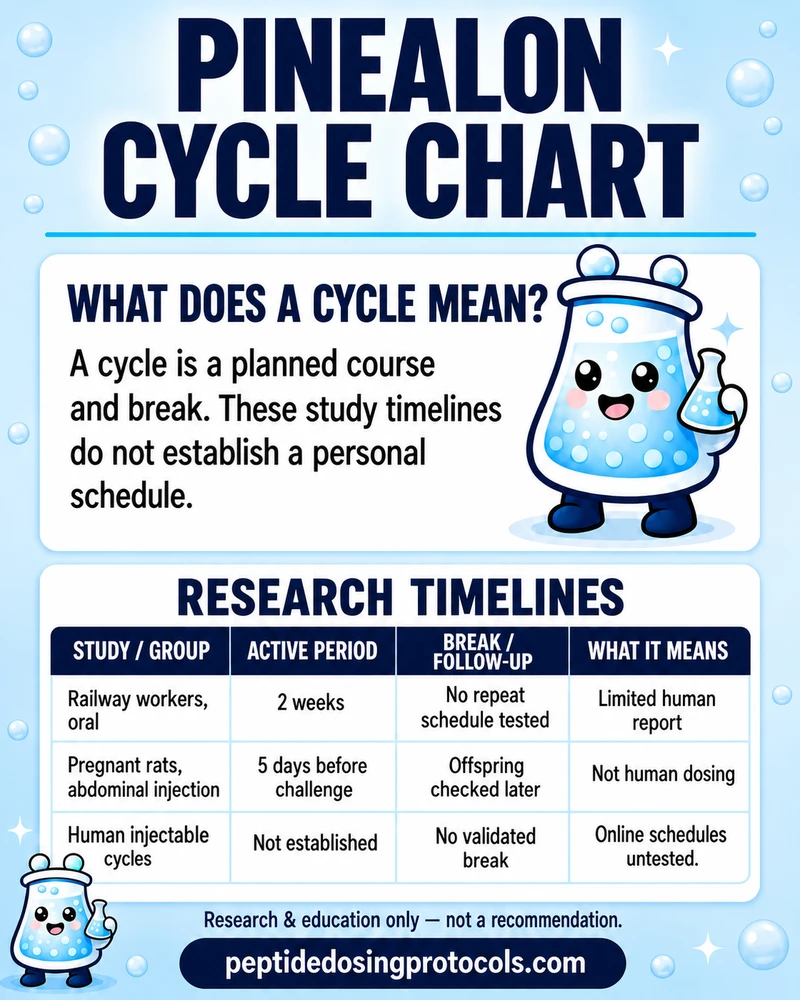
How Long Is a Pinealon Cycle?
There is no validated personal Pinealon cycle in the evidence reviewed here. A cycle usually means a course, time off, and a possible restart. A study that reports a change at the end of one course does not establish that full pattern. Breaks and repeat courses need their own evidence.
Pinealon is a synthetic chain of three amino acids: glutamic acid, aspartic acid, and arginine. Its short name is EDR, also written Glu-Asp-Arg. The original cell study identifies that exact sequence. The term bioregulator describes a proposed biological role; it is not a standard schedule shared by all peptides.
The evidence includes laboratory experiments, animal models, and limited human reports. Saying there is no established cycle is not the same as saying no human research exists. The key question is whether a report supports the exact route, population, and outcome claimed for a proposed course. Subcutaneous means injected under the skin; it is a different route from swallowing a capsule.
Start with the right question
This guide examines duration and evidence. The Pinealon protocol background explains other product terms. Vial arithmetic or a suggested schedule elsewhere does not establish that a route or cycle is clinically validated.
Community Reports: Untested Cycle Lengths
Personal reports cannot establish a safe cycle
The durations and breaks below are untested anecdotes or proposals, not recommendations. We cannot verify product identity, purity, other substances, or complete side-effect reporting. Do not turn them into an injection plan or supply count.
A September 2024 r/PeptideForum thread describes an almost-complete subcutaneous course without an exact day count. The writer later referred to borrowing a 10- or 20-day bioregulator pattern. Replies proposed a three-week course with one week off, or a 30-day course. Those proposals are not confirmed completed schedules.
The first account reported interrupted sleep, head pressure or warmth, and little change in mood, energy, or thinking. Tirzepatide was also being used. Months later, the writer described normal sleep, better recall, and less mental fatigue. Later benefit does not erase an earlier problem or prove Pinealon caused either change.
After reporting several courses, the writer suggested three to six months off. That conflicts with the other commenter's proposed one-week break. These opinions cannot be averaged into a recommended interval.
Original post and visible comments reviewed October 15, 2026. This is one thread with several accounts, not a survey. A total amount printed on a vial is also not a duration; it cannot reveal how many days a person used it without additional assumptions.
What Durations Can Be Traced to Research?
A useful timeline keeps the route and study setting beside each number. The strongest conclusion from this table is that the research periods are different kinds of observations. They cannot be combined into one general Pinealon cycle.
Pinealon exposure and observation periods
These are study descriptions, not personal treatment schedules.
Evidence
Railway workers, 2012; oral capsules
Reported duration
2 weeks
What it does not establish
An injectable cycle, an ideal break, or a yearly repeat count
Evidence
Pregnant rats, 2012; intraperitoneal injection
Reported duration
5 days before methionine loading
What it does not establish
A human route or a course for pregnant people
Evidence
Offspring in that rat study
Reported duration
Cells assessed at 10 days old; behavior at 45 days old
What it does not establish
10 or 45 days of Pinealon treatment
Evidence
Older adults with several conditions, 2015
Reported duration
Course length not stated in the indexed abstract
What it does not establish
A reproducible personal schedule from the abstract alone
Evidence
Cell-culture experiments
Reported duration
Laboratory exposure windows
What it does not establish
A human treatment or recovery timetable
| Evidence | Reported duration | What it does not establish |
|---|---|---|
| Railway workers, 2012; oral capsules | 2 weeks | An injectable cycle, an ideal break, or a yearly repeat count |
| Pregnant rats, 2012; intraperitoneal injection | 5 days before methionine loading | A human route or a course for pregnant people |
| Offspring in that rat study | Cells assessed at 10 days old; behavior at 45 days old | 10 or 45 days of Pinealon treatment |
| Older adults with several conditions, 2015 | Course length not stated in the indexed abstract | A reproducible personal schedule from the abstract alone |
| Cell-culture experiments | Laboratory exposure windows | A human treatment or recovery timetable |
Intraperitoneal means injected into the abdominal cavity in the animal experiment. It is different from injection under the skin. The primary reports are linked in the sections below.
A later measurement can be scientifically important without representing more treatment. In animal work, the age of the animal being tested is another separate number. Before using a duration from a paper, identify exactly whose exposure or whose age the number describes.
Pinealon Cycle Supplies Needed
There is no established personal Pinealon cycle from which to calculate vial, diluent, or syringe quantities. The featured research listing is separate from oral capsules in the human report. No exact international Pinealon product is verified in the shared directory; the international option opens a general supplier catalog with illustrative artwork. DailyPrintz, SiPhox, and Amazon cards are optional shopping resources. A clinician should decide which tests, if any, are appropriate. A commercial panel cannot prove an untested cycle safe.
Research Supplies
Choose your region
Use discount code SAVE10 at Orbitrex Peptides checkout. See why we love Orbitrex Peptides.
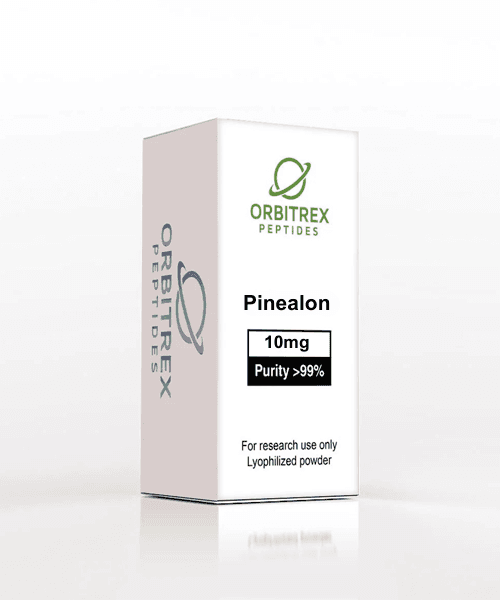
Pinealon
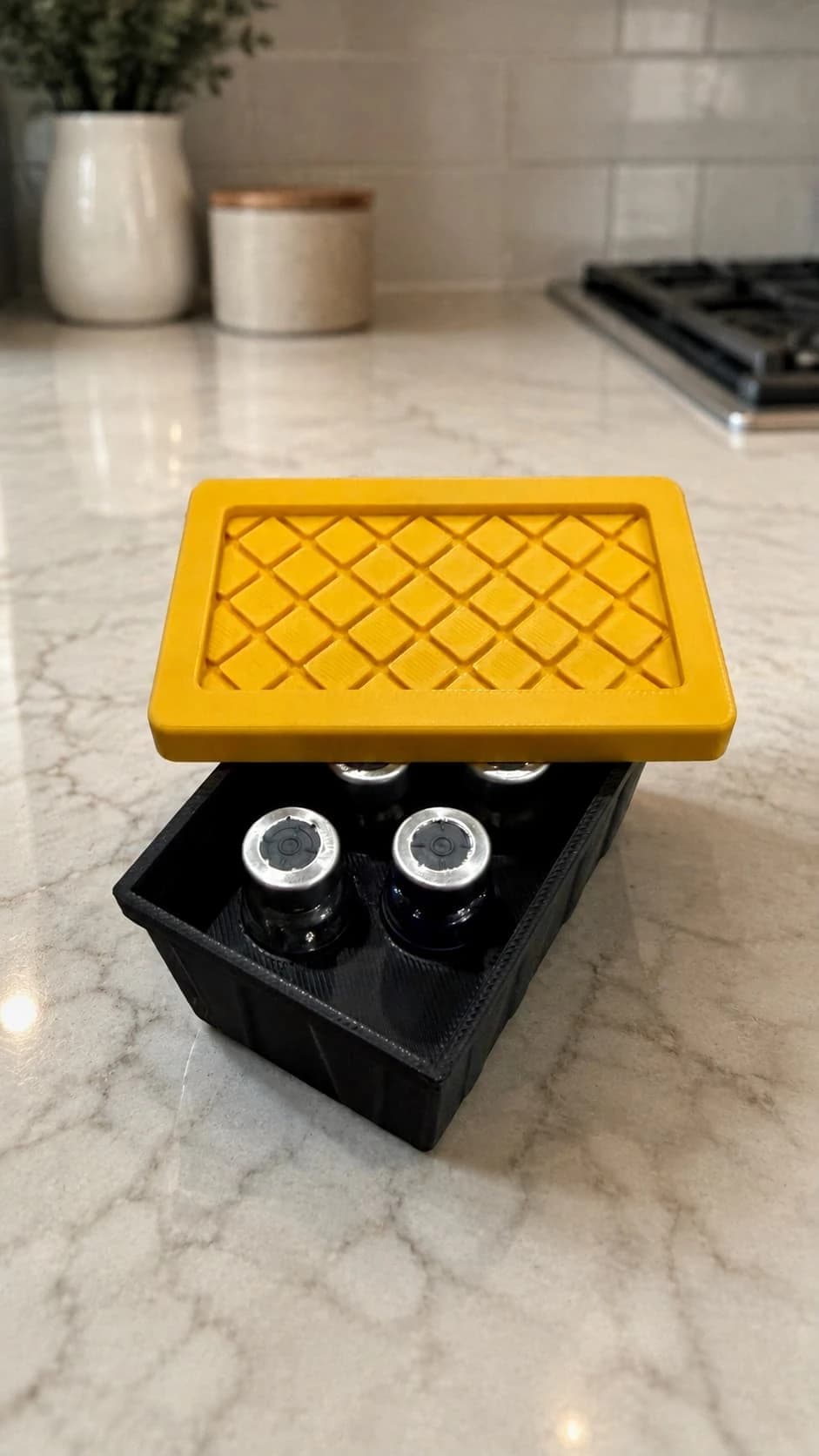
5-Vial Tote Case
At-Home Blood Test
Research Supplies
Disclosure: supply links may earn PDP a commission at no cost to you.
Compound, formulation, and quantity
| Supply check | What to verify |
|---|---|
Exact identity EDR / Glu-Asp-Arg | Confirm the complete compound name. Pinealon is not Epitalon, Vesugen, Cortexin, or a generic mixed bioregulator product. |
Oral versus injected Separate evidence | Capsule research does not determine injection materials or quantities. A research powder vial is not the oral preparation used in a human report. |
Vials and handling supplies Counts not established | Do not calculate a personal vial, diluent, syringe, or swab count from an animal study or a community duration. |
Exact identity
EDR / Glu-Asp-Arg
Confirm the complete compound name. Pinealon is not Epitalon, Vesugen, Cortexin, or a generic mixed bioregulator product.
Oral versus injected
Separate evidence
Capsule research does not determine injection materials or quantities. A research powder vial is not the oral preparation used in a human report.
Vials and handling supplies
Counts not established
Do not calculate a personal vial, diluent, syringe, or swab count from an animal study or a community duration.
Storage and optional clinical review
| Supply check | What to verify |
|---|---|
Temperature and containers Product-specific | Verify documented storage and after-opening requirements. A case, household mini fridge, or travel cooler does not automatically meet those requirements. |
Blood work and records Only if clinically useful | Keep exact product information and symptom timing for a clinician. There is no validated laboratory panel or marker that makes repeat Pinealon use safe. |
Temperature and containers
Product-specific
Verify documented storage and after-opening requirements. A case, household mini fridge, or travel cooler does not automatically meet those requirements.
Blood work and records
Only if clinically useful
Keep exact product information and symptom timing for a clinician. There is no validated laboratory panel or marker that makes repeat Pinealon use safe.
A supplier's batch report is not a clinical trial. Accessory links do not establish an administration method, mixing instruction, storage life, or purchasing plan.
Companion Supplies & Routine Support
What Does the Two-Week Human Report Show?
A 2012 paper about railway crew workers describes oral Pinealon capsules over two weeks. The authors reported changes in biological-age and adaptation measures. The indexed abstract does not provide the number of treated participants, describe random assignment, or give a detailed safety assessment.
Those missing details limit how strongly the result can guide a decision. A biological-age measure estimates aging from selected health measurements. It does not show that people live longer, avoid dementia, or work more safely. The report also does not establish a stop-and-restart strategy.
Oral means swallowed. That route matters because the product passes through the digestive system. A short capsule report cannot validate a powder prepared for injection, even if both labels say Pinealon. The body may handle the products differently, and the quality requirements also differ.
The fair reading is that a short human exposure has been reported, with important gaps in the accessible record. It would be inaccurate to call this a large, well-described trial of injectable cycles or to use its duration as a safe default.
What About Other Human Reports?
A 2015 indexed human report discusses Pinealon and Vesugen in older adults with several chronic conditions and an existing brain disorder. It reports 32 participants. Its abstract does not clearly describe each treatment group's size, route, or course length, so it cannot support a precise personal schedule.
The paper describes favorable changes in some measures, but also reports pro-oxidant activity, meaning a shift toward oxidation, and fewer CD34-positive blood-forming cells. Those are laboratory findings, not a proven diagnosis of harm in every user. Presenting the report only as antioxidant or anti-aging success would leave out important results.
A claim about one biological-age score should not become a claim of slower aging overall. Several health conditions, other treatment, and the way a score is calculated can influence the result. Without a clear comparison and longer follow-up, cause and lasting benefit remain uncertain.
When a review or sales page quotes a larger human study, look for the original report. It should explain who received which product, the route, the comparison group, the outcome, and harms. A repeated citation is not independent confirmation if every page leads back to the same brief claim.
What Happened in the Five-Day Rat Experiment?
In the 2012 prenatal rat experiment, researchers gave Pinealon to pregnant rats before a methionine challenge. That challenge raised homocysteine, a substance whose high levels can damage cells. The Pinealon injections went into the abdominal cavity, not under the skin.
The later tests concerned the offspring. Researchers examined cells from young pups and learning behavior in older pups. They reported better performance on a water-maze task and less oxidative cell damage in the Pinealon group. Oxidative damage means injury linked to reactive molecules made in cells.
The timing is crucial: pretreatment in a mother animal, a planned experimental challenge, and tests in her offspring are three separate stages. They cannot be collapsed into a short adult memory cycle. Nor does this study establish safety for pregnant people or children.
Animal exposure is not a human regimen
A weight-based animal amount cannot be converted into a safe human course by simple scaling. Route, development, metabolism, and the purpose of the experiment all differ.
Can Cell Studies Tell Us When Results Start?
The 2011 laboratory study tested Pinealon in several cell systems under stress. It reported less buildup of reactive oxygen species and changes in cell survival and signaling. A cell's response in a dish is useful for studying a mechanism, but it does not establish when a person should feel better.
A 2017 experiment in cultured mouse nerve cells examined EDR and a different peptide, KED. Researchers measured small structures called dendritic spines, which help nerve cells connect. The model used amyloid-related damage to study a feature linked to Alzheimer's disease. It was not treatment of people with Alzheimer's disease.
A cell concentration is not a daily human dose. A change in the number of cell structures is not a memory-test score. Likewise, the words cell cycle refer to stages of cell growth and division, not a course of peptide use. That shared word can make unrelated timelines sound connected.
These experiments support further research questions. They do not establish a day when sleep, focus, or recall should improve, or show that a longer course will produce more repair. Claims about permanent brain changes need direct human evidence over time.
Why Routes and Other Bioregulators Must Stay Separate
Pinealon, Epitalon, Vesugen, and Cortexin are different substances or preparations. A study mentioning several of them is not evidence that each produced every result. A timing rule used for one compound cannot be transferred simply because both are described as bioregulators.
The same rule applies within Pinealon products. Swallowed capsules, under-the-tongue products, nasal liquids, and subcutaneous research vials need their own route-specific evidence. No controlled human comparison verified for this guide establishes that they give equivalent exposure or should use identical course lengths.
Similar wording does not make the evidence match
What a source says
EDR peptide
What still needs checking
Whether the material is Pinealon and how it was prepared
What a source says
Short peptide or bioregulator
What still needs checking
The exact sequence; this label covers different compounds
What a source says
Injection in rats
What still needs checking
The route; abdominal-cavity injection is not subcutaneous use
What a source says
Oral Pinealon report
What still needs checking
The capsule preparation and whether the result applies outside that population
What a source says
Pinealon plus another compound
What still needs checking
Whether Pinealon's contribution can be separated at all
| What a source says | What still needs checking |
|---|---|
| EDR peptide | Whether the material is Pinealon and how it was prepared |
| Short peptide or bioregulator | The exact sequence; this label covers different compounds |
| Injection in rats | The route; abdominal-cavity injection is not subcutaneous use |
| Oral Pinealon report | The capsule preparation and whether the result applies outside that population |
| Pinealon plus another compound | Whether Pinealon's contribution can be separated at all |
An exact-name research product is still not proven equivalent to a study medicine. A certificate may address a batch measurement, while a clinical claim concerns what happens in a person. Those are separate questions with different kinds of evidence.
Are Breaks or Two to Three Courses a Year Established?
The studies reviewed here do not establish a standard time off or a yearly repeat count for personal Pinealon use. A statement such as repeat every few months needs a study that actually followed that pattern. It cannot be inferred just because a first course was short.
To compare repeat use fairly, researchers would need to define the product and route, set the course and break in advance, and compare outcomes across later courses. They would also need to collect harms rather than only reports of benefit. A person describing several rounds online is not the same design.
A break also has several possible meanings. It might reflect a side effect, a supply gap, a personal choice, or a study's planned observation phase. Without the reason, calling all of these time off hides important differences.
There is no evidence-based tolerance reset in these sources. Returning to a usual sleep pattern after stopping does not identify a safe restart date. Nor does feeling no effect establish that the course was too short or that another course is needed.
Do Sleep or Memory Benefits Last After a Course?
The evidence reviewed here cannot predict a lasting sleep or memory benefit for an individual. Reports of vivid dreams, better recall, or mental clarity describe experiences worth studying. They are not a substitute for a controlled trial using reliable measurements before, during, and after treatment.
Vivid dreams and good sleep are different outcomes. A person can remember more dreams while waking more often. Likewise, feeling more productive does not by itself show better memory. A fair assessment should name the outcome rather than combine all positive feelings into brain improvement.
Repeatedly taking the same memory task can improve a score through practice. Better sleep, less stress, caffeine changes, or another medicine can change performance too. A placebo group, which receives a comparison treatment without the active ingredient, helps separate some of those influences.
A useful symptom record can include sleep duration, awakenings, daytime function, and other changes. Its role is to support a clinical discussion. It cannot prove the product caused a benefit or make an untested course safe to repeat.
What Safety and Storage Gaps Matter?
The available studies do not provide a complete safety picture for long-term personal use or combinations. A small report can miss rare problems. A laboratory finding that cells survive under one kind of stress is not proof that a prepared human product is safe.
Route and product quality matter alongside duration. Research-use labeling does not establish that a vial is suitable for human administration. A purity result does not necessarily test sterility, harmful bacterial residues, dose accuracy, or stability after preparation. A longer break cannot correct a product-quality problem.
Course length and storage life also answer different questions. The first asks how long treatment was used. The second asks how long a specific product remains within its tested quality limits. An online claim about bacteriostatic water does not establish the storage life of every peptide mixture.
Symptoms matter more than finishing a calendar
Seek medical advice for persistent headaches, sleep disruption, mood changes, or other new symptoms. Trouble breathing, facial swelling, sudden weakness, or confusion requires urgent assessment. Do not keep using a product just to finish an online cycle.
People who are pregnant, breastfeeding, under 18, or managing serious illness should not treat this limited evidence as a personal-use plan. Bring the exact product and other medicines to a qualified clinician. There is no validated screening checklist that makes experimental use risk-free.
How to Read a Pinealon Cycle Claim
- Confirm the exact peptide. Look for Pinealon, EDR, or Glu-Asp-Arg rather than a general bioregulator label.
- Identify the route. Oral capsules, nasal products, and different injection routes are not interchangeable.
- Separate people, animals, and isolated cells. Do not describe all three as human clinical evidence.
- Check what each date measures: treatment days, an animal's age, a follow-up visit, or time since stopping.
- Look for a comparison group and a meaningful outcome. A change in a marker is not proof of longer life or better memory.
- Ask whether breaks and repeated courses were actually tested. If not, leave the interval unknown.
The most useful answer may be that a detail is not known. Filling that gap with a precise number can make a chart look more complete while making it less accurate. A trustworthy cycle guide should show where the evidence ends.
Pinealon Cycle FAQs
Q1: Is 10 to 20 days the standard Pinealon cycle?
No standard personal cycle is established. Those durations appear in community discussion, but repeated claims do not validate a schedule. The verified short human duration on this page concerns oral capsules, not subcutaneous research vials.
Q2: Has Pinealon been studied in people?
Yes, limited human reports exist. They are much less detailed than the large controlled trials needed to establish a safe treatment plan. It would be inaccurate to call all Pinealon evidence animal-only or to call these reports proof of injectable cycles.
Q3: Can oral Pinealon research support injections?
Not by assumption. Swallowing a product and injecting it can lead to different exposure and safety concerns. The exact formulation and route need direct evidence.
Q4: How long should the break between Pinealon cycles be?
No validated interval is established in the studies reviewed here. Community suggestions range widely and cannot identify a safe reset period. A side effect disappearing after stopping does not establish when restarting is safe.
Q5: Are two or three Pinealon courses a year supported?
The cited research does not establish that yearly pattern. A claim about repeated courses needs follow-up across those courses with both benefit and harm measured.
Q6: Was the rat study a 45-day Pinealon cycle?
No. Forty-five days described the age of offspring during behavioral testing. It was not the number of days they received Pinealon. The exposure and the later test belong to different parts of the experiment.
Q7: Is Pinealon the same as Epitalon?
No. They are different peptides. A sleep, aging, or cycle claim about Epitalon cannot be transferred to Pinealon because their names sound alike or both are described as bioregulators.
Q8: Do vivid dreams prove that Pinealon is improving sleep?
No. Dream recall, sleep duration, nighttime awakenings, and daytime function are different measures. The verified community thread includes disrupted sleep as well as later perceived benefits.
Q9: Can a blood test show that another cycle is safe?
There is no validated blood panel that establishes the safety of repeat Pinealon use. Testing should address a clinician's specific question, not be treated as clearance for an untested schedule.
Q10: How many vials are needed for a Pinealon cycle?
No evidence-based personal supply quantity is established. Vial size is a packaging amount, not a treatment duration. Do not build a purchasing or injection plan from an animal timeline or a Reddit report.
Sources & Research
- 1. Nazimko VA, Morgul' EV, Petrova OA, et al. Analysis of some parameters of biological age and adaptation possibilities of workers of locomotive brigades Advances in Gerontology; indexed human-report abstract (2012)
- 2. Meshchaninov VN, Tkachenko EL, Zharkov SV, et al. Effect of synthetic peptides on aging of patients with chronic polymorbidity and organic brain syndrome of the central nervous system in remission Advances in Gerontology; indexed human-report abstract (2015)
- 3. Arutjunyan A, Kozina L, Stvolinskiy S, Bulygina Y, Mashkina A, Khavinson V Pinealon protects the rat offspring from prenatal hyperhomocysteinemia International Journal of Clinical and Experimental Medicine (2012)
- 4. Khavinson V, Ribakova Y, Kulebiakin K, et al. Pinealon increases cell viability by suppression of free radical levels and activating proliferative processes Rejuvenation Research (2011)
- 5. Kraskovskaya NA, Kukanova EO, Lin'kova NS, Popugaeva EA, Khavinson VKh Tripeptides Restore the Number of Neuronal Spines under Conditions of In Vitro Modeled Alzheimer's Disease Bulletin of Experimental Biology and Medicine (2017)
- 6. 20 MG Pinealon Experience r/PeptideForum; original personal report and later comments, reviewed October 15, 2026 (2024–2026)
Related Dosing Protocols
Educational use only
Peptide Dosing Protocols is an independent educational reference. This page is not medical advice or a recommendation for human use of research products. Consult a licensed healthcare provider about symptoms and treatment decisions.
Keep Pinealon's identity and route clear
Read the compound background alongside the primary research. A familiar schedule is not a clinically established cycle.

Written by Garret Grant
Founder & Lead Researcher · B.S. Civil Engineering, UCLA
Last updated: October 2026
Human-researched and AI-assisted with full editorial review. I verify sources, protocol interpretation, and final judgments personally. See methodology.
Share this page