
How Long Is a Semax Cycle?
There is no single evidence-based Semax cycle for all uses. A cycle means a planned treatment course, time off, and sometimes a restart. To support that whole plan, a study needs to test more than a benefit during the first course. It also needs to examine what happens after stopping and with later exposure.
Semax is a synthetic peptide made from seven amino acids, the small building blocks of proteins. This guide concerns original Semax. N-acetyl Semax, N-acetyl Semax amidate, Adamax, and Semax/Selank blends are different products. A familiar name or similar sales description does not make their evidence interchangeable.
In FDA's July 2026 review, Semax was described as a registered nasal-drop medicine in Russia and not an ingredient in an FDA-approved drug. Its use in one country's medical system does not turn an online powder vial into the same medicine.
Keep duration separate from dose
This page addresses study length and breaks. The Semax protocol background covers product and route terminology. A calculation, a vial size, or a proposed protocol does not validate the length or safety of a human cycle.
Community Reports: Untested Cycle Lengths
These schedules are not recommendations
The reports below are personal accounts, not clinical trials. Product identity, purity, other substances, and side effects cannot be verified. Their course lengths and breaks have not been shown to be safe or effective.
A May 2021 two-week report in r/Nootropics was written while use was still underway. The writer described better verbal fluency and memory, but also emotional blunting and worse sleep. They acknowledged other factors and did not yet know what would last after stopping. The post does not clearly state the route, so it should not be labeled an injectable or nasal-only result.
A December 2021 Semax and Selank report described a completed four-week course, two weeks off, and the start of another planned two-week course. The writer confirmed nasal use in the comments. They reported clearer thinking, but also anxiety with Vyvanse, and used several other substances. They expressly said they could not separate the effects of the two peptides.
These are different kinds of evidence: an ongoing two-week account and a completed combination course followed by a reported restart. They do not establish a community consensus, an ideal break, or a result from Semax alone. A report of feeling an effect more strongly on restarting is not a test of restored sensitivity.
Original posts and visible comments reviewed October 15, 2026. The sample is small and self-selected. People who post online may differ from those who stop quietly, feel no effect, or have problems they never report.
What Timelines Have Semax Studies Used?
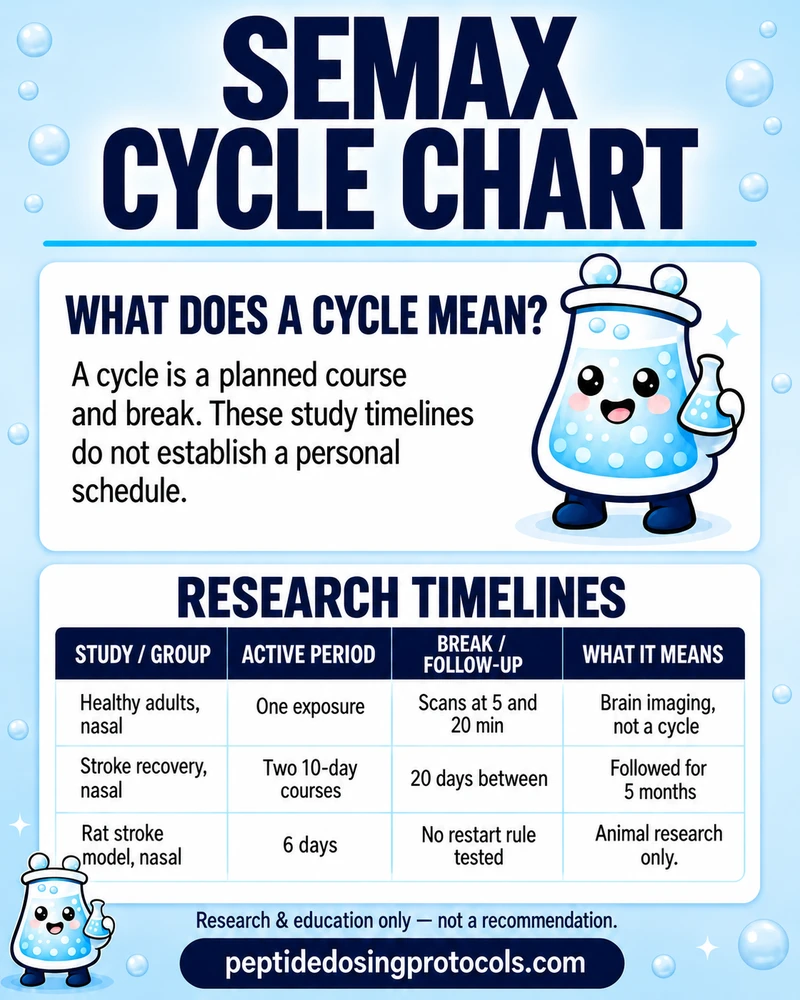
The table separates time receiving Semax from time being observed. Each row belongs to its own population and route. The numbers are research details, not a menu of cycles to choose from.
Semax exposure, observation, and evidence limits
Clinical treatment, short laboratory checks, and animal work answer different questions.
Study setting
Healthy adults, 2018; intranasal 1% solution
Exposure or course
One exposure
What the clock means
Brain scans before exposure and 5 and 20 minutes afterward
Study setting
Stroke rehabilitation, 2018; intranasal 1% drops
Exposure or course
Two 10-day courses, separated by 20 days
What the clock means
Follow-up continued to month 5; it was not continuous treatment
Study setting
Acute stroke, 1997; route not stated in the indexed abstract
Exposure or course
5- and 10-day courses reported
What the clock means
Treatment alongside intensive stroke care; no general restart rule
Study setting
Experimental stroke in rats, 2006; intranasal
Exposure or course
6 days
What the clock means
An animal injury model, not a human cycle
| Study setting | Exposure or course | What the clock means |
|---|---|---|
| Healthy adults, 2018; intranasal 1% solution | One exposure | Brain scans before exposure and 5 and 20 minutes afterward |
| Stroke rehabilitation, 2018; intranasal 1% drops | Two 10-day courses, separated by 20 days | Follow-up continued to month 5; it was not continuous treatment |
| Acute stroke, 1997; route not stated in the indexed abstract | 5- and 10-day courses reported | Treatment alongside intensive stroke care; no general restart rule |
| Experimental stroke in rats, 2006; intranasal | 6 days | An animal injury model, not a human cycle |
Sources: the Lebedeva brain-imaging study, Gusev stroke papers, and Romanova rat study linked below. Do not fill missing route information from a seller's chart.
A trial's calendar can include screening, treatment, rehabilitation, and later checkups. Only the treatment part describes exposure. Even a well-documented course does not tell us whether a shorter, longer, or repeated course would produce the same balance of benefit and harm.
Semax Cycle Supplies Needed
No validated human injection cycle supports a standard number of Semax vials, diluent bottles, or syringes. The exact research-catalog listing below is separate from the nasal formulations in the studies. Any generic supplier artwork is illustrative, not proof of the current product pack. The DailyPrintz case, SiPhox test kit, and Amazon links are optional shopping resources. A clinician decides which tests, if any, are appropriate; a commercial panel cannot establish that an untested cycle is safe. An optional Beyond Whoosh service card may also appear for a Semax/Selank blend. That blend is not original Semax alone and is not the nasal study material.
Research Supplies
Choose your region
Use discount code PEPPAL at Peptide Partners checkout. See why we love Peptide Partners.
 Illustrative brand image · Not the listed product
Semax (30mg vials)
Pharmacy Grade Semax / Selank
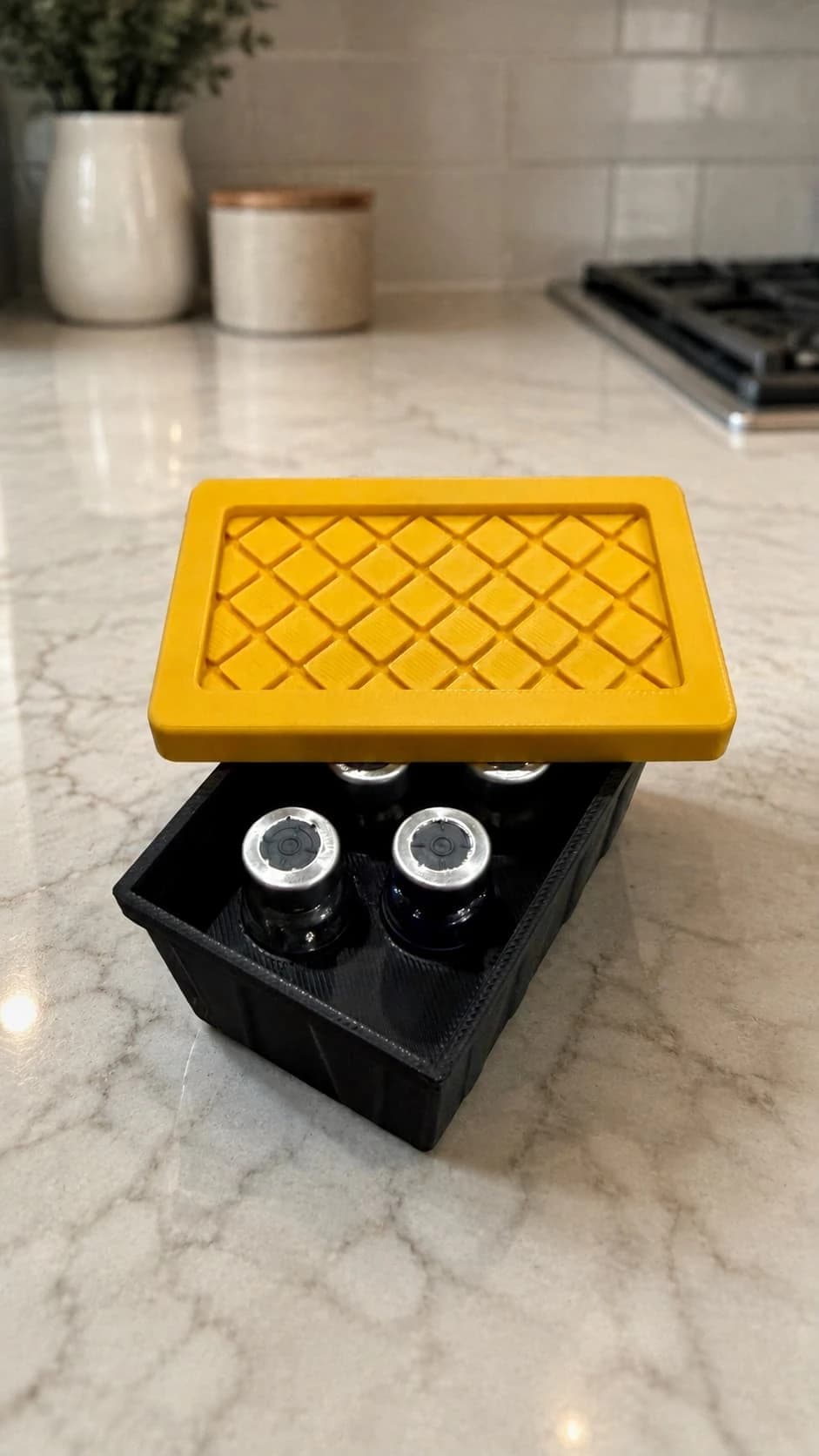
5-Vial Tote Case
At-Home Blood Test
Research Supplies
Disclosure: supply links may earn PDP a commission at no cost to you.
Exact compound and route
| Supply check | What matters |
|---|---|
Original Semax Identity must match | Check the full chemical name and formulation. An acetylated analog or Semax/Selank blend is not the single compound discussed here. |
Nasal product Product-specific device | Drops and metered sprays have different delivery systems. An injectable vial, syringe, or diluent does not establish nasal-product compatibility. |
Research vial quantities Not established | No personal vial, diluent, swab, or syringe count follows from a stroke-study timeline or an online course report. |
Original Semax
Identity must match
Check the full chemical name and formulation. An acetylated analog or Semax/Selank blend is not the single compound discussed here.
Nasal product
Product-specific device
Drops and metered sprays have different delivery systems. An injectable vial, syringe, or diluent does not establish nasal-product compatibility.
Research vial quantities
Not established
No personal vial, diluent, swab, or syringe count follows from a stroke-study timeline or an online course report.
Storage and optional records
| Supply check | What matters |
|---|---|
Storage and travel Verify the exact product | Follow documented temperature, container, and after-opening requirements. A generic mini fridge or travel case does not by itself meet medicine storage requirements. |
Clinical review Tests only if indicated | Keep product details, other medicines, and any new symptoms available for a clinician. There is no blood-test panel that clears an untested Semax cycle. |
Storage and travel
Verify the exact product
Follow documented temperature, container, and after-opening requirements. A generic mini fridge or travel case does not by itself meet medicine storage requirements.
Clinical review
Tests only if indicated
Keep product details, other medicines, and any new symptoms available for a clinician. There is no blood-test panel that clears an untested Semax cycle.
Supply links are separate from research citations. Neither buying an exact-name product nor checking a batch report proves medical suitability, a safe route, or a safe restart date.
Companion Supplies & Routine Support
What Did the Two 10-Day Courses Test?
The 2018 stroke-rehabilitation paper included 110 people after ischemic stroke, a stroke caused by blocked blood flow. Participants received rehabilitation with or without Semax. The methods describe nasal drops and visits at the start and at months 1, 2, and 5. Treatment was given alongside medicines, exercise, and other rehabilitation care.
The authors reported changes in blood BDNF, a protein linked to nerve-cell support, and in daily functioning. They used the Barthel index, which scores tasks such as eating, walking, and personal care. Those results concern recovery after stroke. They do not measure exam performance, work productivity, or memory gains in healthy adults.
The planned gap is real, but its presence does not prove it was the best gap. The study did not compare several break lengths or show that a break prevents tolerance. A schedule can be part of a study without being the part that the study tested against alternatives.
Follow-up is not a five-month cycle
Later visits help show how outcomes change over time. They do not mean the medicine was taken each day until the last visit, nor that a benefit will last that long for a different person.
Do Earlier 5–10-Day Reports Set a Standard?
An earlier clinical report compared 30 people receiving Semax during acute stroke care with 80 people receiving conventional treatment. The indexed abstract reports five- and ten-day courses. It does not specify the route, so the abstract alone cannot verify an injection or nasal schedule.
Acute stroke care and later rehabilitation are different settings. A short course started around a brain injury is not evidence that the same number of days improves focus in an otherwise healthy person. Disease severity, other treatment, timing, and the measured outcome all affect what can be learned.
A later paper is not automatically stronger because it uses more days, and an earlier paper is not useless because it is old. The useful questions are whether the comparison was fair, whether the outcome matters, and whether the exact product and route match the claim being made today.
What Do the Healthy-Volunteer Brain Scans Show?
The 2018 brain-imaging study included 24 healthy volunteers: 14 received nasal Semax and 10 received placebo, a comparison treatment without Semax. Researchers measured resting brain activity with functional MRI. They found a difference in part of the brain's default-mode network, a set of areas active during rest.
A change on a scan shows a measurable effect under those conditions. It does not by itself show better learning, fewer mistakes at work, or lasting memory improvement. The study's checks within minutes also cannot establish how a person responds after weeks or months.
Brain-scan timing is sometimes confused with onset of benefit. A scan taken at a certain minute tells us when researchers looked. It does not promise that a person will notice a useful effect by then. A meaningful clinical benefit needs its own measurement, ideally compared with placebo.
Can Animal Studies or BDNF Set a Cycle Length?
In a rat study of experimental brain injury, six days of nasal Semax was linked to a smaller damaged area and better performance on a learned avoidance task. The study used an induced stroke-like injury. It did not test long-term cycles in people.
Animal studies help researchers explore mechanisms and decide what to study next. Their timelines depend on the model, the animal's biology, and the experiment's goal. A number of days cannot be carried from that setting to a person just because the compound has the same name.
The same limit applies to BDNF claims. A blood-protein change, a brain-tissue change, and better day-to-day function are separate findings. A higher marker is not automatically a better result. It cannot tell someone when to stop, how long to wait, or whether another course will help.
Why Nasal and Injectable Semax Need Separate Evidence
Intranasal means given into the nose. Subcutaneous means injected under the skin. These routes bring a substance into contact with different tissues and may lead to different exposure. Matching the amount written on two labels does not prove that the body receives the same treatment.
Even within nasal use, a dropper and a spray pump are not the same device. Concentration describes how much is in a volume of liquid. Delivery depends on how much liquid the device releases. A study of a prepared nasal medicine cannot validate a homemade spray made from research powder.
FDA's 2026 scientific review found insufficient information to define nasal Semax safety and no safety data for the proposed subcutaneous route. It also identified gaps in product quality and possible immune reactions related to peptide clumping or impurities. These concerns cannot be solved by choosing a shorter cycle.
An analog is a new evidence question
Do not transfer an original-Semax course to N-acetyl Semax, its amidated version, Adamax, or a blend. Chemical changes and added ingredients need their own evidence for duration, stopping, and safety.
How Much Time Off Is Supported?
No general break length has been established for healthy-user Semax cycles. A gap used in a stroke study and a gap described online are facts about those accounts. Neither establishes a universal reset period. There is also no verified rule here that using Semax only on weekdays prevents loss of effect.
Tolerance means a response becomes weaker with repeated exposure. Feeling less of an effect can also reflect sleep loss, stress, expectations, a different product, or a change in other substances. A diary may show when something changed, but it cannot tell which explanation is correct.
To show that breaks restore a response, researchers would need to compare continued treatment with defined breaks and follow later courses. The comparison should measure both useful outcomes and harms. Simply repeating the first course does not answer that question.
Feeling worse during use is not a reason to wait for an online cycle to finish. New or persistent symptoms deserve clinical review. If a clinician is directing treatment, discuss interruptions or changes with them rather than using a forum's restart date.
Do Benefits Last, and Can Half-Life Set the Break?
There is no reliable prediction here for how long a focus or memory effect lasts after stopping. An online report may reflect a genuine experience, but it lacks a matched untreated comparison. Ongoing recovery, improved sleep, practice on a task, and changed expectations can all affect the result.
Half-life is the time for a measured drug level to fall by half. It is not the same as the length of a benefit, the end of all biological effects, or a safe restart time. A claim that several half-lives equal a complete reset needs more than arithmetic.
FDA's review also found no published human pharmacokinetic studies for Semax. Pharmacokinetics describes how the body absorbs, moves, and clears a substance. A human break plan should not be built from an unverified half-life or a value taken from rats.
Three clocks, three questions
Time receiving the product, time until the next measurement, and time until a reported effect fades are different. None should be silently substituted for another in a cycle chart.
What Safety Limits Matter Before Repeat Use?
Small or short studies can miss uncommon harms. A paper that does not discuss adverse events is not evidence that no adverse events occurred. A familiar course length cannot fill gaps in information about repeated use, combinations, pregnancy, or individual health risks.
Bring the exact product label, route, other medicines, and timing of symptoms to a qualified clinician. A symptom record is useful for that discussion. It is not a self-run safety trial, and a normal routine blood panel does not prove that an unapproved product is safe.
Do not delay urgent care
Sudden trouble speaking, facial droop, one-sided weakness, or a severe new headache needs emergency assessment. Trouble breathing or facial swelling also needs urgent care. A peptide course must never delay care for a possible stroke or severe allergic reaction.
For less urgent problems such as persistent sleep disruption, anxiety, or headaches, seek medical advice rather than adding another compound to balance the effect. Adding substances makes both risks and the cause of symptoms harder to assess.
How to Check a Semax Cycle Claim
- Find the original paper or complete personal report. A seller's summary is not a substitute for it.
- Confirm the exact compound and route. Original Semax, modified analogs, and blends are separate products.
- Check who was studied. Stroke rehabilitation, healthy volunteers, and injured rats are different settings.
- Mark treatment days separately from follow-up visits. Do not count every study month as exposure.
- Ask whether the break itself was compared with another break or with continued treatment.
- Look for meaningful outcomes and side-effect reporting. A scan, marker, or enthusiastic testimonial cannot answer every question.
A careful claim should still make sense after all those details are added. If it only works when the population, route, or study limits are removed, it is too broad to guide a health decision.
Semax Cycle FAQs
Q1: Is 10 days the standard Semax cycle?
No. Ten-day courses appear in clinical research, but that does not establish a general focus or memory cycle. The population, nasal formulation, other care, and follow-up matter. Research vials cannot inherit that schedule.
Q2: Was a 20-day break actually studied?
A stroke-rehabilitation paper included that interval between two courses. It did not compare different breaks or show that the interval resets tolerance. A study design is not a universal restart rule.
Q3: Can Semax be used for four weeks on and two weeks off?
That pattern appears in a verified personal report involving both Semax and Selank. It is not a validated Semax-only schedule. The writer used other substances and reported both benefits and anxiety.
Q4: Does Semax need weekend breaks?
The studies reviewed here do not establish a weekday-only schedule or show that weekend gaps prevent tolerance. A convenient calendar pattern is not evidence of a safer cycle.
Q5: Can I use a nasal study to plan subcutaneous Semax?
No. A change in route changes the exposure and safety questions. Nasal drops, sprays, and injected research material cannot be treated as the same product with different packaging.
Q6: Does a brain-scan change prove better memory?
No. Functional MRI measures patterns linked to brain activity. A change on a scan does not itself show better learning, work performance, or a lasting benefit after a course ends.
Q7: Does Semax half-life tell me when to restart?
No. Clearance, biological effects, and safety are different questions. A half-life calculation does not establish a reset period, especially when reliable human exposure data are missing.
Q8: Are N-acetyl Semax and Semax the same cycle?
They should not share a cycle by assumption. The chemical modification creates a separate evidence question. The same applies to amidated analogs, Adamax, and blends with Selank.
Q9: How many Semax vials are needed for a cycle?
There is no established personal injection cycle from which to calculate a supply quantity. A trial duration or a community report cannot determine a safe vial, diluent, or syringe count.
Q10: Does compounding discussion mean Semax is FDA-approved?
No. A compounding review and approval of a medicine are separate processes. Neither a committee discussion nor a research listing establishes an approved personal cycle.
Sources & Research
- 1. Gusev EI, Martynov MY, Kostenko EV, Petrova LV, Bobyreva SN The efficacy of semax in the treatment of patients at different stages of ischemic stroke Zhurnal Nevrologii i Psikhiatrii imeni S.S. Korsakova; original Russian full text (2018)
- 2. Lebedeva IS, Panikratova YR, Sokolov OY, et al. Effects of Semax on the Default Mode Network of the Brain Bulletin of Experimental Biology and Medicine (2018)
- 3. Gusev EI, Skvortsova VI, Miasoedov NF, et al. Effectiveness of semax in acute period of hemispheric ischemic stroke (a clinical and electrophysiological study) Zhurnal Nevrologii i Psikhiatrii imeni S.S. Korsakova; indexed abstract (1997)
- 4. Romanova GA, et al. Neuroprotective and antiamnesic effects of Semax during experimental ischemic infarction of the cerebral cortex Bulletin of Experimental Biology and Medicine (2006)
- 5. U.S. Food and Drug Administration Semax-related bulk drug substances: Semax (free base) and Semax acetate July 24, 2026 Pharmacy Compounding Advisory Committee scientific presentation (2026)
- 6. Semax 2 Week Experience r/Nootropics; original personal report and comments, reviewed October 15, 2026 (2021)
- 7. Semax & Selank Actetate Experience r/Nootropics; original personal report and comments, reviewed October 15, 2026 (2021)
Related Dosing Protocols
Educational use only
Peptide Dosing Protocols is an independent educational reference. This page is not medical advice or a recommendation to use research products. Consult a licensed healthcare provider about symptoms or decisions to start, change, stop, or restart treatment.
Keep the route attached to the research
Read the Semax background alongside the original studies. Product math does not establish a clinical cycle.

Written by Garret Grant
Founder & Lead Researcher · B.S. Civil Engineering, UCLA
Last updated: October 2026
Human-researched and AI-assisted with full editorial review. I verify sources, protocol interpretation, and final judgments personally. See methodology.
Share this page