
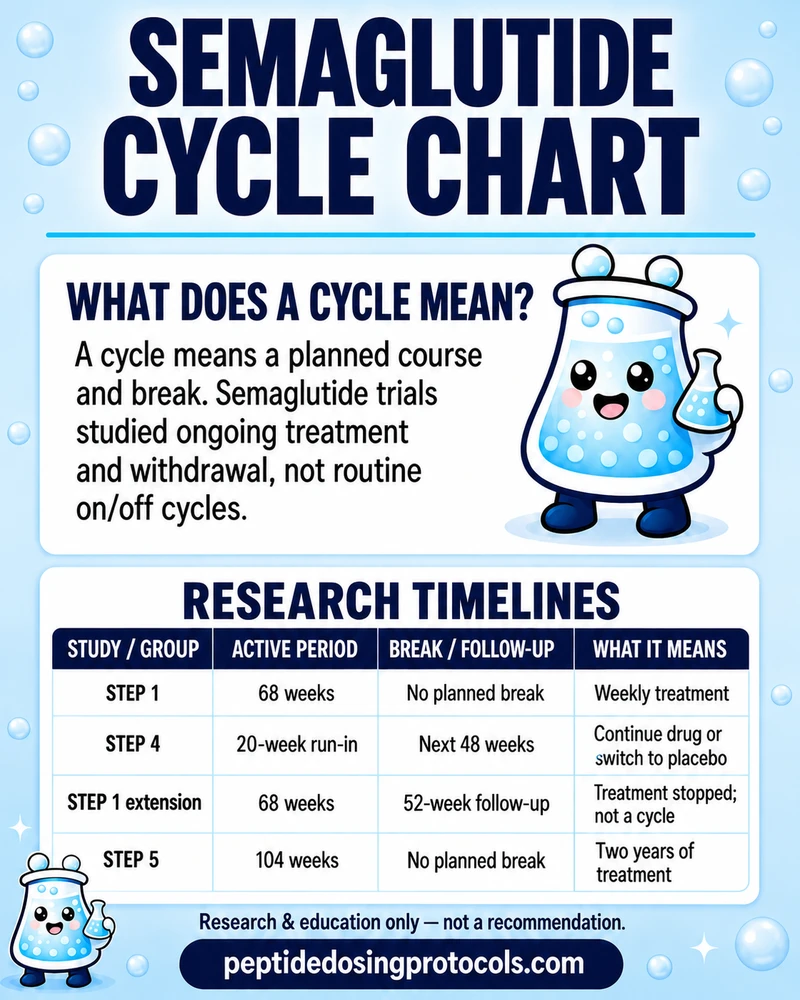
How Long Is a Semaglutide Cycle?
There is no standard on-and-off semaglutide cycle established by the trials below. For prescribed weight management, the better-supported model is ongoing treatment with regular review. That does not mean every person must continue forever. It means a calendar alone cannot decide when treatment should end.
Online, cycle may mean a few months of use followed by time off. In a study, treatment duration means how long the research plan assigned treatment. Follow-up means the period during which researchers kept checking participants, sometimes after the drug stopped. These terms are not interchangeable.
The useful question
Ask what condition is being treated, whether the treatment is helping, and what happens if it changes. A package advertised as a three-month supply does not establish a three-month medical course.
This page covers duration and stopping. The semaglutide protocol guide provides separate product and dosing background. For personal treatment, use the exact prescription label and your clinician's instructions.
Which Semaglutide Product and Use Are We Discussing?
The ingredient name does not tell the whole story. The U.S. labels reviewed for this guide distinguish weekly injections from daily tablets, used alongside the specified diet and activity measures. Approval for one version or patient group does not apply to every semaglutide product.
Approved U.S. products: key differences
Product
Wegovy injection
Approved uses and limits
Weight reduction and long-term maintenance in adults and ages 12+ with obesity, or adults with overweight and a weight-related condition. Also reduces major cardiovascular events in adults with established cardiovascular disease and overweight or obesity. Treats adult noncirrhotic MASH with F2–F3 liver fibrosis (moderate to advanced scarring) under accelerated approval.
Product
Wegovy tablets
Approved uses and limits
Adult weight reduction and maintenance, and the adult cardiovascular indication above. No pediatric or MASH indication.
Product
Ozempic injection
Approved uses and limits
Blood-sugar control in adults with type 2 diabetes. Reduces major cardiovascular events with established cardiovascular disease, and specified kidney and cardiovascular risks with chronic kidney disease, in adults with type 2 diabetes.
Product
Rybelsus tablets and Ozempic tablets
Approved uses and limits
Blood-sugar control in adults with type 2 diabetes, and reduction of major cardiovascular events in adults with type 2 diabetes at high risk for those events. These tablet formulations are not interchangeable milligram for milligram.
| Product | Approved uses and limits |
|---|---|
| Wegovy injection | Weight reduction and long-term maintenance in adults and ages 12+ with obesity, or adults with overweight and a weight-related condition. Also reduces major cardiovascular events in adults with established cardiovascular disease and overweight or obesity. Treats adult noncirrhotic MASH with F2–F3 liver fibrosis (moderate to advanced scarring) under accelerated approval. |
| Wegovy tablets | Adult weight reduction and maintenance, and the adult cardiovascular indication above. No pediatric or MASH indication. |
| Ozempic injection | Blood-sugar control in adults with type 2 diabetes. Reduces major cardiovascular events with established cardiovascular disease, and specified kidney and cardiovascular risks with chronic kidney disease, in adults with type 2 diabetes. |
| Rybelsus tablets and Ozempic tablets | Blood-sugar control in adults with type 2 diabetes, and reduction of major cardiovascular events in adults with type 2 diabetes at high risk for those events. These tablet formulations are not interchangeable milligram for milligram. |
Cardiovascular disease affects the heart or blood vessels. Major events include cardiovascular death, heart attack, or stroke. MASH is a form of fatty liver disease with inflammation; fibrosis means scarring. Noncirrhotic means cirrhosis has not developed.
Sources: Wegovy injection and tablets label, Ozempic injection label, and Rybelsus and Ozempic tablets label. The MASH approval depends on further confirmation of clinical benefit. These are U.S. indications; local approvals can differ.
Community Reports: Untested Cycle Lengths
Anecdotes are not a treatment schedule
The durations below are online reports and proposals, not clinically established cycles or recommendations. Product identity, purity, route, other treatments, and side effects cannot be independently checked. A forum's rules do not verify the product a writer used.
In the original Semaglutide Break discussion, the author describes six months of use with favorable results and proposes a one-month break. The post does not report completing that break and restart. It also does not identify the exact prescription product or route.
The original Cycling semaglutide thread asks about four months on and four months off before the writer has started. That is a proposed plan, not a completed experience. Replies disagree: some describe repeat use, while another describes seven months of Ozempic followed by strong hunger and weight regain over three months off. Those accounts cannot establish why the outcomes differed.
These discussions were reviewed October 15, 2026. They are a small, self-selected sample, not a survey or community consensus. We could read the original accounts, but could not verify a formulation-and-route-specific cycling regimen. In particular, a claimed reset is not a measured change in drug response. The prescription and withdrawal evidence below carries more weight.
What Timelines Did Human Studies Test?
STEP 1, STEP 4, STEP 5, and SELECT targeted a 2.4 mg weekly injection. OASIS 4 studied a 25 mg daily tablet. These identify the research formulations, not a dose recommendation. A placebo is a comparison treatment without the active drug. In a randomized study, people are assigned to groups by chance to make the comparison fairer.
Semaglutide study time versus time off treatment
These are study designs, not recommended personal courses.
Study
STEP 1
Timeline
68 weeks
What it tested
Weekly injection versus placebo, with lifestyle support
Study
STEP 4
Timeline
20-week lead-in + 48 weeks
What it tested
Continue the injection or switch to placebo; lifestyle support continued
Study
STEP 1 extension
Timeline
68 weeks + 52 weeks off treatment
What it tested
A subset followed after drug and trial lifestyle support stopped
Study
STEP 5
Timeline
104 weeks
What it tested
Two years of weekly injection versus placebo
Study
SELECT
Timeline
Mean follow-up: 39.8 months
What it tested
Cardiovascular outcomes; average time on study medicine was shorter
Study
OASIS 4
Timeline
Week-64 main outcome; 71-week trial
What it tested
Daily oral treatment in adults without diabetes
| Study | Timeline | What it tested |
|---|---|---|
| STEP 1 | 68 weeks | Weekly injection versus placebo, with lifestyle support |
| STEP 4 | 20-week lead-in + 48 weeks | Continue the injection or switch to placebo; lifestyle support continued |
| STEP 1 extension | 68 weeks + 52 weeks off treatment | A subset followed after drug and trial lifestyle support stopped |
| STEP 5 | 104 weeks | Two years of weekly injection versus placebo |
| SELECT | Mean follow-up: 39.8 months | Cardiovascular outcomes; average time on study medicine was shorter |
| OASIS 4 | Week-64 main outcome; 71-week trial | Daily oral treatment in adults without diabetes |
Details and source links appear below. A study's total length can include periods when participants no longer receive the drug.
Keep the study group attached to the number. For example, the STEP 4 continued-treatment group and withdrawal group had different amounts of active treatment, even though both were part of the same 68-week trial.
Semaglutide Treatment and Research Supplies Needed
For prescribed semaglutide, the dispensing pharmacy should confirm the exact product, device, refill amount, and storage instructions. The research-catalog card is a separate category and is not an approved medicine. The case, blood-test kit, and Amazon links are optional shopping resources. A clinician decides which tests, if any, are useful; a commercial panel cannot prove an untested cycle safe. A generic case or mini fridge does not by itself meet a medicine's temperature requirements. An optional Beyond Whoosh clinician-service card may list compounded semaglutide. Compounded products are not FDA-approved and are not the branded medicines tested in these trials.
Research Supplies
Choose your region
Use discount code PEPPAL at Peptide Partners checkout. See why we love Peptide Partners.
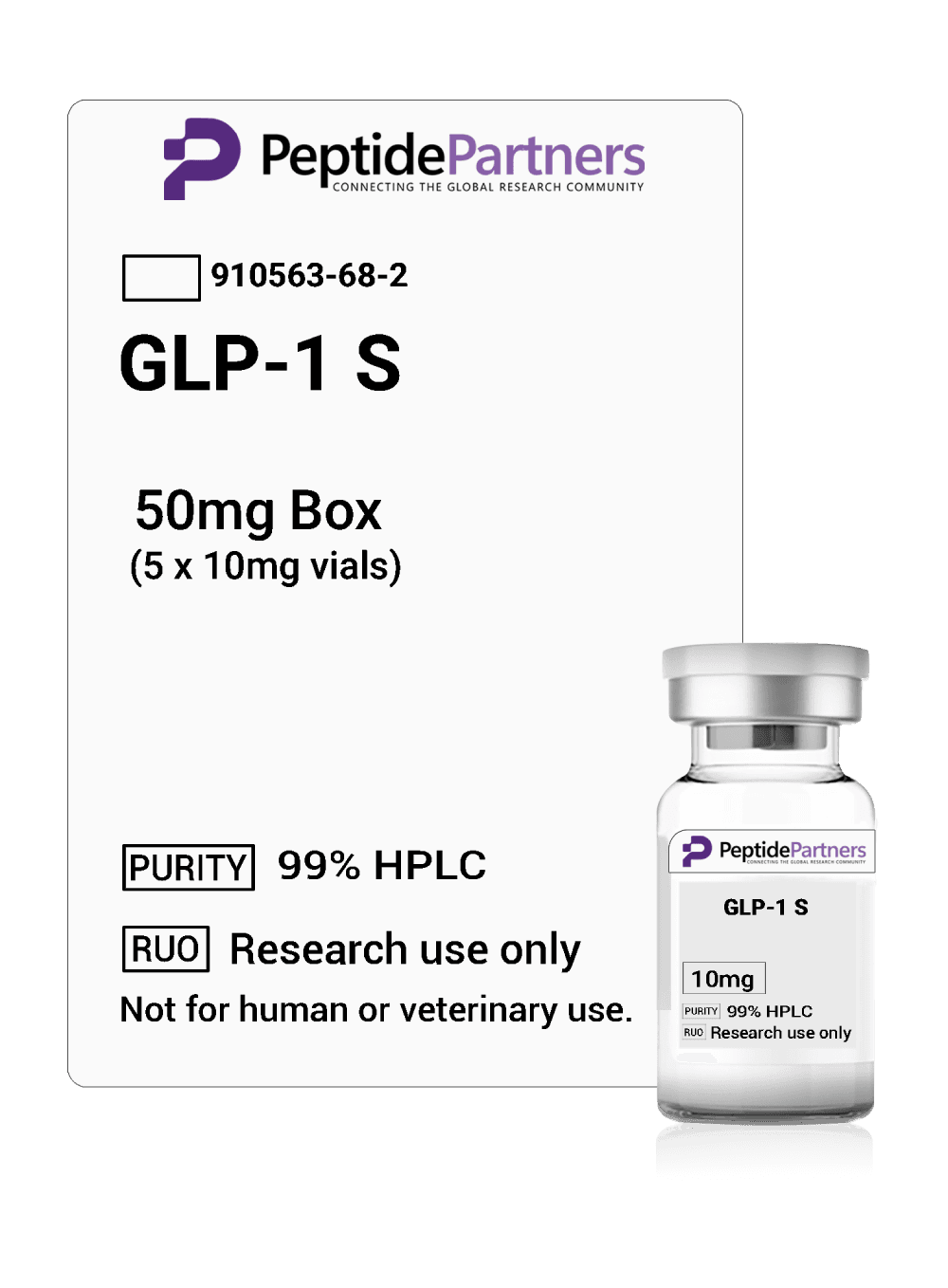
GLP-1 Semaglutide (10mg vials)
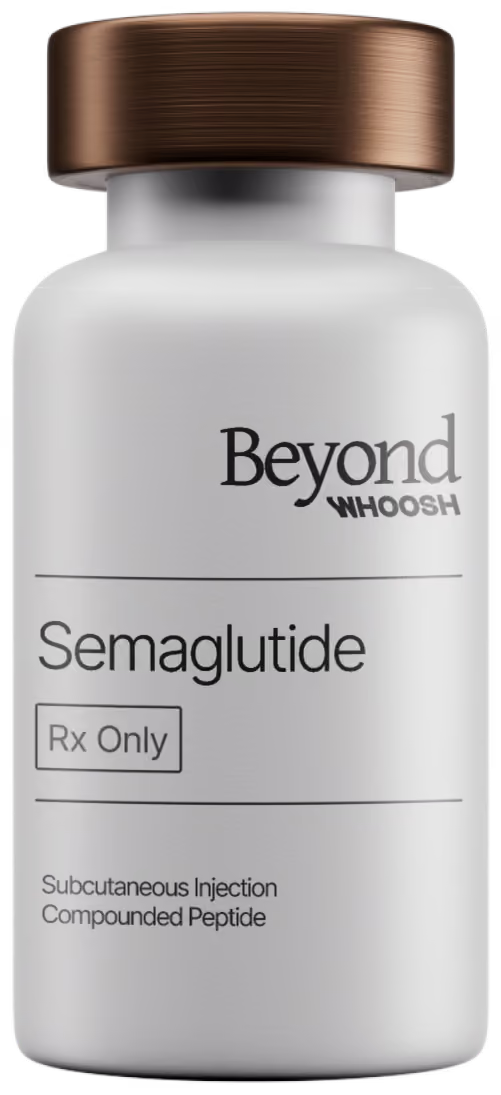
Pharmacy Grade Semaglutide
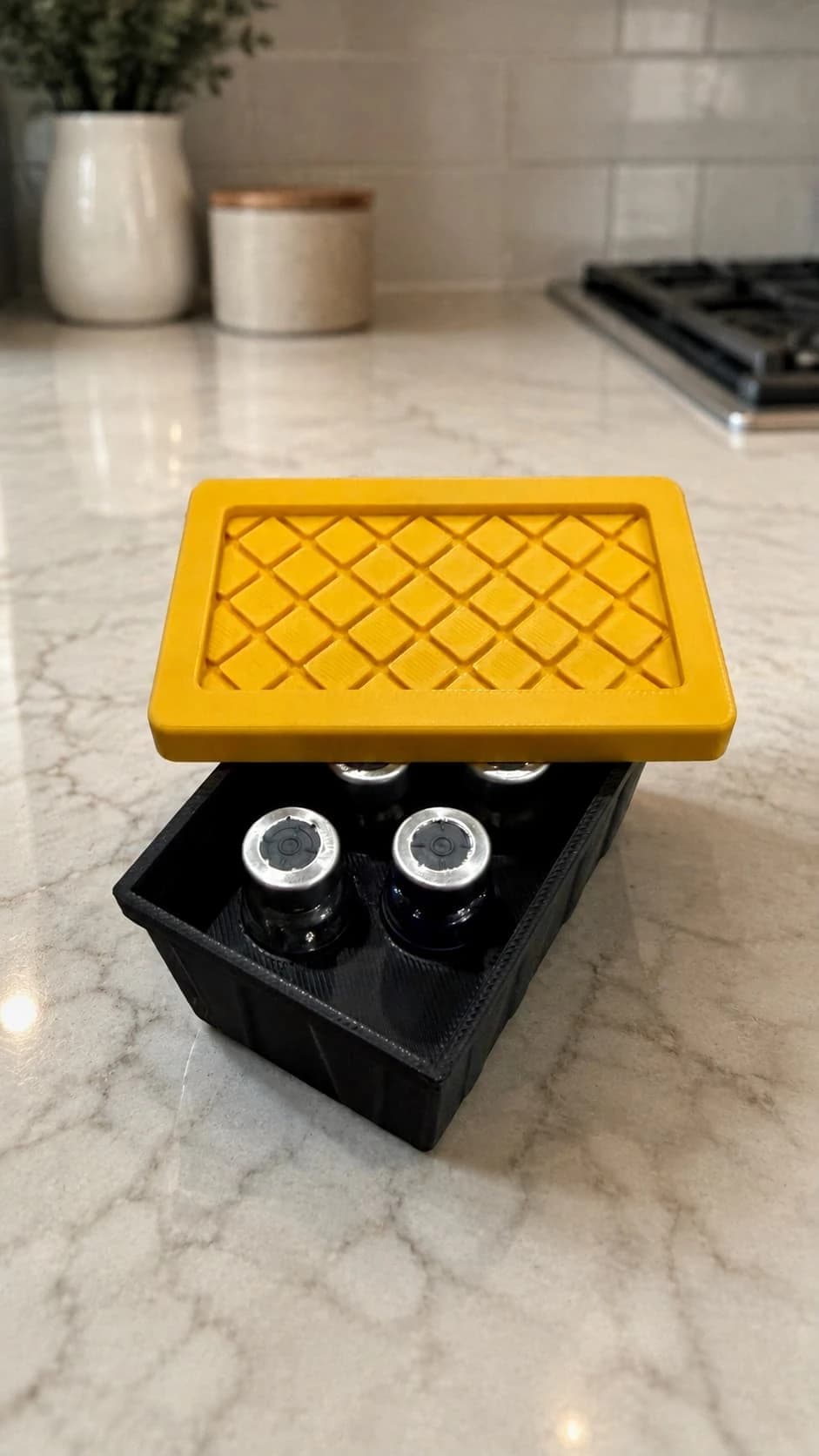
5-Vial Tote Case
At-Home Blood Test
Research Supplies
Disclosure: supply links may earn PDP a commission at no cost to you.
Exact prescription product
Treatment duration alone does not tell you what to buy or how many packages are needed.
| Supply check | What to verify |
|---|---|
Brand, form, and device As prescribed | Confirm whether the prescription is for a particular injection presentation or a tablet. Ask the pharmacy which materials are supplied and which compatible accessories, if any, are needed. |
Refills and interruption plan Pharmacy-confirmed quantity | Check the next refill before running out. A change in access is a reason to contact the prescriber, not to invent a break-and-restart schedule. |
Brand, form, and device
As prescribed
Confirm whether the prescription is for a particular injection presentation or a tablet. Ask the pharmacy which materials are supplied and which compatible accessories, if any, are needed.
Refills and interruption plan
Pharmacy-confirmed quantity
Check the next refill before running out. A change in access is a reason to contact the prescriber, not to invent a break-and-restart schedule.
Handling and storage
| Supply check | What to verify |
|---|---|
Finished medicine Product-specific instructions | Approved injections and tablets do not use research-powder reconstitution instructions. Do not substitute generic BAC-water math or draw medicine out of a pen to fit a research-vial plan. |
Temperature and discard dates Check the supplied label | Unopened storage, in-use storage, travel limits, and discard dates can differ by product and device. Ask the pharmacy about a temperature excursion rather than judging the medicine by appearance. |
Finished medicine
Product-specific instructions
Approved injections and tablets do not use research-powder reconstitution instructions. Do not substitute generic BAC-water math or draw medicine out of a pen to fit a research-vial plan.
Temperature and discard dates
Check the supplied label
Unopened storage, in-use storage, travel limits, and discard dates can differ by product and device. Ask the pharmacy about a temperature excursion rather than judging the medicine by appearance.
Research listings and optional accessories
| Supply check | What to verify |
|---|---|
Vials, diluent, and syringes No established cycle quantity | The clinical trials and community posts do not establish a personal research-vial supply plan. A catalog strength does not establish equivalence to the trial medicine, sterility, or usable storage life. |
Case and testing links Optional | Check fit, transport needs, and any test's purpose before buying. Neither a five-vial case nor a blood panel implies that five vials or routine commercial testing are needed. |
Vials, diluent, and syringes
No established cycle quantity
The clinical trials and community posts do not establish a personal research-vial supply plan. A catalog strength does not establish equivalence to the trial medicine, sterility, or usable storage life.
Case and testing links
Optional
Check fit, transport needs, and any test's purpose before buying. Neither a five-vial case nor a blood panel implies that five vials or routine commercial testing are needed.
Separate shopping information from clinical evidence. Supply counts and accessories do not determine whether treatment is suitable or how long it should continue.
Companion Supplies & Routine Support
What Does the 68-Week STEP 1 Trial Show?
STEP 1 enrolled 1,961 adults with obesity, or overweight with a related health condition, without diabetes. It compared weekly semaglutide injection with placebo for 68 weeks, alongside lifestyle support. Average weight change was a 14.9% reduction with semaglutide and a 2.4% reduction with placebo.
This was a group average, not a promise for one person. The main analysis included the effects of treatment interruptions and other weight-management treatments. A result calculated only among people who stayed on the medicine can answer a different question and give a different number.
The week-68 measurement does not mean treatment only begins working then. Nor does it identify an ideal stop date. To establish a repeat cycle, a study would need to test the actual sequence of treatment, break, and restart, with clear outcomes and safety checks.
STEP 4: What Happened When Treatment Continued or Stopped?
In STEP 4, 902 adults entered a 20-week lead-in, when everyone received semaglutide. Of these, 803 reached the maintenance dose and were assigned to continue treatment or switch to placebo for 48 more weeks. Both groups kept lifestyle support.
From week 20 to week 68, average weight changed by −7.9% with continued treatment versus +6.9% after the switch to placebo. These percentages start at week 20, after the lead-in weight loss. They are not changes measured from the original starting weight.
A withdrawal comparison is not a cycling test
The placebo group was not testing a break followed by a new course. Also, only people who reached the study's maintenance dose entered the randomized comparison. That limits how directly the result applies to someone who cannot tolerate starting treatment.
What Does the Two-Thirds Weight-Regain Finding Mean?
The STEP 1 extension followed 327 participants for 52 weeks after the 68-week treatment phase. Both medication and structured lifestyle support had ended.
The former semaglutide group had lost an average 17.3% before stopping. Over the next year, it regained 11.6 percentage points, about two-thirds of that loss. Average weight remained 5.6% below the original starting level. This subset's 17.3% is different from the main STEP 1 result.
Two-thirds describes the average amount regained, not how many people regained everything. This exploratory follow-up was not a new randomized stopping-versus-continuing trial. Removing lifestyle support also limits what can be attributed to drug withdrawal alone.
Discuss maintenance before stopping. This study cannot predict individual regain or establish a taper that prevents it.
Does a Plateau Mean Semaglutide Needs a Reset?
The STEP 5 trial studied 304 adults for 104 weeks. Average weight change was −15.2% with semaglutide versus −2.6% with placebo. Weight loss leveled off around week 60 and was largely maintained through the rest of the trial.
That matters because a stable lower weight can be a maintained benefit. It is not, by itself, proof that the drug stopped working or that the body needs time off. STEP 5 did not compare a reset break with continued treatment.
If progress changes, review the whole picture with the prescriber: the original treatment goal, side effects, missed treatment, other medicines, food intake, and activity. A plateau alone cannot identify its cause. The decision may be to maintain, adjust, change, or stop treatment, but those choices need more information than a week count.
What Do Longer SELECT Results Add?
SELECT enrolled 17,604 adults aged 45 or older with existing cardiovascular disease and overweight or obesity, without diabetes. It tested major heart and stroke outcomes. Participants received the assigned study treatment for an average 34.2 months and were followed for an average 39.8 months. Follow-up was longer than time on treatment.
The main cardiovascular outcome occurred in 6.5% of the semaglutide group and 8.0% of the placebo group. This is a 1.5-percentage-point absolute difference; the trial reported a 20% lower risk over time, based on a hazard ratio of 0.80. That measure accounts for when events happen. It is not calculated by simply dividing those two percentages, and it is not a personal prediction.
A separate SELECT weight analysis reported weight outcomes through week 208, or four years. Mean weight change at that point was −10.2% with semaglutide and −1.5% with placebo. That adds longer-term evidence, but it does not mean every participant took uninterrupted treatment for four years.
These results should not be ranked against STEP 1 by percentage alone. SELECT enrolled an older, higher-risk population and answered a different main question. Its four-year observation also does not set either a universal four-year limit or proof of lifelong safety.
Do Tablets Have the Same Cycle Evidence as Injections?
No. OASIS 4 studied daily oral semaglutide in 307 adults without diabetes. Its main weight outcomes were assessed at week 64 within a 71-week trial. Average weight change at week 64 was −13.6% with oral semaglutide and −2.2% with placebo.
This was not a trial of switching between tablets and injections, or taking regular tablet holidays. A matching ingredient does not make the formulations interchangeable. The amount absorbed and the approved instructions differ. Nor can results for one oral version be treated as a dosing plan for another.
The Rybelsus and Ozempic tablets label specifically separates those formulations. Follow the exact product's rules for missed doses and switching. A tablet is not a way to recreate an injection schedule through milligram arithmetic.
Is the Starting Phase a Complete Treatment Course?
Titration means changing the dose in steps. For Wegovy injection, the initial escalation spans weeks 1–16 before the maintenance stage. That starting period is meant to help tolerability; it does not define a 16-week course followed by time off.
A maintenance dose is the dose used for ongoing treatment. Maintenance does not mean that every patient must remain on the same amount forever. It also does not mean weight can never change again. The product, indication, response, and side effects still guide review.
The trial durations on this page often include the starting phase. Counting only time at the final study dose would produce a different number. Neither count supplies a tested off-cycle period. Use the product-specific protocol background for dosing questions rather than treating the research chart as a prescription.
Are Breaks, Tapers, or Repeated Courses Proven to Work?
The studies reviewed here do not establish a standard two-, four-, or eight-week break, or show that planned breaks restore the drug's effect. They also do not establish a taper that reliably prevents regain. A clinician-led treatment change is different from a repeating cycle chosen in advance.
Stopping can happen for many reasons: side effects, pregnancy planning, another illness, access problems, or a change in goals. Those reasons need different responses. A temporary pause for a medical problem does not become evidence that healthy patients benefit from regular breaks.
An interruption needs its own restart plan
Do not assume the previous dose is suitable after a gap. The June 2026 Wegovy injection label directs restarting escalation at a lower dose after two or more consecutive missed doses. Contact the prescriber for the exact plan; that instruction is not a recommendation to schedule breaks.
If access may lapse, discuss it before the supply runs out. Ask who to contact, which health measures need review, and what the plan is if the gap lasts longer than expected. Do not replace a prescription with a research product or combine products to cover the interruption.
Does Half-Life Tell You How Long to Take Off?
Half-life is the time for the drug level in the body to fall by half. The Ozempic injection label describes a half-life of about one week and drug remaining in circulation for about five weeks after the last dose.
This describes drug clearance, not a reset of appetite, body weight, or treatment response. Drug levels fall gradually; that does not prove that all effects end on one date. Multiplying the half-life cannot produce an evidence-based restart rule.
For the same reason, a pregnancy-planning interval is not a weight-loss cycling interval. The Ozempic injection label directs stopping at least two months before a planned pregnancy. Discuss this early with the treating clinician, including how the underlying condition will be managed. Other products and indications need their own review.
Can Research Vials or Blends Use the Same Evidence?
The FDA's guidance on unapproved GLP-1 products distinguishes approved medicines from compounded and illegally marketed versions. Compounded drugs are not FDA-approved. Semaglutide sodium and semaglutide acetate are different active ingredients from the semaglutide used in approved products.
FDA also warns about dosing errors and products sold as research materials for human use. The supplier card on this page identifies a research listing only. It does not show that the material is equivalent to the drug used in STEP, SELECT, or OASIS.
A batch analysis cannot answer every question about sterility, handling, or clinical safety. Likewise, adding cagrilintide or another compound changes the treatment being studied. Single-drug results cannot establish the benefit, duration, or safety of that combination. Read combination evidence separately rather than borrowing the longest semaglutide trial.
Which Safety Issues Can Change the Treatment Plan?
Common problems include nausea, vomiting, diarrhea, constipation, and abdominal discomfort. Longer studies give more time to detect harms, but a short course does not remove risk. Side effects deserve review when they happen, not only at the end of a planned course.
The Ozempic injection label warns about pancreas inflammation, gallbladder problems, dehydration-related kidney injury, and diabetic eye complications. Low blood sugar is more likely with insulin or medicines that increase insulin release. These concerns can matter even when weight is falling.
The oral semaglutide label includes a boxed warning about thyroid C-cell tumors seen in rodents; the human risk is unknown. Do not use these products with a personal or family history of medullary thyroid cancer, or MEN 2, an inherited condition that raises the risk of certain tumors. Do not use a product after a serious allergic reaction to semaglutide or one of its other ingredients.
Semaglutide slows stomach emptying. Tell the anesthesia team about it before surgery or deep sedation because stomach contents may enter the lungs, called aspiration. Do not set your own surgery-related pause. The team needs the exact medicine, recent use, symptoms, and procedure details.
Do not wait for a cycle to end
Get urgent medical advice for severe or persistent abdominal pain, repeated vomiting, or signs of dehydration. Trouble breathing or swelling of the face or throat needs emergency care. Tell the prescriber promptly about vision changes or other new symptoms.
What Should a Maintenance Discussion Cover?
A useful review starts with the reason for treatment. A weight-management goal, blood-sugar goal, kidney-risk goal, and cardiovascular-risk goal are not interchangeable. Scale weight alone cannot tell whether all of those goals have been met.
- What benefit are we measuring, and when will we review it?
- Are side effects or other medicines changing the balance of benefit and risk?
- If weight is stable, does that represent successful maintenance?
- What is the plan if cost, supply, illness, or pregnancy plans interrupt treatment?
- If treatment stops, what support and follow-up will remain in place?
- Who should I contact before restarting or switching formulations?
Keep a clear record of the exact product, relevant symptoms, interruptions, and agreed review date. That is more useful than tracking only how many weeks are left in a cycle. An ongoing plan should remain open to change when the person's needs change.
Semaglutide Cycle FAQs
Q1: Is 12 weeks a complete semaglutide cycle?
The reviewed evidence does not establish 12 weeks as a complete course followed by a break. Early dose increases and total treatment duration are different. Discuss the goal and review date for the exact prescribed product.
Q2: Does the 68-week trial mean I should stop at week 68?
No. A research endpoint tells you when investigators measured outcomes. It does not identify the best stopping date for every patient or prove that benefit will last without treatment.
Q3: Will everyone regain all their weight after stopping?
No. The withdrawal studies report averages and substantial variation. Weight regain was common, but no study result can predict an individual's amount or timing. A maintenance discussion should happen before treatment changes.
Q4: Does a plateau prove that receptors need a break?
No. A stable lower weight may be a maintained benefit. The trials reviewed here do not establish a receptor-reset break. A change in progress is a reason to review the treatment plan, not proof of a particular cause.
Q5: Can I resume my old dose after a long gap?
Do not assume so. Contact the prescriber and follow the exact product's restart instructions. The reason for the interruption, its length, and previous side effects all matter. Restart guidance is not permission to plan repeated breaks.
Q6: Are Ozempic tablets the same as Rybelsus?
They share semaglutide but have distinct formulations and doses. Their label says they cannot be substituted milligram for milligram. Wegovy tablets are another product with different approved uses. Confirm the exact prescription with the pharmacy.
Q7: Do four-year results prove lifelong safety?
No. Longer observation adds useful evidence, but it cannot cover every future exposure or patient group. Treatment exposure can also be shorter than total follow-up. Continuing treatment still needs benefit and safety review.
Q8: Does the same plan apply to diabetes and weight management?
No. The condition being treated changes the goals and follow-up. A person taking semaglutide for diabetes may need a blood-sugar plan if treatment changes, even if they are satisfied with their weight.
Q9: How many research vials do the trials say I need?
They do not establish a personal vial count. Prescription refills should come from the dispensing pharmacy's plan. Research vial strength, a community timeline, or a supplier bundle cannot determine safe treatment supplies.
Q10: Can a blood test prove that an off-cycle plan is safe?
No. Testing can answer specific clinical questions, but a normal panel cannot validate an untested break, restart, product, or combination. Ask which tests would change a treatment decision before buying a commercial panel.
Sources & Research
- 1. U.S. Food and Drug Administration / Novo Nordisk Wegovy injection and tablets: prescribing information FDA (2026)
- 2. U.S. Food and Drug Administration / Novo Nordisk Ozempic injection: prescribing information FDA (2026)
- 3. Novo Nordisk Rybelsus and Ozempic tablets: prescribing information DailyMed
- 4. Wilding JPH, Batterham RL, Calanna S, et al. Once-Weekly Semaglutide in Adults with Overweight or Obesity New England Journal of Medicine (2021)
- 5. Rubino D, Abrahamsson N, Davies M, et al. Effect of Continued Weekly Subcutaneous Semaglutide vs Placebo on Weight Loss Maintenance in Adults With Overweight or Obesity: The STEP 4 Randomized Clinical Trial JAMA (2021)
- 6. Wilding JPH, Batterham RL, Davies M, et al. Weight regain and cardiometabolic effects after withdrawal of semaglutide: The STEP 1 trial extension Diabetes, Obesity and Metabolism (2022)
- 7. Garvey WT, Batterham RL, Bhatta M, et al. Two-year effects of semaglutide in adults with overweight or obesity: the STEP 5 trial Nature Medicine (2022)
- 8. Lincoff AM, Brown-Frandsen K, Colhoun HM, et al. Semaglutide and Cardiovascular Outcomes in Obesity without Diabetes New England Journal of Medicine (2023)
- 9. Ryan DH, Lingvay I, Deanfield J, et al. Long-term weight loss effects of semaglutide in obesity without diabetes in the SELECT trial Nature Medicine (2024)
- 10. Wharton S, Lingvay I, Bogdanski P, et al. Oral Semaglutide at a Dose of 25 mg in Adults with Overweight or Obesity New England Journal of Medicine (2025)
- 11. U.S. Food and Drug Administration FDA's Concerns with Unapproved GLP-1 Drugs Used for Weight Loss FDA
Related Dosing Protocols
Educational use only
Peptide Dosing Protocols is an independent educational reference. This page is not medical advice or a recommendation to use research products. Consult a licensed healthcare provider about starting, changing, stopping, or restarting prescribed treatment.
Keep the product and purpose together
Read the semaglutide background guide for differences between prescription products and research materials.

Written by Garret Grant
Founder & Lead Researcher · B.S. Civil Engineering, UCLA
Last updated: October 2026
Human-researched and AI-assisted with full editorial review. I verify sources, protocol interpretation, and final judgments personally. See methodology.
Share this page