
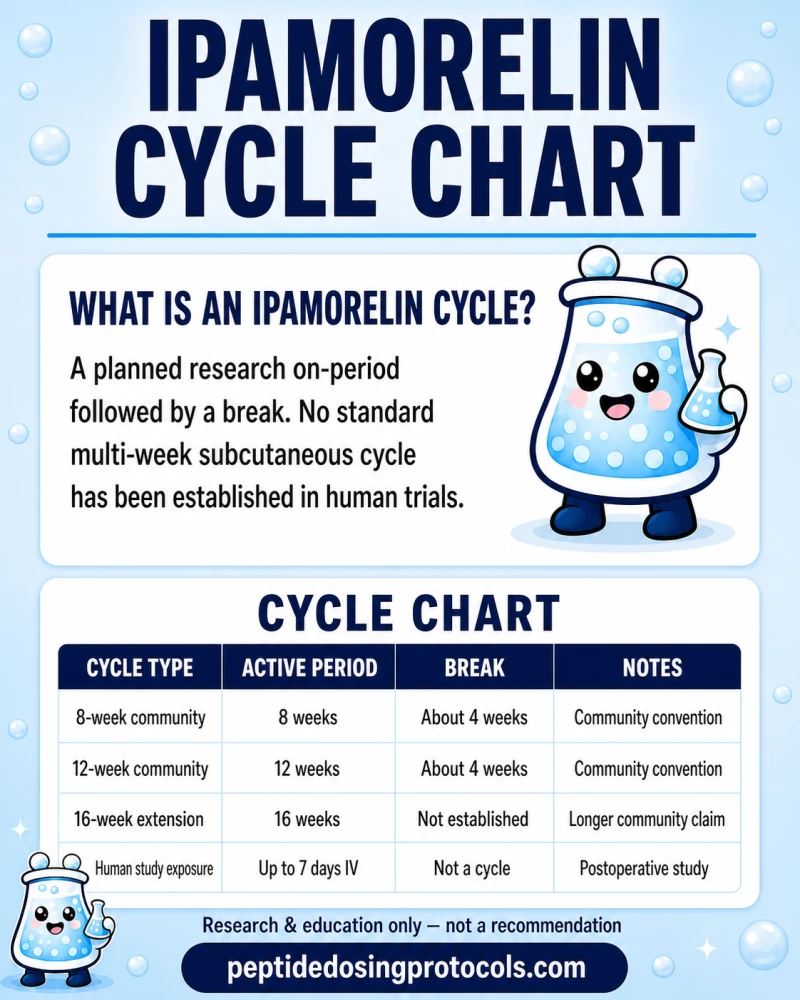
How Long Is an Ipamorelin Cycle?
There is no clinically established Ipamorelin cycle length. Eight-, 12-, and 16-week schedules are common in community and clinic-style web guidance, but they were not created from human trials that tested those exact subcutaneous cycle lengths.
The published human research is much narrower. A 1999 pharmacokinetic study tested short intravenous infusions in healthy men. A later Phase II study in bowel-surgery patients used intravenous Ipamorelin from postoperative day 1 through day 7 or hospital discharge. Another Phase II trial measured outcomes for up to 10 days. None of those studies validated a multi-month subcutaneous cycle.
Important evidence boundary
The 8-, 12-, and 16-week labels on this page describe common research-community cycle structures and search terms. They are not approved schedules, clinical recommendations, or proof that one duration is better than another.
Ipamorelin Cycle Chart: 8 vs 12 vs 16 Weeks
The chart below compares the cycle lengths readers most often encounter. It does not add a dose. Dose, timing, and reconstitution are separate questions covered in the Ipamorelin protocol.
Common Ipamorelin cycle-length conventions
Community context only. These durations have not been validated as standard subcutaneous cycles in human trials.
Cycle length
8 weeks
How it is commonly described
Shorter community cycle
Published Ipamorelin evidence
No human trial established an 8-week SC cycle
Evidence level
Community convention
Cycle length
12 weeks
How it is commonly described
Common community cycle endpoint
Published Ipamorelin evidence
No human trial established a 12-week SC cycle
Evidence level
Community convention
Cycle length
16 weeks
How it is commonly described
Longer or extended community cycle
Published Ipamorelin evidence
No human trial established a 16-week SC cycle
Evidence level
Community convention
Cycle length
Up to 7 days
How it is commonly described
Published postoperative trial exposure
Published Ipamorelin evidence
IV Ipamorelin from postoperative day 1 to day 7 or hospital discharge
Evidence level
Human clinical study
Cycle length
Up to 10 days
How it is commonly described
Phase II outcome window
Published Ipamorelin evidence
Repeated IV dosing arms with outcomes measured up to 10 days
Evidence level
Human clinical study
| Cycle length | How it is commonly described | Published Ipamorelin evidence | Evidence level |
|---|---|---|---|
| 8 weeks | Shorter community cycle | No human trial established an 8-week SC cycle | Community convention |
| 12 weeks | Common community cycle endpoint | No human trial established a 12-week SC cycle | Community convention |
| 16 weeks | Longer or extended community cycle | No human trial established a 16-week SC cycle | Community convention |
| Up to 7 days | Published postoperative trial exposure | IV Ipamorelin from postoperative day 1 to day 7 or hospital discharge | Human clinical study |
| Up to 10 days | Phase II outcome window | Repeated IV dosing arms with outcomes measured up to 10 days | Human clinical study |
The clinical rows used intravenous Ipamorelin in postoperative patients. They should not be converted into a subcutaneous cycle for another purpose.
8-Week Ipamorelin Cycle: What the Term Means
An 8-week Ipamorelin cycle usually means eight continuous weeks in the on-phase of a community protocol. It is one of the shorter multi-week schedules discussed online.
What matters most is what the term does not mean. Eight weeks is not an FDA-approved duration, and the published human Ipamorelin literature does not show that eight weeks is an optimal stopping point. The major human trials were designed around short IV exposure, not an eight-week SC schedule.
8-week evidence check
Useful as a community cycle label for comparison. Not established as an effective, safer, or optimal Ipamorelin cycle by human clinical trials.
12-Week Ipamorelin Cycle: Why It Appears So Often
A 12-week Ipamorelin cycle is one of the most common durations repeated across current peptide guides. It is often paired with a break afterward, which is why readers may also see phrases such as "12 weeks on, 4 weeks off."
That repetition can make 12 weeks look like a clinical standard. It is not. I did not find a human Ipamorelin trial that compared 8 weeks with 12 weeks, tested a 12-week subcutaneous cycle, or showed that stopping at week 12 improves receptor response.
Why this distinction matters
A schedule can become common online without becoming evidence-based. For Ipamorelin, 12 weeks is best described as a community convention unless a future controlled trial directly tests it.
16-Week Ipamorelin Cycle: What Is Known?
A 16-week Ipamorelin cycle is usually presented as an extended version of the more common 8- to 12-week structure. It appears in some community and clinic-style protocols when the on-phase is continued longer.
The evidence gap becomes larger at this duration. The published trials found for this review do not establish the safety, effectiveness, or ideal monitoring plan for 16 continuous weeks of subcutaneous Ipamorelin.
- There is no approved 16-week Ipamorelin schedule.
- The human pharmacokinetic study was an acute IV infusion study, not a long cycle.
- The published postoperative trial used IV dosing for no more than about one week.
- FDA's review found limited clinical information and no data supporting the proposed subcutaneous route for the medical uses it evaluated.
Ipamorelin Cycle Supplies Needed
This calculation-only example uses the existing community-reported 200 mcg once-daily schedule, a 10 mg vial, and 3.0 mL of BAC water per vial. It compares supply quantities for 8-, 12-, and 16-week research frameworks without recommending a dose or cycle.
Recommended U.S. and Canada Supply
Choose your region
Use discount code PEPPAL at Peptide Partners checkout. See why we love Peptide Partners.
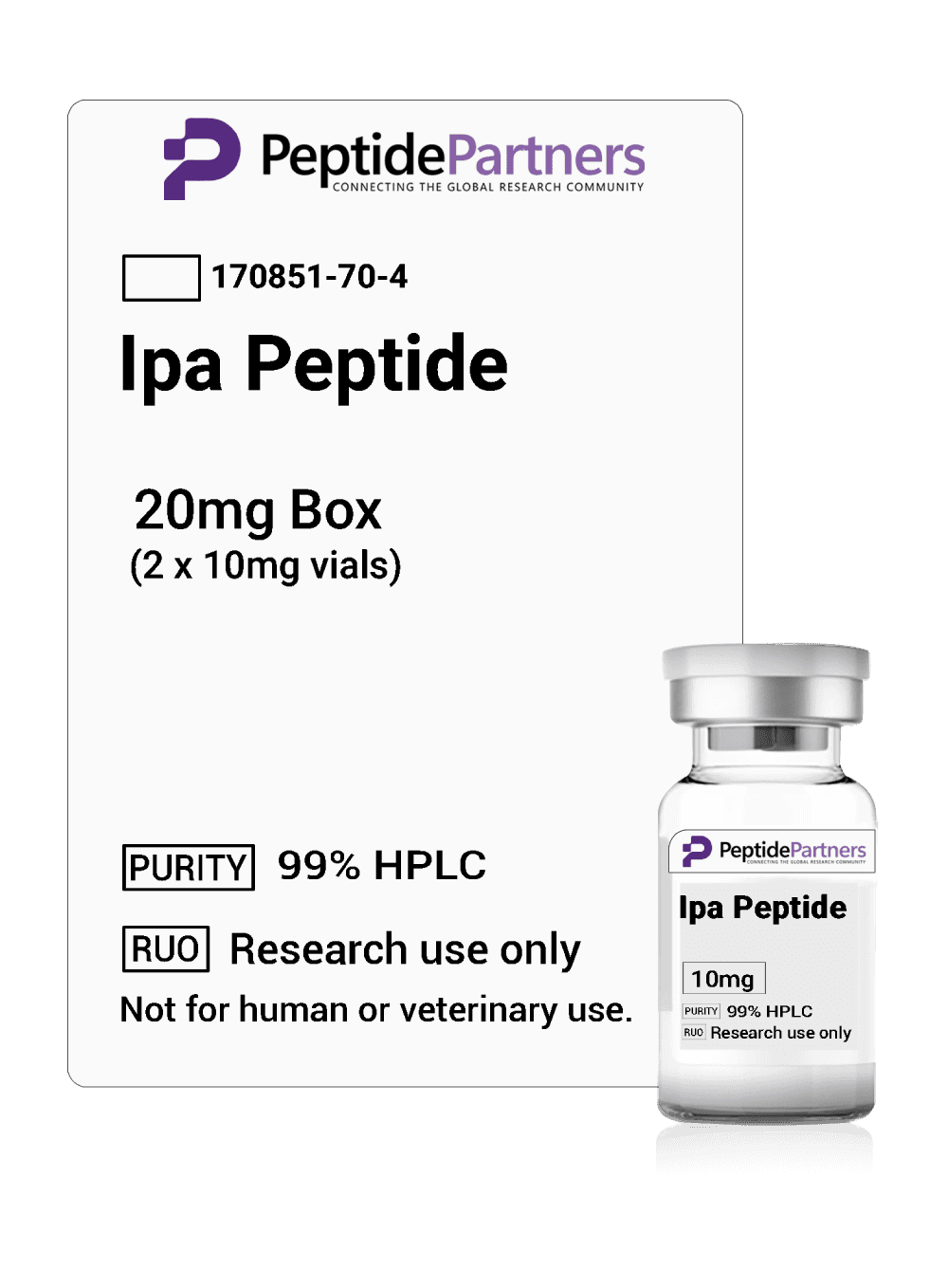
Ipamorelin Research Supply
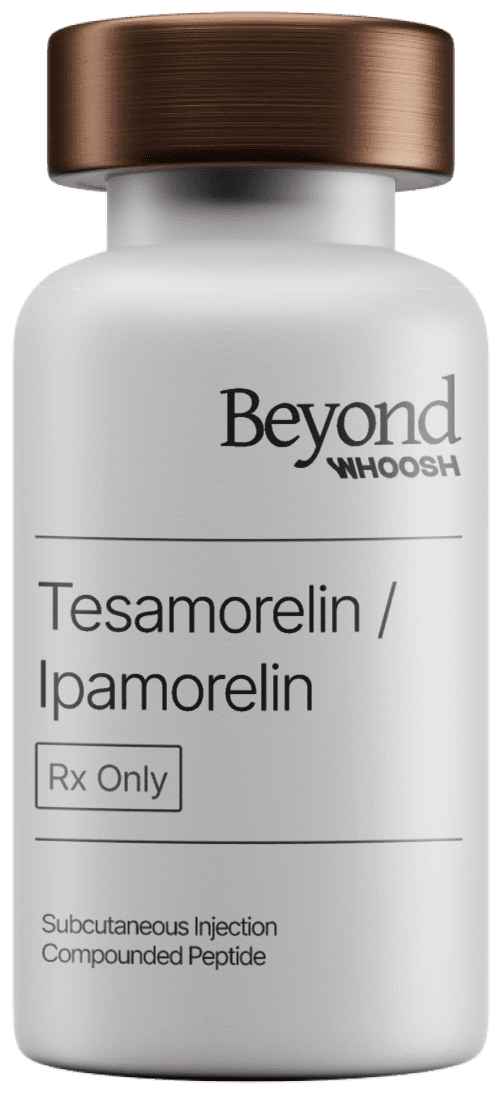
Pharmacy Grade Tesamorelin / Ipamorelin
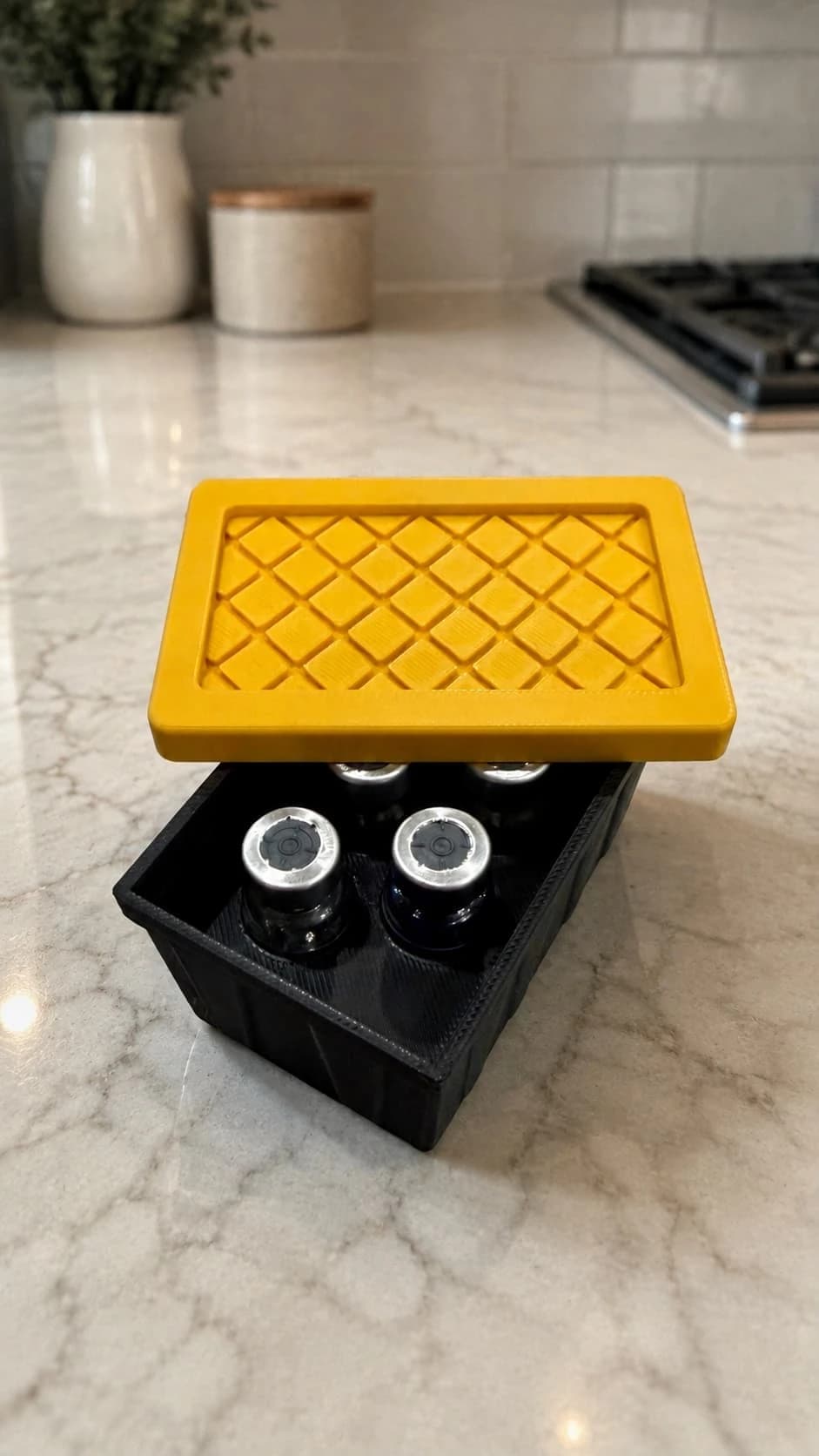
5-Vial Tote Case
At-Home Blood Test
Research Supplies
Disclosure: supply links may earn PDP a commission at no cost to you.
Ipamorelin Vials (10 mg)
At the calculation-only 200 mcg once-daily example, one 10 mg vial contains 50 planned administrations before normal handling losses.
| Cycle length | Planning note |
|---|---|
8-12 weeks 2 vials | 8 weeks: 56 daily administrations require 11.2 mg before handling losses.; 12 weeks: 84 daily administrations require 16.8 mg before handling losses. |
16 weeks 3 vials | 112 daily administrations require 22.4 mg before handling losses. |
8-12 weeks
2 vials
8 weeks: 56 daily administrations require 11.2 mg before handling losses.; 12 weeks: 84 daily administrations require 16.8 mg before handling losses.
16 weeks
3 vials
112 daily administrations require 22.4 mg before handling losses.
Insulin Syringes (U-100)
One new syringe per planned administration in this calculation example.
| Cycle length | Planning note |
|---|---|
8 weeks 56 syringes | One syringe for each planned daily administration. |
12 weeks 84 syringes | One syringe for each planned daily administration. |
16 weeks 112 syringes | Round up to allow for damaged or dropped supplies. |
8 weeks
56 syringes
One syringe for each planned daily administration.
12 weeks
84 syringes
One syringe for each planned daily administration.
16 weeks
112 syringes
Round up to allow for damaged or dropped supplies.
Bacteriostatic Water
This example uses 3.0 mL of BAC water for each 10 mg vial.
| Cycle length | Planning note |
|---|---|
8-12 weeks 1 x 10 mL bottle | Two vials use 6 mL total. |
16 weeks 2 x 10 mL bottles | Three vials use 9 mL total; a second bottle gives handling margin. |
8-12 weeks
1 x 10 mL bottle
Two vials use 6 mL total.
16 weeks
2 x 10 mL bottles
Three vials use 9 mL total; a second bottle gives handling margin.
These quantities are arithmetic planning examples based on values already explained in the Ipamorelin protocol. Round up for normal handling losses and review the protocol page before doing custom concentration math.
Companion Supplies & Routine Support
What Human Ipamorelin Studies Actually Tested
The easiest way to understand the cycle evidence is to look at the human studies directly. Their routes, populations, and time frames are very different from the multi-month subcutaneous schedules discussed online.
Human Ipamorelin studies relevant to cycle-length claims
Study
Gobburu et al. 1999
Population
Healthy male volunteers
Route
IV infusion
Time frame
Single 15-minute infusion
What it tells us
Characterized PK/PD and found a terminal half-life of about 2 hours; it did not test a multi-week cycle.
Study
Beck et al. 2014 / NCT00672074
Population
Bowel-resection patients
Route
IV infusion
Time frame
Postoperative day 1-7 or hospital discharge
What it tells us
Tested short repeated exposure for postoperative ileus; it did not validate a long SC cycle.
Study
NCT01280344
Population
Bowel-resection patients
Route
IV infusion
Time frame
Outcomes measured up to 10 days
What it tells us
Compared repeated IV dosing arms; it did not establish an 8-, 12-, or 16-week cycle.
| Study | Population | Route | Time frame | What it tells us |
|---|---|---|---|---|
| Gobburu et al. 1999 | Healthy male volunteers | IV infusion | Single 15-minute infusion | Characterized PK/PD and found a terminal half-life of about 2 hours; it did not test a multi-week cycle. |
| Beck et al. 2014 / NCT00672074 | Bowel-resection patients | IV infusion | Postoperative day 1-7 or hospital discharge | Tested short repeated exposure for postoperative ileus; it did not validate a long SC cycle. |
| NCT01280344 | Bowel-resection patients | IV infusion | Outcomes measured up to 10 days | Compared repeated IV dosing arms; it did not establish an 8-, 12-, or 16-week cycle. |
The 1999 human PK/PD study is useful for understanding how quickly Ipamorelin clears after an IV infusion. The 2014 Phase II study and ClinicalTrials.gov records are useful for understanding the longer repeated-dose research. None provides a clinical basis for a multi-month SC cycle.
How Long Is an Ipamorelin Off Cycle?
A 4-week off cycle is commonly paired with 8- or 12-week community schedules. The usual explanation is that a break may help avoid a reduced response to repeated stimulation.
That specific four-week number has not been established by the human Ipamorelin trials reviewed here. The studies did not compare different washout periods or show that four weeks restores a measured response better than two, six, or another number of weeks.
What is established
Ipamorelin produces a short GH response after IV administration, and the 1999 study reported a terminal half-life of about two hours.
What is not established
A required four-week break after a multi-month subcutaneous cycle has not been validated in a controlled human Ipamorelin trial.
How to read online schedules
Treat fixed off-period rules as community or clinic practice unless the source can point to a study that tested that exact schedule.
Does Ipamorelin Need to Be Cycled?
Human evidence does not establish that Ipamorelin must be cycled on a specific schedule. Cycling is common in research-community guidance, but the available trials were not designed to prove that an on/off pattern is necessary.
Online explanations often point to receptor sensitivity or a reduced response with repeated stimulation. That is a plausible pharmacology question, but a general receptor concept is not the same as proof that Ipamorelin requires eight or 12 weeks on followed by four weeks off.
Do not turn theory into a rule
No human Ipamorelin study found for this guide established a required cycle, a required off period, or a best long-term schedule for the subcutaneous use discussed in community protocols.
Ipamorelin Half-Life vs Cycle Length
Ipamorelin's half-life and cycle length answer different questions. Half-life describes how quickly the compound leaves the body. Cycle length describes how many days or weeks a research schedule continues.
In the 1999 human IV study, the terminal half-life was about two hours. GH peaked at about 0.67 hours and then declined. Those findings help explain the short pharmacologic window after an infusion, but they do not tell researchers whether a long cycle should last 8, 12, or 16 weeks.
Term
Half-life
What it means
Time related to drug clearance
What the evidence says
About 2 hours after IV infusion in the 1999 human PK/PD study
Term
GH response window
What it means
Short hormone response after exposure
What the evidence says
GH peaked near 0.67 hours in the 1999 IV study
Term
Cycle length
What it means
Total weeks in a repeated schedule
What the evidence says
No validated 8-, 12-, or 16-week SC duration
Term
Off cycle
What it means
Planned period without exposure
What the evidence says
No validated 4-week washout rule in human Ipamorelin trials
| Term | What it means | What the evidence says |
|---|---|---|
| Half-life | Time related to drug clearance | About 2 hours after IV infusion in the 1999 human PK/PD study |
| GH response window | Short hormone response after exposure | GH peaked near 0.67 hours in the 1999 IV study |
| Cycle length | Total weeks in a repeated schedule | No validated 8-, 12-, or 16-week SC duration |
| Off cycle | Planned period without exposure | No validated 4-week washout rule in human Ipamorelin trials |
What Do We Know About Long-Term Ipamorelin Use?
Long-term Ipamorelin claims should be treated carefully. The published clinical program focused on short exposure for postoperative gastrointestinal recovery, not months or years of subcutaneous use for body composition, recovery, sleep, or anti-aging goals.
FDA reviewed Ipamorelin-related bulk drug substances in 2024 and said the clinical information was limited. The agency also said it had not identified data supporting the proposed subcutaneous route for the growth-hormone-deficiency or postoperative-ileus uses it evaluated.
That does not prove every longer research schedule is harmful. It means the evidence needed to call a long cycle established, effective, or well characterized is missing.
Regulatory context
FDA's 2024 briefing stated that neither Ipamorelin free base nor Ipamorelin acetate is a component of an FDA-approved drug. FDA also proposed not adding either substance to the 503A Bulks List after reviewing characterization, historical use, effectiveness, and safety information.
Ipamorelin Cycle vs Dosage Protocol
Cycle length is only one part of a protocol. A cycle answers how long a schedule runs. Dosage answers how much is used at one time or across a day. Reconstitution answers what concentration and draw volume result after liquid is added.
Cycle length
Stay on this page for 8-, 12-, and 16-week cycle context, off periods, and the evidence behind duration claims.
Dosage and timing
Use the main Ipamorelin protocol for dose ranges, timing, frequency, and published-vs-community dosing context.
Reconstitution math
The protocol page also owns vial concentration, mL, and U-100 syringe-unit calculations so those topics do not get duplicated here.
Keeping these intents separate prevents a cycle page from competing with the stronger dosage page. It also gives readers a clear path depending on whether they are asking about duration or dose.
Ipamorelin Cycles With CJC-1295 or Other Compounds
An Ipamorelin-only cycle should not be treated as the same thing as a CJC-1295 plus Ipamorelin cycle. Adding another compound changes the research question, exposure pattern, and evidence that must be reviewed.
This page does not copy combination schedules into the Ipamorelin-only cycle guide. For combination-specific context, use the dedicated CJC-1295 + Ipamorelin guide.
Separate search intent
Queries about an Ipamorelin cycle belong here. Queries about a CJC-1295 + Ipamorelin cycle belong on the combination page so each URL can answer one main question well.
How to Evaluate an Ipamorelin Cycle Claim
Cycle claims are easy to repeat and hard to validate. A useful check is to ask whether the source is describing a human trial, a clinic protocol, a community schedule, or a calculation.
- 01
Check the route
IV research does not automatically validate a subcutaneous schedule. Keep route attached to the evidence.
- 02
Check the duration
A study lasting days cannot prove that an 8-, 12-, or 16-week cycle is optimal.
- 03
Check the population
Postoperative bowel-surgery patients are different from healthy volunteers and from the populations discussed in online peptide protocols.
- 04
Check the endpoint
A study of gastrointestinal recovery does not prove body-composition, recovery, sleep, or anti-aging outcomes.
- 05
Check whether the off period was tested
If a source says four weeks off is required, look for a study that compared washout periods. The human Ipamorelin trials reviewed here did not do that.
Published Evidence vs Community Cycle Schedules
What can and cannot be concluded about Ipamorelin cycle length
Claim
Ipamorelin has human PK/PD data
Evidence status
Supported
How to present it
Published human IV research
Claim
Ipamorelin was studied with repeated dosing after bowel surgery
Evidence status
Supported
How to present it
Published Phase II IV research
Claim
8 weeks is the best cycle length
Evidence status
Not established
How to present it
Community convention only
Claim
12 weeks is the standard clinical cycle
Evidence status
Not established
How to present it
Community convention only
Claim
16 weeks is proven safe or more effective
Evidence status
Not established
How to present it
Do not present as a proven claim
Claim
4 weeks off is required to restore sensitivity
Evidence status
Not established
How to present it
Community rationale, not a validated human rule
Claim
A 2-hour half-life proves a multi-week cycle length
Evidence status
Incorrect inference
How to present it
Half-life and cycle duration are separate concepts
| Claim | Evidence status | How to present it |
|---|---|---|
| Ipamorelin has human PK/PD data | Supported | Published human IV research |
| Ipamorelin was studied with repeated dosing after bowel surgery | Supported | Published Phase II IV research |
| 8 weeks is the best cycle length | Not established | Community convention only |
| 12 weeks is the standard clinical cycle | Not established | Community convention only |
| 16 weeks is proven safe or more effective | Not established | Do not present as a proven claim |
| 4 weeks off is required to restore sensitivity | Not established | Community rationale, not a validated human rule |
| A 2-hour half-life proves a multi-week cycle length | Incorrect inference | Half-life and cycle duration are separate concepts |
The most defensible answer to "how long should an Ipamorelin cycle be?" is that no human trial has established a standard multi-week subcutaneous cycle. Eight to 12 weeks is a common community framework, while 16 weeks is a longer extension. Those labels are useful for comparing what people mean by a cycle, but they should not be presented as clinically proven schedules.
Ipamorelin Cycle FAQ
Q1: How long is an Ipamorelin cycle?
There is no clinically established Ipamorelin cycle length. Eight to 12 weeks is a common community convention, while some guides extend to 16 weeks. Human trials did not validate those multi-week subcutaneous schedules.
Q2: Is 8 weeks a standard Ipamorelin cycle?
Eight weeks is a common community cycle length, not an approved or clinically validated standard. Published human Ipamorelin studies used much shorter IV exposure.
Q3: Is a 12-week Ipamorelin cycle clinically proven?
No. Twelve weeks is widely repeated in community and clinic-style guidance, but the human trials reviewed here did not test or validate a 12-week subcutaneous cycle.
Q4: Can an Ipamorelin cycle last 16 weeks?
Some community protocols describe 16 weeks as an extended cycle. Human research has not established the safety, effectiveness, or ideal structure of a 16-week subcutaneous Ipamorelin cycle.
Q5: How long should an Ipamorelin off cycle be?
A four-week off period is common in community schedules, but human Ipamorelin trials have not established a required washout period or shown that four weeks is optimal.
Q6: Does Ipamorelin need to be cycled?
Human evidence does not establish that Ipamorelin must follow a specific on-and-off cycle. Cycling is common in community guidance, but the available trials were not designed to prove that a fixed cycle is required.
Q7: Does Ipamorelin's two-hour half-life determine cycle length?
No. The roughly two-hour terminal half-life reported in a human IV study describes drug clearance after an infusion. It does not establish whether a repeated schedule should last 8, 12, or 16 weeks.
Q8: What cycle length was used in human Ipamorelin studies?
The human studies did not use the common 8- to 16-week subcutaneous cycle format. One published Phase II study used IV Ipamorelin from postoperative day 1 through day 7 or hospital discharge, while another trial measured outcomes for up to 10 days.
Q9: Is long-term Ipamorelin use well studied?
No. The published clinical program focused on short IV exposure. It does not establish the effects of months or years of repeated subcutaneous use.
Q10: Is Ipamorelin FDA approved?
No FDA-approved drug contains Ipamorelin as a component. FDA's 2024 review also found limited clinical information for the uses it evaluated and proposed not adding Ipamorelin-related bulk drug substances to the 503A Bulks List.
Q11: Where is the Ipamorelin dosage and reconstitution guide?
Use the main Ipamorelin protocol page for dose, timing, frequency, reconstitution, mL, and U-100 syringe-unit math. This cycle page stays focused on duration and off-cycle questions.
Q12: Is a CJC-1295 and Ipamorelin cycle the same as an Ipamorelin cycle?
No. A combination changes the research question and exposure pattern. The dedicated CJC-1295 + Ipamorelin guide covers combination-specific context.
References
- 1. Gobburu JV, Agersø H, Jusko WJ, Ynddal L Pharmacokinetic-pharmacodynamic modeling of ipamorelin, a growth hormone releasing peptide, in human volunteers Pharmaceutical Research (1999)
- 2. Beck DE, Sweeney WB, McCarter MD; Ipamorelin 201 Study Group Prospective, randomized, controlled, proof-of-concept study of the ghrelin mimetic ipamorelin for the management of postoperative ileus in bowel resection patients International Journal of Colorectal Disease (2014)
- 3. Safety and Efficacy of Ipamorelin for Management of Post-Operative Ileus (NCT00672074) ClinicalTrials.gov (2017)
- 4. Safety and Efficacy of Ipamorelin Compared to Placebo for the Recovery of Gastrointestinal Function (NCT01280344) ClinicalTrials.gov (2017)
- 5. Evaluation of Ipamorelin-Related Bulk Drug Substances for Inclusion on the 503A Bulk Drug Substances List U.S. Food and Drug Administration (2024)
Related Dosing Protocols
Educational use only
Peptide Dosing Protocols is an independent educational reference. Nothing here is medical advice or a recommendation for human use. Consult a licensed healthcare provider before considering any compound.
Need Ipamorelin dosage and reconstitution context?
The main Ipamorelin protocol covers dose ranges, timing, reconstitution math, syringe units, clinical evidence, and safety context without duplicating the cycle-length focus of this page.

Written by Garret Grant
Founder & Lead Researcher · B.S. Civil Engineering, UCLA
Last updated: August 2026
Human-researched and AI-assisted with full editorial review. I verify sources, protocol interpretation, and final judgments personally. See methodology.
Share this page