How Long Is a GHK-Cu Cycle?
There is no single evidence-based GHK-Cu cycle length. A cycle usually means a period of use followed by a planned break. Published studies tested specific products, ways of using them, and results. A study lasting several weeks is not automatically proof that everyone should use the compound for that long.
Start with the route, meaning how a product enters or is applied to the body. A skin cream, a wound gel, and an injection under the skin reach the body in different ways. The studies below tested skin products in people. They do not fill the gap in human evidence for injections that may affect the whole body.
Use the right page for the question
This page covers duration, follow-up, and breaks. The GHK-Cu protocol background explains ways of using the compound and terms related to dose. Community schedules on a protocol page remain community claims unless a matching human trial supports them.
Community Reports: Untested Cycle Lengths
Not clinically researched cycle guidance
These examples come from people describing their own use online. Clinical studies have not established the cycle lengths or breaks below. We cannot confirm what products they used, how they took them, or what else they took. We also cannot check their results or side effects. Repeated claims and upvotes do not prove that a schedule works or is safe.
Injectable GHK-Cu discussions describe eight-week use, planned sixteen-week courses, and continuous use, with conflicting advice about breaks. This variation does not establish a standard cycle. Keep these reports separate from topical creams and gels.
In an August 2025 r/Peptidesource thread, a commenter reported being in week eight and planning a break. A March 2026 r/BodyHackGuide discussion includes continuous use and a planned sixteen-week course. Planned use is not a completed outcome report, and these posts cannot confirm the identity or purity of the products used.
No validated injectable cycle was identified in the research reviewed. Topical study assessment dates cannot establish an injection schedule or a safe restart interval. FDA flags limited human safety data and immune-reaction or impurity concerns for injectable GHK-Cu.
Community sources reviewed October 14, 2026. These are a few discussions, not a survey. They do not show that the wider community agrees on a schedule.
Which GHK-Cu Timelines Were Studied?
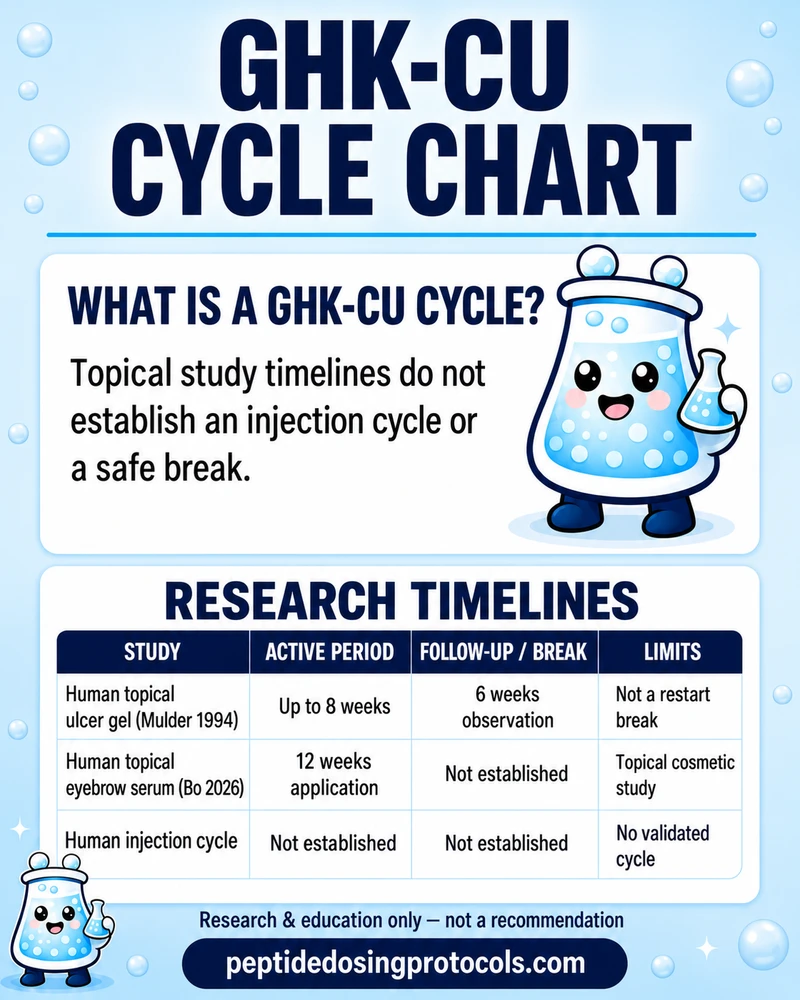
Read the timeline together with its study setting. These are selected human studies with traceable timing. None compared different lengths of injectable use or tested a standard on-and-off schedule.
GHK-Cu: treatment is different from follow-up
Study and route
Mulder 1994: topical diabetic-ulcer gel
Time receiving treatment
Up to 8 weeks in the group treated right away
When results were checked
6 further weeks of observation
What it does not establish
A 14-week active course or a 6-week restart break
Study and route
Miller 2006: topical care after laser resurfacing
Time receiving treatment
Skin-care plans after the procedure
When results were checked
Skin outcomes assessed 12 weeks after the procedure
What it does not establish
A 12-week injectable cycle
Study and route
Bo 2026: topical eyebrow serum
Time receiving treatment
Twice-daily applications for 12 weeks
When results were checked
Assessments during treatment, including week 12
What it does not establish
Maintenance or repeat-course timing
| Study and route | Time receiving treatment | When results were checked | What it does not establish |
|---|---|---|---|
| Mulder 1994: topical diabetic-ulcer gel | Up to 8 weeks in the group treated right away | 6 further weeks of observation | A 14-week active course or a 6-week restart break |
| Miller 2006: topical care after laser resurfacing | Skin-care plans after the procedure | Skin outcomes assessed 12 weeks after the procedure | A 12-week injectable cycle |
| Bo 2026: topical eyebrow serum | Twice-daily applications for 12 weeks | Assessments during treatment, including week 12 | Maintenance or repeat-course timing |
Research designs, not directions for use. The short laser-study report says when results were checked. It does not give the full calendar for applying the products.
Sources: ulcer study, laser study, and eyebrow study. The ulcer timing comes from the primary paper’s full methods, rather than an assumed duration from its abstract.
GHK-Cu Cycle Supplies Needed
There is no validated human GHK-Cu cycle from which to calculate a required vial count. This section identifies the product and supply limits without turning a community report into a shopping or injection plan. The case, blood-test kit, and Amazon links below are optional shopping resources. A clinician should choose which blood tests, if any, are appropriate; a commercial panel cannot prove that an untested cycle is safe. Check device compatibility and product-specific storage needs. A case or mini fridge does not by itself meet a medicine’s temperature requirements.
Research Supplies
Choose your region
Use discount code SAVE10 at Orbitrex Peptides checkout. See why we love Orbitrex Peptides.
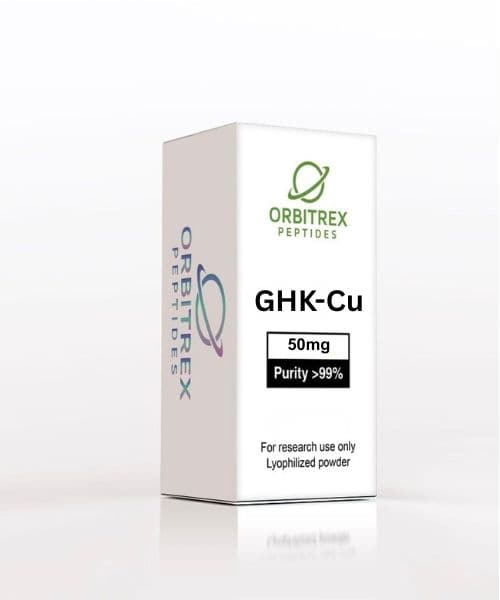
GHK-Cu 50mg
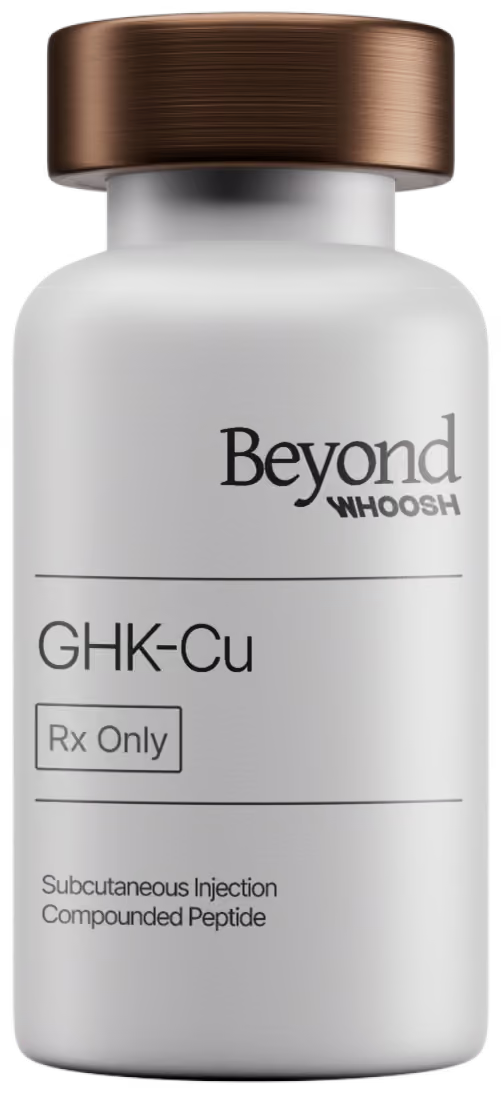
Pharmacy Grade GHK-Cu
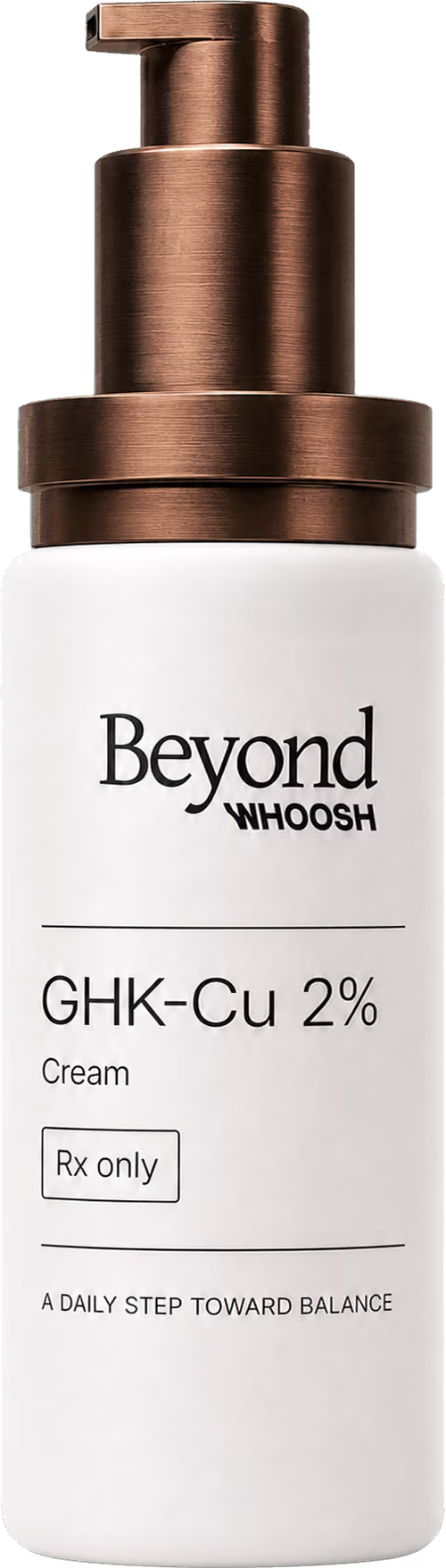
Pharmacy Grade Topical GHK-Cu
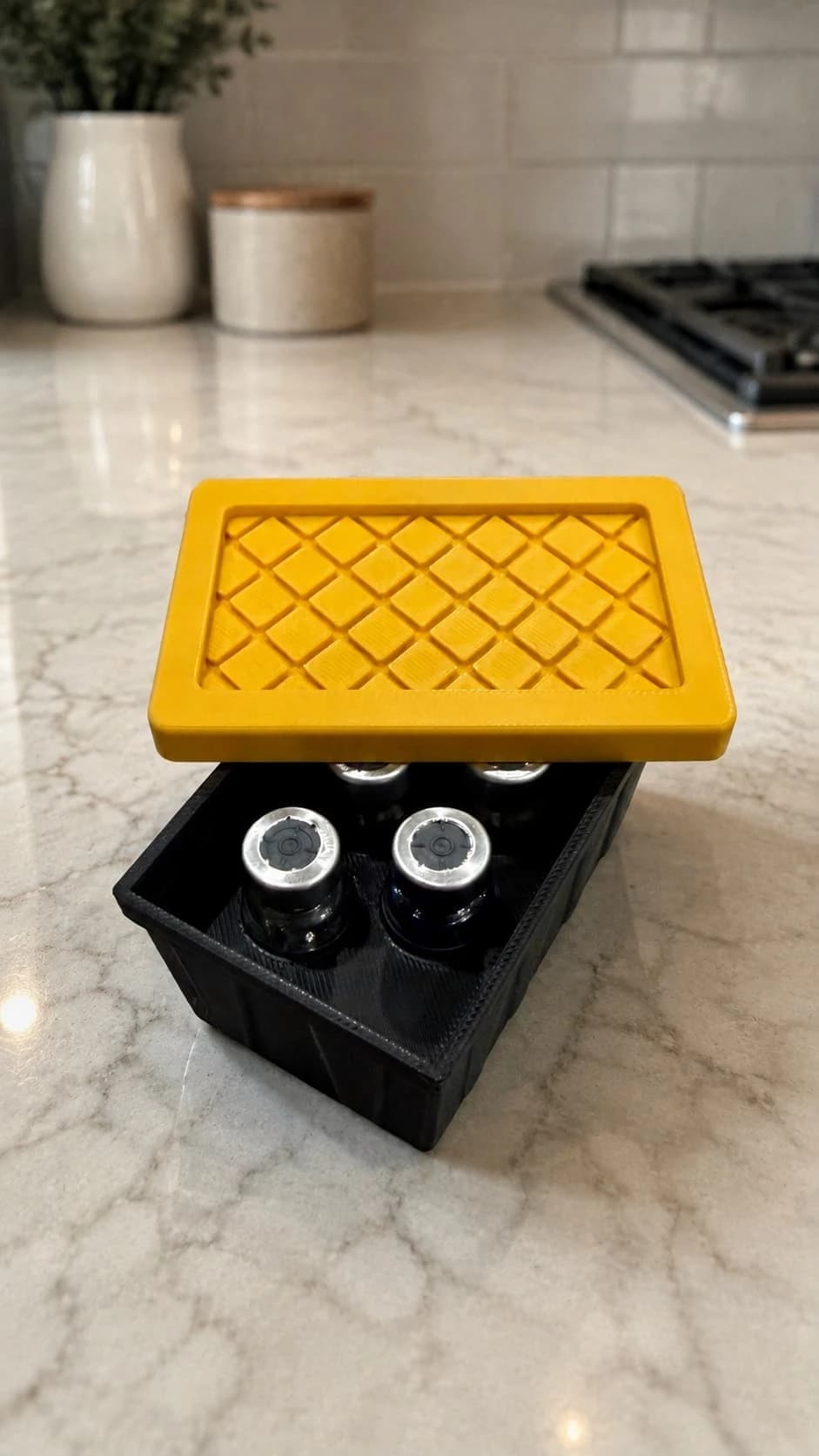
5-Vial Tote Case
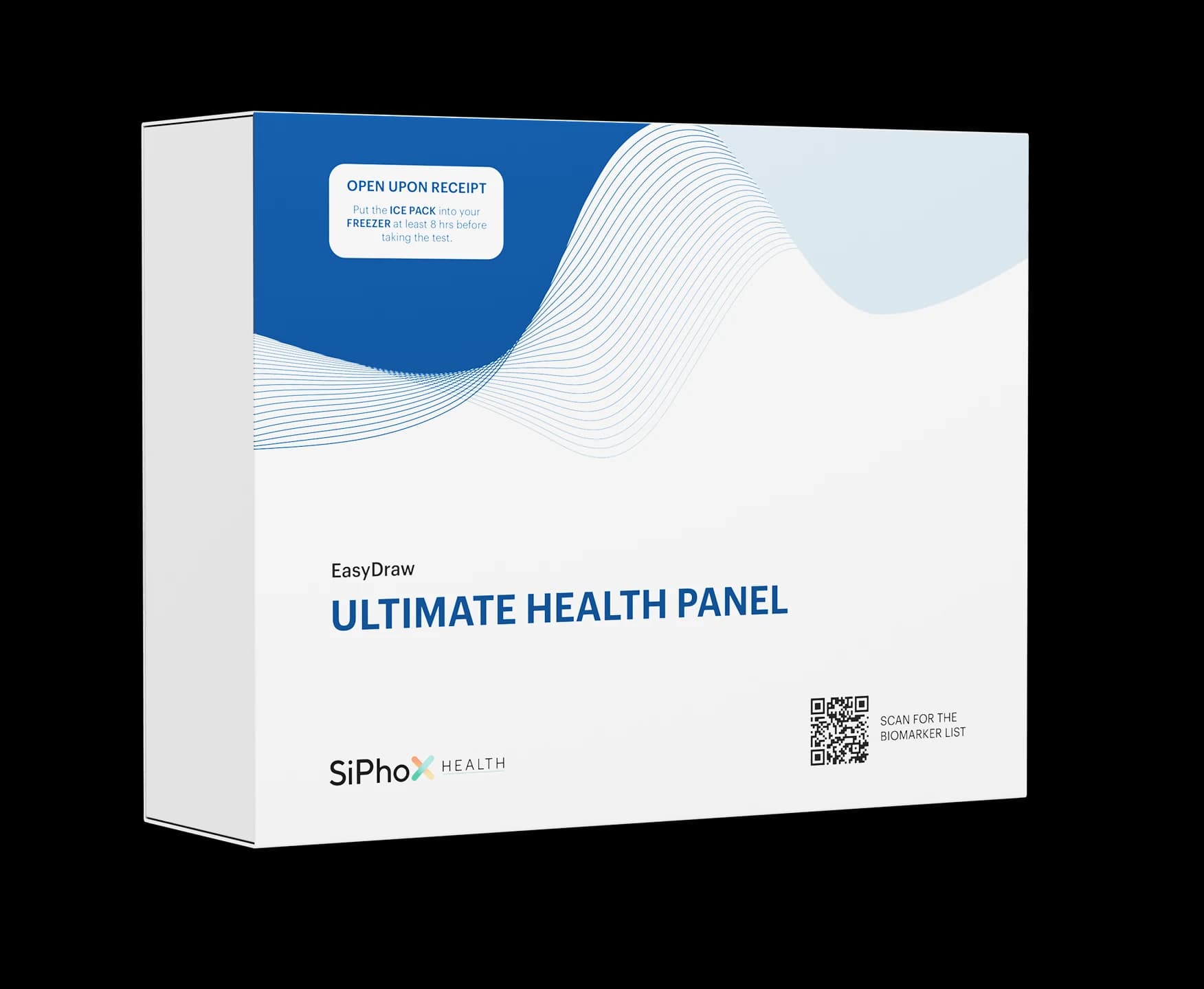
At-Home Blood Test
Research Supplies
Disclosure: supply links may earn PDP a commission at no cost to you.
Compound and formulation
| Supply check | What to verify |
|---|---|
Identity check Exact product required | Keep topical products, injectable research vials, and blends separate. A topical study cannot establish supplies or a course for injection. |
Identity check
Exact product required
Keep topical products, injectable research vials, and blends separate. A topical study cannot establish supplies or a course for injection.
Vials and preparation materials
| Supply check | What to verify |
|---|---|
Human cycle quantity Not established | A seller’s vial strength does not establish a human dose, course length, diluent amount, or syringe count. Those quantities are not estimated from anecdotes here. |
Human cycle quantity
Not established
A seller’s vial strength does not establish a human dose, course length, diluent amount, or syringe count. Those quantities are not estimated from anecdotes here.
Storage and handling information
| Supply check | What to verify |
|---|---|
Research product documentation Product-specific | Check the actual product documentation, batch information, and storage requirements. Product testing or supplies do not establish safety or suitability for human use. |
Research product documentation
Product-specific
Check the actual product documentation, batch information, and storage requirements. Product testing or supplies do not establish safety or suitability for human use.
Research-only products are not approved human medicines. No supply quantity on this page establishes a safe cycle, break, or restart interval.
Companion Supplies & Routine Support
What Does the Ulcer-Gel Study Tell Us?
One group started a specific skin gel along with wound care right away. A delayed-start group first used the gel base without GHK-Cu for four weeks. Researchers call that base the vehicle. This group then had eight more weeks of its assigned treatment. The first four weeks were not a break after GHK-Cu.
In some comparisons, the paper found greater wound closure in ulcers on the sole of the foot, called plantar ulcers. Participants also received wound cleaning, pressure-relieving footwear, and diabetes-care support. The result reflects that whole care setting; it does not show that a research vial alone heals an untreated wound.
A follow-up interval is not an off-cycle
Observation after treatment asks what happens next. A restart study would have to give another course and measure its benefits and harms. Those are separate questions. A six-week observation period does not establish a six-week reset.
Wounds also differ. An ulcer related to diabetes is not the same as a vein-related leg ulcer, an acne scar, or a fresh cut from surgery. Matching the condition matters as much as matching the name on the bottle. A result in one setting cannot set the ideal duration for every other setting.
Do Twelve Weeks Guarantee Better Skin?
No. In the laser-resurfacing trial, 13 people completed the study. The study measurements did not show a clear statistical benefit for redness, wrinkles, or overall skin quality with GHK-Cu. However, people rated the GHK-Cu skin-care plan more highly on a questionnaire. Those are different results, and both belong in the summary.
A person can feel more satisfied without the study detecting a change on its chosen measurements. A small trial can also miss a real difference. The fair conclusion is limited evidence in that setting, rather than guaranteed benefit or proof that no benefit is possible.
The Bishop venous-ulcer trial offers another useful caution. Among 86 patients whose results could be assessed, the copper-tripeptide cream did not shrink ulcers more than the cream base alone. Product and wound differences make a broad claim that all topical GHK-Cu studies succeeded misleading.
A study endpoint is a planned date for comparing groups. It is not a promise about when one person will see a result. Nor does a negative comparison tell us that extending treatment for several more weeks would solve the problem. That longer course would need its own evidence.
What About Hair and Eyebrow Timelines?
A small 2026 split-face study enrolled 18 adults. Each person used the active serum on one eyebrow and a comparison serum on the other. The report described improvements in eyebrow hair count and diameter after the treatment period. This is a cosmetic study of a specific skin product.
The two sides of one face provide a useful comparison, but 18 participants still leave much unknown. Eyebrow findings do not establish scalp-hair regrowth, treatment of a diagnosed hair disorder, or a benefit from injections. The body site and outcome must stay attached to the finding.
This study also does not answer what happens months after stopping. A result measured during use cannot tell us how long it persists, whether maintenance is needed, or whether a second course repeats the effect. Those questions require planned off-treatment follow-up and repeat-course comparisons.
Avoid a guaranteed results calendar
A week-12 measurement means researchers checked at week 12. It does not mean a visible change must appear by then, or that lack of a change should trigger a stronger product or a longer course.
Why Topical Evidence Does Not Set an Injection Cycle
Topical use means applying a product to a surface, such as the skin. Subcutaneous use means injecting it under the skin. Intravenous, or IV, use puts it into a vein. These routes change where the material goes and which safety questions matter. They cannot share one schedule just because the ingredient name is similar.
The reviewed clinical sources do not establish a course of repeated GHK-Cu injections under the skin for skin, hair, or whole-body recovery. That is a narrower and more accurate statement than saying that GHK-Cu has never been studied in any human setting. Human topical research exists; it answers different questions.
Match the evidence to the way a product is used
Claim
A topical product improves a skin outcome
What would support it
A human study of that skin product and the claimed result
Claim
An injection course works and has acceptable side effects
What would support it
Human research matching the injection type, product, length of use, and condition
Claim
A break makes repeat exposure safer
What would support it
A study that tracks repeated courses and tests that length of break
| Claim | What would support it |
|---|---|
| A topical product improves a skin outcome | A human study of that skin product and the claimed result |
| An injection course works and has acceptable side effects | Human research matching the injection type, product, length of use, and condition |
| A break makes repeat exposure safer | A study that tracks repeated courses and tests that length of break |
A route match is necessary, but it is only one part of a good study match.
An untested route is not proved unsafe in every circumstance merely because evidence is missing. It is also not proved safe. Filling that gap with a topical trial creates more certainty than the research supports.
Does the Exact Product Matter?
Yes. GHK is a short chain of amino acids, the building blocks of proteins. GHK-Cu is GHK bound to copper. A finished cosmetic may include many other ingredients. A percentage on a serum label and a milligram amount on a research vial describe different products. Neither number tells us how much reaches the part of the body being studied over time.
In a laboratory study using human skin samples, researchers measured copper movement through different skin preparations. This was not a trial in living users, and the tests measured copper. They did not prove that GHK and copper stayed bound together or reached the intended part of the body.
That distinction matters when a seller turns a skin-penetration experiment into a promise of whole-body effects. Movement through a lab sample shows how material can pass through that sample. Symptom relief, scar appearance, and safety across repeated courses are separate outcomes.
Blends need their own evidence
Adding GHK-Cu to BPC-157, TB-500, or another ingredient creates a different product. Studies of the separate ingredients do not establish a cycle for the blend. They also cannot reveal which ingredient caused a reported benefit or reaction.
Half-Life, Shelf Life, and Cycle Length Are Different
Half-life is the time it takes for the measured amount of a substance to fall by half under set conditions. Shelf life describes how long a product meets its quality requirements in storage. Cycle length describes the planned time of use. Confusing these terms can turn an unrelated number into a treatment rule.
A laboratory stability experiment may expose a sample to heat or a particular chemical environment. It cannot establish how many weeks a person should use the product. A vial’s use-by date cannot establish that either. Product quality and human exposure need different evidence.
Likewise, a short reported half-life would not show that every tissue effect ends quickly. A longer-lasting biological response would not prove that a break is unnecessary. To support a restart date, researchers need information about the effects, side effects, and repeated use. An estimate of how fast the body removes a substance is not enough.
This guide does not use a claimed blood half-life to calculate a GHK-Cu break. The available human studies do not validate that calculation for a repeated injection course. A precise calendar produced from an uncertain input is still an uncertain calendar.
Does GHK-Cu Need a Break?
The reviewed sources do not establish a required break, a safe maximum number of courses, or a maintenance schedule. That applies to claims that a break is necessary and claims that continuous use is harmless. Neither conclusion follows simply from the lack of a tested off-period.
- Four to eight weeks of injections is not validated by an eight-week topical wound study.
- Five days on and two days off is not a proven way to prevent tolerance.
- A two-to-four-week break is not established as a copper reset.
- A completed cosmetic study does not prove that year-round use has the same risks.
Tolerance means a response weakens with repeated exposure. A claim that a break reverses tolerance needs evidence that the problem occurred and that the proposed gap changed it. Without those steps, a reset explanation is a theory, not a tested reason for choosing a schedule.
A useful repeat-course trial would state each course length, the time between courses, how many courses occurred, and what happened after the last one. It should also compare outcomes and harms with a relevant alternative. None of the timelines shown here supplies that full answer.
Can Animal Studies Fill the Timing Gaps?
Animal studies help explain why researchers remain interested. A rat wound experiment used daily topical treatment for 13 days. A rabbit wound experiment used daily topical treatment for 21 days. Both used wounds made for the experiments and comparisons chosen for those studies.
These are research windows in animals, not two-week or three-week human cycles. The species, injury, product, and healing process differ. An animal experiment can support a next research question without resolving the right duration or safety of treatment in people.
Short animal windows can also hide the question a reader really wants answered. Measuring wound closure at the end of an experiment is not the same as following several courses over a year. More collagen in a tissue sample is not automatically better function, a better-looking scar, or a safer long-term treatment.
Safety and Regulatory Context
FDA flags injectable GHK-Cu for possible immune reactions linked to clumping and peptide-related impurities, along with limited human safety information. An immune reaction is a response by the body’s defense system. A planned break does not remove risks tied to the material itself.
No validated injection cycle emerges from that safety record. Questions about treatment, ongoing symptoms, wounds, or a suspected reaction belong with a licensed clinician. An untested schedule should not delay care for a condition with proven treatments.
FDA’s May 2026 compounding update separates the review of GHK-Cu for uses other than injection from a withdrawn request to list injectable GHK-Cu. These lists concern substances used to make compounded drugs. A change to a list is not drug approval or proof that a cycle is safe. The way the product is used matters.
FDA also explains that most cosmetics and cosmetic ingredients are not approved by FDA before they go on sale. A product being sold as a cosmetic therefore does not mean FDA has approved its benefit, its use on injured skin, or an injection version.
Quality reports and clinical evidence answer different questions
A batch report may describe identity, purity, or other tests on a sample. It does not validate a human cycle or establish long-term safety. The research supplier card links to a catalog. It does not recommend treatment.
How to Check a GHK-Cu Cycle Claim
When a page offers an exact number of weeks, ask what that number represents before comparing it with another schedule. A useful claim should let you trace the route, product, time point, and result back to the original research.
- Identify the material. Is it GHK-Cu alone, a finished topical product, or a blend?
- Identify the route and setting. Unbroken skin, a wound being treated, and an injection need different evidence.
- Separate active use from observation. Check what happened between the first treatment and the last visit.
- Name the outcome. A photograph, a questionnaire, a wound measurement, and a lab marker answer different questions.
- Look for the actual comparison. Was the claimed course or restart interval tested against another schedule?
- Keep the missing evidence visible. Do not turn an unreported break into a recommendation for continuous use.
For a clinical discussion, the most useful information is the exact product label, route, timing, symptoms, and any other treatments used. Those details help frame the question. They do not make an untested schedule proven or replace a clinician’s assessment.
The practical takeaway
GHK-Cu research must be read with the way each product was used in mind. It does not establish one universal cycle. Treat the chart as a map of published research, with breaks and repeat use left unknown where they were not tested.
GHK-Cu Cycle FAQs
Q1: Is four to eight weeks a proven injectable GHK-Cu cycle?
No. The reviewed human sources do not validate that schedule for injections under the skin. A topical study with a similar number of weeks is a different exposure. A community schedule should be labeled as a community claim rather than a clinical standard.
Q2: Was the ulcer study a fourteen-week GHK-Cu course?
No. In the group treated right away, active treatment could last up to eight weeks, followed by six weeks of observation. The full calendar includes time after treatment. The observation period did not test restarting another course.
Q3: Does a twelve-week topical study prove injections work for skin?
No. A human study can be relevant to the product and route it tested while leaving another route unproven. Changing from a cream or serum to an injection changes exposure and safety questions. The same peptide name does not make the routes equivalent.
Q4: Are topical GHK-Cu results consistently positive?
No. Findings differ across settings and measurements. Some reports describe benefits, while controlled studies have also found no advantage for their main measured results. That mixed record is a reason to keep the product, condition, and outcome attached to every claim.
Q5: Can GHK-Cu be used continuously without breaks?
The studies reviewed do not establish use without an end date as safe or better than planned breaks. They also do not establish a universal break requirement. A short course without a reported problem cannot settle the safety of repeated or year-round exposure.
Q6: Does GHK-Cu need a copper-reset break?
No validated reset interval was established in the reviewed evidence. The amount of peptide listed on a product, the copper it contains, and the body’s handling of copper are different questions. A simple calendar rule cannot substitute for evidence about repeated exposure.
Q7: Can a blood copper result tell me when to restart?
A lab result may help a clinician assess a specific medical question. It does not validate a GHK-Cu restart schedule. One value cannot establish every tissue effect, product-related risk, or possible immune response, so a result in range is not proof that another course is safe.
Q8: Can I apply the eyebrow-study schedule to scalp hair?
The study setting does not establish a scalp-hair treatment course. The number of eyebrow hairs, scalp hair loss, and a diagnosed hair disorder are different questions. Evidence about one body site should not be presented as a proven calendar for another.
Q9: Does being a cosmetic ingredient mean GHK-Cu is FDA-approved?
No. FDA generally does not approve cosmetics or cosmetic ingredients before marketing, apart from certain color additives. Cosmetic availability is not approval of a drug, and it does not validate an injectable formulation or a schedule for treating disease.
Q10: Does a research supplier’s certificate prove the cycle is safe?
No. Quality testing addresses the sample and the tests performed. A clinical trial addresses outcomes and harms under specified conditions. A certificate cannot replace human evidence for the same way of using the product or show that a particular on-and-off schedule is safe.
Sources & Research
- 1. Mulder GD, Patt LM, Sanders L, et al. Enhanced healing of ulcers in patients with diabetes by topical treatment with glycyl-L-histidyl-L-lysine copper Wound Repair and Regeneration (1994)
- 2. Miller TR, Wagner JD, Baack BR, Eisbach KJ. Effects of topical copper tripeptide complex on CO2 laser-resurfaced skin Archives of Facial Plastic Surgery (2006)
- 3. Bo SL, Nararatwanchai T, Supornpun N, et al. Topical GHK-Cu serum for eyebrow hypotrichosis: a split-face comparative study Procedia of Multidisciplinary Research (2026)
- 4. Bishop JB, Phillips LG, Mustoe TA, et al. Randomized evaluator-blinded trial of potential wound-healing agents for venous stasis ulcers Journal of Vascular Surgery (1992)
- 5. Hostynek JJ, Dreher F, Maibach HI. Human skin penetration of a copper tripeptide in vitro as a function of skin layer Inflammation Research (2011)
- 6. Canapp SO Jr, Farese JP, Schultz GS, et al. Topical tripeptide-copper complex in ischemic open wounds: rat experiment Veterinary Surgery (2003)
- 7. Cangul IT, Gul NY, Topal A, Yilmaz R. Topical tripeptide-copper complex and zinc oxide in rabbit wound healing Veterinary Dermatology (2006)
- 8. U.S. Food and Drug Administration Compounding substances with potential significant safety risks: injectable GHK-Cu FDA
- 9. U.S. Food and Drug Administration Bulk substances nominated under section 503A: May 14, 2026 update FDA (2026)
- 10. U.S. Food and Drug Administration FDA authority over cosmetics and premarket approval FDA
Related Dosing Protocols
Educational use only
Peptide Dosing Protocols is an independent educational reference. Nothing here is medical advice or a recommendation for human use. Consult a licensed healthcare provider about treatment decisions.
Keep the route and evidence together
Read the compound background alongside the study timelines and their limits.

Written by Garret Grant
Founder & Lead Researcher · B.S. Civil Engineering, UCLA
Last updated: October 2026
Human-researched and AI-assisted with full editorial review. I verify sources, protocol interpretation, and final judgments personally. See methodology.
Share this page