
How Long Is a 5-Amino-1MQ Cycle?
Direct answer
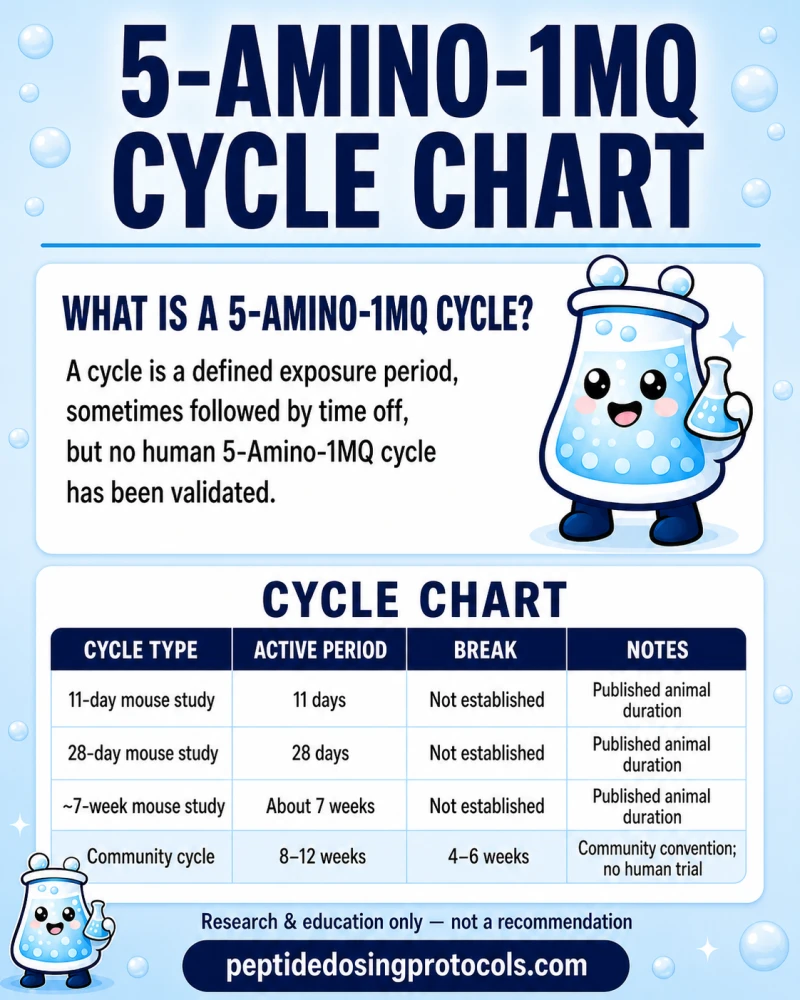
There is no proven human 5-Amino-1MQ cycle length. Published rodent studies have tested treatment for 11 days, 28 days, and about 7 weeks. The 8–12 week cycle often discussed online comes from community practice, not a completed human clinical trial.
If you searched how long to cycle 5-Amino-1MQ, the most important distinction is between a study duration and a community cycle. A study duration is the time researchers exposed animals to the compound under a defined experiment. A community cycle is an informal schedule discussed outside controlled trials.
Those two ideas should not be treated as equal evidence. The published studies show that researchers have observed 5-Amino-1MQ across several time frames. They do not establish that a person should use the same duration, dose, route, or off period.
No human cycle has been validated
The published duration data on this page come from animal research. The 8–12 week and 4–6 week patterns are community-reported conventions. Neither is a medically established human protocol.
Published 5-Amino-1MQ Study Durations
The best way to understand the evidence is to look at the actual length of the published experiments. Three studies give useful duration anchors: an 11-day proof-of-concept study, a 28-day metabolic study, and a study that continued treatment for about 7 weeks.
Published 5-Amino-1MQ treatment durations in animal research
These are experimental animal-study designs, not human cycle recommendations.
Study
Neelakantan et al. (2018)
Model
Diet-induced obese mice
Treatment length
11 days
Route / schedule
Subcutaneous, three times daily in the published model
What the duration tells us
A short proof-of-concept exposure was long enough for researchers to measure changes during the study.
Study
Babula et al. (2024)
Model
Diet-induced obese mice
Treatment length
28 days
Route / schedule
Once daily
What the duration tells us
A later study extended exposure to four weeks and followed metabolic and body-composition measures over time.
Study
Dimet-Wiley et al. (2022)
Model
Diet-induced obese mice with a diet change
Treatment length
About 7 weeks
Route / schedule
Repeated subcutaneous treatment
What the duration tells us
The published literature also includes a longer multi-week exposure, showing that research duration has varied by study design.
| Study | Model | Treatment length | Route / schedule | What the duration tells us |
|---|---|---|---|---|
| Neelakantan et al. (2018) | Diet-induced obese mice | 11 days | Subcutaneous, three times daily in the published model | A short proof-of-concept exposure was long enough for researchers to measure changes during the study. |
| Babula et al. (2024) | Diet-induced obese mice | 28 days | Once daily | A later study extended exposure to four weeks and followed metabolic and body-composition measures over time. |
| Dimet-Wiley et al. (2022) | Diet-induced obese mice with a diet change | About 7 weeks | Repeated subcutaneous treatment | The published literature also includes a longer multi-week exposure, showing that research duration has varied by study design. |
None of these animal durations validates a fixed 4-, 8-, or 12-week human cycle.
11-day study
The early proof-of-concept study was deliberately short. It tested whether NNMT inhibition could produce measurable effects in a diet-induced obesity mouse model over less than two weeks.
28-day study
The 2024 study used once-daily 5A1MQ for 28 days in obese mice. This gives a clear four-week research duration, but it still does not establish a four-week human cycle.
About 7 weeks
A separate mouse study combined 5-Amino-1MQ with a diet change and continued treatment for about seven weeks. This is the longest directly documented duration highlighted in this guide.
What Animal Study Length Can—and Cannot—Tell Us
Published study length can tell us how researchers designed an experiment. It can show that a compound was observed for days or weeks under controlled conditions. It cannot tell us the ideal human cycle length.
Published evidence can show
How long a specific mouse experiment lasted
Published evidence cannot establish
The best 5-Amino-1MQ cycle length for a person
Published evidence can show
Which route and schedule were used in that experiment
Published evidence cannot establish
That the same route or schedule should be copied in humans
Published evidence can show
When researchers collected study endpoints
Published evidence cannot establish
How long it takes a person to notice an effect
Published evidence can show
Whether repeated exposure was studied for several weeks
Published evidence cannot establish
The long-term safety of repeated or continuous human use
Published evidence can show
That different experiments used different durations
Published evidence cannot establish
That one duration is proven superior to another
| Published evidence can show | Published evidence cannot establish |
|---|---|
| How long a specific mouse experiment lasted | The best 5-Amino-1MQ cycle length for a person |
| Which route and schedule were used in that experiment | That the same route or schedule should be copied in humans |
| When researchers collected study endpoints | How long it takes a person to notice an effect |
| Whether repeated exposure was studied for several weeks | The long-term safety of repeated or continuous human use |
| That different experiments used different durations | That one duration is proven superior to another |
This distinction matters because search results often turn a rodent study period into a human-looking cycle chart. That skips a major step. Species, route, dose, metabolism, and study goal all affect how long an experiment runs.
Where the 8–12 Week 5-Amino-1MQ Cycle Comes From
The 8–12 week 5-Amino-1MQ cycle is best described as a research-community convention. It does not come from a published human trial. The site's main 5-Amino-1MQ protocol guide already summarizes this pattern as 8–12 weeks on followed by 4–6 weeks off.
That convention is longer than the 11-day and 28-day animal experiments and somewhat longer than the roughly 7-week study. The extra time should not be presented as evidence-backed simply because it is common online.
How common cycle lengths should be interpreted
Cycle length
About 2 weeks
Evidence level
Close to the 11-day mouse proof-of-concept study
Best interpretation
A short animal-study reference point, not a human minimum cycle.
Cycle length
4 weeks
Evidence level
Matches the 28-day mouse study duration
Best interpretation
A published animal duration, not a validated human cycle.
Cycle length
6–8 weeks
Evidence level
Near the longest multi-week mouse exposure highlighted here
Best interpretation
Closer to published animal-study duration, but still not human cycle evidence.
Cycle length
8–12 weeks
Evidence level
Community-reported convention
Best interpretation
Common online cycle structure with no completed human trial establishing it.
Cycle length
Longer than 12 weeks
Evidence level
Human long-term data are lacking
Best interpretation
Evidence becomes even thinner as duration extends beyond the common community range.
| Cycle length | Evidence level | Best interpretation |
|---|---|---|
| About 2 weeks | Close to the 11-day mouse proof-of-concept study | A short animal-study reference point, not a human minimum cycle. |
| 4 weeks | Matches the 28-day mouse study duration | A published animal duration, not a validated human cycle. |
| 6–8 weeks | Near the longest multi-week mouse exposure highlighted here | Closer to published animal-study duration, but still not human cycle evidence. |
| 8–12 weeks | Community-reported convention | Common online cycle structure with no completed human trial establishing it. |
| Longer than 12 weeks | Human long-term data are lacking | Evidence becomes even thinner as duration extends beyond the common community range. |
This table compares evidence categories. It is not a schedule to follow.
Why this page keeps the categories separate
A popular schedule can still be unproven. Community repetition does not turn an 8–12 week cycle into clinical evidence.
4-Week vs 8-Week vs 12-Week 5-Amino-1MQ Cycles
Searches for a 4-week, 8-week, or 12-week 5-Amino-1MQ cycle often make these durations look like competing proven protocols. They are not. Each duration sits at a different level of evidence.
4 weeks
There is a published 28-day mouse study. That makes four weeks a real animal-study duration, but not a validated human cycle length.
8 weeks
Eight weeks is close to the longest multi-week mouse exposure discussed here and also falls inside common community schedules. The overlap does not make it a proven human protocol.
12 weeks
Twelve weeks appears in community cycle discussions, not in the core animal studies reviewed for this page. Human safety and efficacy over a 12-week cycle have not been established by these studies.
The main takeaway is simple: a duration can be common without being clinically validated. Longer exposure also creates a larger evidence gap because published human long-term data are not available to define what happens with repeated cycles.
How Much Time Off Between 5-Amino-1MQ Cycles?
Direct answer
There is no published human study that establishes a required 5-Amino-1MQ off period. The commonly discussed 4–6 weeks off is a community convention, not a proven washout rule.
The phrase 5-Amino-1MQ 4–6 weeks off is often explained as time for NNMT activity to 'reset.' That idea should be treated carefully. The studies reviewed here do not show that four to six weeks is required to reset NNMT in humans.
A break may be built into an informal cycle so a researcher can separate an exposure period from a non-exposure period. That is a study-design idea. It is different from claiming that a specific number of weeks off has been biologically proven.
Off-cycle claim
4–6 weeks off is required
Evidence status
Not established by a human clinical trial.
Off-cycle claim
The off period resets NNMT activity
Evidence status
Not proven in humans by the studies reviewed here.
Off-cycle claim
A break helps separate on-treatment and off-treatment observations
Evidence status
Reasonable as an experimental-design concept, but not a medical protocol.
Off-cycle claim
The same break length fits every cycle
Evidence status
Unsupported. No validated human cycle framework exists.
| Off-cycle claim | Evidence status |
|---|---|
| 4–6 weeks off is required | Not established by a human clinical trial. |
| The off period resets NNMT activity | Not proven in humans by the studies reviewed here. |
| A break helps separate on-treatment and off-treatment observations | Reasonable as an experimental-design concept, but not a medical protocol. |
| The same break length fits every cycle | Unsupported. No validated human cycle framework exists. |
Can 5-Amino-1MQ Be Run Continuously?
There is not enough human evidence to treat continuous 5-Amino-1MQ exposure as an established research standard. The animal studies reviewed here used defined endpoints and stopped after a set study period.
That matters because continuous use asks a different question from an 11-day, 28-day, or 7-week experiment. It requires longer-term data on exposure, adaptation, organ effects, and what happens after stopping. Those questions have not been answered by the short preclinical studies.
Longer does not mean better studied
Extending a community cycle past 12 weeks moves farther beyond the published duration evidence summarized here. It should not be described as a proven or safer approach.
Cycle Length Is Not the Same as Half-Life
A common mistake is to use half-life to justify cycle length. Half-life tells researchers how quickly drug levels fall after a dose. Cycle length tells them how long an experiment continues. Those are different questions.
A 2021 rat pharmacokinetic study reported a mean terminal half-life of about 3.8 hours after IV administration and 6.9 hours after oral administration, with about 38.4% oral bioavailability in rats. These are rat data. They do not establish a human half-life or an 8–12 week human cycle.
Concept
Half-life
What it means
How fast measured drug concentration declines in a specific PK study
What it does not mean
How many weeks a cycle should last
Concept
Dose interval
What it means
How often a study administers a compound
What it does not mean
How long the full experiment should continue
Concept
Cycle length
What it means
Total exposure period in a study or community schedule
What it does not mean
A value that can be calculated from half-life alone
Concept
Washout
What it means
Time after exposure stops
What it does not mean
A proven 4–6 week requirement for 5-Amino-1MQ
| Concept | What it means | What it does not mean |
|---|---|---|
| Half-life | How fast measured drug concentration declines in a specific PK study | How many weeks a cycle should last |
| Dose interval | How often a study administers a compound | How long the full experiment should continue |
| Cycle length | Total exposure period in a study or community schedule | A value that can be calculated from half-life alone |
| Washout | Time after exposure stops | A proven 4–6 week requirement for 5-Amino-1MQ |
How Researchers Choose a Study Duration
In controlled research, duration is chosen around the question being tested. The 11-day, 28-day, and multi-week studies did not use the same length because they were not asking the exact same question.
- Define the research endpoint. A short proof-of-concept study may need less time than a longer metabolic or tissue study.
- Choose the model. Cell work, rats, and mice can require different observation windows.
- Match measurements to the endpoint. Body composition, tissue analysis, pharmacokinetics, and microbiome work may be collected on different timelines.
- Keep route and exposure tied to the study. A published subcutaneous mouse schedule cannot be turned into an oral human cycle.
- Stop at the planned endpoint and compare the data. Extending a study changes the question and may require a different safety plan.
This is also why a single universal 'best cycle length' is hard to defend. The published literature uses duration as part of experimental design, not as a ready-made human protocol.
When Did Published Studies Measure Changes?
Cycle searches often overlap with questions about how long 5-Amino-1MQ takes to work. The safest evidence-based answer is to report when animal studies measured changes, not promise a human timeline.
Research period
Days 6–10
What the study did
The 11-day mouse study reported group differences during the treatment period.
What not to conclude
This does not mean a person will notice a result in the first week.
Research period
28 days
What the study did
The 2024 mouse study followed body-composition and metabolic measures across four weeks.
What not to conclude
This does not prove four weeks is enough for a human outcome.
Research period
About 7 weeks
What the study did
A longer DIO mouse experiment continued treatment through a multi-week diet intervention.
What not to conclude
This does not establish seven or eight weeks as an ideal human cycle.
| Research period | What the study did | What not to conclude |
|---|---|---|
| Days 6–10 | The 11-day mouse study reported group differences during the treatment period. | This does not mean a person will notice a result in the first week. |
| 28 days | The 2024 mouse study followed body-composition and metabolic measures across four weeks. | This does not prove four weeks is enough for a human outcome. |
| About 7 weeks | A longer DIO mouse experiment continued treatment through a multi-week diet intervention. | This does not establish seven or eight weeks as an ideal human cycle. |
For a deeper look at outcomes, use the dedicated 5-Amino-1MQ results and benefits guide rather than turning cycle duration into an outcome claim.
See the 5-Amino-1MQ results and benefits guide for the separate question of what the published animal studies measured. This cycle page stays focused on duration, breaks, and evidence level.
Cycle Length vs Dosage Protocol
A cycle page answers how long the exposure period lasts. A protocol page answers different questions, such as route, research amount, frequency, timing, reconstitution, and vial math.
Use this cycle guide for
Cycle length, published study durations, 4 vs 8 vs 12 weeks, time off, continuous-use evidence, and the difference between research data and community conventions.
Use the protocol guide for
Route-specific research context, dosage evidence, oral vs subcutaneous discussion, timing, reconstitution, and calculation-only syringe math.
Use the results guide for
Animal-study outcomes, results timelines, body-composition findings, and the limits of before-and-after claims.
Keeping those intents separate helps prevent the cycle page from competing with the main protocol page for dosage searches.
5-Amino-1MQ Cycle Supplies Needed
Supply needs depend on the research format. Oral capsules do not need mixing supplies. A lyophilized vial needs BAC water, U-100 syringes, and alcohol swabs. This checklist does not validate a route, dose, or cycle length.
Recommended U.S. and Canada Supply
Choose your region
Use discount code PEPPAL at Peptide Partners checkout. See why we love Peptide Partners.
5-Amino-1MQ Research Supply
5-Vial Tote Case
At-Home Blood Test
Research Supplies
Disclosure: supply links may earn PDP a commission at no cost to you.
Route-specific supply checklist
The main protocol page contains the route-specific research context and calculation tables.
| Research format | Evidence note |
|---|---|
Oral capsule research 5-Amino-1MQ capsules | No BAC water or injection supplies are needed. No human oral dose or cycle has been established. |
Lyophilized vial research Vial, BAC water, U-100 syringes, and alcohol swabs | Use the protocol guide for calculation-only reconstitution and syringe-unit math. Subcutaneous schedules remain community-reported. |
Oral capsule research
5-Amino-1MQ capsules
No BAC water or injection supplies are needed. No human oral dose or cycle has been established.
Lyophilized vial research
Vial, BAC water, U-100 syringes, and alcohol swabs
Use the protocol guide for calculation-only reconstitution and syringe-unit math. Subcutaneous schedules remain community-reported.
This section is a supply checklist, not a dosing recommendation. Product strength and format can vary, so confirm the label before doing any calculation.
Companion Supplies & Routine Support
5-Amino-1MQ Cycle Takeaway
The evidence-based bottom line
There is no clinically validated human 5-Amino-1MQ cycle. Published animal studies span 11 days, 28 days, and about 7 weeks. The familiar 8–12 weeks on and 4–6 weeks off pattern belongs in a separate community-practice category and should not be presented as proven.
That distinction is more useful than pretending there is one perfect cycle. It tells readers exactly what has been studied, what is only common online, and where the evidence stops.
5-Amino-1MQ Cycle FAQs
Q1: How long should a 5-Amino-1MQ cycle be?
No human study has established an ideal 5-Amino-1MQ cycle length. Published mouse studies have used 11 days, 28 days, and about 7 weeks. The common 8–12 week cycle is a community convention, not a clinically validated schedule.
Q2: What is the common 5-Amino-1MQ cycle length?
Research communities commonly discuss 8–12 weeks on followed by 4–6 weeks off. That pattern is not based on a completed human clinical trial and should be labeled as community practice.
Q3: Is a 4-week 5-Amino-1MQ cycle supported by research?
A 2024 mouse study used once-daily 5A1MQ for 28 days. That makes four weeks a published animal-study duration, but it does not validate a four-week human cycle.
Q4: Is an 8-week 5-Amino-1MQ cycle evidence-based?
Published mouse work includes treatment lasting about 7 weeks, so eight weeks is near one studied animal duration. It still has not been validated as an ideal human cycle.
Q5: Is a 12-week 5-Amino-1MQ cycle proven?
No. Twelve weeks appears in community cycle discussions, but the core published animal studies reviewed here did not establish a 12-week human protocol.
Q6: How much time off should there be between 5-Amino-1MQ cycles?
No human study has established a required off period. Four to six weeks off is a common community convention, not a proven washout or NNMT-reset interval.
Q7: Does 5-Amino-1MQ need to be cycled?
Published research does not establish a human rule that 5-Amino-1MQ must be cycled or can be used continuously. The animal studies used defined treatment periods and endpoints rather than indefinite exposure.
Q8: Can 5-Amino-1MQ be used continuously instead of in cycles?
Long-term continuous human exposure has not been established by the studies reviewed here. Extending use beyond common community cycle lengths moves farther beyond the available duration evidence.
Q9: Does the half-life determine the 5-Amino-1MQ cycle length?
No. Half-life describes how quickly drug levels decline after a dose, while cycle length is the total duration of an experiment. Rat pharmacokinetic data cannot be used to calculate an ideal human cycle length.
Q10: How long did 5-Amino-1MQ animal studies last?
Published studies reviewed here include an 11-day mouse study, a 28-day mouse study, and a treatment period of about 7 weeks in another mouse experiment.
Q11: How long does 5-Amino-1MQ take to work?
There is no proven human timeline. Animal studies measured changes during periods ranging from days to several weeks, but those findings cannot predict when or whether a person would notice an effect.
Q12: Is 5-Amino-1MQ actually a peptide?
No. 5-Amino-1MQ is a small-molecule inhibitor of nicotinamide N-methyltransferase, or NNMT. It is often grouped with peptide research compounds online, but it is not a peptide.
Q13: Where can I find 5-Amino-1MQ dosage and reconstitution information?
Use the main 5-Amino-1MQ protocol guide for dosage evidence, oral vs subcutaneous research context, timing, reconstitution, and calculation-only vial math. This page stays focused on cycle duration.
References
- 1. Harshini Neelakantan et al. Selective and membrane-permeable small molecule inhibitors of nicotinamide N-methyltransferase reverse high fat diet-induced obesity in mice Biochemical Pharmacology (2018)
- 2. Ololade Awosemo et al. Development & validation of LC-MS/MS assay for 5-amino-1-methyl quinolinium in rat plasma: Application to pharmacokinetic and oral bioavailability studies Journal of Pharmaceutical and Biomedical Analysis (2021)
- 3. Catherine M. Sampson et al. Combined nicotinamide N-methyltransferase inhibition and reduced-calorie diet normalizes body composition and enhances metabolic benefits in obese mice Scientific Reports (2021)
- 4. Andrea Dimet-Wiley et al. Reduced calorie diet combined with NNMT inhibition establishes a distinct microbiome in DIO mice Scientific Reports (2022)
- 5. JoAnne J. Babula et al. Nicotinamide N-methyltransferase inhibition mitigates obesity-related metabolic dysfunction Diabetes, Obesity and Metabolism (2024)
Related Dosing Protocols
Educational use only
Peptide Dosing Protocols is an independent educational reference. Nothing here is medical advice or a recommendation for human use. Consult a licensed healthcare provider before considering any compound.
Need dosage and reconstitution context?
The protocol guide covers route-specific research, dosage evidence, timing, reconstitution, and calculation-only vial math. Keep those questions separate from cycle-duration evidence.

Written by Garret Grant
Founder & Lead Researcher · B.S. Civil Engineering, UCLA
Last updated: August 2026
Human-researched and AI-assisted with full editorial review. I verify sources, protocol interpretation, and final judgments personally. See methodology.
Share this page