How to evaluate peptide suppliers in Australia
A long product list or a high purity claim does not tell you much on its own. The better question is whether the supplier gives you enough information to check its claims independently.
For research materials, testing and traceability are two of the clearest things you can compare. A report is more useful when it belongs to a specific batch and can be checked through the testing lab itself.
Batch-specific testing
Look for a separate report for each batch instead of one old report used across a full product line.
Independent verification
A lab task number or verification key should let you check the result outside the supplier's own website.
Batch traceability
The batch number on the vial or package should match the batch shown on the report.
Clear test methods
The report should explain what was tested, such as identity, purity or content. One test does not answer every quality question.
Business transparency
A supplier should clearly identify the business behind the website and provide a real way to contact it.
Testing example: Polaris Research
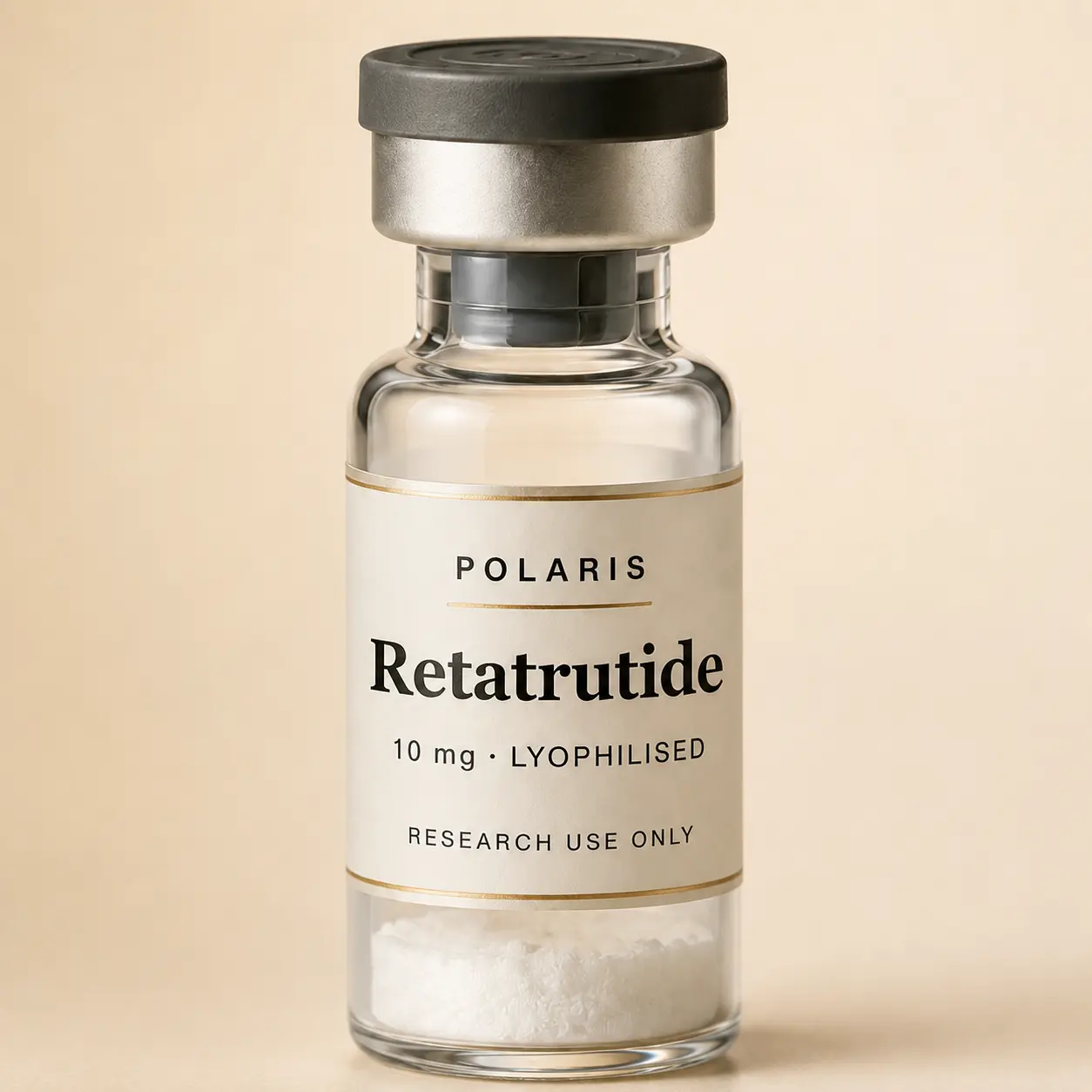
Polaris Research is a useful real-world example because its testing process can be checked outside its own website. The company states that it is Australian owned and ABN registered, and it publishes testing information for individual batches rather than relying on one general purity claim.
That matters because a statement such as “99% pure” is hard to judge by itself. A better setup gives the reader a batch number, a laboratory report, and a way to confirm that report through the laboratory that performed the test.
Polaris says each batch is independently tested before it is listed. Its testing records include batch information and a verification path that lets researchers compare the supplier’s published claim with the report from the outside laboratory.
The company also provides a batch lookup page. This gives researchers a way to connect a batch identifier with the report published for that batch. A system like this is more useful than a general COA page where it is not clear which report belongs to which material.
As one example, a Polaris retatrutide report is listed under Janoshik task 76483. The lab-hosted report shows a reported purity of 99.562%. The important part is not the number itself. The useful part is that the result can be checked through Janoshik instead of relying only on a screenshot or PDF controlled by the supplier.
This does not prove every quality measure for the material. A purity test does not automatically tell you about sterility, endotoxin levels, storage conditions, or every other part of product quality. It only tells you what the specific test measured.
Polaris also states that it can provide samples for independent testing. That gives researchers another way to check published claims instead of depending only on the supplier’s own testing process.
None of these points make Polaris automatically better than every other Australian peptide supplier. They simply give researchers several pieces of information that can be checked independently. That is the standard we think is most useful when comparing supplier transparency.
Why this example matters
A supplier should not need to be trusted blindly. The strongest testing systems give researchers enough information to check the report, confirm the batch, understand what was tested, and see the limits of the result.
What we checked at Polaris Research
We looked at Polaris using the same basic questions we would use for any research peptide supplier.
Check
Australian business information
What we found
Polaris states that it is Australian owned and ABN registered.
Check
Batch-specific testing
What we found
The supplier states that individual batches are independently tested.
Check
Outside laboratory
What we found
Published reports can include testing from Janoshik Analytical.
Check
Lab-hosted verification
What we found
At least some reports can be checked through the laboratory’s own verification system.
Check
Batch lookup
What we found
Polaris provides a lookup page that connects batch information with published testing.
Check
Purity information
What we found
Published reports can include measured purity results.
Check
Independent sample testing
What we found
Polaris states that samples can be provided for independent testing.
Check
Limits of testing
What we found
A purity result does not by itself establish sterility, endotoxin levels, storage quality, or suitability for human use.
| Check | What we found |
|---|---|
| Australian business information | Polaris states that it is Australian owned and ABN registered. |
| Batch-specific testing | The supplier states that individual batches are independently tested. |
| Outside laboratory | Published reports can include testing from Janoshik Analytical. |
| Lab-hosted verification | At least some reports can be checked through the laboratory’s own verification system. |
| Batch lookup | Polaris provides a lookup page that connects batch information with published testing. |
| Purity information | Published reports can include measured purity results. |
| Independent sample testing | Polaris states that samples can be provided for independent testing. |
| Limits of testing | A purity result does not by itself establish sterility, endotoxin levels, storage quality, or suitability for human use. |
The main reason to include this table is not to give Polaris a score. It is to show the type of information that can be checked when researching an Australian supplier.
A supplier with fewer public records is not automatically unreliable, and a supplier with detailed reports is not automatically safe. Testing and transparency are only part of a larger review.
Research Supplies
Use supplier records as a starting point for verification, not as proof that a product is safe, approved, or suitable for human use.
Research Resources & Supplies
Use discount code SAVE10 at Polaris Research checkout. See why we love Polaris Research.
Polaris Research Products
At-Home Blood Test
Research Supplies
Disclosure: supply links may earn PDP a commission at no cost to you.
Affiliate disclosure: PDP may earn a commission from eligible supply links at no added cost to you. Supplier listings and discount details can change, so review current testing and terms before ordering.
Companion Supplies & Routine Support
How to verify a peptide batch
The basic check only takes a few steps. The goal is to confirm that the report is real and that it belongs to the batch being discussed.
- 01
Find the report number
Look for a lab task number, verification key or report ID. A screenshot with no way to check the source gives you much less information.
- 02
Open the testing lab
Go to the laboratory's own website. Do not depend only on a copy of the report hosted by the supplier.
- 03
Check the report details
Confirm the compound name, reported result, test date and other details shown by the laboratory.
- 04
Match the batch
Compare the batch identifier on the report with the identifier shown on the vial, package or supplier batch record.
A purity result is only one test
Purity does not automatically prove sterility, low endotoxin levels, correct storage or every other quality measure. Read the actual report and check which tests were performed.
How to read supplier testing claims
Testing claims can sound impressive even when they provide very little useful information. These are some practical differences to look for.
Common testing and transparency signals
Signal
Testing frequency
Less useful
One report used for many batches
More useful
A report tied to each specific batch
Signal
Report source
Less useful
Only a screenshot or seller-hosted image
More useful
A report that can also be checked with the testing lab
Signal
Batch traceability
Less useful
No clear batch identifier
More useful
A batch identifier that connects the material to a specific report
Signal
Test details
Less useful
A purity percentage with little context
More useful
The report names the test methods and measurements performed
Signal
Business identity
Less useful
Little information about who operates the site
More useful
Clear business and contact information that can be independently checked
| Signal | Less useful | More useful |
|---|---|---|
| Testing frequency | One report used for many batches | A report tied to each specific batch |
| Report source | Only a screenshot or seller-hosted image | A report that can also be checked with the testing lab |
| Batch traceability | No clear batch identifier | A batch identifier that connects the material to a specific report |
| Test details | A purity percentage with little context | The report names the test methods and measurements performed |
| Business identity | Little information about who operates the site | Clear business and contact information that can be independently checked |
These signals help assess transparency. They do not prove that a product is safe, approved, legal for a particular purpose or suitable for human use.
Questions worth asking any peptide supplier
Before relying on a supplier’s testing claims, ask a few simple questions:
- Is this report tied to the exact batch being discussed?
- Can the report be checked through the testing laboratory?
- What did the laboratory actually test?
- Does the vial or package have a batch identifier?
- Does that identifier match the published report?
- Is the report recent enough to apply to the current batch?
- Is the supplier clear about what the test does not measure?
- Can a researcher arrange independent testing of a sample?
A supplier does not need to use one specific laboratory or one specific testing format. What matters is whether its claims can be followed back to evidence that can be checked.
Peptide regulation in Australia
Australian peptide rules are more complicated than a simple legal or illegal label. The regulatory position can depend on the compound, its scheduling, whether a product is included in the Australian Register of Therapeutic Goods, and how it is supplied.
The TGA says prescription-only medicines and unapproved therapeutic goods generally cannot be advertised to the Australian public. This can apply even when an unapproved product may be accessed through a separate legal pathway.
The TGA also published a peptide-specific enforcement warning on 20 July 2026. It states that advertising unapproved therapeutic goods to Australian consumers is generally unlawful and specifically includes websites, online marketplaces, social media, influencer content and other digital marketing.
The same TGA warning says influencers, affiliates, online sellers and others promoting unapproved peptide products may be held accountable for unlawful advertising. The TGA says it is actively increasing enforcement in this area.
Research use wording does not answer the legal question
Calling a product a research material does not by itself decide its legal or regulatory status. The actual compound, product, claims, supply pathway and intended market all matter.
Why the specific peptide matters
Peptides should not be treated as one legal category. Australian scheduling can apply to individual substances or groups of substances.
BPC-157 is one clear example. A TGA scheduling decision added BPC-157 to Schedule 4 and Appendix D, clause 5, with an implementation date of 1 June 2024. The TGA scheduling decision should be checked directly when researching its current status.
Schedule 4 is the prescription-only category. Appendix D can add further controls. State and territory laws can also affect possession, supply and other activities.
Check the compound, not just the word peptide
Do not assume that one peptide has the same legal status as another. Check the current Poisons Standard and TGA information for the specific substance you are researching.
Approved, unapproved and scheduled are different terms
Australian regulatory terms are easy to mix up. A substance being scheduled and a specific product being approved are not the same thing.
Basic Australian regulatory terms
Term
ARTG
What it generally means
The Australian Register of Therapeutic Goods. Most therapeutic goods must be included unless an exemption or other legal pathway applies.
Term
Unapproved therapeutic good
What it generally means
A therapeutic good that is not included in the ARTG. Limited legal access pathways may exist in some situations.
Term
Schedule 4
What it generally means
A prescription-only substance under the Poisons Standard.
Term
Appendix D
What it generally means
Additional controls that can apply to certain scheduled substances.
| Term | What it generally means |
|---|---|
| ARTG | The Australian Register of Therapeutic Goods. Most therapeutic goods must be included unless an exemption or other legal pathway applies. |
| Unapproved therapeutic good | A therapeutic good that is not included in the ARTG. Limited legal access pathways may exist in some situations. |
| Schedule 4 | A prescription-only substance under the Poisons Standard. |
| Appendix D | Additional controls that can apply to certain scheduled substances. |
The exact rules depend on the product and circumstances. This table is a simple overview, not legal advice.
The TGA's public advertising guidance says prescription-only medicines and unapproved therapeutic goods are among the products that cannot generally be advertised to the public.
Domestic and overseas suppliers are not the same
The location of a supplier changes some practical issues, but it does not decide whether a compound is lawful.
Domestic and overseas supplier considerations
Factor
International border
Overseas supplier
The shipment crosses Australia's international border and may be inspected
Australian supplier
A domestic shipment does not cross Australia's international border
Factor
Import rules
Overseas supplier
Australian import requirements can apply
Australian supplier
The buyer is not personally importing the domestic shipment
Factor
Scheduling
Overseas supplier
Australian scheduling can still apply
Australian supplier
Australian scheduling can still apply
Factor
Testing
Overseas supplier
Testing should be checked independently
Australian supplier
Testing should be checked independently
Factor
Business verification
Overseas supplier
May require checking records in another country
Australian supplier
Australian business details may be easier to check locally
| Factor | Overseas supplier | Australian supplier |
|---|---|---|
| International border | The shipment crosses Australia's international border and may be inspected | A domestic shipment does not cross Australia's international border |
| Import rules | Australian import requirements can apply | The buyer is not personally importing the domestic shipment |
| Scheduling | Australian scheduling can still apply | Australian scheduling can still apply |
| Testing | Testing should be checked independently | Testing should be checked independently |
| Business verification | May require checking records in another country | Australian business details may be easier to check locally |
Domestic supply does not make a scheduled or unapproved therapeutic good lawful. Import, supply, possession and advertising can involve different rules.
Red flags when researching peptide suppliers
- A purity number with no laboratory name, task number or way to verify the source.
- The same test report appears to be used for several different batches.
- Reports exist only as screenshots or images controlled by the seller.
- The material has no batch number that can be matched to a test report.
- The website makes strong health, treatment, weight-loss, muscle-building or anti-ageing claims about unapproved products.
- The supplier describes a product as approved or legal without linking to the rule or regulatory record behind the claim.
- The business provides very little information about who operates the website.
- The site uses urgency or fear instead of giving readers information they can independently check.
Why neutral information matters
The TGA separates neutral information from advertising by looking at the full context. Its advertising guidance says factors can include persuasive language, superlatives, favourable comparisons, purchase information, discounts and whether the publisher has a financial interest in sales.
For that reason, this guide focuses on testing methods, source verification and regulation.
Independent checks matter more than rankings
Supplier claims can change. A repeatable way to check testing, batch records and regulatory information is more useful than treating any supplier rating as permanent.
The goal of this guide is not to tell researchers where to buy peptides. It is to show which supplier claims can be checked, where those checks have limits, and why Australian regulation should be reviewed alongside testing information.
FAQ
Q1: How can I compare peptide suppliers in Australia?
Start with information you can check independently. Look for batch-specific reports, clear test methods, a laboratory verification number, matching batch identifiers and transparent business details. These checks do not prove that a product is safe, approved or legal for a particular use.
Q2: What should I look for in peptide testing?
Check what was actually measured. Purity, identity, content, endotoxin and other tests answer different questions. A high purity number alone does not tell you everything about a sample.
Q3: How do I verify a peptide COA?
Find the laboratory task number or verification key and check it through the laboratory itself. Confirm the compound, test date and reported results, then make sure the batch identifier matches the batch being discussed.
Q4: Why is Polaris Research mentioned in this guide?
Polaris Research is included as a real-world example of a supplier with testing records that can be checked outside the supplier’s own website. Polaris states that it tests individual batches, provides a batch lookup system, and publishes verification information that can connect a batch with an outside laboratory report. We use it to show what a more transparent testing process can look like. Its inclusion is not a recommendation to buy or use any peptide.
Q5: Does third-party testing prove a peptide supplier is reliable?
No. Third-party testing is useful because it gives researchers information that may be checked independently, but it does not answer every question about a supplier or a product. A purity report may not test sterility, endotoxins, storage conditions, labeling accuracy across every batch, or other quality issues. Testing should be treated as one part of a larger review.
Q6: What makes a peptide COA more useful?
A COA is more useful when it is tied to a specific batch, names the testing laboratory, explains what was measured, includes a report or task number, and can be checked through the laboratory itself. A screenshot showing only a purity percentage gives the reader much less information.
Q7: Is a 99% purity result enough to judge a peptide?
No. Purity is only one measurement. It does not automatically answer questions about sterility, endotoxins, storage, handling or every other quality factor. Check which tests were actually performed.
Q8: Are peptides legal in Australia?
There is no single answer for every peptide. Australian rules can depend on the specific substance, its schedule, the product's ARTG status and how it is supplied or accessed. Check the current Poisons Standard and TGA guidance for the compound in question.
Q9: What does Schedule 4 mean in Australia?
Schedule 4 is the prescription-only category in the Poisons Standard. Supply and access are subject to Australian law, and state or territory rules can also apply.
Q10: Is BPC-157 Schedule 4 in Australia?
The TGA scheduling decision for BPC-157 added it to Schedule 4 and Appendix D, clause 5, with an implementation date of 1 June 2024. Current rules should still be checked before relying on older information.
Q11: Can unapproved peptides be advertised in Australia?
The TGA says advertising unapproved therapeutic goods to Australian consumers is generally unlawful. Its July 2026 peptide warning says this can include websites, marketplaces, social media, influencer content and other digital marketing.
Q12: Does a research use only label make a peptide legal?
Not by itself. Regulatory status depends on the actual product, substance, claims, supply pathway and circumstances. A label or disclaimer does not replace those rules.
Q13: Are Australian peptide suppliers safer than overseas suppliers?
Supplier location alone does not prove quality or safety. Australian and overseas suppliers should both be checked for testing, traceability and business transparency. Australian law can apply regardless of where a supplier is based.
Q14: Is this page medical or legal advice?
No. This page is an educational research reference about testing practices and Australian regulation. It does not recommend human use, treatment, dosing or a particular legal course of action.
Sources & Research
- 1. Unapproved peptide product promoters and suppliers are put on notice Therapeutic Goods Administration (2026)
- 2. Determining if your content is advertising Therapeutic Goods Administration (2026)
- 3. What can and cannot be advertised to the general public Therapeutic Goods Administration (2026)
- 4. Notice of final decision to amend the current Poisons Standard – ACMS #43 Therapeutic Goods Administration (2024)
- 5. COA & Testing Policy Polaris Research (2026)
- 6. Polaris Research batch lookup Polaris Research (2026)
- 7. Janoshik Analytical batch verification – task 76483 Janoshik Analytical (2026)
Research & Education Note
This page is an educational reference about supplier testing, verification and Australian regulation. It does not recommend buying or using any peptide, does not provide medical or legal advice, and does not endorse human use of research compounds. Australian rules can change, so check current TGA guidance and the Poisons Standard before relying on older information.

Written by Garret Grant
Founder & Lead Researcher · B.S. Civil Engineering, UCLA
Last updated: July 2026
Human-researched and AI-assisted with full editorial review. I verify sources, protocol interpretation, and final judgments personally. See methodology.
Share this page
See our research first on Google
Add us as a preferred source for Top Stories.